EUROPE
734 articles
USA
0 articles
DIGITAL
13 articles (à imprimer)
Partitions Digitales
Partitions à imprimer
13 partitions trouvées


Small Ensemble Cello,Clarinet,Flute,Piano - Level 5 - Digital Download SKU: A0.1002844 Composed by Panayiotis Kokoras. Contemporary. Score and parts. With Moreover, electroacoustic techniques are modeled using acoustic instrumental means. To achieve that I make use conventional musical instruments, utilizing extended performance techniques (which I could call timbral techniques). As well, instruments couple. 37 pages. Panayiotis Kokoras #431113. Published by Panayiotis Kokoras (A0.1002844). Friction was composed at the beginning for the 8th International Academy for New Composition and Audio Art Avantgarde Schwaz 2000 (Tirol/ Austria), during the Summer 2000. The initial line up adjusted to the Academie’s ensemble in residence Het trio (Flute, Bass Clarinet, Piano) plus Alto Saxophone. Almost One year later I revised the piece and slightly changed the instrumentation, using Violoncello instead of Alto Sax. That gave to the piece more timbral variety with better balance as well as expressed better the work’s musical idea. The starting point of the work is the characteristics of Friction a real world sounding event, which then is abstracted and applied to form the idea for the compositional process. The work has three main sections. The first section is quite homophonic and harmonic; the middle one is inharmonic and energetic and works as crossfade to the last section, which is characterized as a more linear with repeated patterns. The transformation from one section to another is the most important and long part of the composition. It is a kind of transformation of the sound itself, a timbral exploration of the characteristics of the initial idea. Moreover, electroacoustic techniques are modeled using acoustic instrumental means. To achieve that I make use conventional musical instruments, utilizing extended performance techniques (which I could call timbral techniques). As well, instruments coupled with the use of unconventional objects treated as musical instruments or extensions of them (boxes, plastic or metal cards etc). That allows a better development, control and transformation of the sound. Friction was awarded the Second Prize at The Second Seoul International Competition for Composers in Seoul/ Korea and was Finalist at The Ensemble Eleven Young Composers Competition 2002 in Manchester/ United Kingdom. - Panayiotis Kokoras, York 2001-.
Friction
Flûte traversière et Piano

$20.00 17.07 € Flûte traversière et Piano PDF SheetMusicPlus

Flute,Piano - Level 5 - Digital Download SKU: A0.533397 Composed by Therese Brenet. Concert,Contemporary,Standards. Score and part. 30 pages. Musik Fabrik Music Publishing #2894443. Published by Musik Fabrik Music Publishing (A0.533397). A sonata in three movements for flute and piano: I. EphémèreII. La lune s'éteignitIII. Miroirs  The sonata lasts aproximately 13 minutes. Thérèse BRENET, born 22 October 1935 in Paris, France began her musical studies at a very early age, receiving her first prize in Piano from the Conservatoire de Reims.At the Paris Conservatory, her prinicipal teachers were Jean Rivier, Darius Milhaud, Maurice Duruflé, Noël Gallon and Henri Dutilleux and she obtained First Prizes in Harmony, Counterpoint, and Fugue. She finished her studies in 1965, receiving a First Prize in Orchestration, A First Prize with highest honors in Composition and the First Grand Prix de Rome in musical composition.She also won the Halphen Prize for Composition and the Fugue, a grant from the Coplay Foundation of Chigaco and was named honorable member of the National Academy of History of Reims. In 1971, she received the Stéphane Chapelier-Clergue-Gabriel Marie Prize from the SACEM and in 1973, the Silver Medal from the City of Paris.After her stay at the French Academy at the Villa Médicis in Rome, Thérèse Brenet undertook several post-graduate voyages for study, notably to Poland. Upon her return in Paris in 1970, she was immediately named to the Faculty of the Paris Conservatory (CNSMD de Paris) where she also was frequently part of the juries for music theory and composition, as well as electroacoustical music.Thérèse Brenet receiving her definitive SACEM membership from Georges Auric She retired from the Paris Conservatory in 2000 and has since devoted her time to musical composition. She uses both tonal and atonal musical language, which she uses to suit her personal style. Her works are strongly influenced by literature, by painting and by science (especially astronomy). She believes that a composer should use all technical means at his or her disposal and use them rather than be used by them.Her first commission from the French National Radio, Clamavit, for Narrator, Chorus and Orchestra which was premièred by the Orchestre Lyrique de l'O.R.T.F., under the direction of André Girard, with Michel Bouquet as the Narrator, was selected to represent France in the Composer's Forum of 'U.N.E.S.C.O., and was performed in many countries. Many other works have also been performed outside of France in countries such as Switzerland, England, Germany, Belgium, Ireland, the former Yugoslavia, Italy, Portugal, the Netherlands, Libya, Canada, Uruguay, Japan and the United States etc...
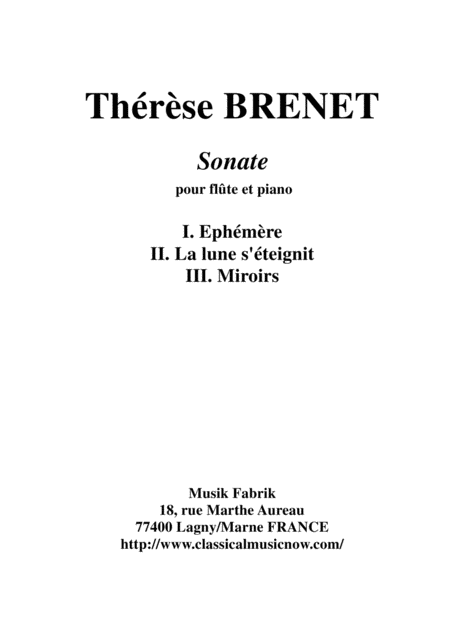
Thérèse Brenet: Sonata for flute and piano
Flûte traversière et Piano

$16.95 14.46 € Flûte traversière et Piano PDF SheetMusicPlus

Instrumental Duet,Piano Flute,Instrumental Duet,Piano - Level 3 - Digital Download SKU: A0.1076270 By Faith Hill. By James Horner, Mariah Carey, and Will Jennings. Arranged by Catherine Ing. 20th Century,Christmas,Contemporary,Holiday,Pop. Score and parts. 16 pages. Deusa Flauta Music #680425. Published by Deusa Flauta Music (A0.1076270). Simple duet arrangement of the popular tune 'Where Are You Christmas?' from 2000's 'How the Grinch Stole Christmas.' Piano accompaniment underpins a soaring flute part which carries the main theme. Thank you for your interest! If you’ve enjoyed this arrangement, or have any questions about this or any of our other arrangements, please contact us on Facebook or Twitter @deusaflauta, or at www.wordpress.com/page/deusaflauta.
Where Are You Christmas?
Flûte traversière et Piano
Faith Hill
$4.99 4.26 € Flûte traversière et Piano PDF SheetMusicPlus

Flute and piano - easy to intermediate - Digital Download SKU: S9.Q11843 Composed by Eduard Puetz. Arranged by Wolfgang Birtel. This edition: Sheet music. Edition Schott - Single Edition. Downloadable. Schott Music - Digital #Q11843. Published by Schott Music - Digital (S9.Q11843). Overcoming the boundaries between 'serious' and entertaining music was what mattered to the musician Eduard Pütz (1911–2000). His compositions therefore include stylistic features of jazz and pop music. Many of his works were written for children and young instrumentalists to offer them a break from the monotony of classical sonatinas and studies. 'Blue Waltz' is such a treat – very easy to play, it carefully helps the player to open a listening ear for jazz sounds. The arrangement for accompanied melodic instrument is also suitable for beginner's lessons and the first ensemble playing.
Blue Waltz
Flûte traversière et Piano

$4.99 4.26 € Flûte traversière et Piano PDF SheetMusicPlus

Flute,Piano - Level 3 - Digital Download SKU: A0.548462 Composed by Johann Pachelbel. Arranged by James M. Guthrie, ASCAP. Wedding. Score and part. 8 pages. Jmsgu3 #3386271. Published by jmsgu3 (A0.548462). Pachelbel's Canon arranged for alto flute & piano. Great for weddings & receptions. Pachelbel's Canon Pachelbel's Canon is, in fact, the traditional title for a composition by the German composer Johann Pachelbel. Other names for the work include namely: Canon and Gigue for 3 violins and basso continuo, Canon and Gigue in D, and of course Canon in D. We do not know when or why in particular it was written. The oldest copy is surprisingly from the 19th century. It is important to realize that it was a common routine for organists to practice improvisation on the chord progression underlying the canon. Pachelbel originally scored the Canon notably for three violins and continuo. He also in fact paired the Canon with a gigue. The movements are homotonal, to clarify, both are in the key of D major. History In due time, Pachelbel's Canon went out of style and remained in virtual oblivion for centuries. The Jean-François Paillard chamber orchestra, however, recorded an arrangement of it in 1968. As a result, it gained approval.  Many ensembles began likewise to record the piece in the 1970s and by the 1980s became ubiquitous as background music. From the 1970s to the early 2000s, pop songs correspondingly used elements of the piece. The chord progression, in particular, was used this way. Also, since the 1980s, it has been not only wildly popular for weddings, but also for funeral ceremonies in the USA and Europe. Pachelbel Background Johann Pachelbel (1653 –1706) was a German composer, as well as an organist. He was furthermore instrumental in bringing the south German organ school to its apex. He wrote a large body of music, both sacred and, equally important, secular. In particular, he uniquely helped develop the chorale prelude and fugue. For this, he has, in fact, earned a rightful place in the company of the most significant composers of the mid-Baroque period. Works Pachelbel's music was certainly popular. With this in mind, he also consequently had many pupils. His music expressly developed into a model for the south German composers. Nowadays, Pachelbel is most famous particularly for the Canon in D, as well as the F minor Chaconne, the Toccata in E minor, and of course the Hexachordum Apollinis, a set of variations for the keyboard. Influences Johann Jakob Froberger and Johann Caspar Kerll were south German composers who significantly influenced Pachelbel. Furthermore, he was especially influenced by Italians such as Frescobaldi and Poglietti. He frequently preferred an articulate, simple contrapuntal style that highlighted clarity. His music is markedly less extravagant and harmonically adventurous than that of Dieterich Buxtehude. However, as a point often overlooked, like Buxtehude, Pachelbel experimented with different instrumental combinations in his chamber music. Legacy All in all, Pachelbel was most famous as a composer for the keyboard. He composed over two hundred pieces specifically for the instrument. Pachelbel was also surprisingly a prolific composer of vocal music. All in all, about a hundred vocal works survive, including 40 or so large-scale works. 
Pachelbel: Canon for Alto Flute & Piano
Flûte traversière et Piano

$26.95 23 € Flûte traversière et Piano PDF SheetMusicPlus

Flute,Piano - Level 3 - Digital Download SKU: A0.727637 Composed by Frances Havergal, Louis Herold. Arranged by Carol Troutman Wiggins. Christian,Sacred. Score and part. 4 pages. Carol Troutman Wiggins #6320003. Published by Carol Troutman Wiggins (A0.727637). Based on Romans 12:1, this hymn was written as a song of self-consecration by Frances Havergal and set to the tune Messiah by Lou­is J. Hér­old, 1830. Ar­ranged by George King­sley, 1838. I urge you, brothers, in view of God’s mercy, to offer your bodies as living sacrifices, holy and pleasing to God-this is your spiritual act of worship. ~  Romans 12:1 Intermediate level piano & easy instrument part Great for preludes, offertories, baptism, and general worship.Key change from F to G Piano Track includes piano & instrumental part combined.  
Take My Life and Let It Be (Flute & Piano)
Flûte traversière et Piano

$9.99 8.52 € Flûte traversière et Piano PDF SheetMusicPlus


Partitions Gratuites
Acheter des Partitions Musicales
Acheter des Partitions Digitales à Imprimer
Acheter des Instruments de Musique

© 2000 - 2025

Accueil - Version intégrale





