EUROPE
8896 articles
USA
3 articles
DIGITAL
93 articles (à imprimer)
Partitions Digitales
Partitions à imprimer
93 partitions trouvées

1 16 31 ....91

Alto Saxophone,Tenor Saxophone - Level 2 - Digital Download SKU: A0.1150653 Composed by Ludwig van Beethoven. Arranged by Ander. Classical,Film/TV,Instructional,Romantic Period,Traditional. Saxophone Duet. 8 pages. Woods Only, Arrangements #750831. Published by Woods Only, Arrangements (A0.1150653). This arrangement adapted for sax duo was written keeping the characteristics of the original work, in order to be performed by young music students who want to enter the symphonic music. Besides, it can also be used by professional musicians, for recitals, repertoire, academic presentations and didactic material. As much as it is a funeral march, it is well suited for any musical performance occasion. The transcription is faithful to the structure, with only one change of key, so that it is comfortable for all the instruments in the formation, as well as for use in ensemble practice between musicians of different traditions. Ludwig van Beethoven began concentrated work on his Symphony No. 7 in A major Op. 92 in 1811, it was completed in 1812, and was dedicated to Count Moritz von Fries, and premiered in Vienna on December 8, 1813. It is considered a remarkable example of the more ebullient side of Beethoven's compositional personality and evidence that even after the onset of deafness, he still found cause for musical optimism. The second movement Allegretto is a funeral march in everything but name. Often several contrasting melodic ideas are made to coexist, as if Beethoven were imagining several processions converging on the cemetery at the same time. As he was working on this symphony during the years of the Napoleonic Wars, this experience was probably within his experience. It was also used as the soundtrack to the film Knowing, by director Alex Proyas and starring Nicolas Cage, where it is used in the final scene of the film. Beethoven called Symphony No. 7 his most excellent symphony, and a music critic of the time reported, this symphony is the most melodically rich and the most pleasing and comprehensible of all Beethoven's symphonies..
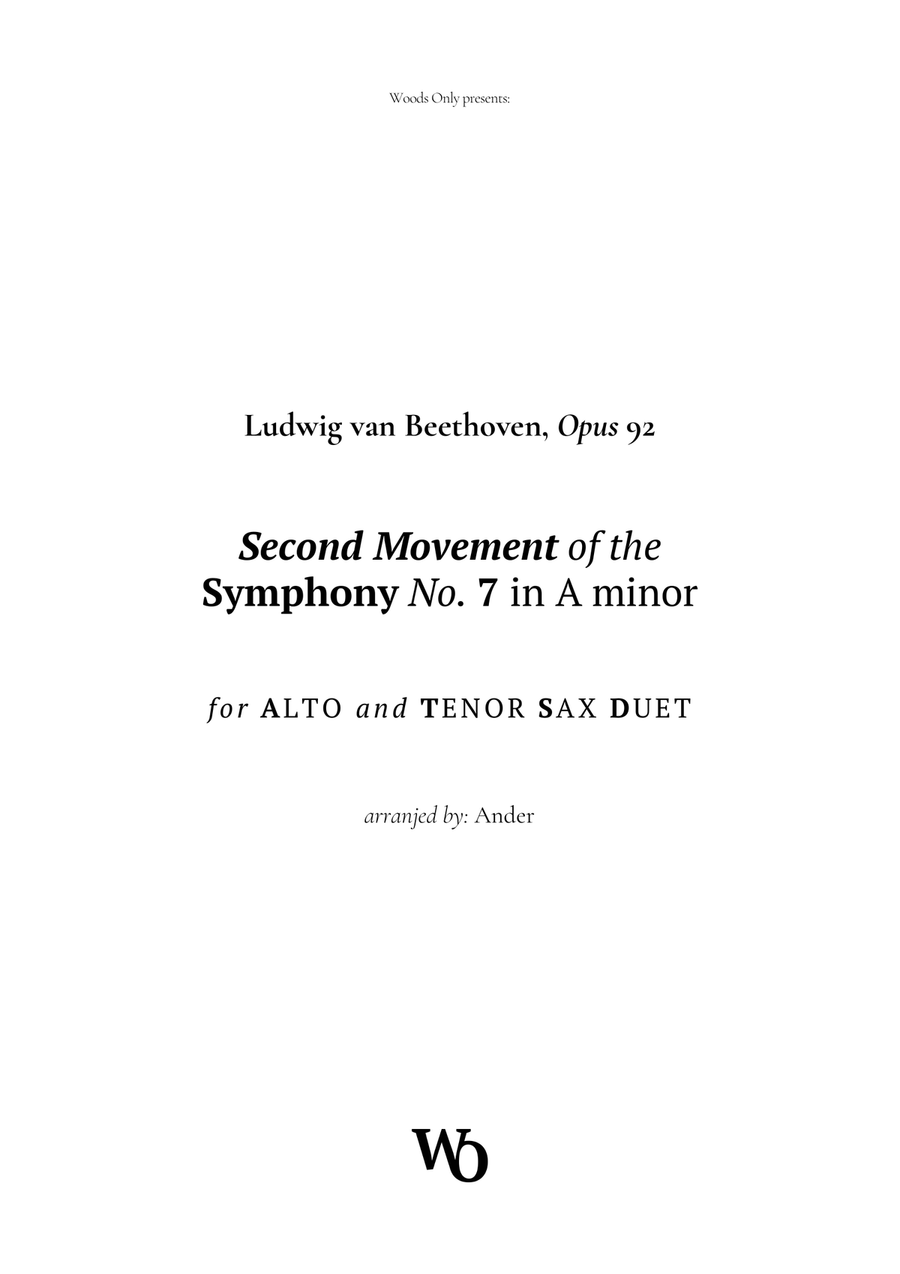
Symphony No. 7 by Beethoven for Saxophone Duet
2 Saxophones (duo)

$3.99 3.37 € 2 Saxophones (duo) PDF SheetMusicPlus

Baritone Saxophone,Tenor Saxophone - Level 2 - Digital Download SKU: A0.1150655 Composed by Ludwig van Beethoven. Arranged by Ander. Classical,Film/TV,Instructional,Romantic Period,Traditional. Saxophone Duet. 8 pages. Woods Only, Arrangements #750833. Published by Woods Only, Arrangements (A0.1150655). This arrangement adapted for low sax duo was written keeping the characteristics of the original work, in order to be performed by young music students who want to enter the symphonic music. Besides, it can also be used by professional musicians, for recitals, repertoire, academic presentations and didactic material. As much as it is a funeral march, it is well suited for any musical performance occasion. The transcription is faithful to the structure, with only one change of key, so that it is comfortable for all the instruments in the formation, as well as for use in ensemble practice between musicians of different traditions. Ludwig van Beethoven began concentrated work on his Symphony No. 7 in A major Op. 92 in 1811, it was completed in 1812, and was dedicated to Count Moritz von Fries, and premiered in Vienna on December 8, 1813. It is considered a remarkable example of the more ebullient side of Beethoven's compositional personality and evidence that even after the onset of deafness, he still found cause for musical optimism. The second movement Allegretto is a funeral march in everything but name. Often several contrasting melodic ideas are made to coexist, as if Beethoven were imagining several processions converging on the cemetery at the same time. As he was working on this symphony during the years of the Napoleonic Wars, this experience was probably within his experience. It was also used as the soundtrack to the film Knowing, by director Alex Proyas and starring Nicolas Cage, where it is used in the final scene of the film. Beethoven called Symphony No. 7 his most excellent symphony, and a music critic of the time reported, this symphony is the most melodically rich and the most pleasing and comprehensible of all Beethoven's symphonies..
Symphony No. 7 by Beethoven for Low Saxophone Duet
2 Saxophones (duo)

$3.99 3.37 € 2 Saxophones (duo) PDF SheetMusicPlus

Tenor Saxophone Duet Tenor Saxophone - Level 2 - Digital Download SKU: A0.1150649 Composed by Ludwig van Beethoven. Arranged by Ander. Classical,Film/TV,Instructional,Romantic Period,Traditional. Score. 8 pages. Woods Only, Arrangements #750827. Published by Woods Only, Arrangements (A0.1150649). This arrangement adapted for tenor sax duo was written keeping the characteristics of the original work, in order to be performed by young music students who want to enter the symphonic music. Besides, it can also be used by professional musicians, for recitals, repertoire, academic presentations and didactic material. As much as it is a funeral march, it is well suited for any musical performance occasion. The transcription is faithful to the structure, with only one change of key, so that it is comfortable for all the instruments in the formation, as well as for use in ensemble practice between musicians of different traditions. Ludwig van Beethoven began concentrated work on his Symphony No. 7 in A major Op. 92 in 1811, it was completed in 1812, and was dedicated to Count Moritz von Fries, and premiered in Vienna on December 8, 1813. It is considered a remarkable example of the more ebullient side of Beethoven's compositional personality and evidence that even after the onset of deafness, he still found cause for musical optimism. The second movement Allegretto is a funeral march in everything but name. Often several contrasting melodic ideas are made to coexist, as if Beethoven were imagining several processions converging on the cemetery at the same time. As he was working on this symphony during the years of the Napoleonic Wars, this experience was probably within his experience. It was also used as the soundtrack to the film Knowing, by director Alex Proyas and starring Nicolas Cage, where it is used in the final scene of the film. Beethoven called Symphony No. 7 his most excellent symphony, and a music critic of the time reported, this symphony is the most melodically rich and the most pleasing and comprehensible of all Beethoven's symphonies..

Symphony No. 7 by Beethoven for Tenor Sax Duet
2 Saxophones (duo)

$3.99 3.37 € 2 Saxophones (duo) PDF SheetMusicPlus

Baritone Saxophone Duet Baritone Saxophone - Level 2 - Digital Download SKU: A0.1150650 Composed by Ludwig van Beethoven. Arranged by Ander. Classical,Film/TV,Instructional,Romantic Period,Traditional. 2 scores. 8 pages. Woods Only, Arrangements #750828. Published by Woods Only, Arrangements (A0.1150650). This arrangement adapted for baritone sax duo was written keeping the characteristics of the original work, in order to be performed by young music students who want to enter the symphonic music. Besides, it can also be used by professional musicians, for recitals, repertoire, academic presentations and didactic material. As much as it is a funeral march, it is well suited for any musical performance occasion. The transcription is faithful to the structure, with only one change of key, so that it is comfortable for all the instruments in the formation, as well as for use in ensemble practice between musicians of different traditions. Ludwig van Beethoven began concentrated work on his Symphony No. 7 in A major Op. 92 in 1811, it was completed in 1812, and was dedicated to Count Moritz von Fries, and premiered in Vienna on December 8, 1813. It is considered a remarkable example of the more ebullient side of Beethoven's compositional personality and evidence that even after the onset of deafness, he still found cause for musical optimism. The second movement Allegretto is a funeral march in everything but name. Often several contrasting melodic ideas are made to coexist, as if Beethoven were imagining several processions converging on the cemetery at the same time. As he was working on this symphony during the years of the Napoleonic Wars, this experience was probably within his experience. It was also used as the soundtrack to the film Knowing, by director Alex Proyas and starring Nicolas Cage, where it is used in the final scene of the film. Beethoven called Symphony No. 7 his most excellent symphony, and a music critic of the time reported, this symphony is the most melodically rich and the most pleasing and comprehensible of all Beethoven's symphonies..

Symphony No. 7 by Beethoven for Baritone Sax Duet
2 Saxophones (duo)

$3.99 3.37 € 2 Saxophones (duo) PDF SheetMusicPlus

Alto Saxophone Duet Alto Saxophone - Level 2 - Digital Download SKU: A0.1150648 Composed by Ludwig van Beethoven. Arranged by Ander. Classical,Film/TV,Instructional,Romantic Period,Traditional. 2 scores. 8 pages. Woods Only, Arrangements #750826. Published by Woods Only, Arrangements (A0.1150648). This arrangement adapted for alto sax duo was written keeping the characteristics of the original work, in order to be performed by young music students who want to enter the symphonic music. Besides, it can also be used by professional musicians, for recitals, repertoire, academic presentations and didactic material. As much as it is a funeral march, it is well suited for any musical performance occasion. The transcription is faithful to the structure, with only one change of key, so that it is comfortable for all the instruments in the formation, as well as for use in ensemble practice between musicians of different traditions. Ludwig van Beethoven began concentrated work on his Symphony No. 7 in A major Op. 92 in 1811, it was completed in 1812, and was dedicated to Count Moritz von Fries, and premiered in Vienna on December 8, 1813. It is considered a remarkable example of the more ebullient side of Beethoven's compositional personality and evidence that even after the onset of deafness, he still found cause for musical optimism. The second movement Allegretto is a funeral march in everything but name. Often several contrasting melodic ideas are made to coexist, as if Beethoven were imagining several processions converging on the cemetery at the same time. As he was working on this symphony during the years of the Napoleonic Wars, this experience was probably within his experience. It was also used as the soundtrack to the film Knowing, by director Alex Proyas and starring Nicolas Cage, where it is used in the final scene of the film. Beethoven called Symphony No. 7 his most excellent symphony, and a music critic of the time reported, this symphony is the most melodically rich and the most pleasing and comprehensible of all Beethoven's symphonies..

Symphony No. 7 by Beethoven for Alto Sax Duet
2 Saxophones (duo)

$3.99 3.37 € 2 Saxophones (duo) PDF SheetMusicPlus

Tenor Saxophone Duet Tenor Saxophone - Level 2 - Digital Download SKU: A0.612843 Composed by Jean Baptiste Loeillet of Ghent (1688 – 1720). Arranged by James M. Guthrie. Baroque,Contest,Festival,Standards,Traditional,Wedding. Score. 59 pages. Jmsgu3 #222038. Published by jmsgu3 (A0.612843). John Baptist Loeillet, a Flemish Baroque composer, wrote six sonatas for flute and basso continuo in his Op. 5 No. 2. This work is widely considered to be some of his most significant compositions, and they are still performed today.The sonatas are divided into three movements each, with two slow movements and one faster one. The flute part is very demanding, as Loeillet often wrote in the high register, and the accompanying basso continuo part provides a solid foundation for the piece. The music has an emotional intensity that was characteristic of the Baroque era, and it features various ornamentations, like trills and mordents. The influence of Corelli can be heard in the contrapuntal textures, and the melodic lines are often based on the scales and modes of the period.Loeillet's Op. 5 No. 2 is a beautiful and captivating work, and its timelessness is a testament to its quality. It has been transcribed and adapted for other instruments, and it remains a popular choice for many classical musicians.Contents:Sonata No. 1 Duration: 9:45 Score: 8 pages 1. Vivace 2. Affetuoso e Poco Vivace 3. Allegro 4. Largo 5. AllegroSonata No. 2 Duration: 16:00, Score: 12 pages 1. La¬rgo 2. Allegro 3. Largo 4. Vivace 5. Vivace 6. Largo 7. GigaSonata No. 3 Duration: 19:20, Score: 14 pages 1. Vivace 2. Largo 3. Gavotto – Allegro 4. Sarabanda 5. Allegro 6. Largo 7. Menuet 8. Giga - AllegroSonata No. 4 Duration: 11:08, Score: 10 pages 1. Vivace 2. Gavott 3. Largo 4. Allegro 5. Sarabanda - Largo 6. AllegroSonata No. 5 Duration: 7:49, Score: 7 pages 1. Largo 2. Allegro 3. Largo 4. GavottSonata No. 6 Duration: 9:42, Score: 8 pages 1. Andante 2. Adagio 3. Allegro 1 4. Allegro 2.
Loeillet: Six Sonatas Op. 5 No. 2 Complete for Tenor Sax Duo
2 Saxophones (duo)

$74.95 63.28 € 2 Saxophones (duo) PDF SheetMusicPlus

Soprano Saxophone Duet Soprano Saxophone - Level 2 - Digital Download SKU: A0.612840 Composed by Jean Baptiste Loeillet of Ghent (1688 – 1720). Arranged by James M. Guthrie. Baroque,Contest,Festival,Standards,Traditional,Wedding. Score. 59 pages. Jmsgu3 #222036. Published by jmsgu3 (A0.612840). John Baptist Loeillet, a Flemish Baroque composer, wrote six sonatas for flute and basso continuo in his Op. 5 No. 2. This work is widely considered to be some of his most significant compositions, and they are still performed today.The sonatas are divided into three movements each, with two slow movements and one faster one. The flute part is very demanding, as Loeillet often wrote in the high register, and the accompanying basso continuo part provides a solid foundation for the piece. The music has an emotional intensity that was characteristic of the Baroque era, and it features various ornamentations, like trills and mordents. The influence of Corelli can be heard in the contrapuntal textures, and the melodic lines are often based on the scales and modes of the period.Loeillet's Op. 5 No. 2 is a beautiful and captivating work, and its timelessness is a testament to its quality. It has been transcribed and adapted for other instruments, and it remains a popular choice for many classical musicians.Contents:Sonata No. 1 Duration: 9:45 Score: 8 pages 1. Vivace 2. Affetuoso e Poco Vivace 3. Allegro 4. Largo 5. AllegroSonata No. 2 Duration: 16:00, Score: 12 pages 1. La¬rgo 2. Allegro 3. Largo 4. Vivace 5. Vivace 6. Largo 7. GigaSonata No. 3 Duration: 19:20, Score: 14 pages 1. Vivace 2. Largo 3. Gavotto – Allegro 4. Sarabanda 5. Allegro 6. Largo 7. Menuet 8. Giga - AllegroSonata No. 4 Duration: 11:08, Score: 10 pages 1. Vivace 2. Gavott 3. Largo 4. Allegro 5. Sarabanda - Largo 6. AllegroSonata No. 5 Duration: 7:49, Score: 7 pages 1. Largo 2. Allegro 3. Largo 4. GavottSonata No. 6 Duration: 9:42, Score: 8 pages 1. Andante 2. Adagio 3. Allegro 1 4. Allegro 2.
Loeillet: Six Sonatas Op. 5 No. 2 Complete for Soprano Sax Duo
2 Saxophones (duo)

$74.95 63.28 € 2 Saxophones (duo) PDF SheetMusicPlus

Alto Saxophone Duet Alto Saxophone - Level 2 - Digital Download SKU: A0.612787 Composed by Jean Baptiste Loeillet of Ghent (1688 – 1720). Arranged by James M. Guthrie. Baroque,Contest,Festival,Standards,Traditional,Wedding. 2 scores. 59 pages. Jmsgu3 #221981. Published by jmsgu3 (A0.612787). John Baptist Loeillet, a Flemish Baroque composer, wrote six sonatas for flute and basso continuo in his Op. 5 No. 2. This work is widely considered to be some of his most significant compositions, and they are still performed today.The sonatas are divided into three movements each, with two slow movements and one faster one. The flute part is very demanding, as Loeillet often wrote in the high register, and the accompanying basso continuo part provides a solid foundation for the piece. The music has an emotional intensity that was characteristic of the Baroque era, and it features various ornamentations, like trills and mordents. The influence of Corelli can be heard in the contrapuntal textures, and the melodic lines are often based on the scales and modes of the period.Loeillet's Op. 5 No. 2 is a beautiful and captivating work, and its timelessness is a testament to its quality. It has been transcribed and adapted for other instruments, and it remains a popular choice for many classical musicians.Contents:Sonata No. 1 Duration: 9:45 Score: 8 pages 1. Vivace 2. Affetuoso e Poco Vivace 3. Allegro 4. Largo 5. AllegroSonata No. 2 Duration: 16:00, Score: 12 pages 1. La¬rgo 2. Allegro 3. Largo 4. Vivace 5. Vivace 6. Largo 7. GigaSonata No. 3 Duration: 19:20, Score: 14 pages 1. Vivace 2. Largo 3. Gavotto – Allegro 4. Sarabanda 5. Allegro 6. Largo 7. Menuet 8. Giga - AllegroSonata No. 4 Duration: 11:08, Score: 10 pages 1. Vivace 2. Gavott 3. Largo 4. Allegro 5. Sarabanda - Largo 6. AllegroSonata No. 5 Duration: 7:49, Score: 7 pages 1. Largo 2. Allegro 3. Largo 4. GavottSonata No. 6 Duration: 9:42, Score: 8 pages 1. Andante 2. Adagio 3. Allegro 1 4. Allegro 2.
Loeillet: Six Sonatas Op. 5 No. 2 Complete for Alto Sax Duo
2 Saxophones (duo)

$74.95 63.28 € 2 Saxophones (duo) PDF SheetMusicPlus

Baritone Saxophone Duet Baritone Saxophone - Level 2 - Digital Download SKU: A0.612788 Composed by Jean Baptiste Loeillet of Ghent (1688 – 1720). Arranged by James M. Guthrie. Baroque,Contest,Festival,Standards,Traditional,Wedding. 2 scores. 59 pages. Jmsgu3 #221982. Published by jmsgu3 (A0.612788). John Baptist Loeillet, a Flemish Baroque composer, wrote six sonatas for flute and basso continuo in his Op. 5 No. 2. This work is widely considered to be some of his most significant compositions, and they are still performed today.The sonatas are divided into three movements each, with two slow movements and one faster one. The flute part is very demanding, as Loeillet often wrote in the high register, and the accompanying basso continuo part provides a solid foundation for the piece. The music has an emotional intensity that was characteristic of the Baroque era, and it features various ornamentations, like trills and mordents. The influence of Corelli can be heard in the contrapuntal textures, and the melodic lines are often based on the scales and modes of the period.Loeillet's Op. 5 No. 2 is a beautiful and captivating work, and its timelessness is a testament to its quality. It has been transcribed and adapted for other instruments, and it remains a popular choice for many classical musicians.Contents:Sonata No. 1 Duration: 9:45 Score: 8 pages 1. Vivace 2. Affetuoso e Poco Vivace 3. Allegro 4. Largo 5. AllegroSonata No. 2 Duration: 16:00, Score: 12 pages 1. La¬rgo 2. Allegro 3. Largo 4. Vivace 5. Vivace 6. Largo 7. GigaSonata No. 3 Duration: 19:20, Score: 14 pages 1. Vivace 2. Largo 3. Gavotto – Allegro 4. Sarabanda 5. Allegro 6. Largo 7. Menuet 8. Giga - AllegroSonata No. 4 Duration: 11:08, Score: 10 pages 1. Vivace 2. Gavott 3. Largo 4. Allegro 5. Sarabanda - Largo 6. AllegroSonata No. 5 Duration: 7:49, Score: 7 pages 1. Largo 2. Allegro 3. Largo 4. GavottSonata No. 6 Duration: 9:42, Score: 8 pages 1. Andante 2. Adagio 3. Allegro 1 4. Allegro 2.
Loeillet: Six Sonatas Op. 5 No. 2 Complete for Baritone Sax Duo
2 Saxophones (duo)

$74.95 63.28 € 2 Saxophones (duo) PDF SheetMusicPlus


1 16 31 ....91


Partitions Gratuites
Acheter des Partitions Musicales
Acheter des Partitions Digitales à Imprimer
Acheter des Instruments de Musique

© 2000 - 2026

Accueil - Version intégrale


