EUROPE
2603 articles
USA
0 articles
DIGITAL
24 articles (à imprimer)
Partitions Digitales
Partitions à imprimer
24 partitions trouvées


Instrumental Duet Bassoon,Instrumental Duet - Level 1 - Digital Download SKU: A0.548710 Composed by Martin Luther. Arranged by James M. Guthrie. Easter,Instructional,Standards. Score and parts. 4 pages. Jmsgu3 #3411733. Published by jmsgu3 (A0.548710). Out of the Depths I Cry to You by Martin Luther arranged for bassoon & piano. The first verses feature modified counterpoint and harmony proceeding at quarter = 82. The final verse is reharmonized for maximum dramatic effect at a more contemplative tempo such as quarter = 64. Features the entire range of the instrument. Very powerful selection for Lent or Easter. Duration (3 verses) 3:05, 36 ms. Score: 3 pg. Solo part: 1 pg. The piano reads from the score. Out of the Depths Aus tiefer Not schrei ich zu dir (From deep affliction I cry out to you), is, of course, a hymn composed by Martin Luther. Moreover, Luther also wrote the lyrics, essentially a paraphrase of Psalm 130. First published in 1524, it is also one of eight songs in the original Lutheran hymnal. It appears likewise in many hymnals and in different translations. The lyrics furthermore stimulated compositions from the Renaissance to the contemporary. Consequently, composers such as Johann Sebastian Bach built an entire chorale cantata on it. Other composers similarly contributed pieces, such as Felix Mendelssohn and Max Reger. Luther Background Martin Luther, (1483 –1546) was a German professor of theology, composer, priest, and moreover, an influential character in the Protestant Reformation. Luther had a momentous impact on church and society due to his contributions to the musical arts. He wanted to disseminate the gospel among mankind and with this intention thought that the best way to do that was through music. Influence It is important to realize that other musicians, and their descendants, were encouraged by Luther’s songs and wrote their own hymns. Luther, to be sure, had a thorough musical education. For example, he knew secular and sacred songs from an early age. He, in particular, played the lute well and sang in the monastery when he was a monk. That is to say, music was an essential part of his life. He in fact first began writing songs in 1523, sometimes writing the melody as well as the lyrics. Luther was certainly able to evaluate the composers of his time. He thought especially highly of Josquin des and Ludwig Senfl. He was also acquainted, with this in mind, with other composers and their works. Legacy The Lutheran musical ethos soon covered all of Germany and later significantly fashioned Protestant musical culture. Heinrich Schütz and Johann Sebastian Bach are the most compelling evidence of this Protestant musical culture. Additionally, as a point often overlooked, the pedal organ, first refined in northern Germany, became universally prevalent. As a matter of fact, Dieterich Buxtehude established a regular evening organ concert series in Lübeck. Another key point is that this concert series, in turn, spread North German Musical ideas worldwide. Luther was especially convinced that music is a beautiful and exclusive offering of the divine.
Luther: Out of the Depths for Bassoon & Piano
2 Bassons (duo)

$24.95 21.74 € 2 Bassons (duo) PDF SheetMusicPlus

Instrumental Duet Bassoon,Instrumental Duet - Level 3 - Digital Download SKU: A0.549828 Composed by Peter Ilyich Tchaikovsky. Arranged by James M. Guthrie, ASCAP. Children,Christmas,Romantic Period,Standards. Score and parts. 48 pages. Jmsgu3 #3549777. Published by jmsgu3 (A0.549828). Duration: 6:12, Score: 29 pages, Solo part: 6 pages, Piano part: 12 pages. This is the grand finale of the Nutcracker Suite. Pyotr Ilyich Tchaikovsky Tchaikovsky is probably the most popular of the great composers in America. His music certainly appeals to musicians. Likewise, it appeals even to folks who don’t normally listen to serious music. This is probably because of his most noteworthy melodies. Above all, he writes with great emotion. This certainly makes a most noteworthy if not an unforgettable impact. Education First of all, He attended classes at the Russian Musical Society. Even more, He also attended the St. Petersburg Conservatory. There he studied music theory with Nikolai Zaremba. He also consequently studied composition with Anton Rubenstein. It seems like Rubenstein came under criticism from a group of Russian composers known as the Five. The Five The Five certainly rejected Western musical influences. They rather sought to use elements from Russian music. They furthermore wanted to use more exotic musical materials. Western Techniques More than other Russian composers, Tchaikovsky studied modern Western music. He certainly develops his music like the European masters. So, rather than repeating a motive, he moves to a new key. He then introduces a different theme in the new key. Hence, he maintained his independence from the Five. Even more, he became the first Russian composer of international stature. Influences Tchaikovsky was probably influenced in his ballet scoring by Léo Delibes. Richard Wagner influenced his symphonic writing. Tchaikovsky’s most famous works include the 1812 Overture, The Nutcracker Suite, and Swan Lake. Also famous are the Violin Concerto in D and the six symphonies. The greatest of the six symphonies may be No. 6, the Pathétique. Nutcracker Suite, Op. 71a The Nutcracker Suite is a ballet that was performed for the first time in December 1892 in St. Petersburg. To begin with, the original ballet failed to attract a positive reception. However, the ballet suite became probably one of the most popular of all of Tchaikovsky’s works. The ballet suite became even more famous in the 1960s. It is now performed all over the world, particularly during the Christmas season.  
Tchaikovsky: Waltz of the Flowers from Nutcracker Suite for Bassoon & Piano
2 Bassons (duo)

$32.95 28.71 € 2 Bassons (duo) PDF SheetMusicPlus

Instrumental Duet Bassoon,Instrumental Duet - Level 3 - Digital Download SKU: A0.549806 Composed by Peter Ilyich Tchaikovsky. Arranged by James M. Guthrie, ASCAP. Children,Christmas,Romantic Period,Standards. Score and parts. 16 pages. Jmsgu3 #3541659. Published by jmsgu3 (A0.549806). Duration: ca. 2:10. Score: 9 pages. 77 measures in 2/4. Solo parts: 2 pages, Piano part: 4 pages. A favorite Christmas selection from the Nutcracker Suite. Pyotr Ilyich Tchaikovsky Tchaikovsky is probably the most popular of the great composers in America. His music certainly appeals to musicians. Likewise, it appeals even to folks who don’t normally listen to serious music. This is probably because of his most noteworthy melodies. Above all, he writes with great emotion. This certainly makes a most noteworthy if not an unforgettable impact. Education First of all, He attended classes at the Russian Musical Society. Even more, He also attended the St. Petersburg Conservatory. There he studied music theory with Nikolai Zaremba. He also consequently studied composition with Anton Rubenstein. It seems like Rubenstein came under criticism from a group of Russian composers known as the Five. The Five The Five certainly rejected Western musical influences. They rather sought to use elements from Russian music. They furthermore wanted to use more exotic musical materials. Western Techniques More than other Russian composers, Tchaikovsky studied modern Western music. He certainly develops his music like the European masters. So, rather than repeating a motive, he moves to a new key. He then introduces a different theme in the new key. Hence, he maintained his independence from the Five. Even more, he became the first Russian composer of international stature. Influences Tchaikovsky was probably influenced in his ballet scoring by Léo Delibes. Richard Wagner influenced his symphonic writing. Tchaikovsky’s most famous works include the 1812 Overture, The Nutcracker Suite, and Swan Lake. Also famous are the Violin Concerto in D and the six symphonies. The greatest of the six symphonies may be No. 6, the Pathétique. Nutcracker Suite, Op. 71a The Nutcracker Suite is a ballet that was performed for the first time in December 1892 in St. Petersburg. To begin with, the original ballet failed to attract a positive reception. However, the ballet suite became probably one of the most popular of all of Tchaikovsky’s works. The ballet suite became even more famous in the 1960s. It is now performed all over the world, particularly during the Christmas season.   
Tchaikovsky: Dance of the Flutes from Nutcracker Suite for Bassoon & Piano
2 Bassons (duo)

$32.95 28.71 € 2 Bassons (duo) PDF SheetMusicPlus

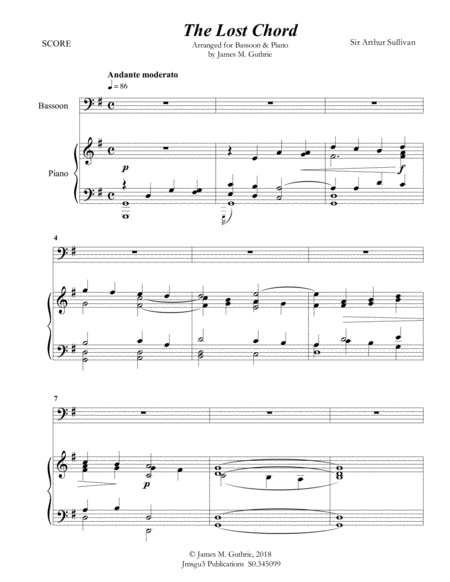
Instrumental Duet Bassoon,Instrumental Duet - Level 4 - Digital Download SKU: A0.549452 Composed by Sir Arthur Seymour Sullivan. Arranged by James M. Guthrie, ASCAP. Instructional,Romantic Period,Sacred,Standards. Score and parts. 15 pages. Jmsgu3 #3497185. Published by jmsgu3 (A0.549452). Score: 10 pages, solo part: 2 pages, piano part: 3 pages. Duration: 4:25. Not difficult, but requires sensitivity & dynamic control. Suitable for recitals, church meditations, or school programs. School Years First of all, Sullivan attended music school at the Royal Academy of Music. Because Sullivan was so talented, the Academy awarded him the Mendelssohn Scholarship for two years in a row. He, therefore, studied with John Goss, who studied with Thomas Atwood, who in turn studied with Mozart. Sullivan similarly studied the piano at the Academy with Arthur O’Leary. Study Abroad During his first year, he also earned money by singing solos in the Chapel Royal. At the end of his second year, the Academy consequently continued his scholarship and sent him to study at the Leipzig Conservatoire. He certainly studied composition, and likewise counterpoint and piano. Hence, during his final year in Leipzig, Sullivan finally completed his graduation composition project: Incidental Music for Shakespeare’s The Tempest. Association with Gilbert It seems like Sullivan built the bulk of his composing career largely in the 1860s. As a result, he became famous for his incidental music for the Tempest and his Irish Symphony. He, therefore, began collaborating with the poet W. S. Gilbert in the 1870s. Rather than focus on serious opera, Gilbert and Sullivan, in contrast, concentrated on comic opera such as H. M. S. Pinafore, the Pirates of Penzance, and the Mikado. Therefore, certainly as a result of his education and experience, Sullivan composed a total of 24 operas, 11 symphonic works, 10 choral pieces. Even more, he wrote a large number of noteworthy hymns such as Onward Christian Soldiers. Lost Chord The general style of his music is maybe similar to Mendelssohn, Schumann, and perhaps Liszt. It seems like Sullivan was fond of writing distinct melodies for each character in his operettas. His melodies combine together as the characters did. Furthermore, he was a master orchestrator, and therefore played the flute, clarinet, trumpet, and trombone fluently. The Lost Chord Sullivan wrote his most noteworthy song the Lost Chord in 1877. As a result, it was a great success and was certainly performed all over the world by a variety of singers such as Enrico Caruso. Because Sullivan was the most famous composer in England, the Lost Chord became the most famous of all British or American songs of the 1870s and 1890s. Consequently, in 1888 Thomas Edison recorded The Lost Chord for the phonograph. It was one of the first songs ever recorded. Furthermore, Queen Victoria knighted Sullivan in 1883.    
Sullivan: The Lost Chord for Bassoon & Piano
2 Bassons (duo)

$26.95 23.48 € 2 Bassons (duo) PDF SheetMusicPlus

Instrumental Duet Bassoon,Instrumental Duet - Level 2 - Digital Download SKU: A0.549433 Composed by Antonin Dvorak. Arranged by James M. Guthrie, ASCAP. Instructional,Romantic Period,Sacred,Standards. Score and parts. 12 pages. Jmsgu3 #3494213. Published by jmsgu3 (A0.549433). Score: 7 pages, solo part: 2 pages, piano part: 3 pages. Duration: 4:25. Not difficult, but requires sensitivity & dynamic c control. Suitable for recitals, church meditations, or school programs. Dvořák Background Antonín Dvořák (1841 –1904) was, of course, a composer from Czechoslovakia. As a matter of fact, he was among the first Bohemian composers to attain universal recognition. It is important to realize that the late Romantic Nationalist period featured composers who used traditional and folk elements to portray the character of their nation. In particular, we see this in the music of Grieg (Norway), Finland (Sibelius), and Smetana (Bohemia).  Dvořák relied markedly on rhythms and other characteristics of Moravian and Bohemian folk music. Ascent to Fame Dvořák was truly a child musical prodigy on the violin. The premiere performances of his compositions notably occurred in 1872 and 1873. He submitted his First Symphony in particular to a German competition, but it failed to win. Consequently, in 1874 he presented two more symphonies to the Austrian State Prize for Composition. Johannes Brahms was the principal of the jury and was accordingly very impressed. They forthwith awarded the prize to Dvořák in 1874, 1876, and 1877. At this point, Brahms thereupon endorsed Dvořák to the publisher Simrock. Later, the publisher commissioned Dvořák to compose the Slavonic Dances, Op. 46. These became popular overnight and, as a result, Dvořák's worldwide status was launched. International Status Dvořák visited England upon invitation nine times. On each visit, he frequently conducted performances of his own compositions. He conducted concerts of his music, especially in Moscow and St. Petersburg. Eventually, the Prague Conservatory in fact appointed Dvořák as a professor. There, to be sure, he wrote his famous Dumky Trio. United States Consequently, the National Conservatory of Music of America appointed him as director in 1892. As a result, Dvořák composed his two most famous symphonic works: the Symphony No. 9 (From the New World), which spread his name universally, and his Concerto for Cello and Orchestra, one of the most famous of all cello works. Moreover, he wrote his most celebrated American String Quartet during this time. At the same time, because of his growing recognition in Europe and his homesickness for his own country, he left to return to Bohemia in 1895.  
DvoÅ™ák: Largo from the New World Symphony for Bassoon & Piano
2 Bassons (duo)

$32.95 28.71 € 2 Bassons (duo) PDF SheetMusicPlus

Instrumental Duet Bassoon,Instrumental Duet - Level 3 - Digital Download SKU: A0.549781 Composed by Peter Ilyich Tchaikovsky. Arranged by James M. Guthrie, ASCAP. Children,Christmas,Romantic Period,Standards. Score and parts. 11 pages. Jmsgu3 #3535059. Published by jmsgu3 (A0.549781). Duration: ca 1:00 Score: 5 pages, Solo part: 2 pages, piano part: 3 pages. Short but fascinating Chinese Dance from the Nutcracker Suite. Program this for a recital encore or Christmas pageant. Pyotr Ilyich Tchaikovsky Tchaikovsky is probably the most popular of the great composers in America. His music certainly appeals to musicians. Likewise, it appeals even to folks who don’t normally listen to serious music. This is probably because of his most noteworthy melodies. Above all, he writes with great emotion. This certainly makes a most noteworthy if not an unforgettable impact. Education First of all, He attended classes at the Russian Musical Society. Even more, He also attended the St. Petersburg Conservatory. There he studied music theory with Nikolai Zaremba. He also consequently studied composition with Anton Rubenstein. It seems like Rubenstein came under criticism from a group of Russian composers known as the Five. The Five The Five certainly rejected Western musical influences. They rather sought to use elements from Russian music. They furthermore wanted to use more exotic musical materials. Western Techniques More than other Russian composers, Tchaikovsky studied modern Western music. He certainly develops his music like the European masters. So, rather than repeating a motive, he moves to a new key. He then introduces a different theme in the new key. Hence, he maintained his independence from the Five. Even more, he became the first Russian composer of international stature. Influences Tchaikovsky was probably influenced in his ballet scoring by Léo Delibes. Richard Wagner influenced his symphonic writing. Tchaikovsky’s most famous works include the 1812 Overture, The Nutcracker Suite, and Swan Lake. Also famous are the Violin Concerto in D and the six symphonies. The greatest of the six symphonies may be No. 6, the Pathétique. Nutcracker Suite, Op. 71a The Nutcracker Suite is a ballet that was performed for the first time in December 1892 in St. Petersburg. To begin with, the original ballet failed to attract a positive reception. However, the ballet suite became probably one of the most popular of all of Tchaikovsky’s works. The ballet suite became even more famous in the 1960s. It is now performed all over the world, particularly during the Christmas season.
Tchaikovsky: Chinese Dance from Nutcracker Suite for Bassoon & Piano
2 Bassons (duo)

$32.95 28.71 € 2 Bassons (duo) PDF SheetMusicPlus

Instrumental Duet Bassoon,Instrumental Duet - Level 3 - Digital Download SKU: A0.549760 Composed by Peter Ilyich Tchaikovsky. Arranged by James M. Guthrie, ASCAP. Children,Christmas,Romantic Period,Standards. Score and parts. 17 pages. Jmsgu3 #3533265. Published by jmsgu3 (A0.549760). Duration: ca. 3:15 Score: 10 pages, solo part: 2 pages, piano part: 4 pages. Tchaikovsky paints a very mysterious mood in this favorite masterpiece from the Nutcracker Suite. It is also a traditional Christmas favorite. Pyotr Ilyich Tchaikovsky Tchaikovsky is probably the most popular of the great composers in America. His music certainly appeals to musicians. Likewise, it appeals even to folks who don’t normally listen to serious music. This is probably because of his most noteworthy melodies. Above all, he writes with great emotion. This certainly makes a most noteworthy if not an unforgettable impact. Education First of all, He attended classes at the Russian Musical Society. Even more, He also attended the St. Petersburg Conservatory. There he studied music theory with Nikolai Zaremba. He also consequently studied composition with Anton Rubenstein. It seems like Rubenstein came under criticism from a group of Russian composers known as the Five. The Five The Five certainly rejected Western musical influences. They rather sought to use elements from Russian music. They furthermore wanted to use more exotic musical materials. Western Techniques More than other Russian composers, Tchaikovsky studied modern Western music. He certainly develops his music like the European masters. So, rather than repeating a motive, he moves to a new key. He then introduces a different theme in the new key. Hence, he maintained his independence from the Five. Even more, he became the first Russian composer of international stature. Influences Tchaikovsky was probably influenced in his ballet scoring by Léo Delibes. Richard Wagner influenced his symphonic writing. Tchaikovsky’s most famous works include the 1812 Overture, The Nutcracker Suite, and Swan Lake. Also famous are the Violin Concerto in D and the six symphonies. The greatest of the six symphonies may be No. 6, the Pathétique. Nutcracker Suite, Op. 71a The Nutcracker Suite is a ballet that was performed for the first time in December 1892 in St. Petersburg. To begin with, the original ballet failed to attract a positive reception. However, the ballet suite became probably one of the most popular of all of Tchaikovsky’s works. The ballet suite became even more famous in the 1960s. It is now performed all over the world, particularly during the Christmas season.
Tchaikovsky: Arabian Dance from Nutcracker Suite for Bassoon & Piano
2 Bassons (duo)

$32.95 28.71 € 2 Bassons (duo) PDF SheetMusicPlus

Instrumental Duet Bassoon,Instrumental Duet - Level 3 - Digital Download SKU: A0.549670 Composed by Peter Ilyich Tchaikovsky. Arranged by James M. Guthrie, ASCAP. Children,Christmas,Romantic Period,Standards. Score and parts. 20 pages. Jmsgu3 #3519035. Published by jmsgu3 (A0.549670). Score: 10 pages: solo part: 3 pages, piano part: 6 pages. Duration: 2:22. This famous selection from the Nutcracker Suite is a classic Christmas program favorite. Pyotr Ilyich Tchaikovsky Tchaikovsky is probably the most popular of the great composers in America. His music certainly appeals to musicians. Likewise, it appeals even to folks who don’t normally listen to serious music. This is probably because of his most noteworthy melodies. Above all, he writes with great emotion. This certainly makes a most noteworthy if not an unforgettable impact. Education First of all, He attended classes at the Russian Musical Society. Even more, He also attended the St. Petersburg Conservatory. There he studied music theory with Nikolai Zaremba. He also consequently studied composition with Anton Rubenstein. It seems like Rubenstein came under criticism from a group of Russian composers known as the Five. The Five The Five certainly rejected Western musical influences. They rather sought to use elements from Russian music. They furthermore wanted to use more exotic musical materials. Western Techniques More than other Russian composers, Tchaikovsky studied modern Western music. He certainly develops his music like the European masters. So, rather than repeating a motive, he moves to a new key. He then introduces a different theme in the new key. Hence, he maintained his independence from the Five. Even more, he became the first Russian composer of international stature. Influences Tchaikovsky was probably influenced in his ballet scoring by Léo Delibes. Richard Wagner influenced his symphonic writing. Tchaikovsky’s most famous works include the 1812 Overture, The Nutcracker Suite, and Swan Lake. Also famous are the Violin Concerto in D and the six symphonies. The greatest of the six symphonies may be No. 6, the Pathétique. Nutcracker Suite, Op. 71a The Nutcracker Suite is a ballet that was performed for the first time in December 1892 in St. Petersburg. To begin with, the original ballet failed to attract a positive reception. However, the ballet suite became probably one of the most popular of all of Tchaikovsky’s works. The ballet suite became even more famous in the 1960s. It is now performed all over the world, particularly during the Christmas season. 
Tchaikovsky: March from Nutcracker Suite for Bassoon & Piano
2 Bassons (duo)

$32.95 28.71 € 2 Bassons (duo) PDF SheetMusicPlus

Instrumental Duet Bassoon,Instrumental Duet - Level 3 - Digital Download SKU: A0.552407 Composed by Leo Delibes (1836-1891). Arranged by James M. Guthrie. Holiday,Romantic Period,Standards,Wedding. Score and parts. 7 pages. Jmsgu3 #6342571. Published by jmsgu3 (A0.552407). Duo of the flowers from Lakme, Act I. A popular wedding selection.Leo Delibes (1836-1891) was a French composer of the Romantic period best known for his ballets and operas. He was a child prodigy and began composing music at the age of seven. He studied at the Paris Conservatoire, where he developed a mastery of the symphonic form and wrote several pieces for the orchestra. His works for the stage are among the most popular and beloved of the Romantic era, including the ballets Coppélia and Sylvia, and the opera Lakmé.Delibes was a pioneer in the use of orchestral color and instrumental effects to enhance the dramatic narrative of his works. His works are often praised for their lyricism, graceful melodies, and colorful orchestrations. His music is considered to be a bridge between the grandiose and romantic works of the French composers before him, such as Gounod and Berlioz, and the more intimate and melodic style of composers like Debussy and Ravel.Delibes’ influence can be heard in the works of later composers such as Stravinsky and Prokofiev, and his music continues to be performed and enjoyed today. His contributions to music history are significant, and his works remain beloved masterpieces of the Romantic era.Léo Delibes' opera Lakmé is an opera in three acts. It was first performed in 1883 at the Théâtre Lyrique in Paris. The libretto was written by Edmond Gondinet and Philippe Gille. The story is set in British-occupied India and tells the story of a young Indian girl, Lakmé, who is in love with a British officer, Gerald. The story follows the couple's romantic journey, as well as the obstacles they face from Lakmé's father and the British military. The opera is best known for its beautiful score, which includes the famous aria The Flower Duet as well as the duet Lakmé! The Bell Song. The opera has been performed in opera houses all over the world and is considered one of Delibes' most popular works.The Duo des Fleurs, composed by French composer Léo Delibes, is a ballet pas de deux from the ballet Lakme, Act I. It is a beloved masterpiece of the Romantic period and is often performed as a standalone piece in many ballet performances. The piece is typically danced by two female ballet dancers and is known for its playful and lighthearted nature. The music consists of a melody that alternates between the two dancers and is often accompanied by a lighthearted waltz. The music has a strong sense of unity and connection between the two dancers, which is enhanced by the use of the same melody. The piece also features a beautiful soaring coda that gives it a sense of grandeur and beauty. The Duo des Fleurs is an exquisite piece of music and an enduring classic of the ballet repertoire.
Delibes: Duo des Fleurs for Bassoon Duo & Piano
2 Bassons (duo)

$26.95 23.48 € 2 Bassons (duo) PDF SheetMusicPlus

Bassoon,Instrumental Duet - Level 2 - Digital Download SKU: A0.1475725 Composed by Camille Saint-Saens. Arranged by Rika K. 19th Century,Chamber,Halloween,Romantic Period,Thriller. 4 pages. Rika K. #1053283. Published by Rika K. (A0.1475725). Step into the mysterious and captivating world of Camille Saint-Saëns' Danse Macabre with our exclusive sheet music arrangement, wrote for Bassoon Duet.Originally composed in 1874, Danse Macabre vividly depicts the medieval legend of Death summoning the dead to dance at midnight on Halloween. Saint-Saëns' evocative score weaves haunting melodies with lively rhythms, creating a vivid musical narrative that entrances listeners with its eerie allure and supernatural charm.Whether for performances at themed events, educational settings exploring musical storytelling, or professional seeking to showcase the rich tapestry of classical repertoire, this adaptation ensures accessibility without compromising the intricate beauty and thematic depth of Danse Macabre.Embrace the allure of Saint-Saëns' masterwork, delve into its narrative richness, and experience the thrill of bringing its chilling melodies to life. Expand your musical repertoire and capture the imagination with our essential sheet music arrangement of Danse Macabre – available now to enrich your musical journey.Don’t miss your chance to summon the magic of this timeless composition – secure your copy today!
Danse Macabre by Camille Saint-Saëns
2 Bassons (duo)

$4.99 4.35 € 2 Bassons (duo) PDF SheetMusicPlus

Bassoon,Instrumental Duet - Level 2 - Digital Download SKU: A0.1477759 Composed by Camille Saint-Saens. Arranged by Rika K. 19th Century,Chamber,Halloween,Romantic Period,Thriller. 4 pages. Rika K. #1055139. Published by Rika K. (A0.1477759). Step into the mysterious and captivating world of Camille Saint-Saëns' Danse Macabre with our exclusive sheet music arrangement, wrote for Bassoon Duet.Originally composed in 1874, Danse Macabre vividly depicts the medieval legend of Death summoning the dead to dance at midnight on Halloween. Saint-Saëns' evocative score weaves haunting melodies with lively rhythms, creating a vivid musical narrative that entrances listeners with its eerie allure and supernatural charm.Whether for performances at themed events, educational settings exploring musical storytelling, or professional seeking to showcase the rich tapestry of classical repertoire, this adaptation ensures accessibility without compromising the intricate beauty and thematic depth of Danse Macabre.Embrace the allure of Saint-Saëns' masterwork, delve into its narrative richness, and experience the thrill of bringing its chilling melodies to life. Expand your musical repertoire and capture the imagination with our essential sheet music arrangement of Danse Macabre – available now to enrich your musical journey.Don’t miss your chance to summon the magic of this timeless composition – secure your copy today!
Danse Macabre by Camille Saint-Saëns
2 Bassons (duo)

$4.99 4.35 € 2 Bassons (duo) PDF SheetMusicPlus


Partitions Gratuites
Acheter des Partitions Musicales
Acheter des Partitions Digitales à Imprimer
Acheter des Instruments de Musique

© 2000 - 2026

Accueil - Version intégrale