EUROPE
1674 articles
USA
0 articles
DIGITAL
12 articles ( imprimer)
Partitions Digitales
Partitions à imprimer
12 partitions trouvées


Instrumental Duet Bassoon,Instrumental Duet - Level 2 - Digital Download SKU: A0.549433 Composed by Antonin Dvorak. Arranged by James M. Guthrie, ASCAP. Instructional,Romantic Period,Sacred,Standards. Score and parts. 12 pages. Jmsgu3 #3494213. Published by jmsgu3 (A0.549433). Score: 7 pages, solo part: 2 pages, piano part: 3 pages. Duration: 4:25. Not difficult, but requires sensitivity & dynamic c control. Suitable for recitals, church meditations, or school programs. Dvořák Background Antonín Dvořák (1841 –1904) was, of course, a composer from Czechoslovakia. As a matter of fact, he was among the first Bohemian composers to attain universal recognition. It is important to realize that the late Romantic Nationalist period featured composers who used traditional and folk elements to portray the character of their nation. In particular, we see this in the music of Grieg (Norway), Finland (Sibelius), and Smetana (Bohemia).  Dvořák relied markedly on rhythms and other characteristics of Moravian and Bohemian folk music. Ascent to Fame Dvořák was truly a child musical prodigy on the violin. The premiere performances of his compositions notably occurred in 1872 and 1873. He submitted his First Symphony in particular to a German competition, but it failed to win. Consequently, in 1874 he presented two more symphonies to the Austrian State Prize for Composition. Johannes Brahms was the principal of the jury and was accordingly very impressed. They forthwith awarded the prize to Dvořák in 1874, 1876, and 1877. At this point, Brahms thereupon endorsed Dvořák to the publisher Simrock. Later, the publisher commissioned Dvořák to compose the Slavonic Dances, Op. 46. These became popular overnight and, as a result, Dvořák's worldwide status was launched. International Status Dvořák visited England upon invitation nine times. On each visit, he frequently conducted performances of his own compositions. He conducted concerts of his music, especially in Moscow and St. Petersburg. Eventually, the Prague Conservatory in fact appointed Dvořák as a professor. There, to be sure, he wrote his famous Dumky Trio. United States Consequently, the National Conservatory of Music of America appointed him as director in 1892. As a result, Dvořák composed his two most famous symphonic works: the Symphony No. 9 (From the New World), which spread his name universally, and his Concerto for Cello and Orchestra, one of the most famous of all cello works. Moreover, he wrote his most celebrated American String Quartet during this time. At the same time, because of his growing recognition in Europe and his homesickness for his own country, he left to return to Bohemia in 1895.  
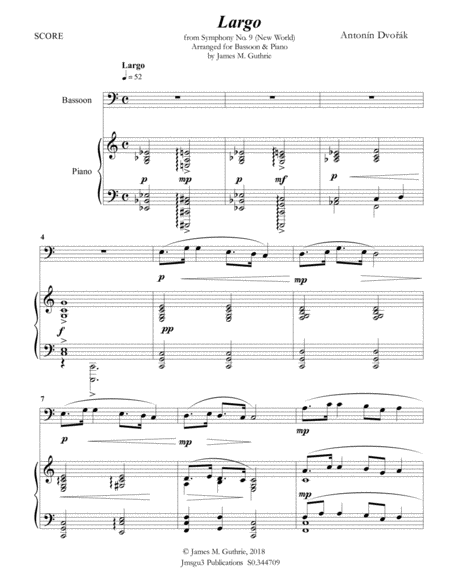
Dvořák: Largo from the New World Symphony for Bassoon & Piano
2 Bassons (duo)

$32.95 28 € 2 Bassons (duo) PDF SheetMusicPlus

Instrumental Duet Bassoon,Instrumental Duet - Level 1 - Digital Download SKU: A0.548710 Composed by Martin Luther. Arranged by James M. Guthrie. Easter,Instructional,Standards. Score and parts. 4 pages. Jmsgu3 #3411733. Published by jmsgu3 (A0.548710). Out of the Depths I Cry to You by Martin Luther arranged for bassoon & piano. The first verses feature modified counterpoint and harmony proceeding at quarter = 82. The final verse is reharmonized for maximum dramatic effect at a more contemplative tempo such as quarter = 64. Features the entire range of the instrument. Very powerful selection for Lent or Easter. Duration (3 verses) 3:05, 36 ms. Score: 3 pg. Solo part: 1 pg. The piano reads from the score. Out of the Depths Aus tiefer Not schrei ich zu dir (From deep affliction I cry out to you), is, of course, a hymn composed by Martin Luther. Moreover, Luther also wrote the lyrics, essentially a paraphrase of Psalm 130. First published in 1524, it is also one of eight songs in the original Lutheran hymnal. It appears likewise in many hymnals and in different translations. The lyrics furthermore stimulated compositions from the Renaissance to the contemporary. Consequently, composers such as Johann Sebastian Bach built an entire chorale cantata on it. Other composers similarly contributed pieces, such as Felix Mendelssohn and Max Reger. Luther Background Martin Luther, (1483 –1546) was a German professor of theology, composer, priest, and moreover, an influential character in the Protestant Reformation. Luther had a momentous impact on church and society due to his contributions to the musical arts. He wanted to disseminate the gospel among mankind and with this intention thought that the best way to do that was through music. Influence It is important to realize that other musicians, and their descendants, were encouraged by Luther’s songs and wrote their own hymns. Luther, to be sure, had a thorough musical education. For example, he knew secular and sacred songs from an early age. He, in particular, played the lute well and sang in the monastery when he was a monk. That is to say, music was an essential part of his life. He in fact first began writing songs in 1523, sometimes writing the melody as well as the lyrics. Luther was certainly able to evaluate the composers of his time. He thought especially highly of Josquin des and Ludwig Senfl. He was also acquainted, with this in mind, with other composers and their works. Legacy The Lutheran musical ethos soon covered all of Germany and later significantly fashioned Protestant musical culture. Heinrich Schütz and Johann Sebastian Bach are the most compelling evidence of this Protestant musical culture. Additionally, as a point often overlooked, the pedal organ, first refined in northern Germany, became universally prevalent. As a matter of fact, Dieterich Buxtehude established a regular evening organ concert series in Lübeck. Another key point is that this concert series, in turn, spread North German Musical ideas worldwide. Luther was especially convinced that music is a beautiful and exclusive offering of the divine.
Luther: Out of the Depths for Bassoon & Piano
2 Bassons (duo)

$24.95 21.2 € 2 Bassons (duo) PDF SheetMusicPlus

Instrumental Duet Bassoon,Instrumental Duet - Level 3 - Digital Download SKU: A0.549806 Composed by Peter Ilyich Tchaikovsky. Arranged by James M. Guthrie, ASCAP. Children,Christmas,Romantic Period,Standards. Score and parts. 16 pages. Jmsgu3 #3541659. Published by jmsgu3 (A0.549806). Duration: ca. 2:10. Score: 9 pages. 77 measures in 2/4. Solo parts: 2 pages, Piano part: 4 pages. A favorite Christmas selection from the Nutcracker Suite. Pyotr Ilyich Tchaikovsky Tchaikovsky is probably the most popular of the great composers in America. His music certainly appeals to musicians. Likewise, it appeals even to folks who don’t normally listen to serious music. This is probably because of his most noteworthy melodies. Above all, he writes with great emotion. This certainly makes a most noteworthy if not an unforgettable impact. Education First of all, He attended classes at the Russian Musical Society. Even more, He also attended the St. Petersburg Conservatory. There he studied music theory with Nikolai Zaremba. He also consequently studied composition with Anton Rubenstein. It seems like Rubenstein came under criticism from a group of Russian composers known as the Five. The Five The Five certainly rejected Western musical influences. They rather sought to use elements from Russian music. They furthermore wanted to use more exotic musical materials. Western Techniques More than other Russian composers, Tchaikovsky studied modern Western music. He certainly develops his music like the European masters. So, rather than repeating a motive, he moves to a new key. He then introduces a different theme in the new key. Hence, he maintained his independence from the Five. Even more, he became the first Russian composer of international stature. Influences Tchaikovsky was probably influenced in his ballet scoring by Léo Delibes. Richard Wagner influenced his symphonic writing. Tchaikovsky’s most famous works include the 1812 Overture, The Nutcracker Suite, and Swan Lake. Also famous are the Violin Concerto in D and the six symphonies. The greatest of the six symphonies may be No. 6, the Pathétique. Nutcracker Suite, Op. 71a The Nutcracker Suite is a ballet that was performed for the first time in December 1892 in St. Petersburg. To begin with, the original ballet failed to attract a positive reception. However, the ballet suite became probably one of the most popular of all of Tchaikovsky’s works. The ballet suite became even more famous in the 1960s. It is now performed all over the world, particularly during the Christmas season.   
Tchaikovsky: Dance of the Flutes from Nutcracker Suite for Bassoon & Piano
2 Bassons (duo)

$32.95 28 € 2 Bassons (duo) PDF SheetMusicPlus

Instrumental Duet Bassoon,Instrumental Duet - Level 3 - Digital Download SKU: A0.549670 Composed by Peter Ilyich Tchaikovsky. Arranged by James M. Guthrie, ASCAP. Children,Christmas,Romantic Period,Standards. Score and parts. 20 pages. Jmsgu3 #3519035. Published by jmsgu3 (A0.549670). Score: 10 pages: solo part: 3 pages, piano part: 6 pages. Duration: 2:22. This famous selection from the Nutcracker Suite is a classic Christmas program favorite. Pyotr Ilyich Tchaikovsky Tchaikovsky is probably the most popular of the great composers in America. His music certainly appeals to musicians. Likewise, it appeals even to folks who don’t normally listen to serious music. This is probably because of his most noteworthy melodies. Above all, he writes with great emotion. This certainly makes a most noteworthy if not an unforgettable impact. Education First of all, He attended classes at the Russian Musical Society. Even more, He also attended the St. Petersburg Conservatory. There he studied music theory with Nikolai Zaremba. He also consequently studied composition with Anton Rubenstein. It seems like Rubenstein came under criticism from a group of Russian composers known as the Five. The Five The Five certainly rejected Western musical influences. They rather sought to use elements from Russian music. They furthermore wanted to use more exotic musical materials. Western Techniques More than other Russian composers, Tchaikovsky studied modern Western music. He certainly develops his music like the European masters. So, rather than repeating a motive, he moves to a new key. He then introduces a different theme in the new key. Hence, he maintained his independence from the Five. Even more, he became the first Russian composer of international stature. Influences Tchaikovsky was probably influenced in his ballet scoring by Léo Delibes. Richard Wagner influenced his symphonic writing. Tchaikovsky’s most famous works include the 1812 Overture, The Nutcracker Suite, and Swan Lake. Also famous are the Violin Concerto in D and the six symphonies. The greatest of the six symphonies may be No. 6, the Pathétique. Nutcracker Suite, Op. 71a The Nutcracker Suite is a ballet that was performed for the first time in December 1892 in St. Petersburg. To begin with, the original ballet failed to attract a positive reception. However, the ballet suite became probably one of the most popular of all of Tchaikovsky’s works. The ballet suite became even more famous in the 1960s. It is now performed all over the world, particularly during the Christmas season. 
Tchaikovsky: March from Nutcracker Suite for Bassoon & Piano
2 Bassons (duo)

$32.95 28 € 2 Bassons (duo) PDF SheetMusicPlus

Instrumental Duet Bassoon,Instrumental Duet - Level 3 - Digital Download SKU: A0.549781 Composed by Peter Ilyich Tchaikovsky. Arranged by James M. Guthrie, ASCAP. Children,Christmas,Romantic Period,Standards. Score and parts. 11 pages. Jmsgu3 #3535059. Published by jmsgu3 (A0.549781). Duration: ca 1:00 Score: 5 pages, Solo part: 2 pages, piano part: 3 pages. Short but fascinating Chinese Dance from the Nutcracker Suite. Program this for a recital encore or Christmas pageant. Pyotr Ilyich Tchaikovsky Tchaikovsky is probably the most popular of the great composers in America. His music certainly appeals to musicians. Likewise, it appeals even to folks who don’t normally listen to serious music. This is probably because of his most noteworthy melodies. Above all, he writes with great emotion. This certainly makes a most noteworthy if not an unforgettable impact. Education First of all, He attended classes at the Russian Musical Society. Even more, He also attended the St. Petersburg Conservatory. There he studied music theory with Nikolai Zaremba. He also consequently studied composition with Anton Rubenstein. It seems like Rubenstein came under criticism from a group of Russian composers known as the Five. The Five The Five certainly rejected Western musical influences. They rather sought to use elements from Russian music. They furthermore wanted to use more exotic musical materials. Western Techniques More than other Russian composers, Tchaikovsky studied modern Western music. He certainly develops his music like the European masters. So, rather than repeating a motive, he moves to a new key. He then introduces a different theme in the new key. Hence, he maintained his independence from the Five. Even more, he became the first Russian composer of international stature. Influences Tchaikovsky was probably influenced in his ballet scoring by Léo Delibes. Richard Wagner influenced his symphonic writing. Tchaikovsky’s most famous works include the 1812 Overture, The Nutcracker Suite, and Swan Lake. Also famous are the Violin Concerto in D and the six symphonies. The greatest of the six symphonies may be No. 6, the Pathétique. Nutcracker Suite, Op. 71a The Nutcracker Suite is a ballet that was performed for the first time in December 1892 in St. Petersburg. To begin with, the original ballet failed to attract a positive reception. However, the ballet suite became probably one of the most popular of all of Tchaikovsky’s works. The ballet suite became even more famous in the 1960s. It is now performed all over the world, particularly during the Christmas season.
Tchaikovsky: Chinese Dance from Nutcracker Suite for Bassoon & Piano
2 Bassons (duo)

$32.95 28 € 2 Bassons (duo) PDF SheetMusicPlus

Instrumental Duet Bassoon,Instrumental Duet - Level 3 - Digital Download SKU: A0.549760 Composed by Peter Ilyich Tchaikovsky. Arranged by James M. Guthrie, ASCAP. Children,Christmas,Romantic Period,Standards. Score and parts. 17 pages. Jmsgu3 #3533265. Published by jmsgu3 (A0.549760). Duration: ca. 3:15 Score: 10 pages, solo part: 2 pages, piano part: 4 pages. Tchaikovsky paints a very mysterious mood in this favorite masterpiece from the Nutcracker Suite. It is also a traditional Christmas favorite. Pyotr Ilyich Tchaikovsky Tchaikovsky is probably the most popular of the great composers in America. His music certainly appeals to musicians. Likewise, it appeals even to folks who don’t normally listen to serious music. This is probably because of his most noteworthy melodies. Above all, he writes with great emotion. This certainly makes a most noteworthy if not an unforgettable impact. Education First of all, He attended classes at the Russian Musical Society. Even more, He also attended the St. Petersburg Conservatory. There he studied music theory with Nikolai Zaremba. He also consequently studied composition with Anton Rubenstein. It seems like Rubenstein came under criticism from a group of Russian composers known as the Five. The Five The Five certainly rejected Western musical influences. They rather sought to use elements from Russian music. They furthermore wanted to use more exotic musical materials. Western Techniques More than other Russian composers, Tchaikovsky studied modern Western music. He certainly develops his music like the European masters. So, rather than repeating a motive, he moves to a new key. He then introduces a different theme in the new key. Hence, he maintained his independence from the Five. Even more, he became the first Russian composer of international stature. Influences Tchaikovsky was probably influenced in his ballet scoring by Léo Delibes. Richard Wagner influenced his symphonic writing. Tchaikovsky’s most famous works include the 1812 Overture, The Nutcracker Suite, and Swan Lake. Also famous are the Violin Concerto in D and the six symphonies. The greatest of the six symphonies may be No. 6, the Pathétique. Nutcracker Suite, Op. 71a The Nutcracker Suite is a ballet that was performed for the first time in December 1892 in St. Petersburg. To begin with, the original ballet failed to attract a positive reception. However, the ballet suite became probably one of the most popular of all of Tchaikovsky’s works. The ballet suite became even more famous in the 1960s. It is now performed all over the world, particularly during the Christmas season.
Tchaikovsky: Arabian Dance from Nutcracker Suite for Bassoon & Piano
2 Bassons (duo)

$32.95 28 € 2 Bassons (duo) PDF SheetMusicPlus

Instrumental Duet Bassoon,Instrumental Duet - Level 3 - Digital Download SKU: A0.549828 Composed by Peter Ilyich Tchaikovsky. Arranged by James M. Guthrie, ASCAP. Children,Christmas,Romantic Period,Standards. Score and parts. 48 pages. Jmsgu3 #3549777. Published by jmsgu3 (A0.549828). Duration: 6:12, Score: 29 pages, Solo part: 6 pages, Piano part: 12 pages. This is the grand finale of the Nutcracker Suite. Pyotr Ilyich Tchaikovsky Tchaikovsky is probably the most popular of the great composers in America. His music certainly appeals to musicians. Likewise, it appeals even to folks who don’t normally listen to serious music. This is probably because of his most noteworthy melodies. Above all, he writes with great emotion. This certainly makes a most noteworthy if not an unforgettable impact. Education First of all, He attended classes at the Russian Musical Society. Even more, He also attended the St. Petersburg Conservatory. There he studied music theory with Nikolai Zaremba. He also consequently studied composition with Anton Rubenstein. It seems like Rubenstein came under criticism from a group of Russian composers known as the Five. The Five The Five certainly rejected Western musical influences. They rather sought to use elements from Russian music. They furthermore wanted to use more exotic musical materials. Western Techniques More than other Russian composers, Tchaikovsky studied modern Western music. He certainly develops his music like the European masters. So, rather than repeating a motive, he moves to a new key. He then introduces a different theme in the new key. Hence, he maintained his independence from the Five. Even more, he became the first Russian composer of international stature. Influences Tchaikovsky was probably influenced in his ballet scoring by Léo Delibes. Richard Wagner influenced his symphonic writing. Tchaikovsky’s most famous works include the 1812 Overture, The Nutcracker Suite, and Swan Lake. Also famous are the Violin Concerto in D and the six symphonies. The greatest of the six symphonies may be No. 6, the Pathétique. Nutcracker Suite, Op. 71a The Nutcracker Suite is a ballet that was performed for the first time in December 1892 in St. Petersburg. To begin with, the original ballet failed to attract a positive reception. However, the ballet suite became probably one of the most popular of all of Tchaikovsky’s works. The ballet suite became even more famous in the 1960s. It is now performed all over the world, particularly during the Christmas season.  
Tchaikovsky: Waltz of the Flowers from Nutcracker Suite for Bassoon & Piano
2 Bassons (duo)

$32.95 28 € 2 Bassons (duo) PDF SheetMusicPlus

Instrumental Duet Bassoon,Instrumental Duet - Level 1 - Digital Download SKU: A0.1190853 By Peabo Bryson And Regina Belle. By Alan Menken and Tim Rice. Arranged by Langanho. Children,Film/TV,Wedding. Score and parts. 4 pages. Avery Lynn Jordan #790390. Published by Avery Lynn Jordan (A0.1190853). This adaptation was made for Bassoon Duet, for better study of the beginner in music, still having all the essence of the original work. A Whole New World is a song from the 1992 Disney movie Aladdin, composed by Alan Menken and written by Tim Rice. The single of the song was released the same year and is sung by Peabo Bryson and Regina Belle. The song was the first song from a Disney animation to top the Billboard Hot 100.
A Whole New World (aladdin's Theme)
2 Bassons (duo)
Peabo Bryson And Regina Belle
$4.99 4.24 € 2 Bassons (duo) PDF SheetMusicPlus

Instrumental Duet Bassoon,Instrumental Duet - Level 1 - Digital Download SKU: A0.1190854 By Peabo Bryson And Regina Belle. By Alan Menken and Tim Rice. Arranged by Langanho. Children,Film/TV,Wedding. Score and parts. 4 pages. Avery Lynn Jordan #790391. Published by Avery Lynn Jordan (A0.1190854). This adaptation was made for Bassoon Duet with Chords, for better study of the beginner in music, still having all the essence of the original work. A Whole New World is a song from the 1992 Disney movie Aladdin, composed by Alan Menken and written by Tim Rice. The single of the song was released the same year and is sung by Peabo Bryson and Regina Belle. The song was the first song from a Disney animation to top the Billboard Hot 100.
A Whole New World (aladdin's Theme)
2 Bassons (duo)
Peabo Bryson And Regina Belle
$5.99 5.09 € 2 Bassons (duo) PDF SheetMusicPlus

Instrumental Duet Bassoon,Instrumental Duet - Level 4 - Digital Download SKU: A0.549932 Composed by Modest MUSSORGSKY (1839 - 1881). Arranged by James M. Guthrie. Holiday,Instructional,Patriotic,Romantic Period,Standards. Score and parts. 91 pages. Jmsgu3 #4303577. Published by jmsgu3 (A0.549932). A classic selection of epic proportions. Score: 75 pages, Solo part: 16 pages, 924 measures. Duration: 34:30 Pictures at an Exhibition (Картинки с выставки) by Modest Petrovič Musorgskij, 1874 (Модест Петрович Мусоргский) Promenade 1  Allegro giusto, nel modo russico; senza allegrezza, ma poco sostenuto    page 1 1. GNOMUS (The Gnome)  Sempre vivo page 4 Promenade 2  Moderato commodo assai e con delicatezza page 10  2. IL VECCHIO CASTELLO (The Old Castle) Andante molto cantabile e con dolore page 12  Promenade 3 Moderato non tanto, pesamente page 18  3. TUILLERIES Dispute d'enfants après jeux (Children's Quarrel after Games) Allegretto non troppo, capriccioso page 19                                                                              4. BYDLO (Cattle) Sempre moderato pesante  page 22 Promenade 4 Tranquillo page 26 5. Ballet of the Unhatched Chicks Балет невылупившихся птенцов Scherzino  page 27 6. Samuel Goldenberg und Schmuÿle  Еврей в меховой шапке. Cандомир  Andante page 30 Promenade 5  Allegro giusto, nel modo russico, poco sostenuto page 36 7. LIMOGES. LE MARCHÉ. (La grande nouvelle) The Market (The Great News) Allegretto vivo, sempre scherzando   page 39 8. CATACOMBAE (Sepulchrum romanum) (Roman Tomb) Парижские катакомбы  Largo page 46    CON MORTUIS IN LINGUA MORTUA (With the Dead in a Dead Language) Andante nontroppo, con lamento page 47 9. The Hut on Hen's Legs (Baba Yaga) Избушка Бабы-Яги на курьих ожках. Часы в русском стиле Allegro con brio, feroce page 50 10. The Bogatyr Gates (In the Capital in Kiev) Проект городских ворот в Киеве. Главный фасад The Great Gates of Kiev Allegro alla breve Maestoso con grandezza page 63Mussorgsky is known for his ability to evoke vivid pictures through his music. He creates soundscapes that transport listeners to other places and times. Through the use of complex harmonies and shifting tonalities, Mussorgsky creates sonic paintings that are as diverse and varied as any works of art in a museum. He takes listeners on a journey through different landscapes and environments, ranging from pastoral settings to the depths of the underworld. In his famous suite, Pictures at an Exhibition, Mussorgsky gives each movement a title that references a painting, sculpture, or architectural feature from an art museum. The suite is composed in such a way that it captures the moods and emotions evoked by the artworks. From the bright and energetic Promenade to the somber and mysterious Catacombs, Mussorgsky's Pictures at an Exhibition paints a vivid sonic landscape that brings the listener into the art museum.
Mussorgsky: Pictures at an Exhibition for Bassoon & Piano
2 Bassons (duo)

$32.95 28 € 2 Bassons (duo) PDF SheetMusicPlus


Partitions Gratuites
Acheter des Partitions Musicales
Acheter des Partitions Digitales à Imprimer
Acheter des Instruments de Musique

© 2000 - 2026

Accueil - Version intégrale





