EUROPE
2101 articles
USA
0 articles
DIGITAL
26 articles ( imprimer)
Partitions Digitales
Partitions à imprimer
26 partitions trouvées


Instrumental Duet Bassoon,Instrumental Duet - Level 4 - Digital Download SKU: A0.551532 Composed by Carl Philipp Emanuel Bach (1714-1788). Arranged by James Guthrie, ASCAP. Classical,Instructional,Standards,Wedding. Score and parts. 22 pages. Jmsgu3 #5309587. Published by jmsgu3 (A0.551532). Sonata in E Minor, Score: 11 pages, Duration: 7:151. Adagio2. Allegro3. Menuett & 2 VariationsCarl Philipp Emanuel Bach (1714-1788) was an influential composer who worked during a time of transition between the Baroque and Classical styles of music. His personal approach, known as empfindsamer Stil or sensitive style, applied the principles of rhetoric and drama to musical structures. The duets composed by C.P.E. Bach are significant because they showcase his unique style and are considered to be some of his most important works. They are known for their unpredictability and expressive qualities, which were a departure from the style of his father, Johann Sebastian Bach.
CPE BACH: Sonata in E Minor WQ124 for Bassoon & Piano
2 Bassons (duo)

$24.95 21.27 € 2 Bassons (duo) PDF SheetMusicPlus

Bassoon,Instrumental Duet - Level 3 - Digital Download SKU: A0.1215964 Composed by Edvard Grieg. Arranged by César Madeira. 19th Century,20th Century,Children,Film/TV,Romantic Period. 6 pages. Sheet Music To Play Editions #812622. Published by Sheet Music To Play Editions (A0.1215964). In The Hall Of The Mountain King by Grieg. Arrangement for Bassoon Duet. With Full Score and Individual Parts. Enjoy it!In the Hall Of The Mountain King is a piece of orchestral music composed by Edvard Grieg in 1875 as incidental music for the sixth scene of act 2 in Henrik Ibsen's 1867 play Peer Gynt. It was originally part of Opus 23 but was later extracted as the final piece of Peer Gynt, Suite No. 1, Op. 46. Its easily recognizable theme has helped it attain iconic status in popular culture, where it has been arranged by many artists.For Tutorials, Play Alongs or request New Arrangements, visit the YouTube Channel: Sheet Music To Play
In The Hall Of The Mountain King - Bassoon Duet (Full Score and Parts)
2 Bassons (duo)

$7.99 6.81 € 2 Bassons (duo) PDF SheetMusicPlus

Instrumental Duet Bassoon,Instrumental Duet - Level 2 - Digital Download SKU: A0.550922 Composed by J. S. Bach - Gounod. Arranged by James M. Guthrie, ASCAP. Christmas,Easter,Standards. Score and parts. 12 pages. Jmsgu3 #4888319. Published by jmsgu3 (A0.550922). This arrangement features the controversial Schwencke measure (ms. 27) that was originally introduced in 1783 by Christian Friedrich Gottlieb Schwencke. The convenient 1st & 2nd endings provide an option for extended performance. Duration with repeat - 4:50. Score: 7 pages. Solo part: 1 page, piano part: 4 pages. Based on Prelude #1 in C Major from the Well-Tempered Clavier, Book 1. Well suited for church meditations or school programs or recital encores.  Ave Maria Ave Maria is a Catholic prayer that consequently asks for the mother of Jesus (Mary) to intercede. Charles Gounod composed a famous version of the Ave Maria. He was a French Romantic composer who overlaid a new melody on an existing Bach chord progression. The progression is from Bach’s Prelude No. 1 from Well-Tempered Clavier I. This version, as well as Schubert’s version, have become essential items at weddings, masses, and funerals. Bach Overview First of all, Johann Sebastian Bach is maybe the greatest composer in music history. Certainly, he was prolific. As a result, everyone has heard of his works. Furthermore, these works number well over a thousand. It seems like people are probably most familiar with instrumental works such as the Brandenburg Concertos, and the Goldberg Variations. But, similarly famous are such noteworthy works as the Well-Tempered Clavier, the Musical Offering, and the Art of Fugue. Seems like his most famous vocal works include the most noteworthy Mass in B Minor. Also, most noteworthy, though, are the St. John Passion, and certainly the Christmas Oratorio.  History Bach came from a long line of musicians and above all, composers. Consequently, he, first of all, pursued a career as a church organist. So as a result, he gained employment in various Protestant churches in Germany. For a while, he worked as a court musician in Weimar and Köthen. Here he probably developed his organ style and likewise his chamber music style. Eventually, he, therefore, gained an appointment as Cantor of St. Thomas in Leipzig. Here he worked until difficulties with his employer ultimately drove him away. The King of Poland finally appointed him as a court composer.  Style It seems like Bach created an engaging new international style. He synthesized elements of the most noteworthy European music ideas into his new style. Even more, this new style was probably his synthesis of European musical rhythm and form. Furthermore, he demonstrated a complete mastery of counterpoint and motivic development. His sense of harmonic organization probably propelled him to the top. Revival               Mendelssohn conducted a Bach revival in the nineteenth century. His effort probably helped to re-familiarize the public with the magnitude of Bach’s works. During this period, scholars published many noteworthy Bach biographies. Moreover, Wolfgang Schmieder published the BWV (Bach Werke Verzeichnis). As a result, this is now the official catalog of his entire artistic output. The BWV number allows us to locate a work in the catalog. Sometimes scholars will simply use an S (Schmieder) as an abbreviation for BWV.  Voyager NASA launched two Voyager spacecraft in 1977. Onboard are phonograph records with sounds, music, and images of life on Earth. The purpose of the launch was to inform intelligent extraterrestrial life forms about conditions on Earth. The music on the disc is varied. There is Bach, Mozart, Beethoven, and Stravinsky among others. However, because Bach is so important in our music history, it contains three times more Bach than all the others combined.
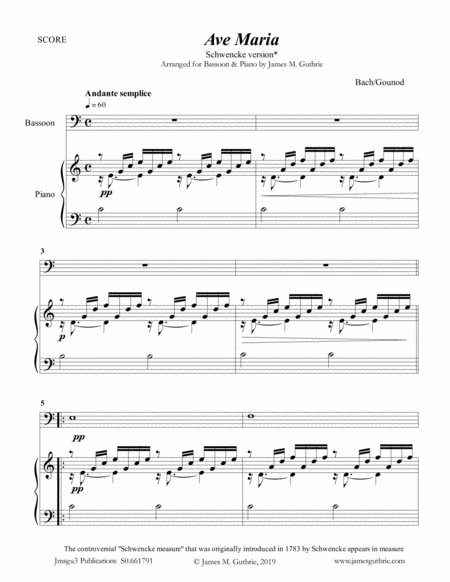
Bach-Gounod: Ave Maria, Schwencke version for Bassoon & Piano
2 Bassons (duo)

$32.95 28.09 € 2 Bassons (duo) PDF SheetMusicPlus

Instrumental Duet Bassoon,Instrumental Duet - Level 2 - Digital Download SKU: A0.549363 Composed by Bach-Gounod. Arranged by James M. Guthrie, ASCAP. Christmas,Contemporary,Easter,Wedding. Score and parts. 11 pages. Jmsgu3 #3490133. Published by jmsgu3 (A0.549363). This arrangement follows the original Bach prelude and so excludes the extra measure that Schwencke introduced in 1783. If you prefer the extra measure, please see Bach-Gounod: Ave Maria, Schwencke version for Bassoon & Piano, S0.661791. The convenient 1st & 2nd endings provide an option for extended performance with minimal page turns for the accompanist. The duration with repeat is about 4:50. Score: 6 pages. Solo part: 1 page, piano part: 4 pages. Based on Prelude #1 in C Major from the Well-Tempered Clavier, Book 1. Well suited for church meditations or school programs or recital encores. Ave Maria Ave Maria is a Catholic prayer that consequently asks for the mother of Jesus (Mary) to intercede. Charles Gounod composed a famous version of the Ave Maria. He was a French Romantic composer who overlaid a new melody on an existing Bach chord progression. The progression is from Bach’s Prelude No. 1 from Well-Tempered Clavier I. This version, as well as Schubert’s version, have become essential items at weddings, masses, and funerals. Bach Overview First of all, Johann Sebastian Bach is maybe the greatest composer in music history. Certainly, he was prolific. As a result, everyone has heard of his works. Furthermore, these works number well over a thousand. It seems like people are probably most familiar with instrumental works such as the Brandenburg Concertos, and the Goldberg Variations. But, similarly famous are such noteworthy works as the Well-Tempered Clavier, the Musical Offering, and the Art of Fugue. Seems like his most famous vocal works include the most noteworthy Mass in B Minor. Also, most noteworthy, though, are the St. John Passion, and certainly the Christmas Oratorio.  History Bach came from a long line of musicians and above all, composers. Consequently, he, first of all, pursued a career as a church organist. So as a result, he gained employment in various Protestant churches in Germany. For a while, he worked as a court musician in Weimar and Köthen. Here he probably developed his organ style and likewise his chamber music style. Eventually, he gained an appointment as Cantor of St. Thomas in Leipzig. Here he worked until difficulties with his employer ultimately drove him away. The King of Poland finally appointed him as court composer.  Style It seems like Bach created an engaging new international style. He synthesized elements of the most noteworthy European music ideas into his new style. Even more, this new style was probably his synthesis of European musical rhythm and form. Furthermore, he demonstrated a complete mastery of counterpoint and motivic development. His sense of harmonic organization probably propelled him to the top. Revival               Mendelssohn conducted a Bach revival in the nineteenth century. His effort probably helped to re-familiarize the public with the magnitude of Bach’s works. During this period, scholars published many noteworthy Bach biographies. Moreover, Wolfgang Schmieder published the BWV (Bach Werke Verzeichnis). As a result, this is now the official catalog of his entire artistic output. The BWV number allows us to locate a work in the catalog. Sometimes scholars will simply use an S (Schmieder) as an abbreviation for BWV.  
Bach-Gounod: Ave Maria for Bassoon & Piano
2 Bassons (duo)

$32.95 28.09 € 2 Bassons (duo) PDF SheetMusicPlus

Instrumental Duet Bassoon,Instrumental Duet - Level 2 - Digital Download SKU: A0.549433 Composed by Antonin Dvorak. Arranged by James M. Guthrie, ASCAP. Instructional,Romantic Period,Sacred,Standards. Score and parts. 12 pages. Jmsgu3 #3494213. Published by jmsgu3 (A0.549433). Score: 7 pages, solo part: 2 pages, piano part: 3 pages. Duration: 4:25. Not difficult, but requires sensitivity & dynamic c control. Suitable for recitals, church meditations, or school programs. Dvořák Background Antonín Dvořák (1841 –1904) was, of course, a composer from Czechoslovakia. As a matter of fact, he was among the first Bohemian composers to attain universal recognition. It is important to realize that the late Romantic Nationalist period featured composers who used traditional and folk elements to portray the character of their nation. In particular, we see this in the music of Grieg (Norway), Finland (Sibelius), and Smetana (Bohemia).  Dvořák relied markedly on rhythms and other characteristics of Moravian and Bohemian folk music. Ascent to Fame Dvořák was truly a child musical prodigy on the violin. The premiere performances of his compositions notably occurred in 1872 and 1873. He submitted his First Symphony in particular to a German competition, but it failed to win. Consequently, in 1874 he presented two more symphonies to the Austrian State Prize for Composition. Johannes Brahms was the principal of the jury and was accordingly very impressed. They forthwith awarded the prize to Dvořák in 1874, 1876, and 1877. At this point, Brahms thereupon endorsed Dvořák to the publisher Simrock. Later, the publisher commissioned Dvořák to compose the Slavonic Dances, Op. 46. These became popular overnight and, as a result, Dvořák's worldwide status was launched. International Status Dvořák visited England upon invitation nine times. On each visit, he frequently conducted performances of his own compositions. He conducted concerts of his music, especially in Moscow and St. Petersburg. Eventually, the Prague Conservatory in fact appointed Dvořák as a professor. There, to be sure, he wrote his famous Dumky Trio. United States Consequently, the National Conservatory of Music of America appointed him as director in 1892. As a result, Dvořák composed his two most famous symphonic works: the Symphony No. 9 (From the New World), which spread his name universally, and his Concerto for Cello and Orchestra, one of the most famous of all cello works. Moreover, he wrote his most celebrated American String Quartet during this time. At the same time, because of his growing recognition in Europe and his homesickness for his own country, he left to return to Bohemia in 1895.  
Dvořák: Largo from the New World Symphony for Bassoon & Piano
2 Bassons (duo)

$32.95 28.09 € 2 Bassons (duo) PDF SheetMusicPlus

Instrumental Duet Bassoon,Instrumental Duet - Level 2 - Digital Download SKU: A0.796718 Composed by Traditional English Carol. Arranged by Gary D. Belshaw (ASCAP). Baroque,Christmas,Concert,Contemporary. Score and parts. 6 pages. DR GARY D BELSHAW #3664549. Published by DR GARY D BELSHAW (A0.796718). 2018 Holiday Contest EntryKey of C MajorThe famous Traditional English Carol is here arranged for two Early Intermediate level bassoonists. At a little over a minute in duration, this carol will make an impressive contribution to a holiday recital or social event. Naturally, it's ideal for any and all church functions during which younger or less-experienced players may participate. Fashioned after the early intermediate level character pieces found the famous Anna Magdalena Bach books, the melody is accompanied by an original counterpoint. The repetition (second verse) of the carol allows each instrument to play the counterpoint.Follow us on Twitter. Like this song on our Facebook page. Your reviews here in Sheet Music Plus are also incredibly valuable to us. We are also ready at any time to create something just for you.
The First Noel
2 Bassons (duo)

$3.99 3.4 € 2 Bassons (duo) PDF SheetMusicPlus

Instrumental Duet Bassoon,Instrumental Duet - Level 4 - Digital Download SKU: A0.549932 Composed by Modest MUSSORGSKY (1839 - 1881). Arranged by James M. Guthrie. Holiday,Instructional,Patriotic,Romantic Period,Standards. Score and parts. 91 pages. Jmsgu3 #4303577. Published by jmsgu3 (A0.549932). A classic selection of epic proportions. Score: 75 pages, Solo part: 16 pages, 924 measures. Duration: 34:30 Pictures at an Exhibition (Картинки с выставки) by Modest Petrovič Musorgskij, 1874 (Модест Петрович Мусоргский) Promenade 1  Allegro giusto, nel modo russico; senza allegrezza, ma poco sostenuto    page 1 1. GNOMUS (The Gnome)  Sempre vivo page 4 Promenade 2  Moderato commodo assai e con delicatezza page 10  2. IL VECCHIO CASTELLO (The Old Castle) Andante molto cantabile e con dolore page 12  Promenade 3 Moderato non tanto, pesamente page 18  3. TUILLERIES Dispute d'enfants après jeux (Children's Quarrel after Games) Allegretto non troppo, capriccioso page 19                                                                              4. BYDLO (Cattle) Sempre moderato pesante  page 22 Promenade 4 Tranquillo page 26 5. Ballet of the Unhatched Chicks Балет невылупившихся птенцов Scherzino  page 27 6. Samuel Goldenberg und Schmuÿle  Еврей в меховой шапке. Cандомир  Andante page 30 Promenade 5  Allegro giusto, nel modo russico, poco sostenuto page 36 7. LIMOGES. LE MARCHÉ. (La grande nouvelle) The Market (The Great News) Allegretto vivo, sempre scherzando   page 39 8. CATACOMBAE (Sepulchrum romanum) (Roman Tomb) Парижские катакомбы  Largo page 46    CON MORTUIS IN LINGUA MORTUA (With the Dead in a Dead Language) Andante nontroppo, con lamento page 47 9. The Hut on Hen's Legs (Baba Yaga) Избушка Бабы-Яги на курьих ожках. Часы в русском стиле Allegro con brio, feroce page 50 10. The Bogatyr Gates (In the Capital in Kiev) Проект городских ворот в Киеве. Главный фасад The Great Gates of Kiev Allegro alla breve Maestoso con grandezza page 63Mussorgsky is known for his ability to evoke vivid pictures through his music. He creates soundscapes that transport listeners to other places and times. Through the use of complex harmonies and shifting tonalities, Mussorgsky creates sonic paintings that are as diverse and varied as any works of art in a museum. He takes listeners on a journey through different landscapes and environments, ranging from pastoral settings to the depths of the underworld. In his famous suite, Pictures at an Exhibition, Mussorgsky gives each movement a title that references a painting, sculpture, or architectural feature from an art museum. The suite is composed in such a way that it captures the moods and emotions evoked by the artworks. From the bright and energetic Promenade to the somber and mysterious Catacombs, Mussorgsky's Pictures at an Exhibition paints a vivid sonic landscape that brings the listener into the art museum.
Mussorgsky: Pictures at an Exhibition for Bassoon & Piano
2 Bassons (duo)

$32.95 28.09 € 2 Bassons (duo) PDF SheetMusicPlus


Partitions Gratuites
Acheter des Partitions Musicales
Acheter des Partitions Digitales à Imprimer
Acheter des Instruments de Musique

© 2000 - 2025

Accueil - Version intégrale





