EUROPE
27133 articles
USA
0 articles
DIGITAL
110 articles (à imprimer)
Partitions Digitales
Partitions à imprimer
110 partitions trouvées

1 16 31 ....106

Bassoon,Instrumental Duet - Level 3 - Digital Download SKU: A0.1452587 Composed by Giovanni Battista Pergolesi. Arranged by Ray Thompson. Baroque. 4 pages. RayThompsonMusic #1031893. Published by RayThompsonMusic (A0.1452587). This is the 4th movement of Pergolesi's Sinfonia a Violoncello Solo.it was used as the basis of Stravinsky's Pulcinella Suite No VII Vivo. He arrangesd it for an unusual combination of trombone and double bass duet.It has a somewhat comical effect.He added his own distictive harmonies and rhythms.My transcription for bassoon duo uses Pergolesi's original harmonies.It does not sound too disimilar to Stravinky's composotion.I have changed the key from F to C major to suit the range of the bassoon.
Pergolesi: Sinfonia a Violoncello Solo IV.Presto (Pulcinella Suite VII.Vivo) - bassoon duet
2 Bassons (duo)

$4.95 4.18 € 2 Bassons (duo) PDF SheetMusicPlus

Instrumental Duet Bassoon,Instrumental Duet - Level 3 - Digital Download SKU: A0.614366 Composed by Trad. Spanish Melody. Arranged by Gary Lanier. Praise & Worship,Sacred. Score and parts. 8 pages. The Lanier Company #546313. Published by The Lanier Company (A0.614366). For the 2016 New Year Contest. COME, CHRISTIANS, JOIN TO SING is a duet arrangement for Bassoon & Piano of one of our most cherished Praise Hymns. The score, including cover and Bassoon part is 8 pages long. This arrangement is perfect for any Church or gathering where the sound of Christian Praise is the focus. A mp3 Piano Accompaniment (aka Rehearsal Track) is also available, listed as: COME, CHRISTIANS, JOIN TO SING (Piano Accompaniment for Bassoon).
Gary Lanier: COME, CHRISTIANS, JOIN TO SING (Duet – Bassoon & Piano with Parts)
2 Bassons (duo)

$6.99 5.9 € 2 Bassons (duo) PDF SheetMusicPlus

Instrumental Duet Bassoon,Instrumental Duet - Level 3 - Digital Download SKU: A0.549381 Composed by George Frideric Handel. Arranged by James M. Guthrie, ASCAP. Baroque,Sacred,Standards,Wedding. Score and parts. 9 pages. Jmsgu3 #3492259. Published by jmsgu3 (A0.549381). Duration: 4:55, Score: 6 pages, Solo part: 1 page, piano part: 2 pages. A very famous aria (Ombra mai fu) from XerxesSuitable for any venue requiring meditative music. Excellent choice for a recital encore. Xerxes Xerxes is, in fact, an opera seria in three acts by Handel. Moreover, Handel conducted the premiere performance in London in 1738. Handel casts the opera in Persia in 470 BC. The part of Xerxes was indeed originally sung by a soprano castrato. Nowadays, the part is generally sung by a mezzo-soprano or conversely a counter-tenor. In the first place, Xerxes sings an opening aria, Ombra mai fu to a plane tree. Handel sets this aria to one of his most truly famous melodies. Although many refer to it traditionally as Handel’s Largo, Handel has, on the contrary, clearly marked Larghetto in the score. Handel Background George Frideric Handel (1685 - 1759) was born in Germany but eventually became a British citizen. Nonetheless, he was a famous Baroque composer. In fact, he became famous for his operas, oratorios, anthems, and organ concertos. Handel studied music and, by and large, worked as a composer in Germany and Italy before moving to London. On the whole, Handel was very familiar with the contemporary music of Italy and Germany. Career in England It is essential to realize that Italian opera was all the rage in England at the time. Moreover, Handel was really good at writing them. Therefore, he started not one but three opera companies in England. Alexander's Feast was a huge success in 1736, but Handel began composing English choral works. After success with the Messiah in 1742) he certainly never again wrote an Italian opera. Consequently, he died in 1759, a treasured genius. Accordingly, the English government gave him full state honors at his funeral. Hence, he is buried in Westminster Abbey in London. Legacy Music historians agree that Handel was in general one of the greatest composers of the Baroque era.  To demonstrate, his works such as the Messiah, Water Music, and Music for the Royal Fireworks remain consistently popular up to the present time. He especially composed the coronation anthem, Zadok the Priest for the coronation of George II. Nevertheless, it has specifically been performed at every succeeding British coronation since. His oratorio Solomon has by all means also continued to be prevalent. As a matter of fact, Sinfonia from act 3 was featured in the 2012 London Olympics opening ceremony. Handel was particularly prolific. To enumerate, he wrote over forty operas.  Since the late 1960s, we have expressly experienced a revival of baroque music. Similarly, we have especially seen a pique of interest in historically informed musical performances. Since his death in 1779, interest in Handel's music has all in all, expanded.  
Handel: Largo from Xerxes for Bassoon & Piano
2 Bassons (duo)

$32.95 27.83 € 2 Bassons (duo) PDF SheetMusicPlus

Bassoon Solo - Level 2 - Digital Download SKU: A0.730989 Composed by Felix Bartholdy Mendelssohn. Arranged by Edwin Sung. Children,Christian,Christmas,Classical,Instructional. Individual part. 2 pages. Edwin Sung #3179. Published by Edwin Sung (A0.730989). This duet piece emphasises on teamwork / co-operation, while not setting the bar too high for the players - music appreciation / enjoyment is what all musicians like! Beginners get to enjoy to play the main tune, while the intermediates/teachers can enjoy wider range and more note decorations from their instruments while supporting the melodies. That’s why this piece is recommended to everyone, ranging from beginners to advanced, to perform professionally or leisurely during Chistmas ideally!
Hark! The Herald Angels Sing (for bassoon duet, suitable for grades 1-5)
2 Bassons (duo)

$3.99 3.37 € 2 Bassons (duo) PDF SheetMusicPlus

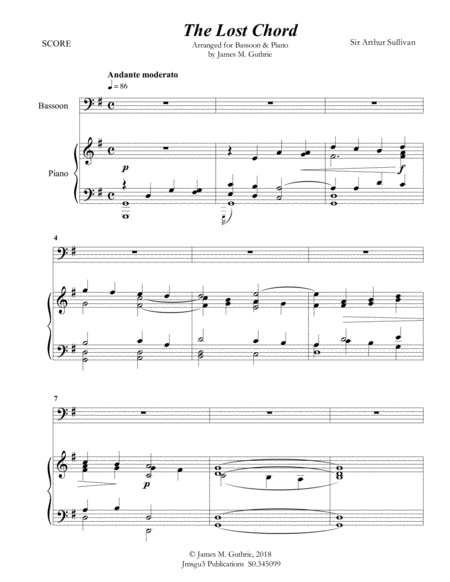
Instrumental Duet Bassoon,Instrumental Duet - Level 4 - Digital Download SKU: A0.549452 Composed by Sir Arthur Seymour Sullivan. Arranged by James M. Guthrie, ASCAP. Instructional,Romantic Period,Sacred,Standards. Score and parts. 15 pages. Jmsgu3 #3497185. Published by jmsgu3 (A0.549452). Score: 10 pages, solo part: 2 pages, piano part: 3 pages. Duration: 4:25. Not difficult, but requires sensitivity & dynamic control. Suitable for recitals, church meditations, or school programs. School Years First of all, Sullivan attended music school at the Royal Academy of Music. Because Sullivan was so talented, the Academy awarded him the Mendelssohn Scholarship for two years in a row. He, therefore, studied with John Goss, who studied with Thomas Atwood, who in turn studied with Mozart. Sullivan similarly studied the piano at the Academy with Arthur O’Leary. Study Abroad During his first year, he also earned money by singing solos in the Chapel Royal. At the end of his second year, the Academy consequently continued his scholarship and sent him to study at the Leipzig Conservatoire. He certainly studied composition, and likewise counterpoint and piano. Hence, during his final year in Leipzig, Sullivan finally completed his graduation composition project: Incidental Music for Shakespeare’s The Tempest. Association with Gilbert It seems like Sullivan built the bulk of his composing career largely in the 1860s. As a result, he became famous for his incidental music for the Tempest and his Irish Symphony. He, therefore, began collaborating with the poet W. S. Gilbert in the 1870s. Rather than focus on serious opera, Gilbert and Sullivan, in contrast, concentrated on comic opera such as H. M. S. Pinafore, the Pirates of Penzance, and the Mikado. Therefore, certainly as a result of his education and experience, Sullivan composed a total of 24 operas, 11 symphonic works, 10 choral pieces. Even more, he wrote a large number of noteworthy hymns such as Onward Christian Soldiers. Lost Chord The general style of his music is maybe similar to Mendelssohn, Schumann, and perhaps Liszt. It seems like Sullivan was fond of writing distinct melodies for each character in his operettas. His melodies combine together as the characters did. Furthermore, he was a master orchestrator, and therefore played the flute, clarinet, trumpet, and trombone fluently. The Lost Chord Sullivan wrote his most noteworthy song the Lost Chord in 1877. As a result, it was a great success and was certainly performed all over the world by a variety of singers such as Enrico Caruso. Because Sullivan was the most famous composer in England, the Lost Chord became the most famous of all British or American songs of the 1870s and 1890s. Consequently, in 1888 Thomas Edison recorded The Lost Chord for the phonograph. It was one of the first songs ever recorded. Furthermore, Queen Victoria knighted Sullivan in 1883.    
Sullivan: The Lost Chord for Bassoon & Piano
2 Bassons (duo)

$26.95 22.76 € 2 Bassons (duo) PDF SheetMusicPlus

Bassoon,Instrumental Duet - Level 3 - Digital Download SKU: A0.549517 Composed by Edvard Grieg. Arranged by James M. Guthrie, ASCAP. Instructional,Romantic Period,Sacred,Standards. 17 pages. Jmsgu3 #3504441. Published by jmsgu3 (A0.549517). Duration: ca. 4:00, Score: 9 pages, solo part: 3 pages, piano part: 4 pages. Super-famous instantly recognizable tune, not very difficult - suitable for a recital or church meditation. Grieg Background In the first place, Edvard Grieg (1843 –1907) was a Norwegian composer as well as a concert pianist. As a matter of fact, most music historians consider him one of the foremost Romantic-era composers. Consequently, his music is part of the international standard classical repertoire. Grieg moreover used Norwegian folk music in his own compositions.  Consequently, he ushered Norwegian music to transnational consciousness. Furthermore, he forged a national musical identity for Norway. It is important to realize that he did this in a manner similar to Jean Sibelius in Finland, and Bedřich Smetana in Bohemia. Legacy Grieg is especially celebrated in the city of Bergen. For example, the city has erected numerous statues depicting Grieg. Specifically, the city has named a concert hall (Grieg Hall), a music school (Grieg Academy), and a professional choir (Edvard Grieg Kor) after him. As a matter of fact, there is also a museum located at his former home in Troldhaugen. Peer Gynt Suite No. 1 (Op. 46) Grieg wrote incidental music for the purpose of illustrating a play by Ibsen known as Peer Gynt. The play includes, in particular, the famous selection entitled, In the Hall of the Mountain King. In this composition, Grieg depicts the exploits of the scoundrel, Peer Gynt. In one famous episode, for example, Peer steals a bride at her wedding. For this reason, the people chase him, but soon Peer falls, striking his skull on a boulder. He wakens forthwith in a highland bounded by angry gnomes. Consequently, the music of In the Hall of the Mountain King represents the mad gnomes taunting Peer. Therefore, each time the theme repeats it gets louder and faster. In the end, Peer surprisingly escapes from the mountain. Holberg Suite and Misc. Summary It must be remembered that Grieg originally wrote his Holberg Suite for the piano. In other words, he only later arranged it for strings. Further, Grieg composed many songs with lyrics by famous writers such as Heine, Goethe, Ibsen, Hans Christian Andersen, Rudyard Kipling, and others. On balance, Norwegian pianist Eva Knardahl recorded altogether Grieg’s whole piano catalog on LP in 1980. These recordings were released again on CD in 2006. In any event, Grieg himself performed and recorded the bulk of these pieces toward the end of his life.
Grieg: Morning Mood from Peer Gynt Suite for Bassoon & Piano
2 Bassons (duo)

$32.95 27.83 € 2 Bassons (duo) PDF SheetMusicPlus


1 16 31 ....106


Partitions Gratuites
Acheter des Partitions Musicales
Acheter des Partitions Digitales à Imprimer
Acheter des Instruments de Musique

© 2000 - 2026

Accueil - Version intégrale