EUROPE
13100 articles
USA
0 articles
DIGITAL
17 articles (à imprimer)
Partitions Digitales
Partitions à imprimer
17 partitions trouvées


B-Flat Clarinet,Bassoon,Instrumental Duet - Level 2 - Digital Download SKU: A0.1304470 By Felix Bartholdy Mendelssohn. By Felix Bartholdy Mendelssohn. Arranged by Arezzo Music. Chamber,March,Romantic Period,Traditional,Wedding. 4 pages. Arezzo Music #893961. Published by Arezzo Music (A0.1304470). Wedding march mendelssohn Clarinet and Bassoon sheet musicElevate your wedding ceremony with the elegant sounds of Felix Mendelssohn's Wedding March arranged for Clarinet and Bassoon. This sheet music provides a beautiful and harmonious duet that will make your special day even more memorable. Whether you're walking down the aisle or planning a musical performance, the rich tones of the Clarinet and Bassoon will create a romantic and sophisticated atmosphere. Let the music celebrate your love and add an extra layer of enchantment to your wedding.wedding march mendelssohn Clarinet and Bassoon sheet music
wedding march mendelssohn Clarinet and Bassoon sheet music
Clarinette, Basson (duo)
Felix Bartholdy Mendelssohn
$3.99 3.47 € Clarinette, Basson (duo) PDF SheetMusicPlus

Bassoon,Clarinet,Instrumental Duet - Level 2 - Digital Download SKU: A0.1150431 Composed by Ludwig van Beethoven. Arranged by Ander. Classical,Folk,March,Opera,Romantic Period. 6 pages. Woods Only, Arrangements #750608. Published by Woods Only, Arrangements (A0.1150431). This arrangement adapted for clarinet and bassoon duet was written keeping the characteristics of the original work, in order to be performed by young music students who want to enter the symphonic music. Besides, it can also be used by professional musicians for recitals, repertoire, academic presentations and didactic material. The transcription remains faithful to the structure, with only one change in tone, so that it is comfortable for all the instruments in the formation, as well as being used as an activity in ensemble practice among musicians of different traditions. Beethoven's Turkish March (Op. 113) is the 4th movement of the operatic work: The Ruins of Athens, a set of incidental pieces written in 1812 by Ludwig van Beethoven, where the melody was originally written in 1809 as Theme with Six Variations for Piano, Op. 76. The work was written to accompany the play of the same name by August von Kotzebue, for the dedication of a new theater in Pest. Perhaps the best known part of the composition is the Marcia alla turca, In Latin America, this movement became known in Jean-Jacques Perrey's version (who titled it The Elephant never Forgets) since it was used as the opening theme of the successful Mexican TV comedy El Chavo del Ocho. The opening and the turkish march are often performed separately, and the other pieces in this set are not often heard.
Turkish March by Beethoven for Clarinet and Bassoon
Clarinette, Basson (duo)

$3.99 3.47 € Clarinette, Basson (duo) PDF SheetMusicPlus

Instrumental Duet Bassoon,Clarinet,Instrumental Duet - Level 4 - Digital Download SKU: A0.956608 Composed by Julius Fucik. Arranged by Catriona Melville-Mason. Concert,Romantic Period,Standards. Score and parts. 7 pages. C Melville-Mason #6477745. Published by C Melville-Mason (A0.956608). Entry of the Gladiators is probably the best known work by Czech composer Julius Fucik (1872-1916) – primarily because of its adoption as an upbeat ‘screamer’ march, heralding the arrival of circus clowns.  In fact, Fucik’s original title for the work was Grande Marche Chromatique, because the piece makes frequent use of chromatic passages.  He later substituted Entry of the Gladiators because of a personal interest in Roman history.  Fucik intended the work to be played at a standard march tempo, though it is generally performed significantly faster in the ‘clowns’ context!This arrangement for duo of B-flat clarinet and bassoon has been classed as 'advanced intermediate' as, although it can be attempted by players of ABRSM Grade 4 - 5 standard, it takes more experienced musicians to do it full justice.
Entry of the Gladiators (Clarinet & Bassoon duet)
Clarinette, Basson (duo)

$4.50 3.91 € Clarinette, Basson (duo) PDF SheetMusicPlus

Instrumental Duet Bassoon,Clarinet,Instrumental Duet - Level 3 - Digital Download SKU: A0.956612 Composed by J Strauss II. Arranged by Catriona Melville-Mason. Concert,Romantic Period,Standards. Score and parts. 7 pages. C Melville-Mason #6477751. Published by C Melville-Mason (A0.956612). In his lifetime, Austrian composer Johann Strauss II (1825 – 1899) was dubbed ‘The Waltz King’, reflecting his prolific output of this type of dance music.  He also composed polkas, quadrilles, marches, operettas and a ballet. During the 1848 upheavals in the Austrian Empire, Johann II opted to side with the revolutionaries.  This allegiance had an adverse effect on his career, as well as deepening the rift between him and his father, so in due course Johann wrote several marches with titles that might encourage the establishment to forget his past pro-revolutionary sympathies. The Ottinger Reiter-Marsch was first published in 1850.  Strauss claimed that the work had been commissioned for a regiment who specifically requested the dedication to General Franz von Ottinger.  At the time, Ottinger was not very popular, largely because of his punitive attitude towards former revolutionaries.This arrangement for mixed woodwind duo of B-flat clarinet and bassoon is suitable for players of ABRSM Grade 4 - 5 standard and above.
Ottinger Reiter Marsch (Clarinet and Bassoon Duet)
Clarinette, Basson (duo)

$4.50 3.91 € Clarinette, Basson (duo) PDF SheetMusicPlus

Bassoon,Clarinet,Instrumental Duet - Level 2 - Digital Download SKU: A0.1150640 Composed by Ludwig van Beethoven. Arranged by Ander. Classical,Film/TV,Instructional,Romantic Period,Traditional. 8 pages. Woods Only, Arrangements #750818. Published by Woods Only, Arrangements (A0.1150640). This arrangement adapted for clarinet and bassoon duet was written keeping the characteristics of the original work, in order to be performed by young music students who want to enter the symphonic music. Besides, it can also be used by professional musicians, for recitals, repertoire, academic presentations and didactic material. As much as it is a funeral march, it is well suited for any musical performance occasion. The transcription is faithful to the structure, with only one change of key, so that it is comfortable for all the instruments in the formation, as well as for use in ensemble practice between musicians of different traditions. Ludwig van Beethoven began concentrated work on his Symphony No. 7 in A major Op. 92 in 1811, it was completed in 1812, and was dedicated to Count Moritz von Fries, and premiered in Vienna on December 8, 1813. It is considered a remarkable example of the more ebullient side of Beethoven's compositional personality and evidence that even after the onset of deafness, he still found cause for musical optimism. The second movement Allegretto is a funeral march in everything but name. Often several contrasting melodic ideas are made to coexist, as if Beethoven were imagining several processions converging on the cemetery at the same time. As he was working on this symphony during the years of the Napoleonic Wars, this experience was probably within his experience. It was also used as the soundtrack to the film Knowing, by director Alex Proyas and starring Nicolas Cage, where it is used in the final scene of the film. Beethoven called Symphony No. 7 his most excellent symphony, and a music critic of the time reported, this symphony is the most melodically rich and the most pleasing and comprehensible of all Beethoven's symphonies..
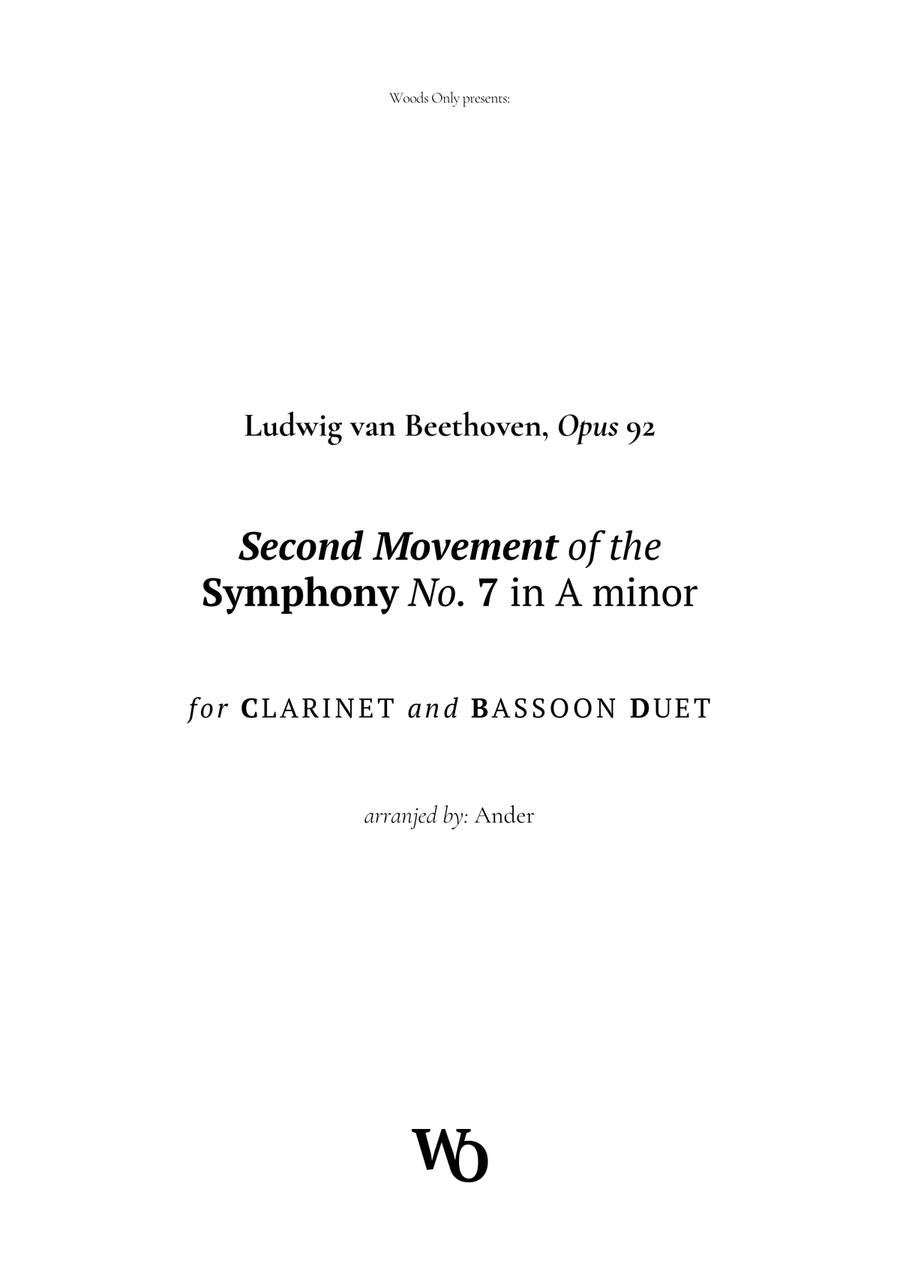
Symphony No. 7 by Beethoven for Clarinet and Bassoon
Clarinette, Basson (duo)

$3.99 3.47 € Clarinette, Basson (duo) PDF SheetMusicPlus


Partitions Gratuites
Acheter des Partitions Musicales
Acheter des Partitions Digitales à Imprimer
Acheter des Instruments de Musique

© 2000 - 2026

Accueil - Version intégrale





