EUROPE
6478 articles
USA
0 articles
DIGITAL
21 articles (à imprimer)
Partitions Digitales
Partitions à imprimer
21 partitions trouvées


High voice and piano - Medium - Digital Download SKU: MQ.8318-4E Composed by Gwyneth W. Walker. Secular, 21st century. 9 pages. E. C. Schirmer Music Company - Digital #8318-4E. Published by E. C. Schirmer Music Company - Digital (MQ.8318-4E). The five letters which provide the lyrics for the songs (adapted by the composer) were selected for their range of topics and sentiments. Some portray the wildlife in the mountains (“Glacier Birds...â€). Others extol the beauty of the Sierra (“Mountain Glory,†“Yosemite Fallsâ€). One expresses the whimsical/temperamental personality of the author (“Ice!â€). And the final letter (“Sequoiaâ€) speaks reverently of the great trees, in a language both naturalistic and sacred. They are the “greatest light in the woods, the greatest light in the world.†The musical settings, especially in the piano accompaniment, are quite programmatic. Glacier birds scamper up and down the keyboard in tone clusters. “Icy†glissandi float off. The great trees take root in large, block chords, and waterfalls cascade down in scales.There is personality in the letters. The bond between John Muir and Mrs. Carr (whom he addresses formally) is one of great kinship- a blending of the souls, a “spiritual romance.†As he marvels at the beauty of the wilderness, he writes ardently, “I wish that you could see this...†When he learns that Mrs. Carr, a botanist (whose plants suffer from the frost), dislikes ice, he chides her, and creates a “mock argument†over the value of glacial ice.The songs begin with an ascent into the mountains. They close with the return to the coast, to the magnificent Sequoia trees, where John Muir camps for the night, in the company of a squirrel. Charmingly, he writes “therefore, my Carr, goodnight.â€.
Ice! from Songs from the High Sierra
Voix haute

$7.25 6.32 € Voix haute PDF SheetMusicPlus

High Voice,Vocal Solo - Level 2 - Digital Download SKU: A0.1141419 Composed by Todd Marchand. Christian,Christmas,Religious,Sacred. 5 pages. Con Spirito Music #741745. Published by Con Spirito Music (A0.1141419). William Blake (1757-1827), a seminal figure in the history of the poetry and visual art of the Romantic Age, published the lyric poem The Lamb in his collection, Songs of Innocence, in 1789.The Lamb is presented as from the viewpoint of, and in the voice of, a child. In the first stanza, the child asks the lamb if it knows its Creator; in the second, it tells the creature, by means of metaphor, that its Creator is the Lord Jesus Christ, who like the lamb took on the flesh of a created being, “little,†“meek,†and “mild.†The child declares that he/she shares with the creature the name of the One who is, in Christian belief, both the sacrificial Lamb and the Shepherd of his flock. Finally, the child pronounces a benediction: “Little lamb, God bless thee!â€This new setting of The Lamb for voice and keyboard accompaniment is intended to evoke the simplicity of the text, and therefore should be performed simply yet expressively, with subtle rubato (flexibility in tempo) to give emphasis to the text.Little lamb, who made thee? / Dost thou know who made thee,Gave thee life, and bid thee feed / By the stream and o'er the mead;Gave thee clothing of delight, / Softest clothing, woolly, bright;Gave thee such a tender voice, / Making all the vales rejoice?Little lamb, who made thee? / Dost thou know who made thee?Little lamb, I'll tell thee; / Little lamb, I'll tell thee:He is called by thy name, / For He calls Himself a Lamb.He is meek, and He is mild, / He became a little child.I a child, and thou a lamb, / We are called by His name.Little lamb, God bless thee! / Little lamb, God bless thee!Soprano range C4-G5; Tenor range C3-G4©Copyright 2022 Todd Marchand / Con Spirito Music (ASCAP). All rights reserved. Visit www.conspiritomusic.com
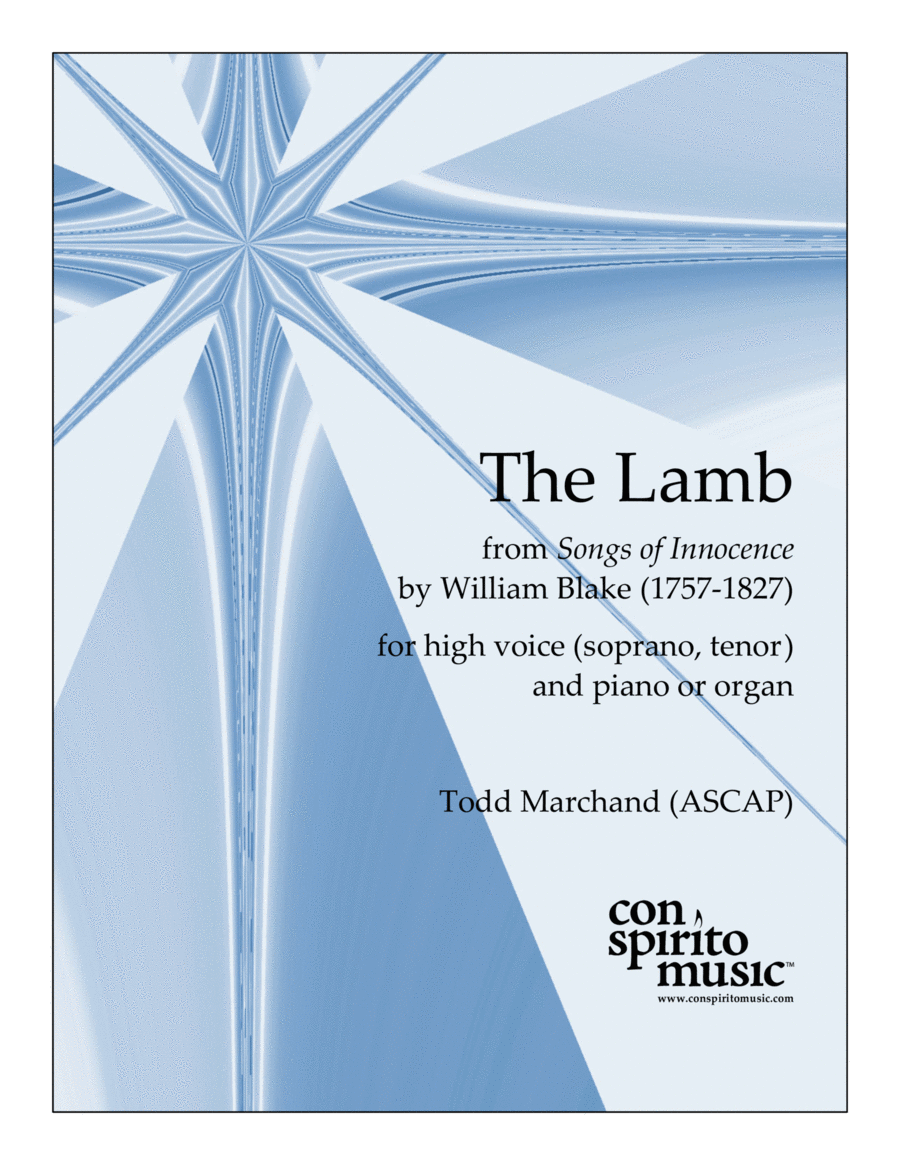
The Lamb (William Blake) — high voice (soprano / tenor), keyboard accompaniment
Voix haute
the stream and o'er the mead;
Gave thee clothing of delight, / Softest clothing, woolly, bright;
Gave thee such a tender voice, / Making all the vales rejoice?
Little lamb, who made thee? / Dost thou know who made thee?

Little lamb, I'll tell thee; / Little lamb, I'll tell thee:
He is called by thy name, / For He calls Himself a Lamb

He is meek, and He is mild, / He became a little child

$4.99 4.35 € Voix haute PDF SheetMusicPlus

High Voice,Vocal Solo - Level 4 - Digital Download SKU: A0.868746 Composed by Francesca CACCINI (1587 – after 1641). Arranged by Sergei PICHUGIN. Baroque,Christmas,Concert,Instructional,Standards. 9 pages. Really Good Music, LLC. #4415015. Published by Really Good Music, LLC. (A0.868746). O che nuovo stupor is an Aria allegra by Francesca CACCINI (1587 – after 1641), an early Baroque Italian composer and singer, daughter of Giulio CACCINI. The realization of this wonderful Christmas song for voice and piano, made by Sergei Pichugin, is based on its publication in Il primo libro delle musiche (Florence, 1618). The aria may be an invaluable addition to the repertoire of vocal teachers and students. It is available in the original key of G minor (D4 – F5) for high voice.
CACCINI Francesca: O che nuovo stupor, aria, arranged for Voice and Piano (G minor)
Voix haute

$5.95 5.18 € Voix haute PDF SheetMusicPlus


Partitions Gratuites
Acheter des Partitions Musicales
Acheter des Partitions Digitales à Imprimer
Acheter des Instruments de Musique

© 2000 - 2026

Accueil - Version intégrale





