EUROPE
16340 articles
USA
0 articles
DIGITAL
16 articles (à imprimer)
Partitions Digitales
Partitions à imprimer
16 partitions trouvées


Instrumental Duet Bass Flute,Harp,Instrumental Duet - Digital Download SKU: A0.1098499 Composed by Johann Pachelbel. Arranged by James M. Guthrie. Baroque,Classical,Standards,Traditional,Wedding. Score and parts. 11 pages. Jmsgu3 #702355. Published by jmsgu3 (A0.1098499). Score: 6 pages. Duration: ca. 2:30. The famous Pachelbel Canon arranged for Bass Flute & Harp. A great choice for weddings & receptions! Pachelbel's Canon Pachelbel's Canon is, in fact, the traditional title for a composition by the German composer Johann Pachelbel. Other names for the work include namely: Canon and Gigue for 3 violins and basso continuo, Canon and Gigue in D, and of course Canon in D. We do not know when or why in particular it was written. The oldest copy is surprisingly from the 19th century. It is important to realize that it was a common routine for organists to practice improvisation on the chord progression underlying the canon. Pachelbel originally scored the Canon notably for three violins and continuo. He also in fact paired the Canon with a gigue. The movements are homotonal, to clarify, both are in the key of D major. History In due time, Pachelbel's Canon went out of style and remained in virtual oblivion for centuries. The Jean-François Paillard chamber orchestra, however, recorded an arrangement of it in 1968. As a result, it gained approval. Many ensembles began likewise to record the piece in the 1970s and by the 1980s became ubiquitous as background music. From the 1970s to the early 2000s, pop songs correspondingly used elements of the piece. The chord progression, in particular, was used this way. Also, since the 1980s, it has been not only wildly popular for weddings, but also for funeral ceremonies in the USA and Europe. Pachelbel Background Johann Pachelbel (1653 –1706) was a German composer, as well as an organist. He was furthermore instrumental in bringing the south German organ school to its apex. He wrote a large body of music, both sacred and, equally important, secular. In particular, he uniquely helped develop the chorale prelude and fugue. For this, he has, in fact, earned a rightful place in the company of the most significant composers of the mid-Baroque period. Works Pachelbel's music was certainly popular. With this in mind, he also consequently had many pupils. His music expressly developed into a model for south German composers. Nowadays, Pachelbel is most famous, particularly for the Canon in D, as well as the F minor Chaconne, the Toccata in E minor, and of course the Hexachordum Apollinis, a set of variations for the keyboard. Influences Johann Jakob Froberger and Johann Caspar Kerll were south German composers who significantly influenced Pachelbel. Furthermore, he was especially influenced by Italians such as Frescobaldi and Poglietti. He frequently preferred an articulate, simple contrapuntal style that highlighted clarity. His music is markedly less extravagant and harmonically adventurous than that of Dieterich Buxtehude. However, as a point often overlooked, like Buxtehude, Pachelbel experimented with different instrumental combinations in his chamber music. Legacy All in all, Pachelbel was most famous as a composer for the keyboard. He composed over two hundred pieces specifically for the instrument. Pachelbel was also surprisingly a prolific composer of vocal music. All in all, about a hundred vocal works survive, including 40 or so large-scale works.
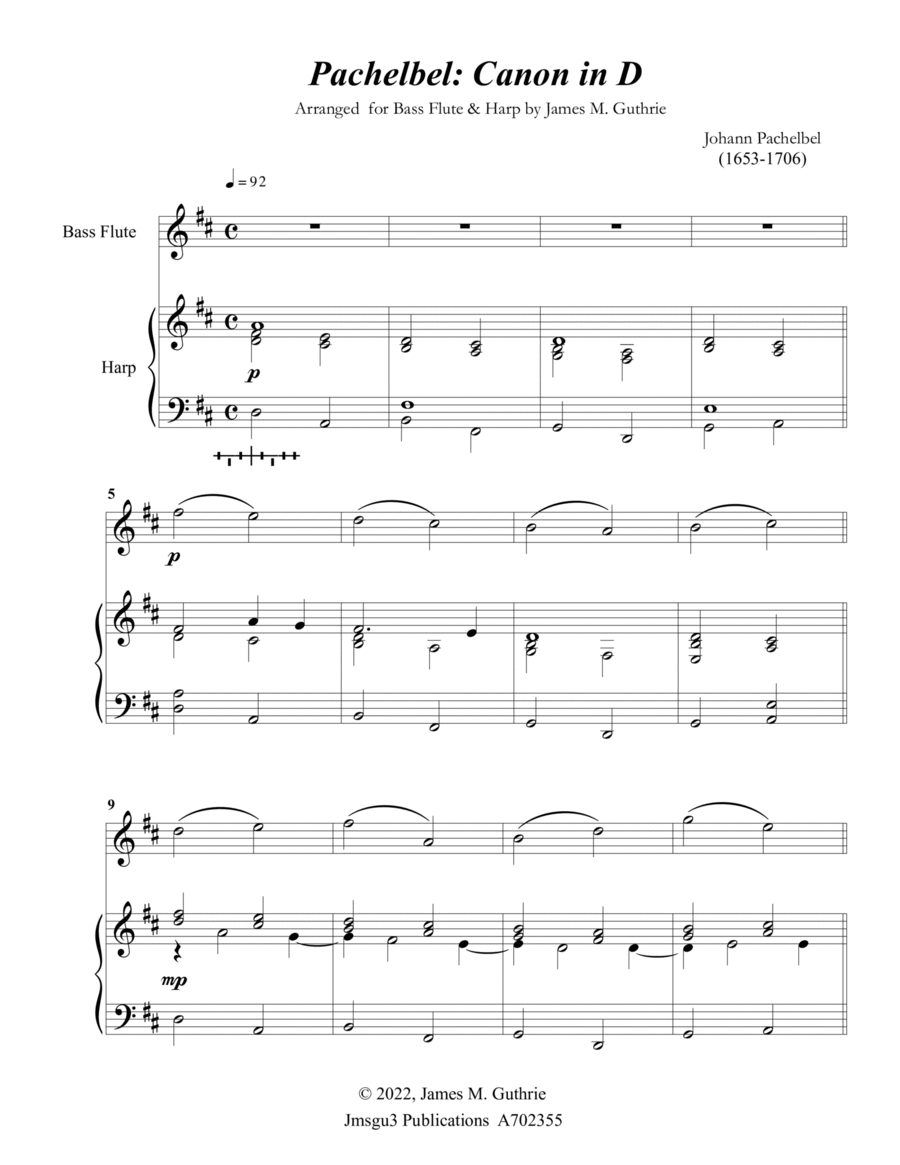
Pachelbel: Canon in D for Bass Flute & Harp
Harpe, Flûte (duo)

$32.95 27.83 € Harpe, Flûte (duo) PDF SheetMusicPlus

Flute,Harp,Instrumental Duet - Level 4 - Digital Download SKU: A0.1190441 Composed by Ottorino Respighi. Arranged by Jennifer Grady and Karen Almquist. 20th Century,Chamber,Classical. 9 pages. HarpSong, Jennifer Grady and Karen Almquist #790016. Published by HarpSong, Jennifer Grady and Karen Almquist (A0.1190441). Ottorino Respighi, an eminent Italian composer, teacher, director, and musician, was born in Bologna July 9, 1879 and died April 18, 1936. Respighi's style of composition is a highly sucessful blend of songful melodies with full and rich harmonies; he was one of the best masters of modern Italian music. His power of evocation of the Italian scene and his ability to sustain interest without prolixity is incontestable. His many works include operas, ballets, choral works, orchestral works, and chamber works. Notturno, which he composed in 1905, came from a set of six solo piano pieces, Notturno being #3. This arrangement, for flute and harp, was arranged from his piano solo of Notturno, which shows signs of Impressionism.
Notturno
Harpe, Flûte (duo)

$10.99 9.28 € Harpe, Flûte (duo) PDF SheetMusicPlus

Instrumental Duet Alto Flute,Harp,Instrumental Duet - Level 2 - Digital Download SKU: A0.1098488 Composed by Johann Pachelbel. Arranged by James M. Guthrie. Baroque,Classical,Standards,Traditional,Wedding. Score and parts. 11 pages. Jmsgu3 #702344. Published by jmsgu3 (A0.1098488). Score: 6 pages. Duration: ca. 2:30. The famous Pachelbel Canon arranged for Alto Flute & Harp. A great choice for weddings & receptions! Pachelbel's Canon Pachelbel's Canon is, in fact, the traditional title for a composition by the German composer Johann Pachelbel. Other names for the work include namely: Canon and Gigue for 3 violins and basso continuo, Canon and Gigue in D, and of course Canon in D. We do not know when or why in particular it was written. The oldest copy is surprisingly from the 19th century. It is important to realize that it was a common routine for organists to practice improvisation on the chord progression underlying the canon. Pachelbel originally scored the Canon notably for three violins and continuo. He also in fact paired the Canon with a gigue. The movements are homotonal, to clarify, both are in the key of D major. History In due time, Pachelbel's Canon went out of style and remained in virtual oblivion for centuries. The Jean-François Paillard chamber orchestra, however, recorded an arrangement of it in 1968. As a result, it gained approval. Many ensembles began likewise to record the piece in the 1970s and by the 1980s became ubiquitous as background music. From the 1970s to the early 2000s, pop songs correspondingly used elements of the piece. The chord progression, in particular, was used this way. Also, since the 1980s, it has been not only wildly popular for weddings, but also for funeral ceremonies in the USA and Europe. Pachelbel Background Johann Pachelbel (1653 –1706) was a German composer, as well as an organist. He was furthermore instrumental in bringing the south German organ school to its apex. He wrote a large body of music, both sacred and, equally important, secular. In particular, he uniquely helped develop the chorale prelude and fugue. For this, he has, in fact, earned a rightful place in the company of the most significant composers of the mid-Baroque period. Works Pachelbel's music was certainly popular. With this in mind, he also consequently had many pupils. His music expressly developed into a model for south German composers. Nowadays, Pachelbel is most famous, particularly for the Canon in D, as well as the F minor Chaconne, the Toccata in E minor, and of course the Hexachordum Apollinis, a set of variations for the keyboard. Influences Johann Jakob Froberger and Johann Caspar Kerll were south German composers who significantly influenced Pachelbel. Furthermore, he was especially influenced by Italians such as Frescobaldi and Poglietti. He frequently preferred an articulate, simple contrapuntal style that highlighted clarity. His music is markedly less extravagant and harmonically adventurous than that of Dieterich Buxtehude. However, as a point often overlooked, like Buxtehude, Pachelbel experimented with different instrumental combinations in his chamber music. Legacy All in all, Pachelbel was most famous as a composer for the keyboard. He composed over two hundred pieces specifically for the instrument. Pachelbel was also surprisingly a prolific composer of vocal music. All in all, about a hundred vocal works survive, including 40 or so large-scale works.
Pachelbel: Canon in D for Alto Flute & Harp
Harpe, Flûte (duo)

$34.95 29.52 € Harpe, Flûte (duo) PDF SheetMusicPlus

Flute,Harp,Instrumental Duet - Level 5 - Digital Download SKU: A0.1312292 By Brigitte Langnickel-Kohler - Harp and Gary Woolf - Flute. By Geraldine (Denny) Green. 21st Century,Chamber,Classical,Contemporary. 17 pages. Geraldine (Denny) Green at Oakmountmusic #901151. Published by Geraldine (Denny) Green at Oakmountmusic (A0.1312292). Duration - 6 minutes approx.Purchase includes Score with separate flute part (Also includes an Enharmonic Flute Part, which some players might find preferable)The Idyll For Flute And Harp was written in May 2021 at the request of flautist Gary Woolf as a wedding present for his good friends Dietrich and Ulla Hoffmann. It was played at the couple’s wedding at the end of July 2021 by Gary and harpist Brigitte Langnickel-Kohler and it received a very warm response from the wedding-goers! There are plans for further concert performances in the coming months. The above recording is the world premiere! Huge thanks to Gary and Brigitte!The music is beautifully melodic with an air about it of mid-summer and pretty countryside. After just having completed The Glastry Pearl, a huge intense orchestral work, writing this gentle little Idyll was like a welcome rest and journey into a beautiful summery meadow filled with flowers and bees and warm sunshine.
Idyll For Flute And Harp
Harpe, Flûte (duo)
Brigitte Langnickel-Kohler - Harp and Gary Woolf - Flute
$15.00 12.67 € Harpe, Flûte (duo) PDF SheetMusicPlus

Instrumental Duet Flute,Harp,Instrumental Duet - Level 4 - Digital Download SKU: A0.534731 Composed by Clémence de Grandval. Concert,Romantic Period,Standards. Score and parts. 22 pages. Musik Fabrik Music Publishing #6362085. Published by Musik Fabrik Music Publishing (A0.534731). Maria-Félicie-Clémence de Grandval (1828–1907) was born on January 28, 1828 at Saint-Rémy-des-Monts, France and died on January 15, 1907 in Paris.After the death of her mother, Louise Adèle du Temple de Mésières, her father the Baron de Reiset, a military officer remarried with an Englishwoman and moved his family to London. After beginning her musical studies privately, she studied the piano with the German composer Friedrich von Flotow, who was a family friend. Returning to France, she studied the piano briefly with Chopin and composition with Camille Saint-Saëns. At first writing mostly sacred music, most of her public success was due to her comic operas: la Comtesse Eva, la Pénitente, Piccolino and Mazeppa. She also wrote orchestral music, chamber music, and over 60 songs (to poets such as Sully Prudhomme, Michel Carré, Henri Meilhac, Georges Hartmann, Charles Grandmougin and Louis Gallet.) She is chiefly known today for her music for wind instruments, especially for the oboe. 
Clémence de Grandval: Valse Mélancolique for flute and harp
Harpe, Flûte (duo)

$12.95 10.94 € Harpe, Flûte (duo) PDF SheetMusicPlus

Flute,Harp,Instrumental Duet - Level 3 - Digital Download SKU: A0.1174114 By Schwarz Matthew H. By Matthew H Schwarz. Arranged by Matthew H Schwarz. Chamber,Classical,Contemporary. 12 pages. Matthew H Schwarz #774278. Published by Matthew H Schwarz (A0.1174114). A four-minute haunting duet for flute and harp.  Generally modal/melodic accessible music.  There are some more advanced rhtyhms and high passages in the flute, and Bach-like runs in the harp that will require practice for intermediate musicians.  The flute goes from low C to the B an octave above the treble cleff (but, only one 3-measure passage goes above the D above the treble cleff).The harp part can be played on a pedal harp or, with a little effort, on a lever harp.  It starts in two flats, there's a middle section with F#s (with time to switch levers - the sheet music indicates some bass notes that can be skipped to flip levers), and the end adds Ab (which will require two levers flipped by reaching over with the right hand - unusual, but not too awkward with practice).  The lowest note in the harp is the G below the bass cleff (however, all notes below the bass cleff are octave doublings and could be ignored on a smaller harp), and the highest is the D above the treble cleff.
The Naiad for flute and harp
Harpe, Flûte (duo)
Schwarz Matthew H
$5.00 4.22 € Harpe, Flûte (duo) PDF SheetMusicPlus

Flute,Harp,Instrumental Duet - Level 1 - Digital Download SKU: A0.1123374 Composed by Mykhailo Verbytsky, 1863. Arranged by James M. Guthrie. Chamber,Historic,Multicultural,Patriotic,World. 6 pages. Jmsgu3 #724179. Published by jmsgu3 (A0.1123374). Ukrainian National Anthem for Flute & Harp гімн України!The Ukrainian National Anthem is an anthem that was adopted by the Ukrainian government in 2003. It is based on the song “Shche ne vmerla Ukrayina†which was written by Pavlo Chubynsky in 1862. The song was written as a response to the Russian occupation of Ukraine. The song was very popular in Ukraine and is considered to be one of the most important symbols of Ukrainian identity.The lyrics of the anthem call for Ukraine to remain strong and united. The song speaks of the Ukrainian people's courage, resilience and patriotism. It also speaks of the beauty of the Ukrainian land and its people. The anthem is a call to action and a reminder of the importance of standing together to protect the freedom and independence of Ukraine. The anthem is a symbol of hope and strength for the Ukrainian people.
Ukrainian National Anthem for Flute & Harp
Harpe, Flûte (duo)

$19.95 16.85 € Harpe, Flûte (duo) PDF SheetMusicPlus

Alto Flute,Harp,Instrumental Duet - Level 2 - Digital Download SKU: A0.1277140 Composed by Johann Sebastian Bach. Arranged by James M. Guthrie. Baroque,Chamber,Contest,Festival,Historic,Wedding. 8 pages. Jmsgu3 #868828. Published by jmsgu3 (A0.1277140). Air on a G String is the popular nickname for the Air from Orchestral Suite #3 in D Major, BWV 1068 by J. S. Bach. Duration: 5:53 (taking both repeats). Level: Intermediate and up. Programming: Great choice for recitals and useful for almost any church service, reception, wedding, or event where insightful meditation is desired. This music is well known and admired by nearly everyone, so you will have an advantage in providing something familiar and well-cherished for your audience. This is the piece to demonstrate dynamic control, tone quality, and strategic phrasing of long melodic lines.Bach: Air on a G String - ~ Bach composed three noteworthy Orchestral Suites. He wrote his third orchestral suite, BWV 1068 in D, for his Collegium Musicum. The Overture of the suite features a double-dotted rhythm in the French style and employs the entire ensemble: trumpet trio, timpani, oboe duet, and strings. The strings were the typical 2 violin parts, viola part, and continuo of cello and harpsichord. Air - the title of the second movement, is, by contrast, scored only for the strings. It seems like this work was entitled Air on a G String not by Bach, but by a nineteenth-century violinist named August Wilhelmj. He arranged the Air such that the first violin part was performed by a single soloist – and entirely on the G String.
Bach: Air on a G String for Alto Flute & Harp
Harpe, Flûte (duo)

$32.95 27.83 € Harpe, Flûte (duo) PDF SheetMusicPlus


Partitions Gratuites
Acheter des Partitions Musicales
Acheter des Partitions Digitales à Imprimer
Acheter des Instruments de Musique

© 2000 - 2026

Accueil - Version intégrale





