EUROPE
407041 articles
USA
0 articles
DIGITAL
54 articles (à imprimer)
Partitions Digitales
Partitions à imprimer
54 partitions trouvées


Small Ensemble Cello,Flute,Harp - Digital Download SKU: A0.912864 Composed by Richard Arnest. Christian,Christmas,Contemporary. Score and parts. 20 pages. MUC #2926195. Published by MUC (A0.912864). Flute, cello, and harp together simply sound like Christmas. This fantasia presents several well-known English Christmas carols, including Here We Come A Wassailing, Nowell Sing We Clear, and God Rest Ye, Merry Gentlemen.It can be performed as special music or an introit in a church service, particularly a service of lessons and carols. It is also useful a seasonal concert piece, and as incidental music for holiday celebrationsCompanion pieces by the same composer include Noël Français and Wexford Variations (without cello).5'00facebook.com/RichardArnestASCAP
An English Christmas
Harpe, Flûte (duo)

$18.00 15.17 € Harpe, Flûte (duo) PDF SheetMusicPlus

Instrumental Duet Flute,Harp,Instrumental Duet - Level 3 - Digital Download SKU: A0.502638 Composed by Antonin Dvorak. Arranged by Arranged by Karen Almquist, Edited by Jennifer Grady. Classical,Romantic Period. Score and parts. 4 pages. HarpSong, Jennifer Grady and Karen Almquist #114989. Published by HarpSong, Jennifer Grady and Karen Almquist (A0.502638). “Goin Home†is a peaceful and moving flute and harp arrangement of Antonin Dvorak’s magnificent Symphony No. 9 “From the New World†2nd Movement. The arrangement in Eb begins and ends quietly in the lower register of the instruments. The flute introduces the melody over quiet eighth note arpeggios on the harp. The harp plays the melody in the second verse. “Goin Home†builds to a glorious ending with an uplifting harp glissando, full rolled chords and flute soaring in its high register. The music is full of emotion and hope. William Arms Fisher a student of Dvorak penned the moving lyrics “Goin Home†to the music. Goin' home. Goin' home. I'm a-goin' home. Quiet-like some still day, I'm just goin' home. It's not far, just close by, through an open door. Work all done, cares laid by, goin' to roam no more; Mother's there 'xpecting me, father's waiting, too, Lots of folks gathered there, all the friends I knew. Morning star lights the way, restless dream all done. Shadows gone, break of day, real life just begun. There's no break, there's no end, just a-living on; Wide awake, with a smile, going on and on. Going home. Going home, I'm just going home. It's not far, just close by, through an open door.
Goin' Home - From the New World Op. 95
Harpe, Flûte (duo)

$4.99 4.21 € Harpe, Flûte (duo) PDF SheetMusicPlus

Instrumental Duet Alto Flute,Harp,Instrumental Duet - Level 3 - Digital Download SKU: A0.501767 By HarpSong - Jennifer Grady, flute, and Karen Almquist, Harp. By African-American Spiritual. Composer unknown. Arranged by HarpSong - Jennifer Grady and Karen Almquist. Folk,Spiritual,Traditional. Score and parts. 8 pages. HarpSong, Jennifer Grady and Karen Almquist #114458. Published by HarpSong, Jennifer Grady and Karen Almquist (A0.501767). This is an arrangement of an old spiritual for two pedal harps and alto flute. We recorded this song on our CD The River (HarpSong) in 2001. It is a peaceful, soothing arrangement. Included in the download is the Score, parts for two Harps, a part for Alto Flute and an optional C-Flute part. 8 Pages in total.
Deep River
Harpe, Flûte (duo)
HarpSong - Jennifer Grady, flute, and Karen Almquist, Harp
$4.99 4.21 € Harpe, Flûte (duo) PDF SheetMusicPlus

Instrumental Duet Bass Flute,Harp,Instrumental Duet - Digital Download SKU: A0.1098499 Composed by Johann Pachelbel. Arranged by James M. Guthrie. Baroque,Classical,Standards,Traditional,Wedding. Score and parts. 11 pages. Jmsgu3 #702355. Published by jmsgu3 (A0.1098499). Score: 6 pages. Duration: ca. 2:30. The famous Pachelbel Canon arranged for Bass Flute & Harp. A great choice for weddings & receptions! Pachelbel's Canon Pachelbel's Canon is, in fact, the traditional title for a composition by the German composer Johann Pachelbel. Other names for the work include namely: Canon and Gigue for 3 violins and basso continuo, Canon and Gigue in D, and of course Canon in D. We do not know when or why in particular it was written. The oldest copy is surprisingly from the 19th century. It is important to realize that it was a common routine for organists to practice improvisation on the chord progression underlying the canon. Pachelbel originally scored the Canon notably for three violins and continuo. He also in fact paired the Canon with a gigue. The movements are homotonal, to clarify, both are in the key of D major. History In due time, Pachelbel's Canon went out of style and remained in virtual oblivion for centuries. The Jean-François Paillard chamber orchestra, however, recorded an arrangement of it in 1968. As a result, it gained approval. Many ensembles began likewise to record the piece in the 1970s and by the 1980s became ubiquitous as background music. From the 1970s to the early 2000s, pop songs correspondingly used elements of the piece. The chord progression, in particular, was used this way. Also, since the 1980s, it has been not only wildly popular for weddings, but also for funeral ceremonies in the USA and Europe. Pachelbel Background Johann Pachelbel (1653 –1706) was a German composer, as well as an organist. He was furthermore instrumental in bringing the south German organ school to its apex. He wrote a large body of music, both sacred and, equally important, secular. In particular, he uniquely helped develop the chorale prelude and fugue. For this, he has, in fact, earned a rightful place in the company of the most significant composers of the mid-Baroque period. Works Pachelbel's music was certainly popular. With this in mind, he also consequently had many pupils. His music expressly developed into a model for south German composers. Nowadays, Pachelbel is most famous, particularly for the Canon in D, as well as the F minor Chaconne, the Toccata in E minor, and of course the Hexachordum Apollinis, a set of variations for the keyboard. Influences Johann Jakob Froberger and Johann Caspar Kerll were south German composers who significantly influenced Pachelbel. Furthermore, he was especially influenced by Italians such as Frescobaldi and Poglietti. He frequently preferred an articulate, simple contrapuntal style that highlighted clarity. His music is markedly less extravagant and harmonically adventurous than that of Dieterich Buxtehude. However, as a point often overlooked, like Buxtehude, Pachelbel experimented with different instrumental combinations in his chamber music. Legacy All in all, Pachelbel was most famous as a composer for the keyboard. He composed over two hundred pieces specifically for the instrument. Pachelbel was also surprisingly a prolific composer of vocal music. All in all, about a hundred vocal works survive, including 40 or so large-scale works.
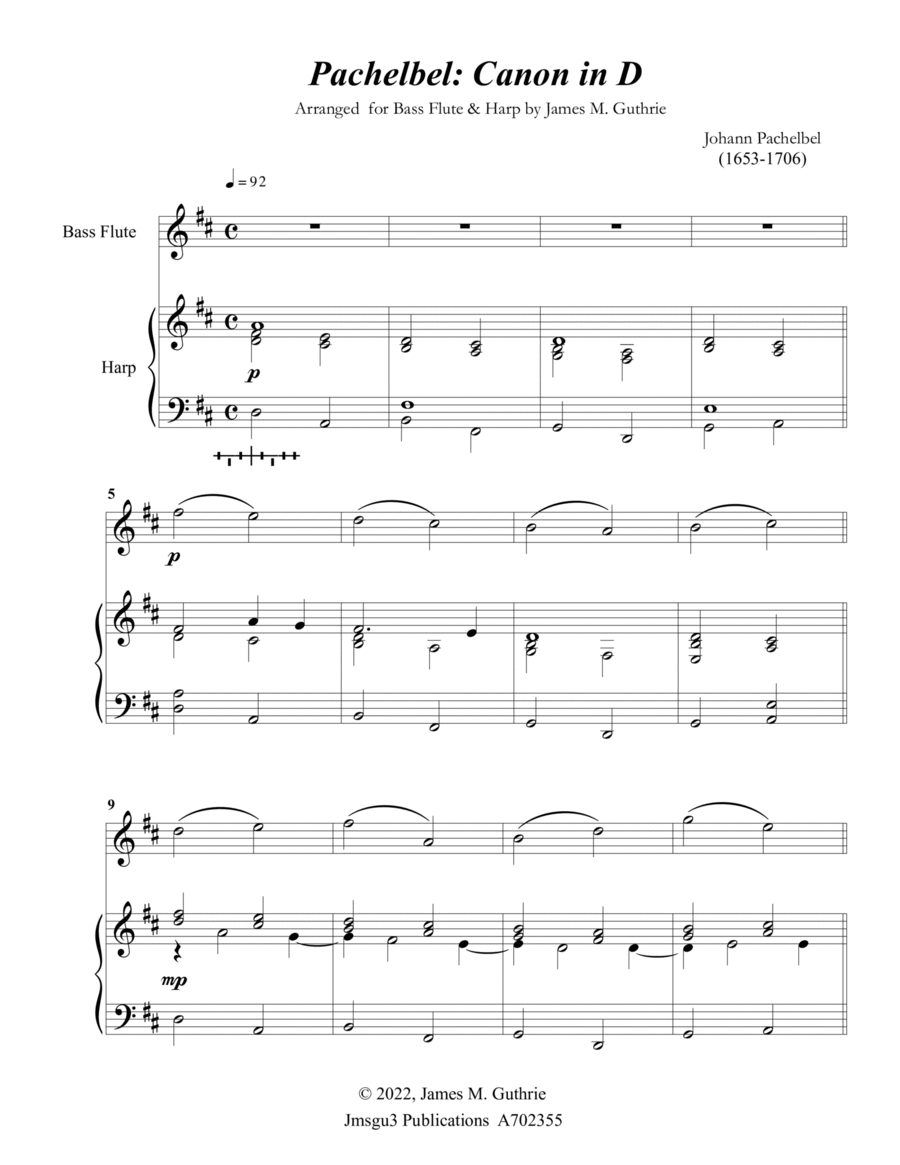
Pachelbel: Canon in D for Bass Flute & Harp
Harpe, Flûte (duo)

$32.95 27.78 € Harpe, Flûte (duo) PDF SheetMusicPlus

Instrumental Duet Alto Flute,Harp,Instrumental Duet - Level 2 - Digital Download SKU: A0.1098488 Composed by Johann Pachelbel. Arranged by James M. Guthrie. Baroque,Classical,Standards,Traditional,Wedding. Score and parts. 11 pages. Jmsgu3 #702344. Published by jmsgu3 (A0.1098488). Score: 6 pages. Duration: ca. 2:30. The famous Pachelbel Canon arranged for Alto Flute & Harp. A great choice for weddings & receptions! Pachelbel's Canon Pachelbel's Canon is, in fact, the traditional title for a composition by the German composer Johann Pachelbel. Other names for the work include namely: Canon and Gigue for 3 violins and basso continuo, Canon and Gigue in D, and of course Canon in D. We do not know when or why in particular it was written. The oldest copy is surprisingly from the 19th century. It is important to realize that it was a common routine for organists to practice improvisation on the chord progression underlying the canon. Pachelbel originally scored the Canon notably for three violins and continuo. He also in fact paired the Canon with a gigue. The movements are homotonal, to clarify, both are in the key of D major. History In due time, Pachelbel's Canon went out of style and remained in virtual oblivion for centuries. The Jean-François Paillard chamber orchestra, however, recorded an arrangement of it in 1968. As a result, it gained approval. Many ensembles began likewise to record the piece in the 1970s and by the 1980s became ubiquitous as background music. From the 1970s to the early 2000s, pop songs correspondingly used elements of the piece. The chord progression, in particular, was used this way. Also, since the 1980s, it has been not only wildly popular for weddings, but also for funeral ceremonies in the USA and Europe. Pachelbel Background Johann Pachelbel (1653 –1706) was a German composer, as well as an organist. He was furthermore instrumental in bringing the south German organ school to its apex. He wrote a large body of music, both sacred and, equally important, secular. In particular, he uniquely helped develop the chorale prelude and fugue. For this, he has, in fact, earned a rightful place in the company of the most significant composers of the mid-Baroque period. Works Pachelbel's music was certainly popular. With this in mind, he also consequently had many pupils. His music expressly developed into a model for south German composers. Nowadays, Pachelbel is most famous, particularly for the Canon in D, as well as the F minor Chaconne, the Toccata in E minor, and of course the Hexachordum Apollinis, a set of variations for the keyboard. Influences Johann Jakob Froberger and Johann Caspar Kerll were south German composers who significantly influenced Pachelbel. Furthermore, he was especially influenced by Italians such as Frescobaldi and Poglietti. He frequently preferred an articulate, simple contrapuntal style that highlighted clarity. His music is markedly less extravagant and harmonically adventurous than that of Dieterich Buxtehude. However, as a point often overlooked, like Buxtehude, Pachelbel experimented with different instrumental combinations in his chamber music. Legacy All in all, Pachelbel was most famous as a composer for the keyboard. He composed over two hundred pieces specifically for the instrument. Pachelbel was also surprisingly a prolific composer of vocal music. All in all, about a hundred vocal works survive, including 40 or so large-scale works.
Pachelbel: Canon in D for Alto Flute & Harp
Harpe, Flûte (duo)

$34.95 29.46 € Harpe, Flûte (duo) PDF SheetMusicPlus

Small Ensemble Flute,Harp - Level 5 - Digital Download SKU: A0.912915 Composed by Brandon Nelson. Concert,Contemporary. Score and parts. 16 pages. Brandon Nelson #1998621. Published by Brandon Nelson (A0.912915). A great piece to show off the talents of mature flute and lever harp performers, this colorful character piece is appropriate for any recital or concert setting. Mannanàn mac Lir occupied several roles in the mythological universe of the Celtic peoples. Most notably, he was considered to be the god of the seas. He was also regarded as a psychopomp-that is, a figure associated with the realm of the dead, acting as a sort of veil between the worlds. In this work, I play on his connection to the sea by quoting the traditional Manx folk tune The Storm Is Up (Callin Veg Dhoan). The tune is developed through several permutations, each portraying a role Mannanàn played. Each movement is ushered to us by a psychopomp veil. With the Churl in the Drab Coat refers to Mannanàn’s association with the trickster figure Bodach an Chota Lachtna. The movement is erratic yet impishly playful. Mannanàn was also regarded as a sort of magician king. In that respect, he was given the role of Guardian of Mag Mell, a place that is comparable to the Nordic conception of Valhalla. Mag Mell was a plain of joy, a kingdom under the sea for a select few. Mannanàn protected this realm with the help of Fragarach, a sword which could slice through any armor and could compel anyone to tell the truth. This movement is bold and heavy in spirit, gradually becoming more dissonant as if portraying an ugly battle to defend this beautiful place. The final veil transports us to the end of times, a fading away of the once-great pantheon. That storm, as all must do, comes to a quiet, peaceful end. Learn more about me at bnelsonmusic.wordpress.com.
Mannanan mac Lir
Harpe, Flûte (duo)

$12.99 10.95 € Harpe, Flûte (duo) PDF SheetMusicPlus

Flute,Harp,Instrumental Duet - Level 5 - Digital Download SKU: A0.1312292 By Brigitte Langnickel-Kohler - Harp and Gary Woolf - Flute. By Geraldine (Denny) Green. 21st Century,Chamber,Classical,Contemporary. 17 pages. Geraldine (Denny) Green at Oakmountmusic #901151. Published by Geraldine (Denny) Green at Oakmountmusic (A0.1312292). Duration - 6 minutes approx.Purchase includes Score with separate flute part (Also includes an Enharmonic Flute Part, which some players might find preferable)The Idyll For Flute And Harp was written in May 2021 at the request of flautist Gary Woolf as a wedding present for his good friends Dietrich and Ulla Hoffmann. It was played at the couple’s wedding at the end of July 2021 by Gary and harpist Brigitte Langnickel-Kohler and it received a very warm response from the wedding-goers! There are plans for further concert performances in the coming months. The above recording is the world premiere! Huge thanks to Gary and Brigitte!The music is beautifully melodic with an air about it of mid-summer and pretty countryside. After just having completed The Glastry Pearl, a huge intense orchestral work, writing this gentle little Idyll was like a welcome rest and journey into a beautiful summery meadow filled with flowers and bees and warm sunshine.
Idyll For Flute And Harp
Harpe, Flûte (duo)
Brigitte Langnickel-Kohler - Harp and Gary Woolf - Flute
$15.00 12.65 € Harpe, Flûte (duo) PDF SheetMusicPlus

Instrumental Duet Flute,Harp,Instrumental Duet - Level 5 - Digital Download SKU: A0.786833 Composed by Richard Storrs Willis. Arranged by Beka Wilson. Christian,Christmas,Sacred. Score and parts. 5 pages. Beka Wilson #6616563. Published by Beka Wilson (A0.786833). This lullaby-like arrangement of It Came Upon a Midnight Clear for instrumental duet will make this piece an excellent addition to a holiday concert, recital, or church service.Length: around 4 minutes (suggested 100 bpm)Level: advanced for most instruments due to range and a brief clef change for some bass/alto clef instruments5 pages (includes score and separate flute part)This arrangement is available as a solo for flute, oboe, clarinet, bassoon, alto sax, tenor sax, F horn, trumpet, trombone, violin, viola, and cello, and as a duet for harp/flute, harp/violin, harp/viola, and harp/cello. Want this piece for a different instrument or in a different key? Email me at bekmars10@gmail.com and I'll post a custom arrangement here on Sheet Music Plus.
It Came Upon a Midnight Clear--flute/harp duet
Harpe, Flûte (duo)

$9.99 8.42 € Harpe, Flûte (duo) PDF SheetMusicPlus


Partitions Gratuites
Acheter des Partitions Musicales
Acheter des Partitions Digitales à Imprimer
Acheter des Instruments de Musique

© 2000 - 2026

Accueil - Version intégrale





