EUROPE
13193 articles
USA
0 articles
DIGITAL
53 articles (à imprimer)
Partitions Digitales
Partitions à imprimer
53 partitions trouvées


Instrumental Duet Flute,Harp,Instrumental Duet - Level 3 - Digital Download SKU: A0.963936 Arranged by Reba Lunsford. Celtic,Christian,Christmas,Holiday,Patriotic. Score and parts. 59 pages. Reba Lunsford #4844807. Published by Reba Lunsford (A0.963936). Music especially for 22 string lap harp, but easily playable on a larger instrument. This book covers some holidays, sacred hymns, folk songs, and a few originals all in one volume! Most songs are in the key of C with a few in G, most are simple or intermediate, a few might be considered advanced. A flute accompaniment part is included for Praetorius' Courante from Terpsichore.Contains:For the Beauty of the Earth, Now Thank We All Our God, Carol of the Bells, The Friendly Beasts, 'Twas in the Moon of Wintertime, Jesus Keep Me Near the Cross, O Sacred Head Now Wounded, Let All Mortal Flesh Keep Silence, Let Us Break Bread Together, My Country Tis of Thee, O Beautiful for Spacious Skies, Courante, Laudemus, The Morning Trumpet, O God, Our Help in Ages Past, Brigid Cruse, The Fairy Reel, Leaving Lismoor, Liberty, Song of the Water Kelpie, Southwind, Waiting for Sunshine.
Songs for All Seasons
Harpe, Flûte (duo)

$14.00 12.16 € Harpe, Flûte (duo) PDF SheetMusicPlus

Instrumental Duet Bass Flute,Harp,Instrumental Duet - Digital Download SKU: A0.1098499 Composed by Johann Pachelbel. Arranged by James M. Guthrie. Baroque,Classical,Standards,Traditional,Wedding. Score and parts. 11 pages. Jmsgu3 #702355. Published by jmsgu3 (A0.1098499). Score: 6 pages. Duration: ca. 2:30. The famous Pachelbel Canon arranged for Bass Flute & Harp. A great choice for weddings & receptions! Pachelbel's Canon Pachelbel's Canon is, in fact, the traditional title for a composition by the German composer Johann Pachelbel. Other names for the work include namely: Canon and Gigue for 3 violins and basso continuo, Canon and Gigue in D, and of course Canon in D. We do not know when or why in particular it was written. The oldest copy is surprisingly from the 19th century. It is important to realize that it was a common routine for organists to practice improvisation on the chord progression underlying the canon. Pachelbel originally scored the Canon notably for three violins and continuo. He also in fact paired the Canon with a gigue. The movements are homotonal, to clarify, both are in the key of D major. History In due time, Pachelbel's Canon went out of style and remained in virtual oblivion for centuries. The Jean-François Paillard chamber orchestra, however, recorded an arrangement of it in 1968. As a result, it gained approval. Many ensembles began likewise to record the piece in the 1970s and by the 1980s became ubiquitous as background music. From the 1970s to the early 2000s, pop songs correspondingly used elements of the piece. The chord progression, in particular, was used this way. Also, since the 1980s, it has been not only wildly popular for weddings, but also for funeral ceremonies in the USA and Europe. Pachelbel Background Johann Pachelbel (1653 –1706) was a German composer, as well as an organist. He was furthermore instrumental in bringing the south German organ school to its apex. He wrote a large body of music, both sacred and, equally important, secular. In particular, he uniquely helped develop the chorale prelude and fugue. For this, he has, in fact, earned a rightful place in the company of the most significant composers of the mid-Baroque period. Works Pachelbel's music was certainly popular. With this in mind, he also consequently had many pupils. His music expressly developed into a model for south German composers. Nowadays, Pachelbel is most famous, particularly for the Canon in D, as well as the F minor Chaconne, the Toccata in E minor, and of course the Hexachordum Apollinis, a set of variations for the keyboard. Influences Johann Jakob Froberger and Johann Caspar Kerll were south German composers who significantly influenced Pachelbel. Furthermore, he was especially influenced by Italians such as Frescobaldi and Poglietti. He frequently preferred an articulate, simple contrapuntal style that highlighted clarity. His music is markedly less extravagant and harmonically adventurous than that of Dieterich Buxtehude. However, as a point often overlooked, like Buxtehude, Pachelbel experimented with different instrumental combinations in his chamber music. Legacy All in all, Pachelbel was most famous as a composer for the keyboard. He composed over two hundred pieces specifically for the instrument. Pachelbel was also surprisingly a prolific composer of vocal music. All in all, about a hundred vocal works survive, including 40 or so large-scale works.
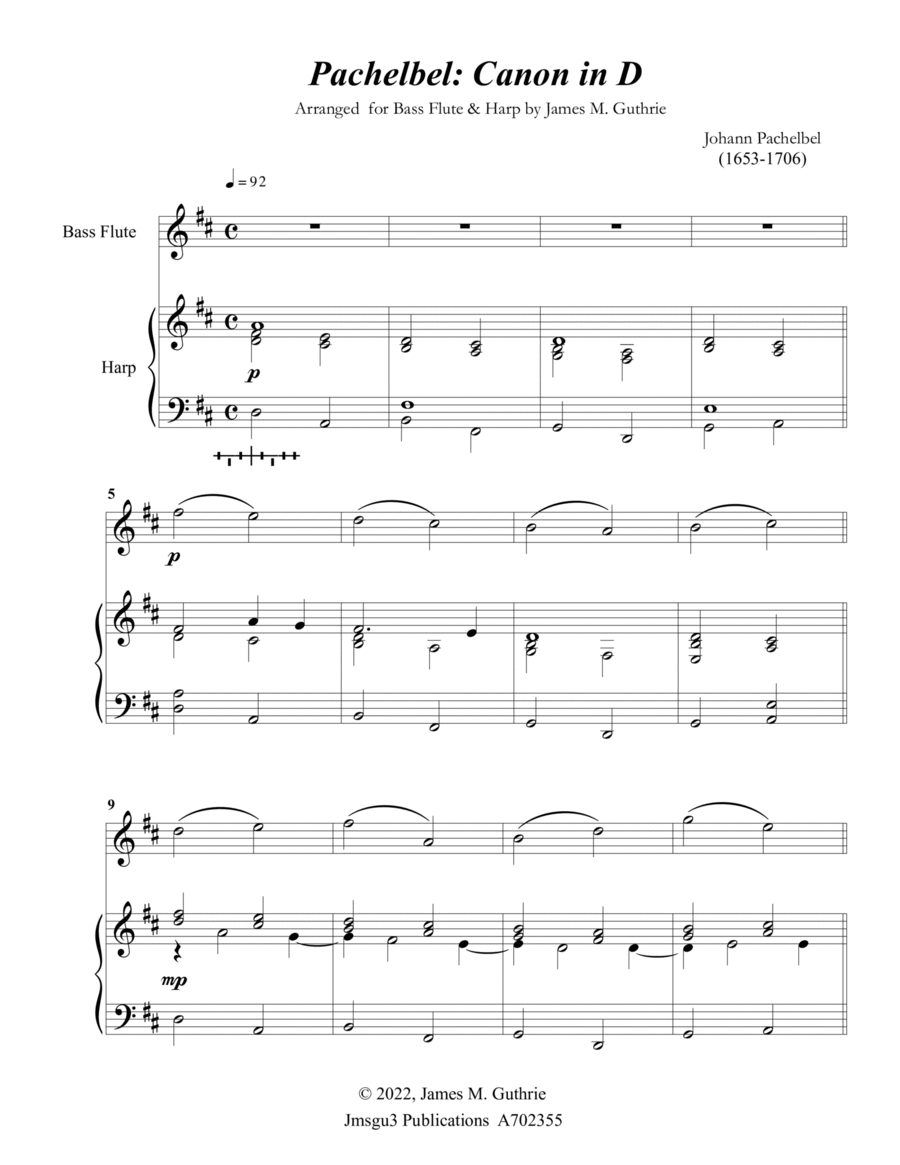
Pachelbel: Canon in D for Bass Flute & Harp
Harpe, Flûte (duo)

$32.95 28.61 € Harpe, Flûte (duo) PDF SheetMusicPlus

Instrumental Duet Alto Flute,Harp,Instrumental Duet - Level 2 - Digital Download SKU: A0.1098488 Composed by Johann Pachelbel. Arranged by James M. Guthrie. Baroque,Classical,Standards,Traditional,Wedding. Score and parts. 11 pages. Jmsgu3 #702344. Published by jmsgu3 (A0.1098488). Score: 6 pages. Duration: ca. 2:30. The famous Pachelbel Canon arranged for Alto Flute & Harp. A great choice for weddings & receptions! Pachelbel's Canon Pachelbel's Canon is, in fact, the traditional title for a composition by the German composer Johann Pachelbel. Other names for the work include namely: Canon and Gigue for 3 violins and basso continuo, Canon and Gigue in D, and of course Canon in D. We do not know when or why in particular it was written. The oldest copy is surprisingly from the 19th century. It is important to realize that it was a common routine for organists to practice improvisation on the chord progression underlying the canon. Pachelbel originally scored the Canon notably for three violins and continuo. He also in fact paired the Canon with a gigue. The movements are homotonal, to clarify, both are in the key of D major. History In due time, Pachelbel's Canon went out of style and remained in virtual oblivion for centuries. The Jean-François Paillard chamber orchestra, however, recorded an arrangement of it in 1968. As a result, it gained approval. Many ensembles began likewise to record the piece in the 1970s and by the 1980s became ubiquitous as background music. From the 1970s to the early 2000s, pop songs correspondingly used elements of the piece. The chord progression, in particular, was used this way. Also, since the 1980s, it has been not only wildly popular for weddings, but also for funeral ceremonies in the USA and Europe. Pachelbel Background Johann Pachelbel (1653 –1706) was a German composer, as well as an organist. He was furthermore instrumental in bringing the south German organ school to its apex. He wrote a large body of music, both sacred and, equally important, secular. In particular, he uniquely helped develop the chorale prelude and fugue. For this, he has, in fact, earned a rightful place in the company of the most significant composers of the mid-Baroque period. Works Pachelbel's music was certainly popular. With this in mind, he also consequently had many pupils. His music expressly developed into a model for south German composers. Nowadays, Pachelbel is most famous, particularly for the Canon in D, as well as the F minor Chaconne, the Toccata in E minor, and of course the Hexachordum Apollinis, a set of variations for the keyboard. Influences Johann Jakob Froberger and Johann Caspar Kerll were south German composers who significantly influenced Pachelbel. Furthermore, he was especially influenced by Italians such as Frescobaldi and Poglietti. He frequently preferred an articulate, simple contrapuntal style that highlighted clarity. His music is markedly less extravagant and harmonically adventurous than that of Dieterich Buxtehude. However, as a point often overlooked, like Buxtehude, Pachelbel experimented with different instrumental combinations in his chamber music. Legacy All in all, Pachelbel was most famous as a composer for the keyboard. He composed over two hundred pieces specifically for the instrument. Pachelbel was also surprisingly a prolific composer of vocal music. All in all, about a hundred vocal works survive, including 40 or so large-scale works.
Pachelbel: Canon in D for Alto Flute & Harp
Harpe, Flûte (duo)

$34.95 30.35 € Harpe, Flûte (duo) PDF SheetMusicPlus

Instrumental Duet Flute,Harp,Instrumental Duet - Level 3 - Digital Download SKU: A0.804202 Composed by Turlough O’Carolan. Arranged by Serena O’Meara. Baroque,Celtic,Folk,Holiday,Irish,Wedding. Score and parts. 7 pages. O'Meara Music #6734243. Published by O'Meara Music (A0.804202). According to legend, Turlough Carolan was visiting the Power family in Dublin when he was challenged to compose a piece in the popular Italian style of the day. The result was this piece in the style of Corelli, dedicated to Mrs. Power. This piece is performed at weddings – either as Processional or Recessional! Arranged for either Lever or Pedal Harps.  The melody has a two octave range.
Carolan’s Concerto, Duet for Flute & Harp
Harpe, Flûte (duo)

$6.00 5.21 € Harpe, Flûte (duo) PDF SheetMusicPlus

Instrumental Duet Flute,Harp,Instrumental Duet - Level 3 - Digital Download SKU: A0.786758 Composed by Joseph Mohr, Franz Gruber. Arranged by Beka Wilson. Christian,Christmas,Sacred. Score and parts. 8 pages. Beka Wilson #6431073. Published by Beka Wilson (A0.786758). A gorgeous, thoughtful rendition of a Christmas classic. Silent Night is said to have been composed by a priest and an organist in Austria on a Christmas Eve, making this a perfect piece to play at a party, recital, or a church service surrounding the holidays.Length: around 2.5 minutes--8 pages (includes score and parts)Level: intermediate for most instruments, advanced intermediate for violin/viola/cello due to pizzicato and/or double stops. Versions with the harp part have no sudden lever changes and a 6-measure rest for the harp near the key change. This arrangement is available as a trio for:flute/flute/harpviolin/violin/harpviola/viola/harpcello/cello/harp;As a duet (with piano accompaniment) for: two flutes/oboestwo B flat instruments (clarinet, trumpet, tenor sax, etc)two alto saxestwo F hornstwo bass clef C instruments (bassoon, trombone, etc)two violinstwo violastwo cellos.
Silent Night--flute/flute/harp trio
Harpe, Flûte (duo)

$9.99 8.67 € Harpe, Flûte (duo) PDF SheetMusicPlus

Instrumental Duet Flute,Harp,Instrumental Duet - Level 3 - Digital Download SKU: A0.552206 Composed by Johann Sebastian Bach. Arranged by James M. Guthrie. Baroque,Concert,Easter,Standards,Wedding. Score and parts. 11 pages. Jmsgu3 #6265633. Published by jmsgu3 (A0.552206). Wachet auf, ruft uns die Stimme(Awake, the Voice is calling us) also known as: Sleepers AwakeBach composed his church cantata Wachet auf (BWV 140) as part of his second annual cantata cycle covering the entire annual church calendar. It is based on the hymn of the same name by Philipp Nicolai (1599). The hymn text covers the readings for the 27th Sunday after Trinity. Bach designed the cantata in seven movements, setting the stanzas in various forms. Among these forms are the chorale fantasia, the chorale prelude, and a four-part chorale. He casts the new lyrics as recitatives – in a manner similar to the opera.Fourth MovementBach writes the fourth movement, Zion hört die Wächter singen (Zion hears the watchmen singing), in the style of a chorale prelude with the chorale phrases performed as a strict cantus firmus. The phrases seem to enter at times erratically against the famous lyrical melody. The violins play this melody in unison as a foil against the cantus phrases. The violin melody is so independent and complete that when the cantus melody appears it catches the listener at times totally off-guard. Bach later transcribed this movement for organ (BWV 645). This transcription became No. 1 of the Six Schübler Chorales.
BACH: Wachet Auf BWV 140 for Flute & Harp
Harpe, Flûte (duo)

$24.95 21.66 € Harpe, Flûte (duo) PDF SheetMusicPlus


Partitions Gratuites
Acheter des Partitions Musicales
Acheter des Partitions Digitales à Imprimer
Acheter des Instruments de Musique

© 2000 - 2026

Accueil - Version intégrale





