EUROPE
234 articles
USA
0 articles
DIGITAL
4 articles (à imprimer)
Partitions Digitales
Partitions à imprimer
4 partitions trouvées


Oboe,Piano - Level 3 - Digital Download SKU: A0.549890 Composed by Felix Bartholdy Mendelssohn. Arranged by James M. Guthrie, ASCAP. Romantic Period,Standards,Wedding. Score and part. 23 pages. Jmsgu3 #3602933. Published by jmsgu3 (A0.549890). Score: 12 pages, piano part: 6 pages, oboe part: 4 pages. duration: ca. 5'.  This is the famous wedding march from Op. 61 composed in 1842 and commonly performed as a recessional march at the end of a wedding. The piece was originally composed for orchestra then arranged for organ and performed by Mendelssohn himself. Mendelssohn: Wedding March Mendelssohn’s Wedding March is so popular that it’s difficult to imagine a wedding without it. It seems like it’s been around for eternity. In any case, it was only 150 years or so ago that the Wedding March came about. It was performed in Potsdam for the first time in 1842, as a piece of Mendelssohn’s music for the Shakespeare play A Midsummer Night’s Dream. It was first used for a wedding in 1858 Mendelssohn Background Felix Mendelssohn (1809 –1847) was, by all means, a German mastermind composer, musician and orchestra conductor of the Romantic period. Consequently, Mendelssohn composed in the usual forms of the time - symphonies, concertos, oratorios, piano music, and chamber music. To summarize, his most famous works include his music for A Midsummer Night's Dream, the Italian Symphony, the Scottish Symphony, The Hebrides Overture, his later Concerto for Violin & Orchestra, and his Octet for Strings. His most well-known piano pieces, by and large, are the Songs Without Words.  Artistic Standing  Musical tastes change from time to time. Moreover, just such a change occurred in the late 19th and early 20th centuries. This plus rampant antisemitism brought a corresponding amount of undue criticism. Fortunately, however, his artistic inventiveness has indeed been critically re-evaluated. As a result, Mendelssohn is once again among the most prevalent composers of the Romantic era. Early Family Life Mendelssohn was, in fact, born into a prominent Jewish family. His grandfather was, notably, the philosopher Moses Mendelssohn. Felix was, in fact, raised without religion. At the age of seven, he was all of a sudden baptized as a Reformed Christian. He was, moreover, a child musical prodigy. Nevertheless, his parents did not attempt to exploit his talent. Early Adulthood Mendelssohn was, in general, successful in Germany. He conducted, in particular, a revival of the music of Johann Sebastian Bach, specifically with his presentation of the St Matthew Passion in 1829. Felix was truly in demand throughout Europe as a composer, conductor, and soloist. For example, he visited Britain ten times. There, he premiered, namely, many of his major works. His taste in music was. To be sure, inventive and well-crafted yet markedly conservative. This conservatism separated him by all means from more audacious musical colleagues like Liszt, Wagner, and Berlioz. Mendelssohn founded the Leipzig Conservatoire which, to clarify, became a defender of this conservative viewpoint. Mature Adulthood Schumann notably wrote that Mendelssohn was the Mozart of the nineteenth century, the most brilliant musician, the one who most clearly sees through the contradictions of the age and for the first time reconciles them. This observation points to a couple of features in particular that illustrate Mendelssohn's works and his artistic procedure. Musical Features In the first place, his musical style was fixed in his methodical mastery of the style of preceding masters. This being said, he certainly recognized and even developed early romanticism from the music of Beethoven and Weber. Secondly, it indicates that Mendelssohn sought to strengthen his inherited musical legacy rather than to exchange it with new forms and styles or replace it with exotic orchestration. Consequently, he diverged his contemporaries in the romantic period, such as Wagner, Be.
Mendelssohn: Wedding March for Oboe & Piano
Hautbois, Piano (duo)

$24.95 21.07 € Hautbois, Piano (duo) PDF SheetMusicPlus

Oboe,Piano - Level 3 - Digital Download SKU: A0.549488 Composed by Felix Mendelssohn (1809 –1847). Arranged by James M. Guthrie, ASCAP. Instructional,Romantic Period,Sacred,Standards. Score and part. 20 pages. Jmsgu3 #3500659. Published by jmsgu3 (A0.549488). Score: 11 pages, solo part: 3 pages, piano part: 5 pages. Duration: 4:20. This is a popular recital piece that would work well also in church or school programs. Mendelssohn Background Felix Mendelssohn (1809 –1847) was, by all means, a German mastermind composer, musician, and orchestra conductor of the Romantic period. Consequently, Mendelssohn composed in the usual forms of the time - symphonies, concertos, oratorios, piano music, and chamber music. To summarize, his most famous works include his music for A Midsummer Night's Dream, the Italian Symphony, the Scottish Symphony, The Hebrides Overture, his later Concerto for Violin & Orchestra, and his Octet for Strings. His most well-known piano pieces, by and large, are the Songs Without Words.  Artistic Standing  Musical tastes change from time to time. Moreover, just such a change occurred in the late 19th and early 20th centuries. This plus rampant antisemitism brought a corresponding amount of undue criticism. Fortunately, however, his artistic inventiveness has indeed been critically re-evaluated. As a result, Mendelssohn is once again among the most prevalent composers of the Romantic era. Early Family Life Mendelssohn was, in fact, born into a prominent Jewish family. His grandfather was, notably, the philosopher Moses Mendelssohn. Felix was, in fact, raised without religion. At the age of seven, he was suddenly baptized as a Reformed Christian. He was, moreover, a child musical prodigy. Nevertheless, his parents did not attempt to exploit his talent. Early Adulthood Mendelssohn was, in general, successful in Germany. He conducted, in particular, a revival of the music of Johann Sebastian Bach, specifically with his presentation of the St Matthew Passion in 1829. Felix was truly in demand throughout Europe as a composer, conductor, and soloist. For example, he visited Britain ten times. There, he premiered, namely, many of his significant works. His taste in music was. To be sure, inventive and well-crafted yet markedly conservative. This conservatism separated him by all means from more audacious musical colleagues like Liszt, Wagner, and Berlioz. Mendelssohn founded the Leipzig Conservatoire which, to clarify, became a defender of this conservative viewpoint. Mature Adulthood Schumann notably wrote that Mendelssohn was the Mozart of the nineteenth century, the most brilliant musician, the one who most clearly sees through the contradictions of the age and for the first time reconciles them. This observation points to a couple of features in particular that illustrate Mendelssohn's works and his artistic procedure. Musical Features In the first place, his musical style was fixed in his systematic mastery of the style of preceding masters. This being said, he certainly recognized and even developed early romanticism from the music of Beethoven and Weber. Secondly, it indicates that Mendelssohn sought to strengthen his inherited musical legacy rather than to exchange it with new forms and styles or replace it with exotic orchestration. Consequently, he diverged his contemporaries in the romantic period, such as Wagner, Berlioz, and Liszt. Mendelssohn revered Liszt's virtuosity at the keyboard but found his music rather insubstantial.
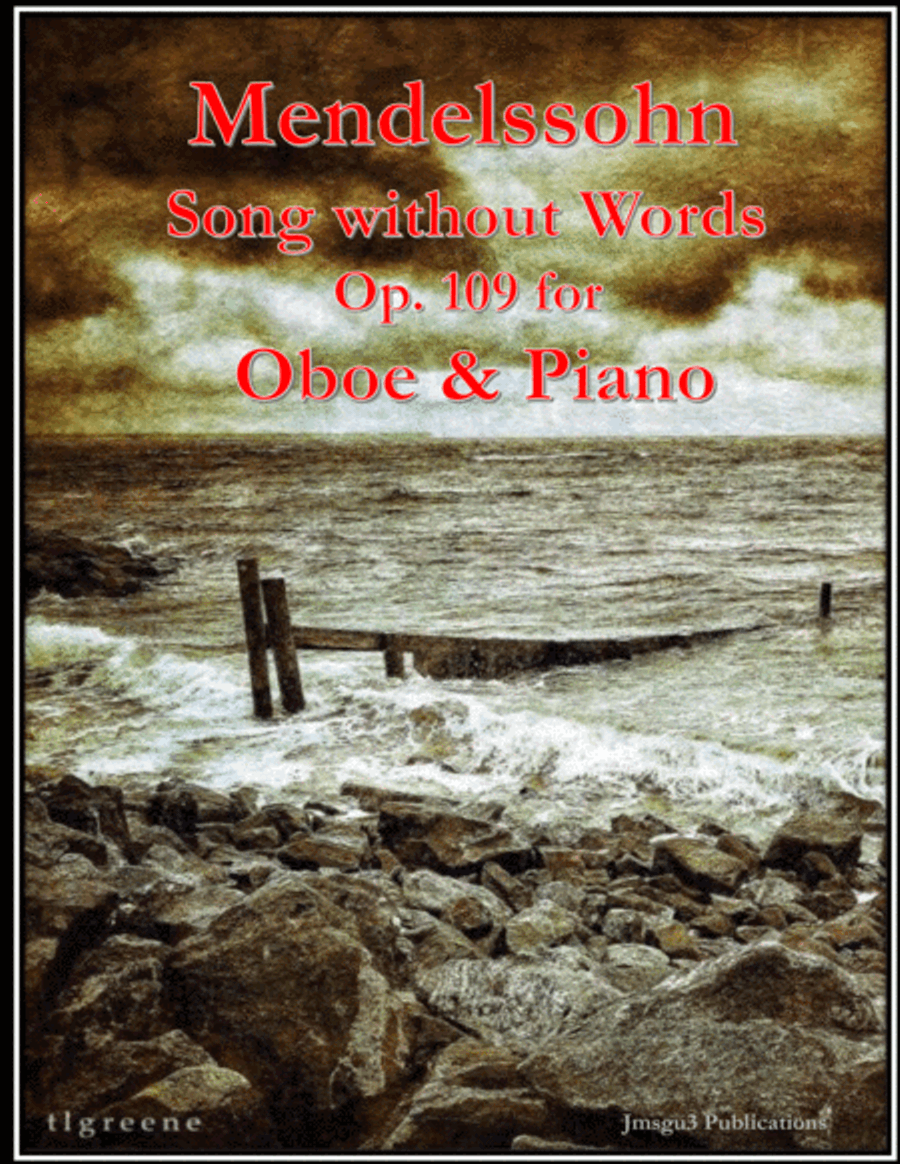
Mendelssohn: Song Without Words Op. 109 for Oboe & Piano
Hautbois, Piano (duo)

$32.95 27.83 € Hautbois, Piano (duo) PDF SheetMusicPlus

Instrumental Duet,Piano Flute,Instrumental Duet,Oboe,Piano - Level 4 - Digital Download SKU: A0.837511 Composed by Brett L. Wery. 20th Century,Concert,Contemporary. Score and parts. 56 pages. Sonata Grendel Publishing #6599293. Published by Sonata Grendel Publishing (A0.837511). An Avaloch Divertimento was begun-in fact the first two movements were completed-at the Avaloch Farm Music Institute in New Hampshire. Avaloch or Abhlach, is from the old Irish word meaning, place of the apple trees. The sacred Isle of the Apple Trees, Avalon-where Arthur, King of the Britons, was taken to be healed of his dreadful wounds-takes its name from this ancient word. Avaloch Farm Music Institute (AFMI) in New Hampshire is also a magical place where chamber music groups come to work and create in an atmosphere free from the distractions of everyday life. In the summer of 2021 I had the pleasure and honor of being a resident of AFMI along with Areli Mendoza-Pannone, Robert Frazier, and Mark Evans as we work-shopped my song cycle, Quarry Songs. Areli, Bobby, and Mark had to go back to the real world half way through the residency, leaving me at AFMI to begin work on An Avaloch Divertimento. The first movement is an Aubade, which are traditionally morning love songs-as opposed to evening love songs or serenades. In the seventeenth century aubades became associated with instrumental works depicting sunrises. It is this sense of the word that is used here, complete with a bird-song oboe cadenza. Pippin takes its name from a variety of apple. While at AFMI I would take afternoon walks through the nearby apple orchard to beautiful Walker Pond. It was on one of these walks that I came up with the first draft of the tune used in the central fughetta of the movement. The word, pippin is also included in Carolyn Forché’s poem, The Museum of Stones, which I had set as the final movement of Quarry Songs. The final movement, Amhrán, means song in Irish and is a simple song form with three interwoven themes that emulate the Irish Bodhran (frame drum), fiddle, and singer. Many thanks to Board Chair, Alfred Tauber, Artistic Director, Deborah Sherr, and Operations Director, Hannah Landes and the whole AFMI staff for creating such a wonderful refuge for musicians to work, learn, and create. Learn about Avaloch Farm Music Institute at www.avalochfarmmusic.org. Learn about more compositions by Brett L. Wery at www.BRETTLWERY.com. Duration: 12 minutes
An Avaloch Divertimento
Hautbois, Piano (duo)

$25.55 21.58 € Hautbois, Piano (duo) PDF SheetMusicPlus

Oboe,Piano - Level 4 - Digital Download SKU: A0.549726 Composed by Gabriel Faure. Arranged by James M. Guthrie, ASCAP. Contemporary,Multicultural,Romantic Period,Standards,World. Score and part. 22 pages. Jmsgu3 #3531383. Published by jmsgu3 (A0.549726). Duration: ca. 7:00, Score: 12 pages, solo part: 2 pages, piano: 7 pages. An epic choice for a recital or funeral.Fauré Background: In the first place, Gabriel Fauré 1845 –1924) was a famous French composer, musician, and educator. Furthermore, his musical ideas influenced numerous 20th-century composers. Therefore, historians regard him as one of the leading French composers of his time. Famous Works: Among his most famous compositions, by and large, are the Pavane, Elegie (op. 24), Requiem, Sicilienne, Nocturnes for piano and the songs Après un rêve and Clair de lune. Inasmuch as his early works are well-known and relatively easy to perform, Faure’s music seems to have become gradually more difficult during his later life. In other words, his later works are somewhat esoteric and complex. Early Home Life: Fauré was in fact born into a well-cultivated family. His aptitude for music became particularly clear early on - when he was still a boy. Under these circumstances, his parents sent him to a music institution in Paris. Consequently, the training he received there prepared him for a career as a church organist and choirmaster. Middle Life: It is important to realize that Fauré studied music composition with the French musical mastermind Camille Saint-Saëns, who became his lifelong friend. Fauré eventually graduated from college and earned a living as an organist and educator. During this period, he had, on the whole, little time to compose. He consequently became more successful in his middle age, becoming organist of the Église de la Madeleine and director of the Paris Conservatoire. However, he still needed time on balance for composing. Therefore, given these points, he withdrew to the countryside during the summer to focus on composing. Later Life: Fauré was, in the final analysis, recognized in France as the foremost French composer of his time. The French government held a national musical tribute particularly for him in Paris. The French President notably headed the ceremony. Elsewhere, on the contrary, Fauré's music was slow to become accepted, except of course, in England. Legacy: Historians often describe Fauré's music in general as a transition between the end of Romanticism and the beginning of modernism. As an illustration, when Fauré was born, Chopin was still composing. However, by the time of Fauré's death, jazz and atonal music, in particular, had come to fruition. Fauré, by all means, suffered from increasing deafness in his later years. Some musicologists believe this to be indeed the cause of the esoteric nature of Faure’s final works.
Fauré: Élégie Op. 24 for Oboe & Piano
Hautbois, Piano (duo)

$32.95 27.83 € Hautbois, Piano (duo) PDF SheetMusicPlus


Partitions Gratuites
Acheter des Partitions Musicales
Acheter des Partitions Digitales à Imprimer
Acheter des Instruments de Musique

© 2000 - 2026

Accueil - Version intégrale





