EUROPE
789 articles
USA
3 articles
DIGITAL
6 articles (à imprimer)
Partitions Digitales
Partitions à imprimer
6 partitions trouvées


Oboe,Piano - Level 4 - Digital Download SKU: A0.551569 Composed by Johann Sebastian Bach. Arranged by James Guthrie, ASCAP. Baroque,Instructional,Standards,Wedding. Score and part. 22 pages. Jmsgu3 #5317561. Published by jmsgu3 (A0.551569). BACH: Sonata in C Major BWV 1033, Duration: 8:30, Score:13 pages.1. Andante - Presto2. Allegro3. Adagio4. Menuet I.5. Menuet II.Johann Sebastian Bach was a German composer, musician, organist, and harpsichordist in the Baroque period of music. He is considered one of the greatest and most influential composers of his time and of all time, and his works form an essential part of the standard concert repertoire. Bach is credited with being largely responsible for the development of the sonata form in the Baroque era. He created several new forms of writing, such as the sinfonia and the prelude, which became popular in the Baroque. Bach also regularly combined two or three voice parts in the form of canons or fugues. His forms were complex and innovative and helped to establish the sonata as a form of composition. He composed some of the most famous and beautiful sonatas in music history. Bach's influence on the sonata form was massive.
BACH: Sonata in C Major BWV 1033 for Oboe & Piano
Hautbois, Piano (duo)

$32.95 27.83 € Hautbois, Piano (duo) PDF SheetMusicPlus

Oboe,Piano - Level 3 - Digital Download SKU: A0.551680 Composed by Georg Philipp Telemann. Arranged by James Guthrie, ASCAP. Baroque,Concert,Instructional,Standards. Score and part. 130 pages. Jmsgu3 #5330427. Published by jmsgu3 (A0.551680). I. Sonata in G Major. Duration: 6:45, Score: 19 pages. In four movements:1. Cantabile 2. Allegro 3. Affettuoso 4. AllegroII. Sonata in C Minor. Duration: 11:47, Score: 22 pages. 209 measures. In five movements:  1. Allegro 2. Adagio 3. Allegro assai 4. Ondeggiando, ma non adagio 5. AllegroIII. Sonata in F Major. Score: 8 pages, Duration: 5:40. In three movements:1. Vivace 2. Largo 3. AllegroIV. Sonata in Bb Major. Score: 17 pages, duration: ca. 9:30. In five movements:1. Largo 2. Allegro 3. Allegretto 4. Vivace 5. Allegro.
Telemann: Four Sonatas for Oboe & Piano
Hautbois, Piano (duo)

$49.95 42.19 € Hautbois, Piano (duo) PDF SheetMusicPlus

Oboe,Piano - Level 4 - Digital Download SKU: A0.955175 Composed by Paolo G. Besozzi (1704-1778). Arranged by Don Werdick (1946 - ). Baroque. Score and part. 28 pages. Chamber Ensemble of Minnesota, Inc. #6325675. Published by Chamber Ensemble of Minnesota, Inc. (A0.955175). Oboe solo part, Piano accompaniment plus Oboe-Piano score of the Bassoon Sonata in Bb Major and String Ensemble, composed in 1735 by P. Besozzi, arranged for Oboe in F Major by D. Werdick. Movements: 1. Allegro 2. Adagio 3. Allegro Time: 10 minutes, 0 seconds During the Baroque period (c. 1600 to 1750) music written in the Italian style, and German music to a lesser degree, scores and solo parts contain little (if any) information about elements like articulation, ornamentation or dynamics, so the soloists and ensemble players needed to make their own informed choices before each performance. This arrangement offers dynamics, articulations, ornamentation and nuances of tone color as to how to effectively present the composition and can help the performer to build on these ideas to effectively communicate the sense of the music ... 2021 Chamber Ensemble of Minnesota, Inc. Publishing.
Oboe Sonata in F Major
Hautbois, Piano (duo)

$8.75 7.39 € Hautbois, Piano (duo) PDF SheetMusicPlus

Oboe,Piano - Level 3 - Digital Download SKU: A0.549470 Composed by Alexander Scriabin. Arranged by James M. Guthrie, ASCAP. Concert,Instructional,Romantic Period,Sacred,Standards. Score and part. 12 pages. Jmsgu3 #3499773. Published by jmsgu3 (A0.549470). Score: 8 pages, solo part: 2 pages, piano part: 2 pages. Duration: 3:10. An introspective and meditative work with a lot of dynamic and phrasing nuance. Works well for church meditations or recital encores. Background Op.11/2 Alto Clarinet version. First of all, Scriabin composed mostly for the solo piano and also the orchestra. This is probably because he was a gifted pianist and therefore certainly appreciated the piano. Scriabin grew up in the late Romantic period, consequently, he was fond of the great piano masters of the time. As a result, he wrote his first noteworthy compositions in the manner of Chopin and Liszt. Forms Likewise, Scriabin used many of the same forms as Chopin. These certainly include the étude, prelude, nocturne, and even the mazurka. In contrast, as he developed his own sense of style his music became more and more unusual. So, the last five of his Piano Sonatas do not have a key signature and therefore lean towards atonality. Philosophy Scriabin also developed a keen interest in philosophy and likewise poetry. He was above all particularly fascinated by Nietzsche, Delville, and Blavatsky. Consequently, he finally established his own ideas about metaphysics and certainly mysticism. Scriabin consequently advanced theories about the relationship between color and musical keys. Synesthesia He also may have experienced a condition called synesthesia where he could probably sense a response created from a different stimulus. Therefore, it was almost as if he could see music and hear colors. Scriabin, therefore, arranged the colors in a circle similar to the circle-of-fifths and assigned each key area a color. Finally, he assigned the key of C to the color red, while the key of G was orange. Similarly, he assigned D to yellow, A to green, and so forth. Strangely, he did not differentiate between major and minor key colors.  Multimedia Hence, his ability to translate colors into music certainly gave Scriabin a most noteworthy interest in creating multimedia events. Furthermore, He designed his biggest work, the Mysterium, to last an entire week. Even more, Scriabin made plans not only for music, but also colored lights, incense, and dancing. He designed the performance to occur in the foothills of the Himalaya mountains. The Mysterium was never performed, and only sketches of the work remain. Modern Performances In modern times, we often experience performances of Scriabin’s most famous completed works accompanied by colored laser lights and incense. These are the Poem of Ecstasy (completed in 1908) and the Poem of Fire (completed in 1910). The lighting effects for these early performances were accomplished by the clavier à lumiéres. It was a keyboard instrument that projected colored light onto a screen.
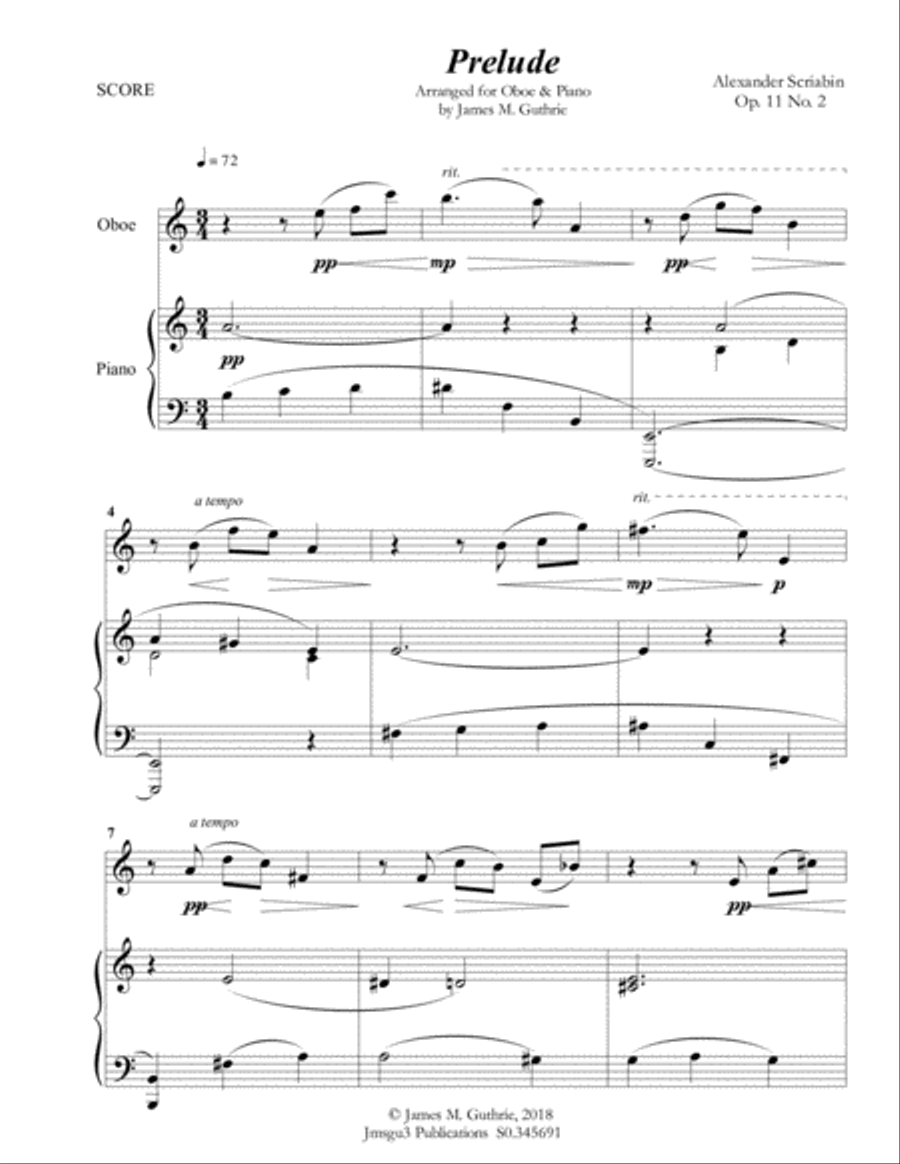
Scriabin: Prelude Op. 11 No. 2 for Oboe & Piano
Hautbois, Piano (duo)

$19.95 16.85 € Hautbois, Piano (duo) PDF SheetMusicPlus


Partitions Gratuites
Acheter des Partitions Musicales
Acheter des Partitions Digitales à Imprimer
Acheter des Instruments de Musique

© 2000 - 2026

Accueil - Version intégrale





