EUROPE
1186 articles
USA
0 articles
DIGITAL
36 articles (à imprimer)
Partitions Digitales
Partitions à imprimer
36 partitions trouvées


Oboe,Piano - Level 1 - Digital Download SKU: A0.548489 Composed by Gruber. Arranged by James M. Guthrie, ASCAP. Christmas. Score and part. 3 pages. Jmsgu3 #3387057. Published by jmsgu3 (A0.548489). Silent Night for Oboe & Piano with new harmony for the final verse. Score: 2 pg. Part: 1 pg. Silent Night Origins Father Joseph Mohr wrote the lyrics for a new Christmas Carol. He wanted the new carol for his Christmas Eve Mass. With only a couple of hours until the service, He asked organist and schoolteacher Franz Gruber to write a melody and simple accompaniment to go with the lyrics. The result is probably the most famous of all Christmas carols – Silent Night. First Performance Perhaps because the organ was undergoing repairs, or to make sure the accompaniment was easy enough, Mohr asked Gruber to write it for the guitar. Mohr played the guitar, and both Mohr and Gruber gave the world premiere performance at the Christmas Eve Mass in 1818 at St. Nicholas Church in Oberndorf in Salzburg. Original Score Eventually, the original score became lost, and consequently, Mohr's name was largely forgotten.  Though the public originally recognized Gruber as the composer, many people over time began rumors that a more famous composer was responsible. Thus, they floated the names of Haydn, Mozart, and even Beethoven. Authorities eventually settled the matter when a manuscript in Mohr’s handwriting turned up in 1820. Consequently, we learn that Mohr wrote the lyrics in 1816, and Gruber composed the melody in 1818. Popularity Nonetheless, Silent Night is still very popular. Singers have performed this song in nearly every genre and in multiple languages. Perhaps the most famous version is the one Bing Crosby crafted. This version is the third best-selling physical single recording in the history of recorded music. This particular recording was released in 1935 and sold at least 30 million copies. Only two songs have ever sold more. Elton John released Candle in the Wind in 1997 and sold 33 million copies. The record for most copies ever sold goes to Bing Crosby. He released White Christmas in 1942 and sold 50 million physical copies.  Register for free lifetime updates and revisions at www.jamesguthrie.com    
Silent Night for Oboe & Piano
Hautbois, Piano (duo)

$28.95 25.22 € Hautbois, Piano (duo) PDF SheetMusicPlus

Small Ensemble Clarinet,Flute,Oboe,Piano - Level 5 - Digital Download SKU: A0.923701 Composed by Cesar Auguste Franck. Arranged by Robert Fruehwald. 20th Century,Contemporary. Score and parts. 39 pages. Robert Fruehwald #2165237. Published by Robert Fruehwald (A0.923701). I have a love-hate relationship with the Cesar Franck D Minor Symphony. It was the first large scale romantic work that I played as a member of a youth orchestra. I remember the thrill of being immersed in the overwhelming drama of the work. As I have returned to the piece over the years, I still love it, or rather I love parts of it. It is a very, very long work. It takes a while to get to the point. The point of the piece, to me, is the last movement. It is fast, exciting, maybe even joyous. The long, dark, angst-ridden build-up seemed profound to me as a teenager. I am less patient today. Now I wish Franck had simply started with the last movement. I decided to try rewriting the symphony myself. I would start with material from the last movement. I would use all of the basic musical material of the piece, but I would condense it down to ten to fifteen minutes of music. I had originally intended to leave the romantic character of the work intact. That intention didn't last very long. As I worked on the piece, it very quickly became more post-modern than romantic. I think that's fine. The profundity may be gone, but I think the piece is more fun this way. As I get older the scales of my life are tipping more and more toward fun and less and less toward profundity. It's kind of nice that, as I age, I see more fun ahead me even if that means I'm seeing profundity recede in the rear-view mirror.
Sonata Franckoniana
Hautbois, Piano (duo)

$8.99 7.83 € Hautbois, Piano (duo) PDF SheetMusicPlus

Oboe,Piano - Level 3 - Digital Download SKU: A0.1269863 By Olivia Rodrigo. By Daniel Nigro and Olivia Rodrigo. Arranged by Benzaiten Editions. 21st Century,Contemporary,Pop,Rock,Singer/Songwriter. Score and part. 7 pages. Benzaiten Editions #862339. Published by Benzaiten Editions (A0.1269863). Hey! Are you a oboe player who wants to learn how to play Vampire by Olivia Rodrigo? It's your lucky day! 🎵Vampire by Olivia Rodrigo - Intermediate Oboe Sheet Music with piano accompaniment and chords The Benzaiten Editions Arrangement Prepare to be entranced by the haunting and emotive ballad, Vampire by Olivia Rodrigo! This poignant song showcases Olivia's incredible songwriting and vocal prowess, making it a powerful and captivating piece for oboe. Our oboe and piano arrangement of Vampire allows you to embody the raw emotion and vulnerability of Olivia's performance. Through delicate melodies and expressive chords, you'll be able to convey the bittersweet essence of this mesmerizing track. Perfect for intermediate oboe players who want to explore Olivia Rodrigo's music or simply appreciate heartfelt compositions, this arrangement strikes a balance between accessibility and musicality. About the song Vampire by Olivia Rodrigo is a soul-stirring ballad that delves into themes of love, heartbreak, and emotional vulnerability. Olivia's evocative lyrics and haunting melody resonate deeply with listeners, capturing the raw essence of human emotions. This oboe arrangement allows you to embody the song's bittersweet beauty and express your own feelings through its touching melodies and chords. Whether you're a devoted fan of Olivia Rodrigo or a oboe enthusiast seeking emotive compositions, Vampire offers a powerful musical journey that speaks straight to the heart.
Vampire
Hautbois, Piano (duo)
Olivia Rodrigo
$5.99 5.22 € Hautbois, Piano (duo) PDF SheetMusicPlus

Oboe,Piano - Level 3 - Digital Download SKU: A0.1269861 By Olivia Rodrigo. By Daniel Nigro and Olivia Rodrigo. Arranged by Benzaiten Editions. 21st Century,Contemporary,Pop,Rock,Singer/Songwriter. Score and part. 7 pages. Benzaiten Editions #862337. Published by Benzaiten Editions (A0.1269861). Hey! Are you a oboe player who wants to learn how to play Vampire by Olivia Rodrigo? It's your lucky day! 🎵Vampire by Olivia Rodrigo - Intermediate Oboe Sheet Music with piano accompaniment The Benzaiten Editions Arrangement Prepare to be entranced by the haunting and emotive ballad, Vampire by Olivia Rodrigo! This poignant song showcases Olivia's incredible songwriting and vocal prowess, making it a powerful and captivating piece for oboe. Our oboe and piano arrangement of Vampire allows you to embody the raw emotion and vulnerability of Olivia's performance. Through delicate melodies and expressive chords, you'll be able to convey the bittersweet essence of this mesmerizing track. Perfect for intermediate oboe players who want to explore Olivia Rodrigo's music or simply appreciate heartfelt compositions, this arrangement strikes a balance between accessibility and musicality. About the song Vampire by Olivia Rodrigo is a soul-stirring ballad that delves into themes of love, heartbreak, and emotional vulnerability. Olivia's evocative lyrics and haunting melody resonate deeply with listeners, capturing the raw essence of human emotions. This oboe arrangement allows you to embody the song's bittersweet beauty and express your own feelings through its touching melodies and chords. Whether you're a devoted fan of Olivia Rodrigo or a oboe enthusiast seeking emotive compositions, Vampire offers a powerful musical journey that speaks straight to the heart.
Vampire
Hautbois, Piano (duo)
Olivia Rodrigo
$5.99 5.22 € Hautbois, Piano (duo) PDF SheetMusicPlus

Oboe,Piano - Level 1 - Digital Download SKU: A0.548719 Composed by Martin Luther. Arranged by James M. Guthrie, ASCAP. Easter,Instructional,Standards. Score and part. 4 pages. Jmsgu3 #3411753. Published by jmsgu3 (A0.548719). Out of the Depths I Cry to You by Martin Luther. The first verses feature modified counterpoint and harmony proceeding at quarter = 82. The final verse is reharmonized for maximum dramatic effect at a more contemplative tempo such as quarter = 64. Features the entire range of the instrument. Very powerful selection for Lent or Easter. Duration (3 verses) 3:05, 36 ms. Score: 3 pg. Solo part: 1 pg. The piano reads from the score. Out of the Depths Aus tiefer Not schrei ich zu dir (From deep affliction I cry out to you), is, of course, a hymn composed by Martin Luther. Moreover, Luther also wrote the lyrics, essentially a paraphrase of Psalm 130. First published in 1524, it is also one of eight songs in the original Lutheran hymnal. It appears likewise in many hymnals and in different translations. The lyrics furthermore stimulated compositions from the Renaissance to the contemporary. Consequently, composers such as Johann Sebastian Bach built an entire chorale cantata on it. Other composers similarly contributed pieces, such as Felix Mendelssohn and Max Reger. Luther Background Martin Luther, (1483 –1546) was a German professor of theology, composer, priest, and moreover, an influential character in the Protestant Reformation. Luther had a momentous impact on church and society due to his contributions to the musical arts. He wanted to disseminate the gospel among mankind and with this intention thought that the best way to do that was through music. Influence It is important to realize that other musicians, and their descendants, were encouraged by Luther’s songs and wrote their own hymns. Luther, to be sure, had a thorough musical education. For example, he knew secular and sacred songs from an early age. He, in particular, played the lute well and sang in the monastery when he was a monk. That is to say, music was an essential part of his life. He in fact first began writing songs in 1523, sometimes writing the melody as well as the lyrics. Luther was certainly able to evaluate the composers of his time. He thought especially highly of Josquin des and Ludwig Senfl. He was also acquainted, with this in mind, with other composers and their works. Legacy The Lutheran musical ethos soon covered all of Germany and later significantly fashioned Protestant musical culture. Heinrich Schütz and Johann Sebastian Bach are the most compelling evidence of this Protestant musical culture. Additionally, as a point often overlooked, the pedal organ, first refined in northern Germany, became universally prevalent. As a matter of fact, Dieterich Buxtehude established a regular evening organ concert series in Lübeck. Another key point is that this concert series, in turn, spread North German Musical ideas worldwide. Luther was especially convinced that music is a beautiful and exclusive offering of the divine.
Luther: Out of the Depths for Oboe & Piano
Hautbois, Piano (duo)

$24.95 21.74 € Hautbois, Piano (duo) PDF SheetMusicPlus

Instrumental Duet,Oboe,Piano - Level 2 - Digital Download SKU: A0.984280 Composed by Karen E McAulay. Contemporary,Romantic Period. 4 pages. Dr Karen E McAulay #4317603. Published by Dr Karen E McAulay (A0.984280). I started out writing an accordion tune - and ended up with an old-fashioned waltz for oboe & piano!  The namesake of this waltz was Miss Lambert - a vicar's daughter & professor's niece in Georgian St Andrews. A bit of a bluestocking, but I like to think she'd have enjoyed her waltz nonetheless. Play it on oboe and piano, but the score does has optional sidedrum, bass and guitar chords for extra performance options.Oboe part listed separately.
Miss Lambert's Waltz - oboe and piano, optional side drum, bass & guitar
Hautbois, Piano (duo)

$10.00 8.71 € Hautbois, Piano (duo) PDF SheetMusicPlus

Oboe,Piano - Level 4 - Digital Download SKU: A0.549448 Composed by Sir Arthur Seymour Sullivan. Arranged by James M. Guthrie, ASCAP. Instructional,Romantic Period,Sacred,Standards. Score and part. 15 pages. Jmsgu3 #3497149. Published by jmsgu3 (A0.549448). Score: 10 pages, solo part: 2 pages, piano part: 3 pages. Duration: 4:25. Requires sensitivity & dynamic control.Suitable for recitals, church meditations, or school programs. School Years First of all, Sullivan attended music school at the Royal Academy of Music. Because Sullivan was so talented, the Academy awarded him the Mendelssohn Scholarship for two years in a row. He, therefore, studied with John Goss, who studied with Thomas Atwood, who in turn studied with Mozart. Sullivan similarly studied the piano at the Academy with Arthur O’Leary. Study Abroad During his first year, he also earned money by singing solos in the Chapel Royal. At the end of his second year, the Academy consequently continued his scholarship and sent him to study at the Leipzig Conservatoire. He certainly studied composition, and likewise counterpoint and piano. Hence, during his final year in Leipzig, Sullivan finally completed his graduation composition project: Incidental Music for Shakespeare’s The Tempest. Association with Gilbert It seems like Sullivan built the bulk of his composing career largely in the 1860s. As a result, he became famous for his incidental music for the Tempest and his Irish Symphony. He, therefore, began collaborating with the poet W. S. Gilbert in the 1870s. Rather than focus on serious opera, Gilbert and Sullivan, in contrast, concentrated on comic opera such as H. M. S. Pinafore, the Pirates of Penzance, and the Mikado. Therefore, certainly as a result of his education and experience, Sullivan composed a total of 24 operas, 11 symphonic works, 10 choral pieces. Even more, he wrote a large number of noteworthy hymns such as Onward Christian Soldiers. Lost Chord The general style of his music is maybe similar to Mendelssohn, Schumann, and perhaps Liszt. It seems like Sullivan was fond of writing distinct melodies for each character in his operettas. His melodies combine together as the characters did. Furthermore, he was a master orchestrator, and therefore played the flute, clarinet, trumpet, and trombone fluently. The Lost Chord Sullivan wrote his most noteworthy song the Lost Chord in 1877. As a result, it was a great success and was certainly performed all over the world by a variety of singers such as Enrico Caruso. Because Sullivan was the most famous composer in England, the Lost Chord became the most famous of all British or American songs of the 1870s and 1890s. Consequently, in 1888 Thomas Edison recorded The Lost Chord for the phonograph. It was one of the first songs ever recorded. Furthermore, Queen Victoria knighted Sullivan in 1883.  Register for free lifetime updates and revisions of this product at www.jamesguthrie.com
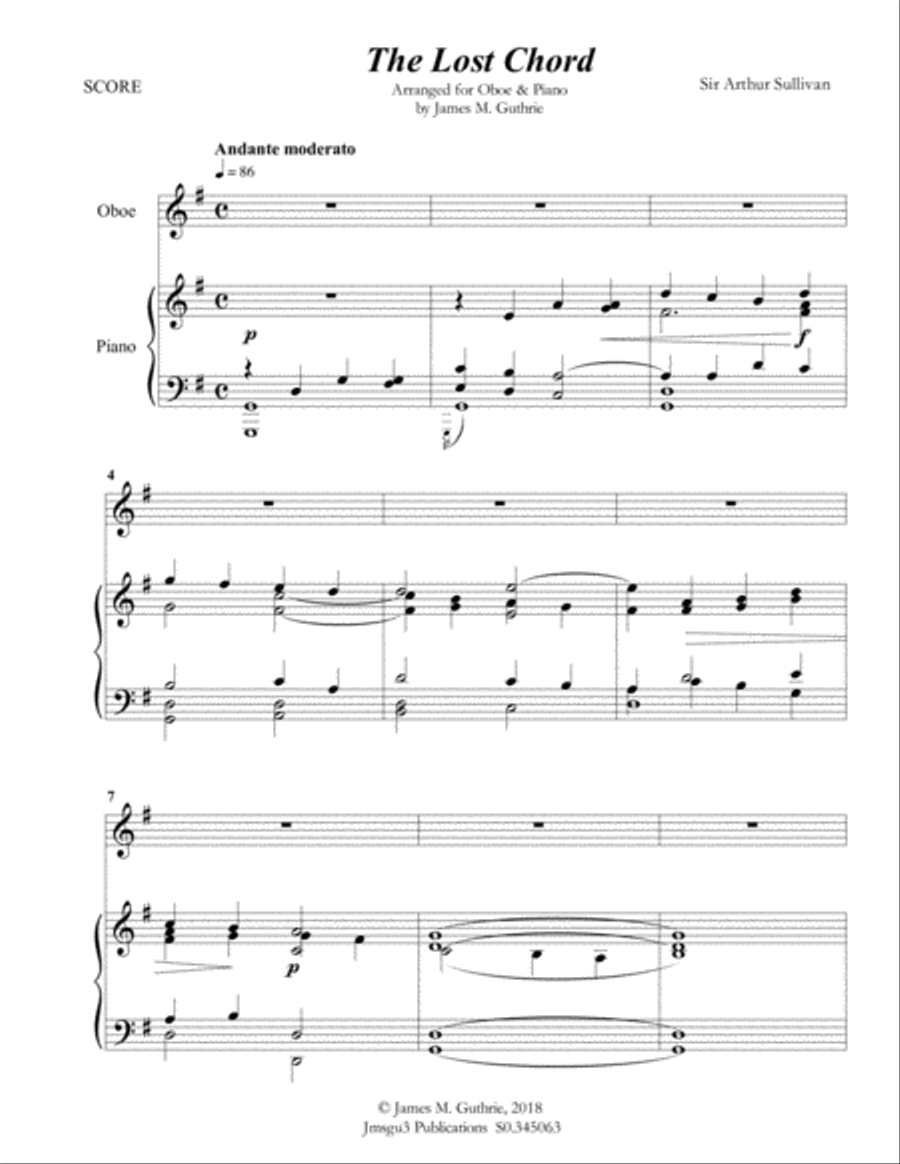
Sullivan: The Lost Chord for Oboe & Piano
Hautbois, Piano (duo)

$26.95 23.48 € Hautbois, Piano (duo) PDF SheetMusicPlus

Oboe,Piano - Level 3 - Digital Download SKU: A0.549386 Composed by George Frideric Handel. Arranged by James M. Guthrie, ASCAP. Baroque,Sacred,Standards,Wedding. Score and part. 9 pages. Jmsgu3 #3492325. Published by jmsgu3 (A0.549386). Duration: 4:55, Score: 6 pages, Solo part: 1 page, piano part: 2 pages. A very famous aria (Ombra mai fu) from XerxesSuitable for any venue requiring meditative music. Excellent choice for a recital encore. Xerxes Xerxes is, in fact, an opera seria in three acts by Handel. Moreover, Handel conducted the premiere performance in London in 1738. Handel casts the opera in Persia in 470 BC. The part of Xerxes was indeed originally sung by a soprano castrato. Nowadays, the part is generally sung by a mezzo-soprano or conversely a counter-tenor. In the first place, Xerxes sings an opening aria, Ombra mai fu to a plane tree. Handel sets this aria to one of his most truly famous melodies. Although many refer to it traditionally as Handel’s Largo, Handel has, on the contrary, clearly marked Larghetto in the score. Handel Background George Frideric Handel (1685 - 1759) was born in Germany but eventually became a British citizen. Nonetheless, he was a famous Baroque composer. In fact, he became famous for his operas, oratorios, anthems, and organ concertos. Handel studied music and, by and large, worked as a composer in Germany and Italy before moving to London. On the whole, Handel was very familiar with the contemporary music of Italy and Germany. Career in England It is essential to realize that Italian opera was all the rage in England at the time. Moreover, Handel was really good at writing them. Therefore, he started not one but three opera companies in England. Alexander's Feast was a huge success in 1736, but Handel began composing English choral works. After success with the Messiah in 1742) he certainly never again wrote an Italian opera. Consequently, he died in 1759, a treasured genius. Accordingly, the English government gave him full state honors at his funeral. Hence, he is buried in Westminster Abbey in London. Legacy Music historians agree that Handel was in general one of the greatest composers of the Baroque era.  To demonstrate, his works such as the Messiah, Water Music, and Music for the Royal Fireworks remain consistently popular up to the present time. He especially composed the coronation anthem, Zadok the Priest for the coronation of George II. Nevertheless, it has specifically been performed at every succeeding British coronation since. His oratorio Solomon has by all means also continued to be prevalent. As a matter of fact, Sinfonia from act 3 was featured in the 2012 London Olympics opening ceremony. Handel was particularly prolific. To enumerate, he wrote over forty operas.  Since the late 1960s, we have expressly experienced a revival of baroque music. Similarly, we have especially seen a pique of interest in historically informed musical performances. Since his death in 1779, interest in Handel's music has all in all, expanded.  
Handel: Largo from Xerxes for Oboe & Piano
Hautbois, Piano (duo)

$32.95 28.71 € Hautbois, Piano (duo) PDF SheetMusicPlus

Oboe,Piano - Level 2 - Digital Download SKU: A0.763436 Composed by Johann Cruger. Arranged by Nigel Williams. Baroque,Holiday,Sacred,Standards. Score and part. 10 pages. Nigel Williams #5728687. Published by Nigel Williams (A0.763436). This well known melody Nun Danket is arranged here in a contemplative style for oboe and piano. The oboe writing is very straightforward, stating the chorale melody in equal length phrases. The piano accompanies with gentle upward moving eighth-note figures, the overall effect is one of contemplation and a sense of quiet fulfillment. This arrangement would make a perfect prelude in any service of worship where this hymn is admired. The performance duration is over two and a half minutes and the full score has a separate oboe part attached. Enjoy browsing my extensive range of instrumental solos, duets, trios, quartets and ensemble arrangements on SMP.
Now Thank We All Our God, for Oboe and Piano
Hautbois, Piano (duo)

$4.49 3.91 € Hautbois, Piano (duo) PDF SheetMusicPlus

Oboe,Piano - Level 3 - Digital Download SKU: A0.549680 Composed by Peter Ilyich Tchaikovsky. Arranged by James M. Guthrie, ASCAP. Children,Christmas,Romantic Period,Standards. Score and part. 15 pages. Jmsgu3 #3520251. Published by jmsgu3 (A0.549680). Duration: ca. 1:42, 52 measures, Score: 7 pages, solo part: 2 pages, piano part: 4 pages. A popular Christmas favorite from Tchaikovsky's Nutcracker Suite. Pyotr Ilyich Tchaikovsky Tchaikovsky is probably the most popular of the great composers in America. His music certainly appeals to musicians. Likewise, it appeals even to folks who don’t normally listen to serious music. This is probably because of his most noteworthy melodies. Above all, he writes with great emotion. This certainly makes a most noteworthy if not an unforgettable impact. Education First of all, He attended classes at the Russian Musical Society. Even more, He also attended the St. Petersburg Conservatory. There he studied music theory with Nikolai Zaremba. He also consequently studied composition with Anton Rubenstein. It seems like Rubenstein came under criticism from a group of Russian composers known as the Five. The Five The Five certainly rejected Western musical influences. They rather sought to use elements from Russian music. They furthermore wanted to use more exotic musical materials. Western Techniques More than other Russian composers, Tchaikovsky studied modern Western music. He certainly develops his music like the European masters. So, rather than repeating a motive, he moves to a new key. He then introduces a different theme in the new key. Hence, he maintained his independence from the Five. Even more, he became the first Russian composer of international stature. Influences Tchaikovsky was probably influenced in his ballet scoring by Léo Delibes. Richard Wagner influenced his symphonic writing. Tchaikovsky’s most famous works include the 1812 Overture, The Nutcracker Suite, and Swan Lake. Also famous are the Violin Concerto in D and the six symphonies. The greatest of the six symphonies may be No. 6, the Pathétique. Nutcracker Suite, Op. 71a The Nutcracker Suite is a ballet that was performed for the first time in December 1892 in St. Petersburg. To begin with, the original ballet failed to attract a positive reception. However, the ballet suite became probably one of the most popular of all of Tchaikovsky’s works. The ballet suite became even more famous in the 1960s. It is now performed all over the world, particularly during the Christmas season.
Tchaikovsky: Dance of the Sugar-Plum Fairy from Nutcracker Suite for Oboe & Piano
Hautbois, Piano (duo)

$32.95 28.71 € Hautbois, Piano (duo) PDF SheetMusicPlus

Oboe,Piano - Level 2 - Digital Download SKU: A0.1378744 Composed by George Frideric Handel. Arranged by Glauco Fernandes. Baroque,Chamber,Classical. Score and part. 3 pages. Glauco Fernandes #963452. Published by Glauco Fernandes (A0.1378744). Discover the charm of Handel's Passacaglia, popularized by Johann Halvorsen, in an easy solo arrangement, perfect for musicians at the easy and intermediate levels. This timeless piece comes to life in a professional edition, ensuring accessibility without compromising the depth and beauty of the original composition.With its simplified and idiomatic writing style, this arrangement offers ease of execution while preserving the essence of Handel's masterpiece. Ideal for beginners looking to explore classical repertoire and intermediate musicians seeking new challenges.Don't miss the chance to enrich your repertoire with this beloved classic. Immerse yourself in the emotion and allure of Handel's Passacaglia, immortalized by Johann Halvorsen, and experience the joy of playing one of today's most cherished pieces for solo performance!For more high-quality sheet music options, consider searching for Glauco Fernandes in the website's search bar. Contact: glaucofernandes.arrangements@gmail.com.
Passacaglia by Handel/Halvorsen - Oboe & Piano with Chord Notation
Hautbois, Piano (duo)

$4.99 4.35 € Hautbois, Piano (duo) PDF SheetMusicPlus

Oboe,Piano - Level 4 - Digital Download SKU: A0.1430123 Composed by Martin J. Van Klompenberg. 21st Century,Classical. Score and part. 44 pages. Martin J. Van Klompenberg #1010798. Published by Martin J. Van Klompenberg (A0.1430123). The Corpse Flower is not only one of the largest free-standing blossoming plants in the world, it also it also highly unique in that it requires 7 – 10 years to bloom for the first time. The plant must go through several germination cycles, moving through a single leaf phase multiple times prior to the first bloom.This work tells the story of a corpse flower, beginning with the initial single leaf. This leaf returns to the corm, the 100-pound bulb from which the plant stems. When the bloom finally arrives, it can be as tall as ten feet tall, but only lasts about 48 hours until it begins to wilt. The withering can take much longer, as the bloom decays and the single leaf stage begins anew.I had the good fortune to get to see a corpse flower in full bloom in the fall of 2020 (The cover art was taken from this flower), and the opportunity to see this marvel in person was the primary motivation behind writing this work.This work was made possible by the following consortium of musicians:Erin Webber, The University of Texas at San Antonio, San Antonio, TexasStephanie Carlson, Murray State University, Murray, KentuckyAmy Collins, The University of South Florida, Tampa, FloridaHeather Killmeyer, East Tennessee State University, Johnson City, TennesseeTheo-Hans Kuijvenhoven, Ridderkerk, NetherlandsKelly McElrath Vaneman, Converse College, Spartanburg, SC
Corpse Flower, for oboe and piano
Hautbois, Piano (duo)

$25.00 21.78 € Hautbois, Piano (duo) PDF SheetMusicPlus

Oboe,Piano - Level 3 - Digital Download SKU: A0.1510544 Composed by Modest Petrovich Mussorgsky. Arranged by César Madeira. 19th Century,Classical,Film/TV,Multicultural,Romantic Period,World. Score and part. 7 pages. Sheet Music To Play Editions #1085742. Published by Sheet Music To Play Editions (A0.1510544). Promenade from Pictures at an Exhibition. Arrangement for Oboe and Piano. With Full Score and Individual Parts. Enjoy it!Modest Petrovitch Mussorgsky (1839 - 1881) was a Russian composer famous for his operas and songs. He discovered new ways of writing for the voice which were very tuneful but which also suited the Russian language. His most famous opera is Boris Godunov. Another very famous piece is called Pictures at an Exhibition. He wrote it for the piano, but many years after his death another composer called Maurice Ravel orchestrated it and this is the version people usually hear today.For Tutorials, Play Alongs or request New Arrangements, visit the YouTube Channel: Sheet Music To Play
Pictures at an Exhibition - Promenade - Oboe and Piano (Full Score and Parts)
Hautbois, Piano (duo)

$8.99 7.83 € Hautbois, Piano (duo) PDF SheetMusicPlus


Partitions Gratuites
Acheter des Partitions Musicales
Acheter des Partitions Digitales à Imprimer
Acheter des Instruments de Musique

© 2000 - 2026

Accueil - Version intégrale





