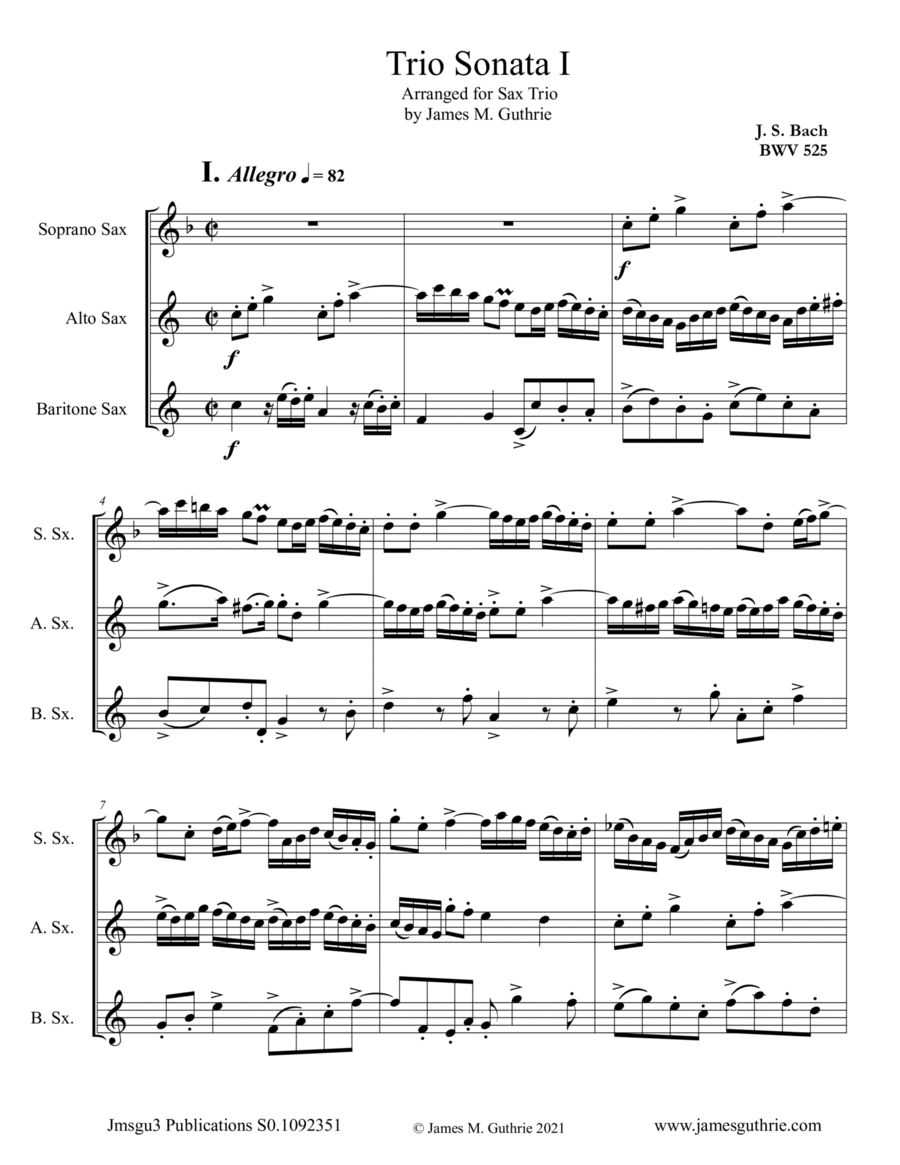
Saxophone Trio,Woodwind Ensemble Alto Saxophone,Baritone Saxophone,Soprano Saxophone - Level 4 - Digital Download SKU: A0.552651 Composed by Johann Sebastian Bach. Arranged by James M. Guthrie. Baroque,Holiday,Standards,Wedding. 36 pages. Jmsgu3 #6492697. Published by jmsgu3 (A0.552651). Sonata No. 1 BWV 525, originally for organ, arranged for sax trio: 1 soprano, 1 alto, 1 baritone. Duration: 14:15, Score: 19 pages.  In three movements.I. AllegroII. AdagioIII. AllegroJ.S. Bach's Trio Sonatas BWV 525-530 are some of the most popular and beloved works of the Baroque period. Composed in 1717, these six trio sonatas for the organ are among Bach's earliest works for the instrument. They are all in the traditional three-movement form and are composed in the style of the Italian concerto grosso, with two upper voices (treble and alto) and a basso continuo. The two upper voices often intertwine in intricate contrapuntal melodies, while the basso continuo provides harmonic support. The works are also full of virtuosic passages that demonstrate Bach's mastery of the organ. The Trio Sonatas are considered to be among the most important and influential works of the Baroque era, and they continue to be widely performed and studied today.The Bach Trio Sonatas have been successfully transcribed for a variety of ensembles, including wind, string, and brass ensembles. The parts are easily divided among a variety of wind instruments, including flute, oboe, clarinet, bassoon, and saxophone. In these transcriptions, the original material is retained, but often with some additional orchestration or embellishment. These transcriptions often emphasize the polyphonic texture of the original works, creating a rich soundscape.  The Sonatas have also been successfully adapted for a variety of string ensembles. In these versions, the original two-part texture with the basso is maintained, creating a full and satisfying sound that allows for a more nuanced interpretation of the works. In addition, these transcriptions often add a variety of dynamic markings and articulations that were not present in the original editions. These transcriptions provide performers with a variety of options for interpreting and performing these beloved works.