EUROPE
5255 articles
USA
0 articles
DIGITAL
6 articles (à imprimer)
Partitions Digitales
Partitions à imprimer
6 partitions trouvées


Saxophone Trio,Woodwind Ensemble Alto Saxophone,Baritone Saxophone,Soprano Saxophone - Level 3 - Digital Download SKU: A0.1342330 Composed by Traditional. Arranged by James M. Guthrie. Chamber,Christian,Christmas,Holiday,Traditional. 3 pages. Jmsgu3 #927846. Published by jmsgu3 (A0.1342330). Greensleeves is a traditional English folk song that has several interesting facts associated with it:Origin: The song's origin is uncertain, and there is no consensus on who composed it. It has been attributed to Henry VIII, the King of England, but this association is considered erroneous, and the song is more likely to be Elizabethan in origin.Christmas Carol: The tune of Greensleeves is used for the classic Christmas carol What Child Is This?Lyrics: The song's lyrics are about a painful romantic problem and include what some historians view as subtly salacious content. The lyrics deal with a spurned lover accusing Lady Greensleeves of casting him off discourteously despite his love for her. The song's scandalous twist is hidden in its title, and its exact meaning has been debated for centuries.Cultural References: The tune was used as the slow march of the London Trained Bands in the 16th and 17th centuries. It was adopted as the quick march of the 7th (City of London) Battalion London Regiment during World War I. Additionally, the tune has been referenced in literature, such as in Shakespeare's The Merry Wives of Windsor.Popularity: In some parts of the world, the Greensleeves tune is famous as a standard chime for ice cream vans.These facts make Greensleeves a fascinating and culturally significant piece of music with a rich history and diverse interpretations.
What Child is This? for Saxophone Trio
3 Saxophones (trio)

$24.95 21.52 € 3 Saxophones (trio) PDF SheetMusicPlus

Saxophone Trio,Woodwind Ensemble Alto Saxophone,Baritone Saxophone,Soprano Saxophone - Level 4 - Digital Download SKU: A0.552651 Composed by Johann Sebastian Bach. Arranged by James M. Guthrie. Baroque,Holiday,Standards,Wedding. 36 pages. Jmsgu3 #6492697. Published by jmsgu3 (A0.552651). Sonata No. 1 BWV 525, originally for organ, arranged for sax trio: 1 soprano, 1 alto, 1 baritone. Duration: 14:15, Score: 19 pages.  In three movements.I. AllegroII. AdagioIII. AllegroJ.S. Bach's Trio Sonatas BWV 525-530 are some of the most popular and beloved works of the Baroque period. Composed in 1717, these six trio sonatas for the organ are among Bach's earliest works for the instrument. They are all in the traditional three-movement form and are composed in the style of the Italian concerto grosso, with two upper voices (treble and alto) and a basso continuo. The two upper voices often intertwine in intricate contrapuntal melodies, while the basso continuo provides harmonic support. The works are also full of virtuosic passages that demonstrate Bach's mastery of the organ. The Trio Sonatas are considered to be among the most important and influential works of the Baroque era, and they continue to be widely performed and studied today.The Bach Trio Sonatas have been successfully transcribed for a variety of ensembles, including wind, string, and brass ensembles. The parts are easily divided among a variety of wind instruments, including flute, oboe, clarinet, bassoon, and saxophone. In these transcriptions, the original material is retained, but often with some additional orchestration or embellishment. These transcriptions often emphasize the polyphonic texture of the original works, creating a rich soundscape.  The Sonatas have also been successfully adapted for a variety of string ensembles. In these versions, the original two-part texture with the basso is maintained, creating a full and satisfying sound that allows for a more nuanced interpretation of the works. In addition, these transcriptions often add a variety of dynamic markings and articulations that were not present in the original editions. These transcriptions provide performers with a variety of options for interpreting and performing these beloved works.
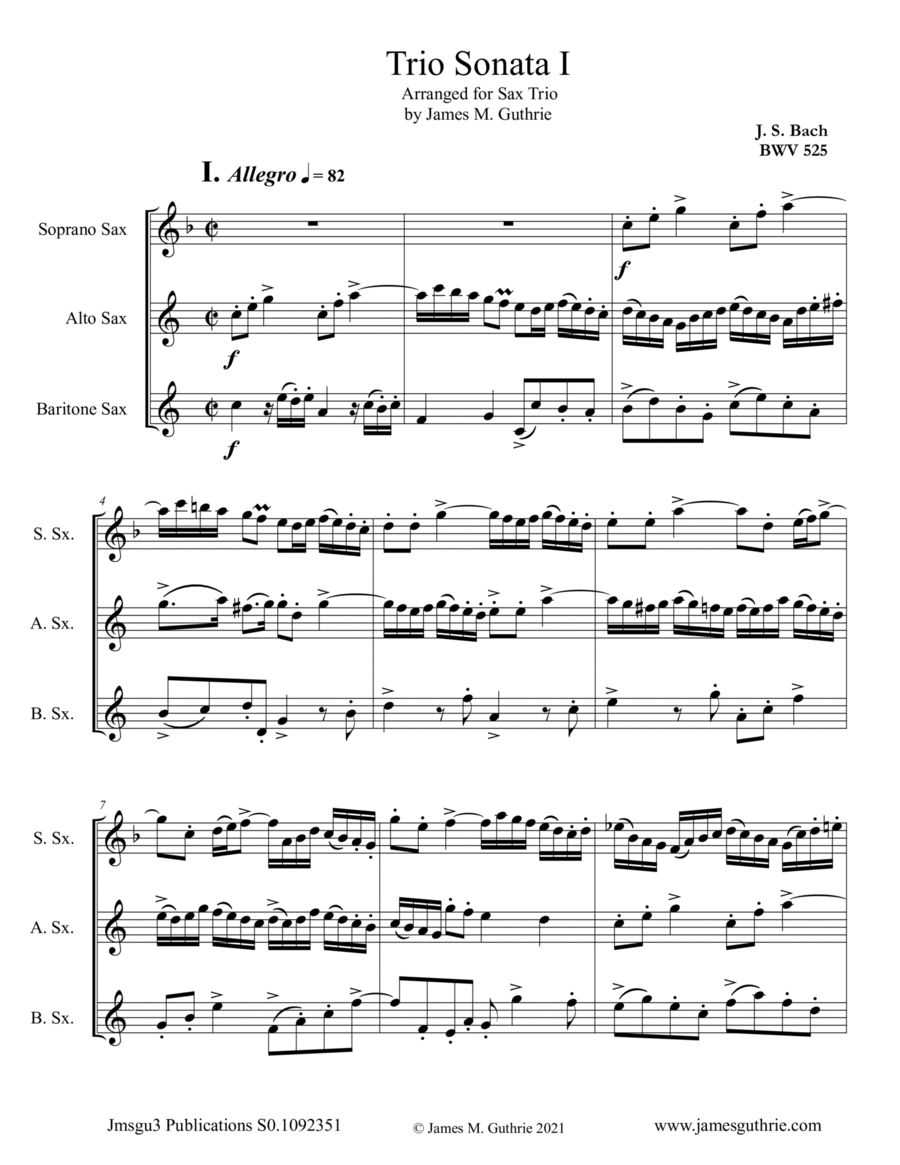
BACH: Trio Sonata No. 1 BWV 525 for Sax Trio
3 Saxophones (trio)

$32.95 28.41 € 3 Saxophones (trio) PDF SheetMusicPlus

Saxophone Trio,Woodwind Ensemble Alto Saxophone,Baritone Saxophone,Soprano Saxophone - Level 3 - Digital Download SKU: A0.1342277 Composed by Traditional. Arranged by James M. Guthrie. Chamber,Christian,Christmas,Holiday,Traditional. 3 pages. Jmsgu3 #927791. Published by jmsgu3 (A0.1342277). O Little Town of Bethlehem is a beloved Christmas carol with an exciting history. It was written by Phillips Brooks in 1868 for the Sunday school children at his Philadelphia parish, Holy Trinity Church, following a pilgrimage to Bethlehem in 1865. The hymn beautifully describes the little town asleep on the December night. It gracefully modulates from a description of Christmas into examining the meaning of Christmas, encouraging charity, faith, and the coming of Christ into the human heart. The hymn is generally sung to its original tune, St. Louis by Louis H. Redner in the United States, and to Forest Green by Ralph Vaughan Williams in the United Kingdom, Canada, and Ireland. The hymn has continued to be a favorite for many people as they celebrate Christmas.O Little Town of Bethlehem has been used in popular culture as a beloved Christmas standard on both sides of the Atlantic. It has been performed by various artists, such as Sarah McLachlan, The Staple Singers, and Amy Grant, and featured in Christmas albums and performances, contributing to its enduring presence in popular culture. The song's timeless and evocative lyrics, paired with different tunes in the United States and Britain, have made it a staple in the Christmas music repertoire, showcasing its cultural significance and widespread appeal.
O Little Town of Bethlehem for Saxophone Trio
3 Saxophones (trio)

$24.95 21.52 € 3 Saxophones (trio) PDF SheetMusicPlus

Woodwind Ensemble,Woodwind Trio Alto Saxophone,Baritone Saxophone - Level 2 - Digital Download SKU: A0.1270547 Composed by Solage. Arranged by James M. Guthrie. Chamber,Contest,Early Music,Festival,Historic,Medieval. 10 pages. Jmsgu3 #862918. Published by jmsgu3 (A0.1270547). INSTRUMENTATION: ALTO SAX, BARITONE SAX, CONTRABASS SAXSources suggest that the song is a love ballad that praises the beauty and virtues of Calextone, a lady from the town of Arouse. The lyrics describe her as having great value and worth; her beauty and grace are compared to smoke and mist. The song composer, Solage, also refers to himself in the refrain with a double meaning, using the spelling soulage. The song is a representative example of French secular music from the late fourteenth century. It is unknown whether Calextone was a real person or a fictional character created by the composer. Some sources suggest that the song may have been composed for a wedding, possibly that of Jeanne de Boulogne and that Solage may have been in the service of Gaston Fébus, compte de Foix, who had a financial interest in the marriage.The composer of the song, Solage, was a prominent figure in the Ars subtilior movement, which was characterized by complex rhythms, intricate melodies, and highly stylized notation. The song is a representative example of this musical style, which flourished in France during the late medieval period. The song's use of acrostics and double meanings in the lyrics, as well as its intricate musical structure, demonstrate the sophistication and complexity of the Ars subtilior style. Overall, Calextone qui fut dame d'Arouse is an essential example of medieval French music and its evolution.
Solage: Calextone qui fut dame for Saxophone Trio
3 Saxophones (trio)

$24.95 21.52 € 3 Saxophones (trio) PDF SheetMusicPlus


Partitions Gratuites
Acheter des Partitions Musicales
Acheter des Partitions Digitales à Imprimer
Acheter des Instruments de Musique

© 2000 - 2026

Accueil - Version intégrale





