EUROPE
14421 articles
USA
0 articles
DIGITAL
55 articles (à imprimer)
Partitions Digitales
Partitions à imprimer
55 partitions trouvées


String Ensemble,String Trio Cello - Level 3 - Digital Download SKU: A0.511763 Composed by E.F.Rimbault. Arranged by Han-Ki Kim. Instructional,Sacred,Standards. Score and parts. 10 pages. Han-Ki Kim #5801715. Published by Han-Ki Kim (A0.511763). O Happy Day that fixed my choice is an arrangement for 3 Violins of a popular old hymn tune. It works great for offertories, special music for a worship service, or for the Concert where inspirational music is desired. Arranger is very experienced(with I Musici - world famous chamber group of Italy), and his works are very loved world widely. Main Theme is rotated by parts, to give interest for all the player. Attached Music file is recorded as 3 Violins just for a referrence.
O Happy Day that fixed my choice (For 3 Cellos)
Trio à Cordes: 3 violoncelles

$5.50 4.76 € Trio à Cordes: 3 violoncelles PDF SheetMusicPlus

String Trio Cello - Level 1 - Digital Download SKU: A0.1270178 Composed by Solage. Arranged by James M. Guthrie. Chamber,Contest,Early Music,Festival,Historic,Medieval. 10 pages. Jmsgu3 #862608. Published by jmsgu3 (A0.1270178). Sources suggest that the song is a love ballad that praises the beauty and virtues of a woman named Calextone, who was a lady from the town of Arouse. The lyrics describe her as having great value and worth, and her beauty and grace are compared to smoke and mist. The composer of the song, Solage, also refers to himself in the refrain with a double meaning, using the spelling soulage. The song is considered a representative example of French secular music from the late fourteenth century.  It is not known whether Calextone was a real person or a fictional character created by the composer. Some sources suggest that the song may have been composed for a wedding, possibly that of Jeanne de Boulogne, and that Solage may have been in the service of Gaston Fébus, compte de Foix, who had a financial interest in the marriage. The composer of the song, Solage, was a prominent figure in the Ars subtilior movement, which was characterized by complex rhythms, intricate melodies, and highly stylized notation. The song is considered a representative example of this musical style, which flourished in France during the late medieval period. The song's use of acrostics and double meanings in the lyrics, as well as its intricate musical structure, demonstrate the sophistication and complexity of the Ars subtilior style. Overall, Calextone qui fut dame d'Arouse is an important example of medieval French music and its evolution over time.
Solage: Calextone qui fut dame for Cello Trio
Trio à Cordes: 3 violoncelles

$24.95 21.59 € Trio à Cordes: 3 violoncelles PDF SheetMusicPlus

String Ensemble,String Trio Cello - Level 3 - Digital Download SKU: A0.1505649 Composed by Traditional English Christmas Carol, Johannes Brahms. Arranged by John A. Dempsey. Christian,Christmas,Holiday,Sacred,Traditional. 15 pages. John A. Dempsey #1081039. Published by John A. Dempsey (A0.1505649). Here the classic Christmas carol The First Noel exudes a mood of flowing serenity and reverent prayerfulness that celebrates the Savior's birth that wondrous night in Bethlehem. With incidental music by Brahms, this cello trio is recommended for traditional church services and other worship events, as a prelude, postlude, an offertory, silent prayer accompaniment and more.  Also suitable as an overture or incidental music for Christmas plays, programs and musicals.  11 pages of music (that includes separate two-page parts for cello 1, cello 2 and cello 3).  Key: C majorThe first noel the angels did say,Was to certain poor shepherds in fields as they lay;In fields where they lay keeping their sheepOn a cold winter's night that was so deep.Noel, noel, noel, noel,Born is the King of Israel.
The First Noel (Cello Trio)
Trio à Cordes: 3 violoncelles

$9.99 8.65 € Trio à Cordes: 3 violoncelles PDF SheetMusicPlus

String Trio Cello - Level 2 - Digital Download SKU: A0.1185236 Composed by Ludwig van Beethoven. Arranged by Ander. Classical,Instructional,March,Opera,Romantic Period. 10 pages. Woods Only, Arrangements #784925. Published by Woods Only, Arrangements (A0.1185236). This arrangement adapted for violoncello trio was written keeping the characteristics of the original work, that is, inspiring and significant to the already known choral symphony by Beethoven, indicated to be performed by young music students, who want to enter the symphonic music, moreover, it can also be used by professional musicians, for recitals, repertoire, academic presentations and didactic material. As much as it is a funeral march, it is well suited for any musical performance occasion. The transcription is faithful to the structure, with only one change in key, so that it is comfortable for all instruments in the formation, thus maintaining the essence of the striking melody, as well as using it for ensemble practice among musicians of different traditions.Beethoven's Ninth Symphony Op. 125 incorporates part of the poem An die Freude (To Joy), a hymn written by Friedrich Schiller, with the text sung by soloists and a choir in its last movement. It was the first example of a major composer using the human voice as prominently as the instruments in a symphony, thus creating a far-reaching work that set the tone for the symphonic form that was to be adopted by Romantic composers. This is the last complete symphony composed by Ludwig van Beethoven. The choral symphony, better known as the Ninth Symphony or The Ninth, is one of the best known works in the Western repertoire, considered both an icon and predecessor of Romantic music, and one of Beethoven's great masterpieces, where it was first performed on May 7, 1824, the same year it was completed, at the Kärntnertortheater in Vienna, Austria. The conductor was Michael Umlauf, the theater's music director, and Beethoven - dissuaded from conducting by the advanced stage of his deafness - was given a special place on the stage next to the conductor. It was later rearranged by Herbert von Karajan to become the anthem of the European Union in 1972, the national anthem of Rhodesia from 1974 until 1979, Rise, O Voices of Rhodesia, used the tune Ode to Joy..
Ode to Joy by Beethoven for Cello Trio
Trio à Cordes: 3 violoncelles

$5.99 5.18 € Trio à Cordes: 3 violoncelles PDF SheetMusicPlus

String Ensemble,String Trio Cello - Level 3 - Digital Download SKU: A0.549785 Composed by Wolfgang Amadeus Mozart. Arranged by James M. Guthrie, ASCAP. Classical,Concert,Sacred,Standards,World. Score and parts. 23 pages. Jmsgu3 #3536083. Published by jmsgu3 (A0.549785). Mozart's Romanze from Eine Kleine Nachtmusik, K. 525 for Piano Trio (Violin, Cello and Piano). Duration: ca. 7:00. Score: 11 pages. Violin: 4 pages, Cello: 2 pages, piano: 4 pages. This is one of the most beloved works in all of Mozart's catalog making it a strong choice for a recital, meditation, nightclub, church or wedding reception. Eine kleine Nachtmusik Eine kleine Nachtmusik is also at the same time known as Serenade No. 13. Indeed, we find it listed in the Köchel Catalog as K. 525. With this in mind, Mozart composed the piece by all means in 1787 probably as a commission. To clarify, the title translates as a little night-music. Mozart originally scored the work in particular for an ensemble of two violins, viola, and cello with double bass (optional). In modern times the work is certainly usually performed by string orchestras, though it is often in fact performed by a string quartet – with or without double bass. Publication A point often overlooked is that the name of the work derives from the entry Mozart made in his private journal. He wrote: Eine kleine Nacht-Musik. This explains that Mozart was probably not naming the piece, but only entering a record that he had completed it. Nevertheless, the work was published by and large in 1827. It had been sold to the publisher for the most part in 1799 by Mozart's widow Constanze. Nowadays, it is on balance extensively performed and recorded. Some critics ultimately claim that it is the most popular of all Mozart's works.   Early Years Wolfgang Amadeus Mozart (1756 – 1791), was a productive and significant Austrian classical composer. Mozart displayed unusual musical capability from his earliest childhood. It seems like he was already capable on keyboard and violin at the age of two. He started composing at age five and performed before European royalty. Middle Period At 17, Mozart was working as a musician at the Salzburg Royal court but grew agitated from boredom and traveled to search for a more interesting job. While visiting Vienna in 1781, he was summarily dismissed from his Salzburg job. Nevertheless, he decided to stay in the capital (Vienna), where he achieved much fame but little economic haven. Throughout his concluding years in the Capital, he composed many of his most famous works: symphonies, operas, and concertos. Final Period The conditions surrounding his death have been much the subject of much conjecture and mythology. He composed more than 600 works, many recognized as highpoints of symphonic, chamber, concertante, choral and operatic. He is among the most everlastingly popular of classical composers, and his impact is substantial on succeeding Western art music.  Register for free lifetime updates and revisions of this product at www.jamesguthrie.com
Mozart: Romanze from K. 525 for Piano Trio
Trio à Cordes: 3 violoncelles

$19.95 17.27 € Trio à Cordes: 3 violoncelles PDF SheetMusicPlus

String Trio Cello - Level 3 - Digital Download SKU: A0.521710 By American Authors. By Aaron Accetta, David Rublin, James Adam Shelley, Matthew Sanchez, Shep Goodman, and Zachary Barnett. Arranged by Sherry Lewis Publishing. Rock. 13 pages. Sherry Lewis Publishing #6383579. Published by Sherry Lewis Publishing (A0.521710). BEST DAY OF MY LIFE Cello Trio (3 cellos) Intermediate Level Score 3 pages Parts: 6 pages Time: 3'15 MY QUARTET VERSIONS, in short notice work fine for solo, two parts and three parts  however I also offer individual versions for one, two and three parts that are more detailed for these ensembles. Please visit  https://www.sheetmusicplus.com/search?Ntt=sherry+lewis+publishing for all of the titles I offer. If you can’t find a title then contact me through www.baysbest.com/smp-arrangeme/ and I’ll give you the link back to Sheet Music Plus’s listing. VERSATILE Titles that include four parts are written with the idea that they can be performed with 1, 2, 3 or 4 musicians. Most of the contemporary/popular titles include a chord chart for a bass instrument. PRACTICE needs would vary according to the level of the performers but my goal is to be sight-readable for most performers and groups.  AUDIO SAMPLE The 30 second mp3 is frequently shortened and may not start at the introduction to get to the reprise. The actual introduction will be in the sheet music. LISTENABILITY I have performed thousands of weddings and special events. I make it a goal for the music to carry as well as possible through loud and large space situations.  ARRANGEMENTS usually follow the original version. There is an mp3 where you can hear 30 seconds and get a feeling of the originality of the work. EXCELLENT for corporate events, weddings, social gatherings and recitals. APPROPRIATE for students and schools. CHURCH REPERTOIRE I’m always adding more titles. Sherry Lewis is a professional arranger and musician residing in Northern California. Thank you for your purchase!
Best Day Of My Life
Trio à Cordes: 3 violoncelles
American Authors
$12.99 11.24 € Trio à Cordes: 3 violoncelles PDF SheetMusicPlus

String Ensemble,String Trio Cello - Level 3 - Digital Download SKU: A0.552065 Composed by Johann Pachelbel. Arranged by James M. Guthrie. Baroque,Instructional,Standards,Wedding. Score and parts. 16 pages. Jmsgu3 #6105689. Published by jmsgu3 (A0.552065). Score: 9 pagesDuration: 2:40. The famous Pachelbel Canon arranged for Piano Trio. A great choice for weddings & receptions! Pachelbel's Canon Pachelbel's Canon is, in fact, the traditional title for a composition by the German composer Johann Pachelbel. Other names for the work include namely: Canon and Gigue for 3 violins and basso continuo, Canon and Gigue in D, and of course Canon in D. We do not know when or why in particular it was written. The oldest copy is surprisingly from the 19th century. It is important to realize that it was a common routine for organists to practice improvisation on the chord progression underlying the canon. Pachelbel originally scored the Canon notably for three violins and continuo. He also in fact paired the Canon with a gigue. The movements are homotonal, to clarify, both are in the key of D major. History In due time, Pachelbel's Canon went out of style and remained in virtual oblivion for centuries. The Jean-François Paillard chamber orchestra, however, recorded an arrangement of it in 1968. As a result, it gained approval. Many ensembles began likewise to record the piece in the 1970s and by the 1980s became ubiquitous as background music. From the 1970s to the early 2000s, pop songs correspondingly used elements of the piece. The chord progression, in particular, was used this way. Also, since the 1980s, it has been not only wildly popular for weddings, but also for funeral ceremonies in the USA and Europe. Pachelbel Background Johann Pachelbel (1653 –1706) was a German composer, as well as an organist. He was furthermore instrumental in bringing the south German organ school to its apex. He wrote a large body of music, both sacred and, equally important, secular. In particular, he uniquely helped develop the chorale prelude and fugue. For this, he has, in fact, earned a rightful place in the company of the most significant composers of the mid-Baroque period. Works Pachelbel's music was certainly popular. With this in mind, he also consequently had many pupils. His music expressly developed into a model for south German composers. Nowadays, Pachelbel is most famous, particularly for the Canon in D, as well as the F minor Chaconne, the Toccata in E minor, and of course the Hexachordum Apollinis, a set of variations for the keyboard. Influences Johann Jakob Froberger and Johann Caspar Kerll were south German composers who significantly influenced Pachelbel. Furthermore, he was especially influenced by Italians such as Frescobaldi and Poglietti. He frequently preferred an articulate, simple contrapuntal style that highlighted clarity. His music is markedly less extravagant and harmonically adventurous than that of Dieterich Buxtehude. However, as a point often overlooked, like Buxtehude, Pachelbel experimented with different instrumental combinations in his chamber music. Legacy All in all, Pachelbel was most famous as a composer for the keyboard. He composed over two hundred pieces specifically for the instrument. Pachelbel was also surprisingly a prolific composer of vocal music. All in all, about a hundred vocal works survive, including 40 or so large-scale works.
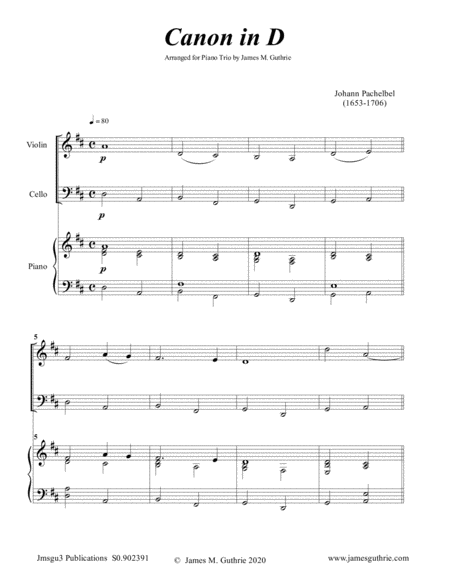
Pachelbel: Canon in D for Piano Trio
Trio à Cordes: 3 violoncelles

$36.95 31.98 € Trio à Cordes: 3 violoncelles PDF SheetMusicPlus

String Ensemble,String Trio Cello - Level 3 - Digital Download SKU: A0.1506100 Composed by James R. Murray. Arranged by John A. Dempsey. Christian,Christmas,Holiday,Sacred,Traditional. 18 pages. John A. Dempsey #1081473. Published by John A. Dempsey (A0.1506100). This triumphant, stirring cello trio - a medley of two Christmas carols - is shaded with quiet, prayerful moments and brightened by joyful bursts of praise.  Embellishments occur, together with mood and tempo changes that add to the dramatic impact of the arrangement.  It's a sweeping musical journey that celebrates the miracle of Jesus' birth.      Recommended for Christmas plays, pageants and programs, holiday recitals and Christmas concerts as well as traditional Christmas church services and other seasonal worship events, as a prelude, postlude, an offertory, interlude, Christmas play overture and special music.  Key: A minor/C major.  14 pages of music (that includes separate two-page parts for cello 1, cello 2 and cello 3).
Christmas Medley (What Child is This / Away in a Manger): Cello Trio
Trio à Cordes: 3 violoncelles

$10.99 9.51 € Trio à Cordes: 3 violoncelles PDF SheetMusicPlus

String Ensemble,String Trio Cello - Level 3 - Digital Download SKU: A0.1506053 Composed by James R. Murray. Arranged by John A. Dempsey. Christian,Christmas,Holiday,Sacred,Traditional. 18 pages. John A. Dempsey #1081436. Published by John A. Dempsey (A0.1506053). This triumphant, stirring cello trio - a medley of two Christmas carols - is shaded with quiet, prayerful moments and brightened by joyful bursts of praise.  Embellishments occur, together with mood and tempo changes that add to the dramatic impact of the arrangement.  It's a sweeping musical journey that celebrates the miracle of Jesus' birth.      Recommended for Christmas plays, pageants and programs, holiday recitals and Christmas concerts as well as traditional Christmas church services and other seasonal worship events, as a prelude, postlude, an offertory, interlude, Christmas play overture and special music.  Key: A minor/C major.  14 pages of music (that includes separate two-page parts for cello 1, cello 2 and cello 3).
Christmas Medley (What Child is This / Away in a Manger): Cello Trio
Trio à Cordes: 3 violoncelles

$10.99 9.51 € Trio à Cordes: 3 violoncelles PDF SheetMusicPlus

String Trio Cello - Level 2 - Digital Download SKU: A0.1184430 Composed by Ludwig van Beethoven. Arranged by Ander. Classical,Film/TV,Instructional,March,Romantic Period. 10 pages. Woods Only, Arrangements #784158. Published by Woods Only, Arrangements (A0.1184430). This arrangement adapted for violoncello trio was written keeping the characteristics of the original work, in order to be performed by young music students who want to enter the symphonic music. Besides, it can also be used by professional musicians, for recitals, repertoire, academic presentations and didactic material. As much as it is a funeral march, it is well suited for any musical performance occasion. The transcription is faithful to the structure, with only one change of key, so that it is comfortable for all the instruments in the formation, as well as for use in ensemble practice between musicians of different traditions.Ludwig van Beethoven began concentrated work on his Symphony No. 7 in A major Op. 92 in 1811, it was completed in 1812, and was dedicated to Count Moritz von Fries, and premiered in Vienna on December 8, 1813. It is considered a remarkable example of the more ebullient side of Beethoven's compositional personality and evidence that even after the onset of deafness, he still found cause for musical optimism. The second movement Allegretto is a funeral march in everything but name. Often several contrasting melodic ideas are made to coexist, as if Beethoven were imagining several processions converging on the cemetery at the same time. As he was working on this symphony during the years of the Napoleonic Wars, this experience was probably within his experience. It was also used as the soundtrack to the film Knowing, by director Alex Proyas and starring Nicolas Cage, where it is used in the final scene of the film. Beethoven called Symphony No. 7 his most excellent symphony, and a music critic of the time reported, this symphony is the most melodically rich and the most pleasing and comprehensible of all Beethoven's symphonies..
Symphony No. 7 by Beethoven for Cello Trio
Trio à Cordes: 3 violoncelles

$5.99 5.18 € Trio à Cordes: 3 violoncelles PDF SheetMusicPlus

String Trio Cello - Level 2 - Digital Download SKU: A0.1427291 Composed by Gerardo Matos Rodríguez. Arranged by Christian Morris. Latin. 10 pages. Hoopla Sheet Music #1008011. Published by Hoopla Sheet Music (A0.1427291). A new arrangement of “La Cumparsita,” a tango written in 1916 by the Uruguayan musician Gerardo Matos Rodríguez. It is among the most famous and recognisable tangos of all time. The title translates as the little parade, and the first version was a tune with no lyrics. Later, Matos Rodríguez produced a version with lyrics that begin: The parade of endless miseries marches around that sick being who will soon die of grief. However, the most popular version of the song is accompanied by lyrics by Pascual Contursi and is also known as Si supieras.
La Cumparsita
Trio à Cordes: 3 violoncelles

$5.99 5.18 € Trio à Cordes: 3 violoncelles PDF SheetMusicPlus

String Trio Cello - Level 1 - Digital Download SKU: A0.1114103 Composed by Johann Sebastian Bach. Arranged by Ander. Baroque,Christmas,Easter,Sacred,Wedding. 6 pages. Woods Only, Arrangements #716023. Published by Woods Only, Arrangements (A0.1114103). This easy arrangement for violoncello trio was adapted to be simple to perform and understand the structure of the original work for various levels of musical knowledge. It can be played freely by beginning students due to the ease imposed on the piece; however, this does not preclude it from being played by professionals and music teachers. It is also ideal for academic recitals, weddings, student method and ceremonies that are arranged in the same way as the piece contains. The Cantata 156 (BWV 156) was written for the third Sunday after Epiphany in 1729, and was first performed on January 23 of that year. The text is by Picander, one of Bach's favorite librettists. of the four cantatas written by Bach for the feast, it was the last and only one scored for solo voice. This is a choral cantata, employing a choral melody in several movements. Cantata 156, in fact, employs two different choral melodies and texts in the second and sixth movements. A cantata is a sung symphony consisting of several parts, one of which is the Arioso, which is the initial instrumental part.
Arioso by Bach for Cello Trio
Trio à Cordes: 3 violoncelles

$5.99 5.18 € Trio à Cordes: 3 violoncelles PDF SheetMusicPlus


Partitions Gratuites
Acheter des Partitions Musicales
Acheter des Partitions Digitales à Imprimer
Acheter des Instruments de Musique

© 2000 - 2026

Accueil - Version intégrale





