EUROPE
6035 articles
USA
0 articles
DIGITAL
16 articles (à imprimer)
Partitions Digitales
Partitions à imprimer
16 partitions trouvées


String Trio Cello - Level 1 - Digital Download SKU: A0.1135325 Composed by Martin Luther. Arranged by Ander. Baroque,Christian,Religious,Renaissance,Sacred. 5 pages. Woods Only, Arrangements #735371. Published by Woods Only, Arrangements (A0.1135325). This easy arrangement for violoncello trio has been adapted to be simple to perform and understand, adapted for various levels of musical knowledge; from beginners to music professionals. It can be played freely due to the ease built into the piece in relation to the author's suggested interpretation. Recommended for performances at Christian ceremonies and liturgical events in churches, it also serves as a study of the Renaissance repertoire. A Mighty Fortress Is Our God or Ein feste Burg ist unser Gott is a hymn written by Martin Luther probably before 1529. The melody was also considered his work for a long time, but it was created at least with the collaboration of Johann Walter. The song is of great symbolic power for Protestantism; where it is also known as Deus noster refugium et virtus. Considered one of the most important hymns in the history of Christianity, it was considered by the Christian poet Johann Heirich Heine (1797-1856) to be the Marseillaise of the Reformation, in an allusion to the French national anthem.
A Mighty Fortress is Our God by Luther for Cello Trio
Trio à Cordes: 3 violoncelles

$5.99 5.21 € Trio à Cordes: 3 violoncelles PDF SheetMusicPlus

String Trio Cello - Level 2 - Digital Download SKU: A0.1185236 Composed by Ludwig van Beethoven. Arranged by Ander. Classical,Instructional,March,Opera,Romantic Period. 10 pages. Woods Only, Arrangements #784925. Published by Woods Only, Arrangements (A0.1185236). This arrangement adapted for violoncello trio was written keeping the characteristics of the original work, that is, inspiring and significant to the already known choral symphony by Beethoven, indicated to be performed by young music students, who want to enter the symphonic music, moreover, it can also be used by professional musicians, for recitals, repertoire, academic presentations and didactic material. As much as it is a funeral march, it is well suited for any musical performance occasion. The transcription is faithful to the structure, with only one change in key, so that it is comfortable for all instruments in the formation, thus maintaining the essence of the striking melody, as well as using it for ensemble practice among musicians of different traditions.Beethoven's Ninth Symphony Op. 125 incorporates part of the poem An die Freude (To Joy), a hymn written by Friedrich Schiller, with the text sung by soloists and a choir in its last movement. It was the first example of a major composer using the human voice as prominently as the instruments in a symphony, thus creating a far-reaching work that set the tone for the symphonic form that was to be adopted by Romantic composers. This is the last complete symphony composed by Ludwig van Beethoven. The choral symphony, better known as the Ninth Symphony or The Ninth, is one of the best known works in the Western repertoire, considered both an icon and predecessor of Romantic music, and one of Beethoven's great masterpieces, where it was first performed on May 7, 1824, the same year it was completed, at the Kärntnertortheater in Vienna, Austria. The conductor was Michael Umlauf, the theater's music director, and Beethoven - dissuaded from conducting by the advanced stage of his deafness - was given a special place on the stage next to the conductor. It was later rearranged by Herbert von Karajan to become the anthem of the European Union in 1972, the national anthem of Rhodesia from 1974 until 1979, Rise, O Voices of Rhodesia, used the tune Ode to Joy..
Ode to Joy by Beethoven for Cello Trio
Trio à Cordes: 3 violoncelles

$5.99 5.21 € Trio à Cordes: 3 violoncelles PDF SheetMusicPlus

String Ensemble,String Trio Cello - Level 3 - Digital Download SKU: A0.552065 Composed by Johann Pachelbel. Arranged by James M. Guthrie. Baroque,Instructional,Standards,Wedding. Score and parts. 16 pages. Jmsgu3 #6105689. Published by jmsgu3 (A0.552065). Score: 9 pagesDuration: 2:40. The famous Pachelbel Canon arranged for Piano Trio. A great choice for weddings & receptions! Pachelbel's Canon Pachelbel's Canon is, in fact, the traditional title for a composition by the German composer Johann Pachelbel. Other names for the work include namely: Canon and Gigue for 3 violins and basso continuo, Canon and Gigue in D, and of course Canon in D. We do not know when or why in particular it was written. The oldest copy is surprisingly from the 19th century. It is important to realize that it was a common routine for organists to practice improvisation on the chord progression underlying the canon. Pachelbel originally scored the Canon notably for three violins and continuo. He also in fact paired the Canon with a gigue. The movements are homotonal, to clarify, both are in the key of D major. History In due time, Pachelbel's Canon went out of style and remained in virtual oblivion for centuries. The Jean-François Paillard chamber orchestra, however, recorded an arrangement of it in 1968. As a result, it gained approval. Many ensembles began likewise to record the piece in the 1970s and by the 1980s became ubiquitous as background music. From the 1970s to the early 2000s, pop songs correspondingly used elements of the piece. The chord progression, in particular, was used this way. Also, since the 1980s, it has been not only wildly popular for weddings, but also for funeral ceremonies in the USA and Europe. Pachelbel Background Johann Pachelbel (1653 –1706) was a German composer, as well as an organist. He was furthermore instrumental in bringing the south German organ school to its apex. He wrote a large body of music, both sacred and, equally important, secular. In particular, he uniquely helped develop the chorale prelude and fugue. For this, he has, in fact, earned a rightful place in the company of the most significant composers of the mid-Baroque period. Works Pachelbel's music was certainly popular. With this in mind, he also consequently had many pupils. His music expressly developed into a model for south German composers. Nowadays, Pachelbel is most famous, particularly for the Canon in D, as well as the F minor Chaconne, the Toccata in E minor, and of course the Hexachordum Apollinis, a set of variations for the keyboard. Influences Johann Jakob Froberger and Johann Caspar Kerll were south German composers who significantly influenced Pachelbel. Furthermore, he was especially influenced by Italians such as Frescobaldi and Poglietti. He frequently preferred an articulate, simple contrapuntal style that highlighted clarity. His music is markedly less extravagant and harmonically adventurous than that of Dieterich Buxtehude. However, as a point often overlooked, like Buxtehude, Pachelbel experimented with different instrumental combinations in his chamber music. Legacy All in all, Pachelbel was most famous as a composer for the keyboard. He composed over two hundred pieces specifically for the instrument. Pachelbel was also surprisingly a prolific composer of vocal music. All in all, about a hundred vocal works survive, including 40 or so large-scale works.
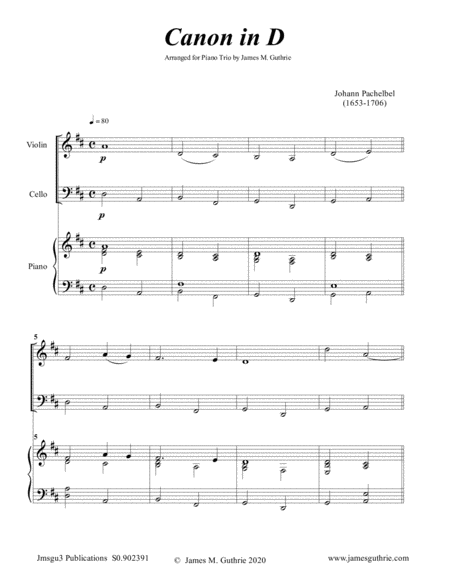
Pachelbel: Canon in D for Piano Trio
Trio à Cordes: 3 violoncelles

$36.95 32.13 € Trio à Cordes: 3 violoncelles PDF SheetMusicPlus

String Trio Cello - Level 2 - Digital Download SKU: A0.1179382 Composed by Ludwig van Beethoven. Arranged by Ander. Classical,Instructional,Opera,Romantic Period,Traditional. 11 pages. Woods Only, Arrangements #779356. Published by Woods Only, Arrangements (A0.1179382). This adaptation was intended for a small group of violoncello trio, where the original essence of the piece was kept, however, with a reduction in the duration, where only the main themes of the opening were extracted. As it is simplified, it is intended for beginner students of instrumental music who want to enter orchestral music, even in a simplified and reduced form, and can be used by music teachers with their students in ensemble practice in situations such as academic recitals, didactic concerts, or assessment tests.The Symphony No. 5 in C minor, Op. 67, known as the Symphony of Destiny, by Ludwig van Beethoven, written between 1804 and 1808, is one of the most popular and best known compositions in the entire repertoire of European music. The four movements are characterized by orchestral homogeneity, being, at the same time, an example of alternation: the first movement, revealing great tension, denounced by the strings and raised to an extreme drama; the second movement reveals solemnity, in a funeral march that rises by its emotion and beauty; the third movement, a crispness; the fourth movement expresses triumph and magnificence.
Symphony No. 5 by Beethoven for Cello Trio
Trio à Cordes: 3 violoncelles

$5.99 5.21 € Trio à Cordes: 3 violoncelles PDF SheetMusicPlus

String Trio Cello - Level 2 - Digital Download SKU: A0.1396802 Composed by Johannes Brahms. Arranged by Rika K. 19th Century,Chamber,Folk,Romantic Period,Traditional. 5 pages. Rika K. #980145. Published by Rika K. (A0.1396802). We present the sheet music for the arrangement of Johannes Brahms’ Hungarian Dance No. 5, adapted for Cello Trio.This piece, one of Brahms’ most popular, was inspired by the Hungarian folk dance Czárdás. It has now been simplified to cater to a variety of musicians and settings. Ideal for music teachers looking for enriching teaching material, parents wishing to introduce their children to this classic repertoire, or professional musicians looking for a practical piece for quick performances. This arrangement is also perfect for academic recitals or public events. Take this opportunity to delve into the rich history of classical music and experience the joy of playing a work by one of the world’s greatest composers.Don’t miss the chance to add this essential sheet music to your musical collection. Get your arrangement of Hungarian Dance No. 5 now!
Hungarian Dance No. 5 by Brahms for Cello Trio
Trio à Cordes: 3 violoncelles

$7.99 6.95 € Trio à Cordes: 3 violoncelles PDF SheetMusicPlus

String Trio Cello - Level 2 - Digital Download SKU: A0.1396801 Composed by Johannes Brahms. Arranged by Rika K. 19th Century,Chamber,Folk,Romantic Period,Traditional. 5 pages. Rika K. #980144. Published by Rika K. (A0.1396801). We present the sheet music for the arrangement of Johannes Brahmsâ?? Hungarian Dance No. 5, adapted for Cello Trio.This piece, one of Brahmsâ?? most popular, was inspired by the Hungarian folk dance Czárdás. It has now been simplified to cater to a variety of musicians and settings. Ideal for music teachers looking for enriching teaching material, parents wishing to introduce their children to this classic repertoire, or professional musicians looking for a practical piece for quick performances. This arrangement is also perfect for academic recitals or public events. Take this opportunity to delve into the rich history of classical music and experience the joy of playing a work by one of the worldâ??s greatest composers.Donâ??t miss the chance to add this essential sheet music to your musical collection. Get your arrangement of Hungarian Dance No. 5 now!
Hungarian Dance No. 5 by Brahms for Cello Trio
Trio à Cordes: 3 violoncelles

$7.99 6.95 € Trio à Cordes: 3 violoncelles PDF SheetMusicPlus

String Ensemble,String Trio Cello - Level 3 - Digital Download SKU: A0.773974 Arranged by Anthony Giamanco. Christian,Concert,Contemporary,Folk,Sacred. Score and parts. 10 pages. Whole Tone Press #6233325. Published by Whole Tone Press (A0.773974). A dignified Gospel-style arrangement for cello trio of this classic hymn. In 9/8 time with a strong Gospel swing. A great addition to any worship service, concert or recital (live or virtual). Intermediate.Anthony Giamanco is a member of ASCAP. His many piano, organ, choir, and chamber works are in the catalogs of numerous publishers including GIA, Shawnee Press, Alfred, Augsburg Fortress, Lorenz, and others. His pieces also can be purchased through sheetmusicplus.com, Sheet Music Marketplace, and JW Pepper.Anthony's music can be heard on his website, anthonygiamanco.com,https://www.anthonygiamanco.com,on SoundCloudhttps://soundcloud.com/tony-giamanco,and on his YouTube channelhttps://www.youtube.com/channel/UC09EezLz7GUoMhNrc5Y8jBg
AMAZING GRACE - cello trio
Trio à Cordes: 3 violoncelles

$5.25 4.57 € Trio à Cordes: 3 violoncelles PDF SheetMusicPlus

String Trio Cello - Level 1 - Digital Download SKU: A0.1270178 Composed by Solage. Arranged by James M. Guthrie. Chamber,Contest,Early Music,Festival,Historic,Medieval. 10 pages. Jmsgu3 #862608. Published by jmsgu3 (A0.1270178). Sources suggest that the song is a love ballad that praises the beauty and virtues of a woman named Calextone, who was a lady from the town of Arouse. The lyrics describe her as having great value and worth, and her beauty and grace are compared to smoke and mist. The composer of the song, Solage, also refers to himself in the refrain with a double meaning, using the spelling soulage. The song is considered a representative example of French secular music from the late fourteenth century.  It is not known whether Calextone was a real person or a fictional character created by the composer. Some sources suggest that the song may have been composed for a wedding, possibly that of Jeanne de Boulogne, and that Solage may have been in the service of Gaston Fébus, compte de Foix, who had a financial interest in the marriage. The composer of the song, Solage, was a prominent figure in the Ars subtilior movement, which was characterized by complex rhythms, intricate melodies, and highly stylized notation. The song is considered a representative example of this musical style, which flourished in France during the late medieval period. The song's use of acrostics and double meanings in the lyrics, as well as its intricate musical structure, demonstrate the sophistication and complexity of the Ars subtilior style. Overall, Calextone qui fut dame d'Arouse is an important example of medieval French music and its evolution over time.
Solage: Calextone qui fut dame for Cello Trio
Trio à Cordes: 3 violoncelles

$24.95 21.7 € Trio à Cordes: 3 violoncelles PDF SheetMusicPlus

String Ensemble,String Trio Cello - Level 3 - Digital Download SKU: A0.511763 Composed by E.F.Rimbault. Arranged by Han-Ki Kim. Instructional,Sacred,Standards. Score and parts. 10 pages. Han-Ki Kim #5801715. Published by Han-Ki Kim (A0.511763). O Happy Day that fixed my choice is an arrangement for 3 Violins of a popular old hymn tune. It works great for offertories, special music for a worship service, or for the Concert where inspirational music is desired. Arranger is very experienced(with I Musici - world famous chamber group of Italy), and his works are very loved world widely. Main Theme is rotated by parts, to give interest for all the player. Attached Music file is recorded as 3 Violins just for a referrence.
O Happy Day that fixed my choice (For 3 Cellos)
Trio à Cordes: 3 violoncelles

$5.50 4.78 € Trio à Cordes: 3 violoncelles PDF SheetMusicPlus

String Ensemble,String Trio Cello - Level 3 - Digital Download SKU: A0.764286 Composed by Adolphe-Charles Adam. Arranged by Kováts István. Christian,Christmas,Contemporary. Score and parts. 5 pages. Kovats Istvan #3382677. Published by Kovats Istvan (A0.764286). 2017 Holiday Contest EntryBeautiful Christmas song arranged for 3 cellos, intermediate level, the kids are loving it.It comes with score and set of parts (I recommend to use only the score, it has only 2 pages it fits on any music stand and it's better if the players see what other voices are doing)I made it for my cello class, we played it on a Christmas Concert, it was a great success, I hope You'll enjoy it as much as we did. :)For more info, contact, etc. visit my Facebook page here: https://www.facebook.com/kovatsmusicGive it a thumbs up, thanks :)
O Holy Night for Cello trio
Trio à Cordes: 3 violoncelles

$3.34 2.9 € Trio à Cordes: 3 violoncelles PDF SheetMusicPlus


Partitions Gratuites
Acheter des Partitions Musicales
Acheter des Partitions Digitales à Imprimer
Acheter des Instruments de Musique

© 2000 - 2026

Accueil - Version intégrale





