EUROPE
58490 articles
USA
0 articles
DIGITAL
89 articles (à imprimer)
Partitions Digitales
Partitions à imprimer
89 partitions trouvées

1 16 31 ....76

String Ensemble,String Trio Cello - Level 4 - Digital Download SKU: A0.1066841 Composed by Norwegian Folk Melody and Traditional American melody. Arranged by Glen Poehlmann. Sacred. Score and parts. 12 pages. Arrangements by GPoehlmann #671144. Published by arrangements by GPoehlmann (A0.1066841). 2 popular hymns are combined in this arrangement for a CELLO TRIO (unaccompanied) MY FAITH HAS FOUND A RESTING PLACE and COME, THOU FOUNT OF EVERY BLESSING Grade 3+ (Medium Difficult) 97 measures. Performance Time approx 3:05 Key: G - A - D - E. Meter: 4/4 - 3/4 Instrument Ranges (C4=middle C) Cello 1 C#3 - A4 Cello 2 A2 - D4 Cello 3 E2 - D4.
MY FAITH HAS FOUND A RESTING PLACE/COME THOU FOUNT OF EVERY BLESSING - Cello Trio (unaccompanied)
Trio à Cordes: 3 violoncelles

$5.00 4.34 € Trio à Cordes: 3 violoncelles PDF SheetMusicPlus

String Trio Cello - Level 2 - Digital Download SKU: A0.1473704 Composed by Camille Saint-Saens. Arranged by Rika K. 19th Century,Chamber,Halloween,Romantic Period,Thriller. 5 pages. Rika K. #1051424. Published by Rika K. (A0.1473704). Step into the mysterious and captivating world of Camille Saint-Saëns' Danse Macabre with our exclusive sheet music arrangement, wrote for Cello Trio .Originally composed in 1874, Danse Macabre vividly depicts the medieval legend of Death summoning the dead to dance at midnight on Halloween. Saint-Saëns' evocative score weaves haunting melodies with lively rhythms, creating a vivid musical narrative that entrances listeners with its eerie allure and supernatural charm.Whether for performances at themed events, educational settings exploring musical storytelling, or professional seeking to showcase the rich tapestry of classical repertoire, this adaptation ensures accessibility without compromising the intricate beauty and thematic depth of Danse Macabre.Embrace the allure of Saint-Saëns' masterwork, delve into its narrative richness, and experience the thrill of bringing its chilling melodies to life. Expand your musical repertoire and capture the imagination with our essential sheet music arrangement of Danse Macabre – available now to enrich your musical journey.Don’t miss your chance to summon the magic of this timeless composition – secure your copy today!
Danse Macabre by Camille Saint-Saëns
Trio à Cordes: 3 violoncelles

$7.99 6.93 € Trio à Cordes: 3 violoncelles PDF SheetMusicPlus

String Trio Cello - Level 2 - Digital Download SKU: A0.1473711 Composed by Camille Saint-Saens. Arranged by Rika K. 19th Century,Chamber,Halloween,Romantic Period,Thriller. 5 pages. Rika K. #1051429. Published by Rika K. (A0.1473711). Step into the mysterious and captivating world of Camille Saint-Saëns' Danse Macabre with our exclusive sheet music arrangement, wrote for Cello Trio .Originally composed in 1874, Danse Macabre vividly depicts the medieval legend of Death summoning the dead to dance at midnight on Halloween. Saint-Saëns' evocative score weaves haunting melodies with lively rhythms, creating a vivid musical narrative that entrances listeners with its eerie allure and supernatural charm.Whether for performances at themed events, educational settings exploring musical storytelling, or professional seeking to showcase the rich tapestry of classical repertoire, this adaptation ensures accessibility without compromising the intricate beauty and thematic depth of Danse Macabre.Embrace the allure of Saint-Saëns' masterwork, delve into its narrative richness, and experience the thrill of bringing its chilling melodies to life. Expand your musical repertoire and capture the imagination with our essential sheet music arrangement of Danse Macabre – available now to enrich your musical journey.Don’t miss your chance to summon the magic of this timeless composition – secure your copy today!
Danse Macabre by Camille Saint-Saëns
Trio à Cordes: 3 violoncelles

$7.99 6.93 € Trio à Cordes: 3 violoncelles PDF SheetMusicPlus

String Ensemble,String Trio Cello - Level 3 - Digital Download SKU: A0.596493 Composed by Juan María Solare. 20th Century,Contemporary,Instructional,Standards. Score and parts. 43 pages. Juan Maria Solare #3088705. Published by Juan Maria Solare (A0.596493). Six Thinking Hats for 3 violoncelli  (in the first position) The title of these six pieces for cello trio refers to the theory of the Six Thinking Hats by Edward de Bono. This is a tool that provides a means for groups to think (plan and decide) together more effectively - or at least in a cohesive way. Six distinct states are identified and assigned a hat color: * Information (white hat): considering exclusively what information is available, what the facts are. * Emotions (red hat): instinctive gut reaction or statements of emotional feeling (but not without any justification) * Bad points judgment (black hat): logic applied to identifying flaws or barriers, seeking mismatch (the cons of an issue). * Good points judgment (yellow hat): logic applied to identifying benefits, seeking harmony (the pros). * Creativity (green hat): statements of provocation and investigation, seeing where a thought goes. * Thinking (blue hat) - thinking about thinking, a control instance. In my Trio, these color hats are assigned to different characters or moods. For instance the red hat is the most emotional last piece, very rhythmical. Or the black hat corresponds to a reflexive, rational piece which is not pessimistic but rather extreme reflexive, pondering. Or the blue hat, which should reflect the thinking about thinking and is therefore a canon. Technically speaking, all pieces are written for cello in the first position (sometimes extended or stretched), which makes them quite suitable for young cellists or adult beginners. The total duration of the work is about 12 minutes. The durations of the single pieces are:   I = Enfática insistencia (white hat)           [1'00]  II = Milonga serena (yellow hat)               [1'45] III = Estado de alerta (green hat)               [1'45]  IV = Canon arcaizante (blue hat)               [4'00]   V = Coral en quintas (black hat)               [1'00]  VI = Finale arrabbiato (red hat)               [2'30] All these pieces can be performed individually. These six pieces for three cellists were composed in Bremen (and Worpswede) between 20th and 29th February 2012. They are dedicated to Juliane Dehning (who also kindly made essential suggestions about the bowings). International Standard Musical Work Code (ISWC): T-803.196.242-3 Recorded in La Rioja, Argentina by Dora Heisecke, Roque González & Mariana Alcaraz: https://www.youtube.com/watch?v=1DluACws6DE More information: http://www.juanmariasolare.com/six_thinking_hats.html
Six Thinking Hats [3 celli]
Trio à Cordes: 3 violoncelles

$11.00 9.54 € Trio à Cordes: 3 violoncelles PDF SheetMusicPlus

String Ensemble,String Trio Cello - Level 3 - Digital Download SKU: A0.549785 Composed by Wolfgang Amadeus Mozart. Arranged by James M. Guthrie, ASCAP. Classical,Concert,Sacred,Standards,World. Score and parts. 23 pages. Jmsgu3 #3536083. Published by jmsgu3 (A0.549785). Mozart's Romanze from Eine Kleine Nachtmusik, K. 525 for Piano Trio (Violin, Cello and Piano). Duration: ca. 7:00. Score: 11 pages. Violin: 4 pages, Cello: 2 pages, piano: 4 pages. This is one of the most beloved works in all of Mozart's catalog making it a strong choice for a recital, meditation, nightclub, church or wedding reception. Eine kleine Nachtmusik Eine kleine Nachtmusik is also at the same time known as Serenade No. 13. Indeed, we find it listed in the Köchel Catalog as K. 525. With this in mind, Mozart composed the piece by all means in 1787 probably as a commission. To clarify, the title translates as a little night-music. Mozart originally scored the work in particular for an ensemble of two violins, viola, and cello with double bass (optional). In modern times the work is certainly usually performed by string orchestras, though it is often in fact performed by a string quartet – with or without double bass. Publication A point often overlooked is that the name of the work derives from the entry Mozart made in his private journal. He wrote: Eine kleine Nacht-Musik. This explains that Mozart was probably not naming the piece, but only entering a record that he had completed it. Nevertheless, the work was published by and large in 1827. It had been sold to the publisher for the most part in 1799 by Mozart's widow Constanze. Nowadays, it is on balance extensively performed and recorded. Some critics ultimately claim that it is the most popular of all Mozart's works.   Early Years Wolfgang Amadeus Mozart (1756 – 1791), was a productive and significant Austrian classical composer. Mozart displayed unusual musical capability from his earliest childhood. It seems like he was already capable on keyboard and violin at the age of two. He started composing at age five and performed before European royalty. Middle Period At 17, Mozart was working as a musician at the Salzburg Royal court but grew agitated from boredom and traveled to search for a more interesting job. While visiting Vienna in 1781, he was summarily dismissed from his Salzburg job. Nevertheless, he decided to stay in the capital (Vienna), where he achieved much fame but little economic haven. Throughout his concluding years in the Capital, he composed many of his most famous works: symphonies, operas, and concertos. Final Period The conditions surrounding his death have been much the subject of much conjecture and mythology. He composed more than 600 works, many recognized as highpoints of symphonic, chamber, concertante, choral and operatic. He is among the most everlastingly popular of classical composers, and his impact is substantial on succeeding Western art music.  Register for free lifetime updates and revisions of this product at www.jamesguthrie.com
Mozart: Romanze from K. 525 for Piano Trio
Trio à Cordes: 3 violoncelles

$19.95 17.31 € Trio à Cordes: 3 violoncelles PDF SheetMusicPlus

String Ensemble,String Trio Cello - Level 4 - Digital Download SKU: A0.1031098 By Adele. By Adele Adkins and Paul Epworth. Arranged by The Cello Playin' Fool. Pop,R & B. Score and parts. 13 pages. Caitlin McAndry #3108637. Published by Caitlin McAndry (A0.1031098). Adele's Rolling in the Deep is an instantly recognisable hit, and is a real crowd pleaser. This arrangement, suitable for competent cellists, is designed to produce a full sound despite the small group size. The melody is swapped between parts to give each player a chance to shine. Suitable for any event, from wedding receptions to concerts, and always guaranteed to draw attention. Arrangement duration: ≈ 3:45Notes on the arrangement:Some sections are technically challenging, including double stopping in 3rds, 6ths, and open string octaves, and use of tenor clef. However anyone wanting to simplify this arrangement to make it more accessible to less experienced players would be able to do so; either by splitting up the double stops between a larger group of player, and/or transposing the melody down an octave.Performance notes:This piece should be played with energy and vigour, as intended by Adele. A good pulse and a steady speed will help players to keep together. Any repeated quavers should be played nice and staccato, and quite percussively. This avoids any mushiness sometimes associated with 3 lower instruments playing together in approximately the same range. More information:If anyone has any questions or wants more information, performance tips, rearrangements,or future requests, feel free to contact me:Caitlin McAndry ~ The Cello Playin' FoolEmail: cmcandry@me.comFacebook: The Cello Playin' FoolKudos for getting this far into the description! Thanks for reading, enjoy the music!From Caitlin The Cello Playin' FoolP.S Sorry for the awful sound quality on the recording, it was recorded on my headphone mic which is not all that good!
Rolling In The Deep
Trio à Cordes: 3 violoncelles
Adele
$12.99 11.27 € Trio à Cordes: 3 violoncelles PDF SheetMusicPlus

String Ensemble,String Trio Cello - Level 3 - Digital Download SKU: A0.552065 Composed by Johann Pachelbel. Arranged by James M. Guthrie. Baroque,Instructional,Standards,Wedding. Score and parts. 16 pages. Jmsgu3 #6105689. Published by jmsgu3 (A0.552065). Score: 9 pagesDuration: 2:40. The famous Pachelbel Canon arranged for Piano Trio. A great choice for weddings & receptions! Pachelbel's Canon Pachelbel's Canon is, in fact, the traditional title for a composition by the German composer Johann Pachelbel. Other names for the work include namely: Canon and Gigue for 3 violins and basso continuo, Canon and Gigue in D, and of course Canon in D. We do not know when or why in particular it was written. The oldest copy is surprisingly from the 19th century. It is important to realize that it was a common routine for organists to practice improvisation on the chord progression underlying the canon. Pachelbel originally scored the Canon notably for three violins and continuo. He also in fact paired the Canon with a gigue. The movements are homotonal, to clarify, both are in the key of D major. History In due time, Pachelbel's Canon went out of style and remained in virtual oblivion for centuries. The Jean-François Paillard chamber orchestra, however, recorded an arrangement of it in 1968. As a result, it gained approval. Many ensembles began likewise to record the piece in the 1970s and by the 1980s became ubiquitous as background music. From the 1970s to the early 2000s, pop songs correspondingly used elements of the piece. The chord progression, in particular, was used this way. Also, since the 1980s, it has been not only wildly popular for weddings, but also for funeral ceremonies in the USA and Europe. Pachelbel Background Johann Pachelbel (1653 –1706) was a German composer, as well as an organist. He was furthermore instrumental in bringing the south German organ school to its apex. He wrote a large body of music, both sacred and, equally important, secular. In particular, he uniquely helped develop the chorale prelude and fugue. For this, he has, in fact, earned a rightful place in the company of the most significant composers of the mid-Baroque period. Works Pachelbel's music was certainly popular. With this in mind, he also consequently had many pupils. His music expressly developed into a model for south German composers. Nowadays, Pachelbel is most famous, particularly for the Canon in D, as well as the F minor Chaconne, the Toccata in E minor, and of course the Hexachordum Apollinis, a set of variations for the keyboard. Influences Johann Jakob Froberger and Johann Caspar Kerll were south German composers who significantly influenced Pachelbel. Furthermore, he was especially influenced by Italians such as Frescobaldi and Poglietti. He frequently preferred an articulate, simple contrapuntal style that highlighted clarity. His music is markedly less extravagant and harmonically adventurous than that of Dieterich Buxtehude. However, as a point often overlooked, like Buxtehude, Pachelbel experimented with different instrumental combinations in his chamber music. Legacy All in all, Pachelbel was most famous as a composer for the keyboard. He composed over two hundred pieces specifically for the instrument. Pachelbel was also surprisingly a prolific composer of vocal music. All in all, about a hundred vocal works survive, including 40 or so large-scale works.
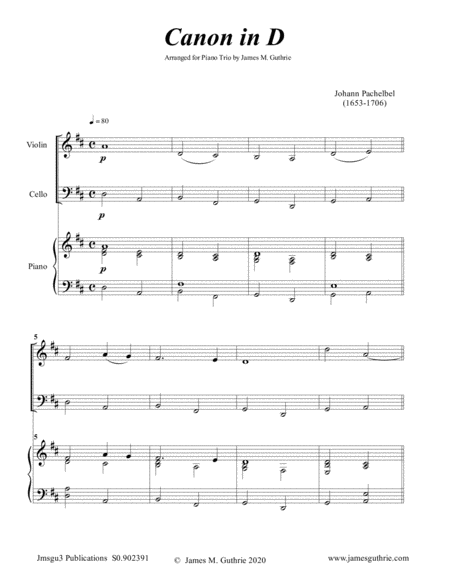
Pachelbel: Canon in D for Piano Trio
Trio à Cordes: 3 violoncelles

$36.95 32.06 € Trio à Cordes: 3 violoncelles PDF SheetMusicPlus

String Trio Cello - Level 1 - Digital Download SKU: A0.1115186 Composed by Johann Sebastian Bach. Arranged by Ander. Baroque,Christian,Christmas,Sacred,Wedding. 5 pages. Woods Only, Arrangements #716994. Published by Woods Only, Arrangements (A0.1115186). This easy arrangement for violoncello trio has been adapted to be simple to perform and understand the structure of the original work for various levels of musical knowledge. It can be played freely by beginning students because of the ease imposed on the piece. Recommended for performance in reverently Christian and liturgical ceremonies such as Good Friday and Christmas time. It also serves as a study for Baroque sacred song. The Jesulein süß, the Jesulein mild is an original traditional German choral melody for voice and continuous bass arranged by Johann Sebastian Bach around 1735. With lyrics by Valentin Thilo, O Jesulein süss is a sacred melody adapted and catalogued as BWV 493. The first translation is by Dirk van Hogendorp, who made it more of a song for the time of suffering.
O Jesulein süss by Bach for Cello Trio
Trio à Cordes: 3 violoncelles

$5.99 5.2 € Trio à Cordes: 3 violoncelles PDF SheetMusicPlus


1 16 31 ....76


Partitions Gratuites
Acheter des Partitions Musicales
Acheter des Partitions Digitales à Imprimer
Acheter des Instruments de Musique

© 2000 - 2026

Accueil - Version intégrale





