EUROPE
553 articles
USA
0 articles
DIGITAL
22 articles (à imprimer)
Partitions Digitales
Partitions à imprimer
22 partitions trouvées


Euphonium,Piano - Level 2 - Digital Download SKU: A0.549222 Composed by Johann Sebastian Bach. Arranged by James M. Guthrie, ASCAP. Baroque,Holiday,Standards,Wedding. Score and part. 9 pages. Jmsgu3 #3468180. Published by jmsgu3 (A0.549222). J. S. Bach BWV 508. Bist du bei mir Bach adapted this aria from a lost Stölzel opera called Diomedes. He changed the original orchestral instrumentation to soprano, strings, and continuo.  He also modified the voice-leading making it sound more like a Bach composition. The work appears as BWV 508 No. 25 in the Anna Magdalena Notebook No. 2.   Source Only a few remnants of the original opera have survived. Historians speculate that Anna Magdalena got the song from the Leipzig Opera after the bankruptcy of 1720. Chances are good, though, that the tune was a favorite of everyone in Leipzig at the time.   Lyrics When thou art near, I go with joyTo death and to my rest.O how joyous would my end be,If your fair hands            Would close my faithful eyes. - Unknown Bach Overview First of all, Johann Sebastian Bach is maybe the greatest composer in music history. Certainly, he was prolific. As a result, everyone has heard of his works. Furthermore, these works number well over a thousand. It seems like people are probably most familiar with instrumental works such as the Brandenburg Concertos, and the Goldberg Variations. But, similarly famous are such noteworthy works as the Well-Tempered Clavier, the Musical Offering, and certainly the Art of Fugue. Seems like his most famous vocal works include the most noteworthy Mass in B Minor. Also, most noteworthy are the St. John Passion, and indeed the Christmas Oratorio.  History Bach came from a long line of musicians and above all, composers. Consequently, he, first of all, pursued a career as a church organist. So as a result, he gained employment in various Protestant churches in Germany. For a while, he worked as a court musician in Weimar and Köthen. Here he probably developed his organ style and likewise his chamber music style. Eventually, he, therefore, gained an appointment as Cantor of St. Thomas in Leipzig. Here he worked until difficulties with his employer ultimately drove him away. The King of Poland finally appointed him as court composer.  Style It seems like Bach created a fascinating new international style. He synthesized elements of the most noteworthy European music ideas into his new style. Even more, this new style was probably his synthesis of European musical rhythm and form. Furthermore, he demonstrated a complete mastery of counterpoint and motivic development. His sense of harmonic organization probably propelled him to the top. Revival                Mendelssohn conducted a Bach revival in the nineteenth century. His effort probably helped to re-familiarize the public with the magnitude of Bach’s works. During this period, scholars published many noteworthy Bach biographies. Moreover, Wolfgang Schmieder published the BWV (Bach Werke Verzeichnis). As a result, this is now the official catalog of his entire artistic output. The BWV number allows us to locate a work in the catalog. Sometimes scholars will simply use an S (Schmieder) as an abbreviation for BWV.  Voyager NASA launched two Voyager spacecraft in 1977. Onboard are phonograph records with sounds, music, and images of life on Earth. The purpose of the launch was to inform intelligent extraterrestrial life forms about conditions on Earth. The music on the disc is varied. There is Bach, Mozart, Beethoven, and Stravinsky among others. However, because Bach is so important in our music history, it contains three times more Bach than all the others combined.
Bach: Bist du bei mir BWV 508 for Euphonium & Piano
Euphonium, Piano (duo)

$32.95 28.52 € Euphonium, Piano (duo) PDF SheetMusicPlus

Euphonium,Piano - Level 3 - Digital Download SKU: A0.549392 Composed by George Frideric Handel. Arranged by James M. Guthrie, ASCAP. Baroque,Sacred,Standards,Wedding. Score and part. 9 pages. Jmsgu3 #3492565. Published by jmsgu3 (A0.549392). Duration: 4:55, Score: 6 pages, Solo part: 1 page, piano part: 2 pages. A very famous aria (Ombra mai fu) from XerxesSuitable for any venue requiring meditative music. Excellent choice for a recital encore. Xerxes Xerxes is, in fact, an opera seria in three acts by Handel. Moreover, Handel conducted the premiere performance in London in 1738. Handel casts the opera in Persia in 470 BC. The part of Xerxes was indeed originally sung by a soprano castrato. Nowadays, the part is generally sung by a mezzo-soprano or conversely a counter-tenor. In the first place, Xerxes sings an opening aria, Ombra mai fu to a plane tree. Handel sets this aria to one of his most truly famous melodies. Although many refer to it traditionally as Handel’s Largo, Handel has, on the contrary, clearly marked Larghetto in the score. Handel Background George Frideric Handel (1685 - 1759) was born in Germany but eventually became a British citizen. Nonetheless, he was a famous Baroque composer. In fact, he became famous for his operas, oratorios, anthems, and organ concertos. Handel studied music and, by and large, worked as a composer in Germany and Italy before moving to London. On the whole, Handel was very familiar with the contemporary music of Italy and Germany. Career in England It is essential to realize that Italian opera was all the rage in England at the time. Moreover, Handel was really good at writing them. Therefore, he started not one but three opera companies in England. Alexander's Feast was a huge success in 1736, but Handel began composing English choral works. After success with the Messiah in 1742) he certainly never again wrote an Italian opera. Consequently, he died in 1759, a treasured genius. Accordingly, the English government gave him full state honors at his funeral. Hence, he is buried in Westminster Abbey in London. Legacy Music historians agree that Handel was in general one of the greatest composers of the Baroque era.  To demonstrate, his works such as the Messiah, Water Music, and Music for the Royal Fireworks remain consistently popular up to the present time. He especially composed the coronation anthem, Zadok the Priest for the coronation of George II. Nevertheless, it has specifically been performed at every succeeding British coronation since. His oratorio Solomon has by all means also continued to be prevalent. As a matter of fact, Sinfonia from act 3 was featured the 2012 London Olympics opening ceremony. Handel was particularly prolific. To enumerate, he wrote over forty operas.  Since the late 1960s, we have expressly experienced a revival of baroque music. Similarly, we have especially seen a pique of interest in historically informed musical performances. Since his death in 1779, interest in Handel's music has all in all, expanded.  
Handel: Largo from Xerxes for Euphonium & Piano
Euphonium, Piano (duo)

$32.95 28.52 € Euphonium, Piano (duo) PDF SheetMusicPlus

Euphonium,Piano - Level 2 - Digital Download SKU: A0.549854 Composed by Johann Sebastian Bach. Arranged by James M. Guthrie, ASCAP. Baroque,Concert,Easter,Sacred,Standards. Score and part. 12 pages. Jmsgu3 #3555095. Published by jmsgu3 (A0.549854). Wachet auf, ruft uns die Stimme (Awake, the voice is calling us) from Cantata BWV 140. Duration: ca. 4:00, Score: 6 pages, solo part 1 page, piano part: 4 pages. Program this for church services during the Easter season, or as a recital encore.Wachet auf, ruft uns die Stimme (Awake, the Voice is calling us) also known as: Sleepers Awake Bach composed his church cantata Wachet auf (BWV 140) as part of his second annual cantata cycle covering the entire annual church calendar. It is based on the hymn of the same name by Philipp Nicolai (1599). The hymn text covers the readings for the 27th Sunday after Trinity. Bach designed the cantata in seven movements, setting the stanzas in various forms. Among these forms are the chorale fantasia, the chorale prelude, and a four-part chorale. He casts the new lyrics as recitatives – in a manner similar to the opera. Fourth Movement Bach writes the fourth movement, Zion hört die Wächter singen (Zion hears the watchmen singing), in the style of a chorale prelude with the chorale phrases performed as a strict cantus firmus. The phrases seem to enter at times erratically against the famous lyrical melody. The violins play this melody in unison as a foil against the cantus phrases. The violin melody is so independent and complete that when the cantus melody appears it catches the listener at times totally off-guard. Bach later transcribed this movement for organ (BWV 645). This transcription became No. 1 of the Six Schübler Chorales. Bach Overview First of all, Johann Sebastian Bach is maybe the greatest composer in music history. Certainly, he was prolific. As a result, everyone has heard of his works. Furthermore, these works number well over a thousand. It seems like people are probably most familiar with the instrumental works such as the Brandenburg Concertos, and the Goldberg Variations. But, similarly famous are such noteworthy works as the Well-Tempered Clavier, the Musical Offering, and certainly the Art of Fugue. Seems like his most famous vocal works include the most noteworthy Mass in B Minor. Also, most noteworthy, though, are the St. John Passion, and certainly the Christmas Oratorio.  History Bach came from a long line of musicians and above all, composers. Consequently, he, first of all, pursued a career as a church organist. So as a result, he gained employment in various Protestant churches in Germany. For a while, he worked as a court musician in Weimar and Köthen. Here he probably developed his organ style and likewise his chamber music style. Eventually, he, therefore, gained an appointment as Cantor of St. Thomas in Leipzig. Here he worked until difficulties with his employer ultimately drove him away. The King of Poland finally appointed him as court composer.  Style It seems like Bach created a fascinating new international style. He synthesized elements of the most noteworthy European music ideas into his new style. Even more, this new style was probably his synthesis of European musical rhythm and form. Furthermore, he demonstrated a complete mastery of counterpoint and motivic development. His sense of harmonic organization probably propelled him to the top. Revival                 Mendelssohn conducted a Bach revival in the nineteenth century. His effort probably helped to re-familiarize the public with the magnitude of Bach’s works. During this period, scholars published many noteworthy Bach biographies. Moreover, Wolfgang Schmieder published the BWV (Bach Werke Verzeichnis). As a result, this is now the official catalog of his entire artistic output. The BWV number allows us to locate a work in the catalog. Sometimes scholars will simply use an S (Schmieder) as an abbreviation for BWV.  .
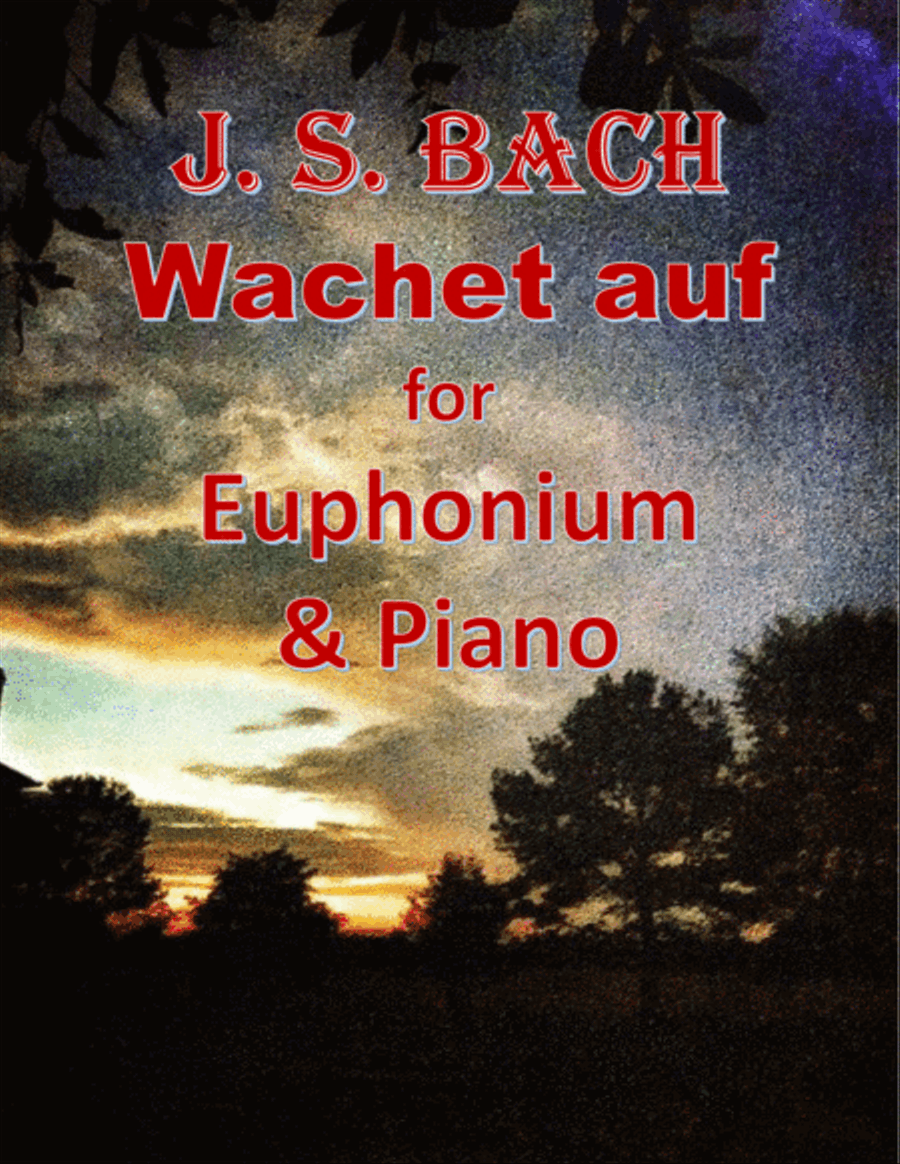
Bach: Wachet auf for Euphonium & Piano
Euphonium, Piano (duo)

$24.95 21.59 € Euphonium, Piano (duo) PDF SheetMusicPlus

Euphonium,Piano - Level 2 - Digital Download SKU: A0.549852 Composed by Johann Sebastian Bach. Arranged by James M. Guthrie, ASCAP. Baroque,Concert,Easter,Sacred,Standards. Score and part. 12 pages. Jmsgu3 #3555081. Published by jmsgu3 (A0.549852). Wachet auf, ruft uns die Stimme (Awake, the voice is calling us) from Cantata BWV 140. Duration: ca. 4:00, Score: 6 pages, solo part 1 page, piano part: 4 pages. Program this for church services during the Easter season, or as a recital encore.Wachet auf, ruft uns die Stimme (Awake, the Voice is calling us) also known as: Sleepers Awake Bach composed his church cantata Wachet auf (BWV 140) as part of his second annual cantata cycle covering the entire annual church calendar. It is based on the hymn of the same name by Philipp Nicolai (1599). The hymn text covers the readings for the 27th Sunday after Trinity. Bach designed the cantata in seven movements, setting the stanzas in various forms. Among these forms are the chorale fantasia, the chorale prelude, and a four-part chorale. He casts the new lyrics as recitatives – in a manner similar to the opera. Fourth Movement Bach writes the fourth movement, Zion hört die Wächter singen (Zion hears the watchmen singing), in the style of a chorale prelude with the chorale phrases performed as a strict cantus firmus. The phrases seem to enter at times erratically against the famous lyrical melody. The violins play this melody in unison as a foil against the cantus phrases. The violin melody is so independent and complete that when the cantus melody appears it catches the listener at times totally off-guard. Bach later transcribed this movement for organ (BWV 645). This transcription became No. 1 of the Six Schübler Chorales. Bach Overview First of all, Johann Sebastian Bach is maybe the greatest composer in music history. Certainly, he was prolific. As a result, everyone has heard of his works. Furthermore, these works number well over a thousand. It seems like people are probably most familiar with the instrumental works such as the Brandenburg Concertos, and the Goldberg Variations. But, similarly famous are such noteworthy works as the Well-Tempered Clavier, the Musical Offering, and certainly the Art of Fugue. Seems like his most famous vocal works include the most noteworthy Mass in B Minor. Also, most noteworthy, though, are the St. John Passion, and certainly the Christmas Oratorio.  History Bach came from a long line of musicians and above all, composers. Consequently, he, first of all, pursued a career as a church organist. So as a result, he gained employment in various Protestant churches in Germany. For a while, he worked as a court musician in Weimar and Köthen. Here he probably developed his organ style and likewise his chamber music style. Eventually, he, therefore, gained an appointment as Cantor of St. Thomas in Leipzig. Here he worked until difficulties with his employer ultimately drove him away. The King of Poland finally appointed him as court composer.  Style It seems like Bach created a fascinating new international style. He synthesized elements of the most noteworthy European music ideas into his new style. Even more, this new style was probably his synthesis of European musical rhythm and form. Furthermore, he demonstrated a complete mastery of counterpoint and motivic development. His sense of harmonic organization probably propelled him to the top. Revival                 Mendelssohn conducted a Bach revival in the nineteenth century. His effort probably helped to re-familiarize the public with the magnitude of Bach’s works. During this period, scholars published many noteworthy Bach biographies. Moreover, Wolfgang Schmieder published the BWV (Bach Werke Verzeichnis). As a result, this is now the official catalog of his entire artistic output. The BWV number allows us to locate a work in the catalog. Sometimes scholars will simply use an S (Schmieder) as an abbreviation for BWV.  .
Bach: Wachet auf for Baritone Horn & Piano
Euphonium, Piano (duo)

$24.95 21.59 € Euphonium, Piano (duo) PDF SheetMusicPlus

Instrumental Duet,Piano Euphonium,Instrumental Duet,Piano - Level 3 - Digital Download SKU: A0.760218 Composed by Wolfgang Amadeus Mozart. Arranged by Raymond Fenech. Classical,Contest,Festival,Instructional,Multicultural,Opera,World. Score and parts. 23 pages. Raymond Fenech #3520115. Published by Raymond Fenech (A0.760218). The Magic Flute (German: Die Zauberflöte), K. 620, is an opera in two acts by Wolfgang Amadeus Mozart to a German libretto by Emanuel Schikaneder. The work is in the form of a Singspiel, a popular form that included both singing and spoken dialogue.[a] The work premiered on 30 September 1791 at Schikaneder's theatre, the Freihaus-Theater auf der Wieden in Vienna, just two months before the composer's premature death. Queen of the Night is a popular aria from The Magic Flute. The Duration is approx. 2.51 minutes and the level is Intermediate.Can send you backing Mp3 with proof of buying. email: rfenech58@gmail.com
Queen of the Night - From the Magic Flute - 2 Euphoniums/ Trombones and Piano
Euphonium, Piano (duo)

$4.99 4.32 € Euphonium, Piano (duo) PDF SheetMusicPlus

Euphonium,Piano - Level 4 - Digital Download SKU: A0.811112 Composed by Various. Arranged by Ralph Sauer. Baroque,Classical,Romantic Period. Score and part. 48 pages. Gordon Cherry #5043705. Published by Gordon Cherry (A0.811112). Ralph Sauer has beautifully edited 13 Bel Canto studies for Euphonium by three Italian operatic masters: Rossini, Bellini and Donizetti. These studies are the in the style of vocalises, (having no words) and can be performed unaccompanied, or with their original accompaniments.The Bel Canto studies which are in bass clef, are from the same era as the famous Bordogni studies and can be used by intermediate performers. These 13 works are a wonderful addition to the Euphonium repertoire and can be performed on recitals, auditions and juries.
Bel Canto Studies for Euphonium with Piano accompaniment
Euphonium, Piano (duo)

$17.50 15.14 € Euphonium, Piano (duo) PDF SheetMusicPlus

Euphonium,Piano - Digital Download SKU: A0.746809 Composed by Giacomo Puccini. Arranged by Keith Terrett. 20th Century,Opera,Patriotic,World. Score and part. 5 pages. Keith Terrett #3578563. Published by Keith Terrett (A0.746809). A great arrangement for low brass players, wanting to explore Italian opera arias on their instrument for their next performance. Nessun dorma (English: None shall sleep) is an aria from the final act of Giacomo Puccini's opera Turandot, and is one of the best-known tenor arias in all opera. It is sung by Calaf, il principe ignoto (the unknown prince), who falls in love at first sight with the beautiful but cold Princess Turandot. However, any man who wishes to wed Turandot must first answer her three riddles; if he fails, he will be beheaded.
Nessun Dorma for Baritone, Euphonium, Trombone (BC) & Piano
Euphonium, Piano (duo)

$7.99 6.91 € Euphonium, Piano (duo) PDF SheetMusicPlus

Euphonium,Piano - Level 3 - Digital Download SKU: A0.1495599 Composed by Leo Delibes. Arranged by Diego Marani. Classical,Film/TV,Instructional,Romantic Period,Standards. Score and part. 10 pages. Diego Marani #1072120. Published by Diego Marani (A0.1495599). Coppélia is a comic ballet from 1870 originally choreographed by Arthur Saint-Léon to the music of Léo Delibes. The ballet's first flush of success was interrupted by the Franco-Prussian War and the siege of Paris, but eventually it became the most-performed ballet at the Opéra.In this arrangement for euphonium - baritone (C B.C. and Bb T.C.) with piano accompaniment we have the most famous waltz (valse) of the opera, a beautiful composition full of charm and lightness at the same time. It is suitable for any occasion: classroom, repertoire and recital.
Waltz from Coppelia for Euphonium and Piano
Euphonium, Piano (duo)

$7.99 6.91 € Euphonium, Piano (duo) PDF SheetMusicPlus


Partitions Gratuites
Acheter des Partitions Musicales
Acheter des Partitions Digitales à Imprimer
Acheter des Instruments de Musique

© 2000 - 2026

Accueil - Version intégrale





