EUROPE
7756 articles
USA
0 articles
DIGITAL
61 articles (à imprimer)
Partitions Digitales
Partitions à imprimer
61 partitions trouvées

1 16 31 ....61

Instrumental Duet Bassoon,Instrumental Duet,Piano - Level 3 - Digital Download SKU: A0.549477 Composed by Alexander Scriabin. Arranged by James M. Guthrie, ASCAP. Concert,Instructional,Romantic Period,Sacred,Standards. Score and parts. 12 pages. Jmsgu3 #3499857. Published by jmsgu3 (A0.549477). Alexander Scriabin Op. 11 No. 2. Score: 8 pages, solo part: 2 pages, piano part: 2 pages. Duration: 3:10. An introspective and meditative work with a lot of dynamic and phrasing nuance. Works well for church meditations or recital encores.Background Op.11/2 Alto Clarinet version. First of all, Scriabin composed mostly for the solo piano and also the orchestra. This is probably because he was a gifted pianist and therefore certainly appreciated the piano. Scriabin grew up in the late Romantic period, consequently, he was fond of the great piano masters of the time. As a result, he wrote his first noteworthy compositions in the manner of Chopin and Liszt. Forms Likewise, Scriabin used many of the same forms as Chopin. These certainly include the étude, prelude, nocturne, and even the mazurka. In contrast, as he developed his own sense of style his music became more and more unusual. So, the last five of his Piano Sonatas do not have a key signature and therefore lean towards atonality. Philosophy Scriabin also developed a keen interest in philosophy and likewise poetry. He was above all particularly fascinated by Nietzsche, Delville, and Blavatsky. Consequently, he finally established his own ideas about metaphysics and certainly mysticism. Scriabin consequently advanced theories about the relationship between color and musical keys. Synesthesia He also may have experienced a condition called synesthesia where he could probably sense a response created from a different stimulus. Therefore, it was almost as if he could see music and hear colors. Scriabin, therefore, arranged the colors in a circle similar to the circle-of-fifths and assigned each key area a color. Finally, he assigned the key of C to the color red, while the key of G was orange. Similarly, he assigned D to yellow, A to green, and so forth. Strangely, he did not differentiate between major and minor key colors.  Multimedia Hence, his ability to translate colors into music certainly gave Scriabin a most noteworthy interest in creating multimedia events. Furthermore, He designed his biggest work, the Mysterium, to last an entire week. Even more, Scriabin made plans not only for music, but also colored lights, incense, and dancing. He designed the performance to occur in the foothills of the Himalaya mountains. The Mysterium was never performed, and only sketches of the work remain. Modern Performances In modern times, we often experience performances of Scriabin’s most famous completed works accompanied by colored laser lights and incense. These are the Poem of Ecstasy (completed in 1908) and the Poem of Fire (completed in 1910). The lighting effects for these early performances were accomplished by the clavier à lumiéres. It was a keyboard instrument that projected colored light onto a screen.
Scriabin: Prelude Op. 11 No. 2 for Bassoon & Piano
Basson, Piano (duo)

$19.95 17.35 € Basson, Piano (duo) PDF SheetMusicPlus

Instrumental Duet Bassoon,Instrumental Duet,Piano - Level 2 - Digital Download SKU: A0.549851 Composed by Johann Sebastian Bach. Arranged by James M. Guthrie, ASCAP. Baroque,Concert,Easter,Sacred,Standards. Score and parts. 12 pages. Jmsgu3 #3555069. Published by jmsgu3 (A0.549851). Wachet auf, ruft uns die Stimme (Awake, the voice is calling us) from Cantata BWV 140. Duration: ca. 4:00, Score: 6 pages, solo part 1 page, piano part: 4 pages. Program this for church services during the Easter season, weddings, or as a recital encore.Wachet auf, ruft uns die Stimme (Awake, the Voice is calling us) also known as: Sleepers Awake Bach composed his church cantata Wachet auf (BWV 140) as part of his second annual cantata cycle covering the entire annual church calendar. It is based on the hymn of the same name by Philipp Nicolai (1599). The hymn text covers the readings for the 27th Sunday after Trinity. Bach designed the cantata in seven movements, setting the stanzas in various forms. Among these forms are the chorale fantasia, the chorale prelude, and a four-part chorale. He casts the new lyrics as recitatives – in a manner similar to the opera. Fourth Movement Bach writes the fourth movement, Zion hört die Wächter singen (Zion hears the watchmen singing), in the style of a chorale prelude with the chorale phrases performed as a strict cantus firmus. The phrases seem to enter at times erratically against the famous lyrical melody. The violins play this melody in unison as a foil against the cantus phrases. The violin melody is so independent and complete that when the cantus melody appears it catches the listener at times totally off-guard. Bach later transcribed this movement for organ (BWV 645). This transcription became No. 1 of the Six Schübler Chorales. Bach Overview First of all, Johann Sebastian Bach is maybe the greatest composer in music history. Certainly, he was prolific. As a result, everyone has heard of his works. Furthermore, these works number well over a thousand. It seems like people are probably most familiar with the instrumental works such as the Brandenburg Concertos, and the Goldberg Variations. But, similarly famous are such noteworthy works as the Well-Tempered Clavier, the Musical Offering, and certainly the Art of Fugue. Seems like his most famous vocal works include the most noteworthy Mass in B Minor. Also, most noteworthy, though, are the St. John Passion, and certainly the Christmas Oratorio.  History Bach came from a long line of musicians and above all, composers. Consequently, he, first of all, pursued a career as a church organist. So as a result, he gained employment in various Protestant churches in Germany. For a while, he worked as a court musician in Weimar and Köthen. Here he probably developed his organ style and likewise his chamber music style. Eventually, he, therefore, gained an appointment as Cantor of St. Thomas in Leipzig. Here he worked until difficulties with his employer ultimately drove him away. The King of Poland finally appointed him as court composer.  Style It seems like Bach created a fascinating new international style. He synthesized elements of the most noteworthy European music ideas into his new style. Even more, this new style was probably his synthesis of European musical rhythm and form. Furthermore, he demonstrated a complete mastery of counterpoint and motivic development. His sense of harmonic organization probably propelled him to the top. Revival               Mendelssohn conducted a Bach revival in the nineteenth century. His effort probably helped to re-familiarize the public with the magnitude of Bach’s works. During this period, scholars published many noteworthy Bach biographies. Moreover, Wolfgang Schmieder published the BWV (Bach Werke Verzeichnis). As a result, this is now the official catalog of his entire artistic output. The BWV number allows us to locate a work in the catalog. Sometimes scholars will simply use an S (Schmieder) as an abbreviation for BWV. &n.
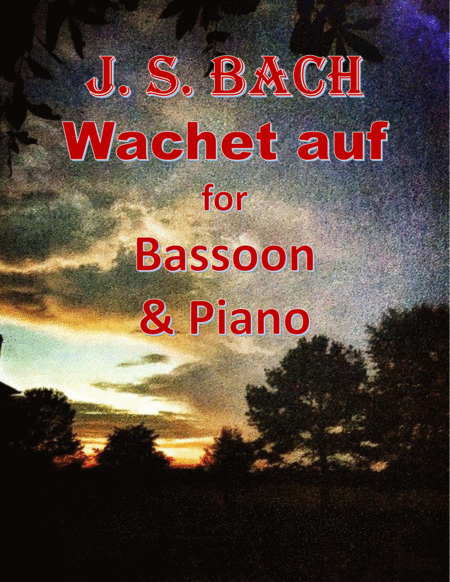
Bach: Wachet auf for Bassoon & Piano
Basson, Piano (duo)

$24.95 21.7 € Basson, Piano (duo) PDF SheetMusicPlus

Bassoon,Piano - Level 2 - Digital Download SKU: A0.1303402 Composed by Gabriel Faure. Arranged by Harry Walker. 19th Century,Romantic Period. Score and part. 8 pages. SCORE EDITIONS #892976. Published by SCORE EDITIONS (A0.1303402). This mélodie is the first in a set of three songs, opus 7, which also comprises Hymne and Barcarolle respectively. All three were composed between 1870 and 1877, then collected and published in 1878 under the title Trois Mélodies. Not originally conceived as a song cycle, these three songs acquired this opus number much later, in the 1890s. The poem for Après un rêve was loosely adapted from an anonymous Italian text by Romain Bussine. It describes, in the form of a dream, the imaginary flight of two lovers who are head over heels in love, although the last verse brings the dreamer inexorably back to harsh reality as dawn is breaking. In this version, the composition was arranged for Bassoon and Piano by Harry Walker.
Après un rêve (Fauré) for Bassoon and Piano
Basson, Piano (duo)

$5.99 5.21 € Basson, Piano (duo) PDF SheetMusicPlus

Bassoon,Piano - Level 3 - Digital Download SKU: A0.549346 By Barry Manilow. By Bruce Johnston. Arranged by James M. Guthrie, ASCAP. Contemporary,Rock. Score and part. 8 pages. Jmsgu3 #3486719. Published by jmsgu3 (A0.549346). Duration: ca. 3:00, score: 5 pages, solo part: 1 page, piano part: 2 pages.Very famous song suitable for church, recital or nightclub. I Write the Songs is a popular song written by Bruce Johnston in 1975 and made famous by Barry Manilow. Manilow's version reached number one on the Billboard Hot 100 chart in January 1976[2] after spending two weeks atop the Billboard adult contemporary chart in December 1975.[3] It won a Grammy Award for Song of the Year and was nominated for Record of the Year in 1977.[3] Billboard ranked it as the No. 13 song of 1976.[4]The original version was recorded by The Captain & Tennille, who worked with Johnston in the early 1970s with The Beach Boys. It appears on their 1975 album, Love Will Keep Us Together. The first release of I Write the Songs as a single was by then teen-idol David Cassidy from his 1975 solo album The Higher They Climb, which was also produced by Bruce Johnston. Cassidy's version reached #11 on the UK Singles Chart in August of that year.[5]Johnston has stated that, for him, the I in the song is God,[2] and that songs come from the spirit of creativity in all of us. He has said that the song is not about his Beach Boys bandmate Brian Wilson.[6]Manilow was initially reluctant to record the song, stating in his autobiography Sweet Life: The problem with the song was that if you didn't listen carefully to the lyric, you would think that the singer was singing about himself. It could be misinterpreted as a monumental ego trip.[3] After persuasion by Clive Davis, then president of Arista Records, Manilow recorded the song, and his version of I Write the Songs was the first single taken from the album Tryin' to Get the Feeling. It first charted on the Billboard Hot 100 on November 15, 1975, reaching the top of the chart nine weeks later, on January 17, 1976. Wikipedia
I Write The Songs
Basson, Piano (duo)
Barry Manilow
$39.95 34.74 € Basson, Piano (duo) PDF SheetMusicPlus

Bassoon,Piano - Level 3 - Digital Download SKU: A0.547879 By Elton John. By Bernie Taupin and Elton John. Arranged by James M. Guthrie, ASCAP. Pop,Rock. Score and part. 11 pages. Jmsgu3 #3073397. Published by jmsgu3 (A0.547879). BASSOON & PIANOScore: 6 pages, solo part: 2 pages, piano part: 3 pages. Score 6 pages, Part 2 pages, Duration 3' 11 at half note = 60. Length: 51 measures. One of Elton John's greatest songs, this mega-hit is suitable for performance in church, nightclub, or recital hall. This song contains many advanced songwriting techniques and shows a complete mastery of advanced tonal harmony and voice leading. The verses are syllabic and arranged in 8 regular phrases. The last phrase is elided with a contrasting melismatic bridge that suddenly modulates to the lowered mediant, causing a foreign chromatic mediant relation. (F major to Ab major). Further drama is evoked by the voice-leading where an ascending leap of a minor 9th signals the beginning of the bridge. The bridge then modulates back to the original key for the refrain, which, like the verses is arranged in 8 regular phrases and elides once again into a final version of the bridge which functions this time as a coda. 
Goodbye Yellow Brick Road
Basson, Piano (duo)
Elton John
$53.95 46.91 € Basson, Piano (duo) PDF SheetMusicPlus

Bassoon,Piano - Level 1 - Digital Download SKU: A0.548737 By Cat Stevens. By Cat Stevens. Arranged by James M. Guthrie, ASCAP. Rock. Score and part. 11 pages. Jmsgu3 #3415197. Published by jmsgu3 (A0.548737). Very strong arrangement for Easter. Duration: 2:48. 84 ms. Score: 7 pg. Solo part 1 pg. piano part 3 pg. Morning Has Broken is a popular and well-known Christian hymn first published in 1931. It has words by English author Eleanor Farjeon and was inspired by the village of Alfriston in East Sussex, then set to a traditional Scottish Gaelic tune known as Bunessan [1] (it shares this tune with the 19th century Christmas Carol Child in the Manger[2]). It is often sung in children's services and in Funeral services.[3] English pop musician and folk singer Cat Stevens included a version on his 1971 album Teaser and the Firecat. The song became identified with Stevens due to the popularity of this recording. It reached number six on the U.S. Billboard Hot 100, number one on the U.S. easy listening chartin 1972,[4] and number four on the Canadian RPM Magazine charts. The hymn originally appeared in the second edition of Songs of Praise (published in 1931), to the tune Bunessan, composed in the Scottish Islands. In Songs of Praise Discussed, the editor, Percy Dearmer, explains that as there was need for a hymn to give thanks for each day, English poet and children's author Eleanor Farjeon had been asked to make a poem to fit the lovely Scottish tune. A slight variation on the original hymn, also written by Eleanor Farjeon, can be found in the form of a poem contributed to the anthology Children's Bells, under Farjeon's new title, A Morning Song (For the First Day of Spring), published by Oxford University Press in 1957. The song is noted in 9/4 time but with a 3/4 feel. Bunessan had been found in L. McBean's Songs and Hymns of the Gael, published in 1900.[5] Before Farjeon's words, the tune was used as a Christmas carol, which began Child in the manger, Infant of Mary, translated from the Scottish Gaelic lyrics written by Mary MacDonald. The English-language Roman Catholic hymnal also uses the tune for the James Quinn hymns, Christ Be Beside Me and This Day God Gives Me, both of which were adapted from the traditional Irish hymn St. Patrick's Breastplate. Another Christian hymn, Baptized In Water, borrows the tune. -Wikipedia  
Morning Has Broken
Basson, Piano (duo)
Cat Stevens
$47.95 41.7 € Basson, Piano (duo) PDF SheetMusicPlus

Bassoon,Piano - Level 1 - Digital Download SKU: A0.548736 By Cat Stevens. By Cat Stevens. Arranged by James M. Guthrie, ASCAP. Rock. Score and part. 11 pages. Jmsgu3 #3415199. Published by jmsgu3 (A0.548736). Very strong arrangement for Easter. Duration: 2:48. 84 ms. Score: 7 pg. Solo part 1 pg. piano part 3 pg. Morning Has Broken is a popular and well-known Christian hymn first published in 1931. It has words by English author Eleanor Farjeon and was inspired by the village of Alfriston in East Sussex, then set to a traditional Scottish Gaelic tune known as Bunessan [1] (it shares this tune with the 19th century Christmas Carol Child in the Manger[2]). It is often sung in children's services and in Funeral services.[3] English pop musician and folk singer Cat Stevens included a version on his 1971 album Teaser and the Firecat. The song became identified with Stevens due to the popularity of this recording. It reached number six on the U.S. Billboard Hot 100, number one on the U.S. easy listening chartin 1972,[4] and number four on the Canadian RPM Magazine charts. The hymn originally appeared in the second edition of Songs of Praise (published in 1931), to the tune Bunessan, composed in the Scottish Islands. In Songs of Praise Discussed, the editor, Percy Dearmer, explains that as there was need for a hymn to give thanks for each day, English poet and children's author Eleanor Farjeon had been asked to make a poem to fit the lovely Scottish tune. A slight variation on the original hymn, also written by Eleanor Farjeon, can be found in the form of a poem contributed to the anthology Children's Bells, under Farjeon's new title, A Morning Song (For the First Day of Spring), published by Oxford University Press in 1957. The song is noted in 9/4 time but with a 3/4 feel. Bunessan had been found in L. McBean's Songs and Hymns of the Gael, published in 1900.[5] Before Farjeon's words, the tune was used as a Christmas carol, which began Child in the manger, Infant of Mary, translated from the Scottish Gaelic lyrics written by Mary MacDonald. The English-language Roman Catholic hymnal also uses the tune for the James Quinn hymns, Christ Be Beside Me and This Day God Gives Me, both of which were adapted from the traditional Irish hymn St. Patrick's Breastplate. Another Christian hymn, Baptized In Water, borrows the tune. -Wikipedia  
Morning Has Broken
Basson, Piano (duo)
Cat Stevens
$47.95 41.7 € Basson, Piano (duo) PDF SheetMusicPlus

Bassoon,Piano - Level 2 - Digital Download SKU: A0.1444475 By Andrea Bocelli. By Leonard Cohen. Arranged by Glauco Fernandes. Chamber,Film/TV,Instructional,Pop,Wedding. Score and part. 4 pages. Glauco Fernandes #1024327. Published by Glauco Fernandes (A0.1444475). Você está procurando um arranjo de partituras que combine facilidade de execução com qualidade profissional? Apresentamos nosso arranjo simplificado de “Hallelujah”, a icônica música de Leonard Cohen, também presente na trilha sonora do filme Shrek. Este arranjo é perfeito para estudantes que buscam um repertório satisfatório e desafiador, além de ser uma excelente ferramenta de ensino para educadores.Nosso arranjo é ideal para músicos de todos os níveis, inclusive profissionais que necessitam de praticidade e qualidade em suas apresentações. Seja para eventos, shows ou casamentos, esse arranjo oferece a combinação perfeita entre simplicidade e sofisticação, permitindo interpretar essa linda música com maestria e emoção.Obtenha sua partitura agora e leve suas apresentações musicais a um novo nível. Garanta um material que alie acessibilidade e excelência, atendendo às necessidades de músicos exigentes e comprometidos com a qualidade.Tags: partituras, arranjo simplificado, Aleluia, Leonard Cohen, trilha sonora, Shrek, estudantes de música, professores de música, músicos profissionais, eventos, casamentos, repertório musical, material didático, qualidade profissional, praticidade.
Hallelujah
Basson, Piano (duo)
Andrea Bocelli
$7.99 6.95 € Basson, Piano (duo) PDF SheetMusicPlus

Bassoon,Piano - Level 2 - Digital Download SKU: A0.1444474 By Andrea Bocelli. By Leonard Cohen. Arranged by Glauco Fernandes. Chamber,Film/TV,Instructional,Pop,Wedding. Score and part. 4 pages. Glauco Fernandes #1024326. Published by Glauco Fernandes (A0.1444474). Você está procurando um arranjo de partituras que combine facilidade de execução com qualidade profissional? Apresentamos nosso arranjo simplificado de “Hallelujah”, a icônica música de Leonard Cohen, também presente na trilha sonora do filme Shrek. Este arranjo é perfeito para estudantes que buscam um repertório satisfatório e desafiador, além de ser uma excelente ferramenta de ensino para educadores.Nosso arranjo é ideal para músicos de todos os níveis, inclusive profissionais que necessitam de praticidade e qualidade em suas apresentações. Seja para eventos, shows ou casamentos, esse arranjo oferece a combinação perfeita entre simplicidade e sofisticação, permitindo interpretar essa linda música com maestria e emoção.Obtenha sua partitura agora e leve suas apresentações musicais a um novo nível. Garanta um material que alie acessibilidade e excelência, atendendo às necessidades de músicos exigentes e comprometidos com a qualidade.Tags: partituras, arranjo simplificado, Aleluia, Leonard Cohen, trilha sonora, Shrek, estudantes de música, professores de música, músicos profissionais, eventos, casamentos, repertório musical, material didático, qualidade profissional, praticidade.
Hallelujah
Basson, Piano (duo)
Andrea Bocelli
$7.99 6.95 € Basson, Piano (duo) PDF SheetMusicPlus

Bassoon,Piano - Level 3 - Digital Download SKU: A0.523882 Composed by Giacomo Puccini. Arranged by John A. Dempsey. Classical,Multicultural,Opera,Romantic Period,Wedding,World. Score and part. 15 pages. John A. Dempsey #4292445. Published by John A. Dempsey (A0.523882). Two Italian masterpieces combined in one arrangement, this medley for bassoon and piano includes melody augmentation, mood shifts, tempo fluctuations, rich dynamic shading and a lavish finale, all built on two of the most beautiful melodies Puccini ever composed.  Included: Un Bel Di (One Fine Day) from Madame Butterfly and Quando M'en Vo (Musetta's Waltz) from La Boheme.  Recommended for weddings, as a prelude, unity candle music, and a bridesmaid processional.  Also popular as a soaring, romantic selection for recitals, concerts and more.  Key: C major.  11 pages of music (that includes a separate two-page bassoon part).  Bassoon Level: Intermediate.  Piano Level: Late Intermediate .
Puccini Medley: Un Bel Di (Madame Butterfly) and Musetta's Waltz (La Boheme): Bassoon and Piano
Basson, Piano (duo)

$6.99 6.08 € Basson, Piano (duo) PDF SheetMusicPlus

Bassoon,Piano - Level 1 - Digital Download SKU: A0.810128 Composed by Anonymous, John Newton, and William Walker. Arranged by Daniel C. M. Christian,Concert,Standards,World. Score and part. 3 pages. Daniel C. M. #4999913. Published by Daniel C. M. (A0.810128). This arrangement is based on the original publication from William Walker's Southern Harmony where the music is basically a 3 voices choral and this arrangement is almost just a transcription to bassoon and piano. The melody has little changes as the way it is interpreted today but keeps almost the same harmony from the original. It is written in a straight easy way for players to enjoy. Although the title of the piece comes from the hymn written by John Newton this is only an instrumental arrangement.
Amazing Grace for bassoon and piano
Basson, Piano (duo)

$3.99 3.47 € Basson, Piano (duo) PDF SheetMusicPlus


1 16 31 ....61


Partitions Gratuites
Acheter des Partitions Musicales
Acheter des Partitions Digitales à Imprimer
Acheter des Instruments de Musique

© 2000 - 2026

Accueil - Version intégrale





