EUROPE
476 articles
USA
0 articles
DIGITAL
6 articles (à imprimer)
Partitions Digitales
Partitions à imprimer
6 partitions trouvées


Bassoon,Piano - Level 3 - Digital Download SKU: A0.1179901 Composed by Frederic Chopin. Arranged by César Madeira. 19th Century,Children,Film/TV,Romantic Period,Wedding. Score and part. 5 pages. Sheet Music To Play Editions #779849. Published by Sheet Music To Play Editions (A0.1179901). Prelude Op.28 No.4 in E minor. Arrangement for Bassoon and Piano. With Full Score and Individual Parts. Enjoy it!Frédéric François Chopin (1810 - 1849), was a Polish composer and virtuoso pianist of the Romantic era who wrote primarily for solo piano. He has maintained worldwide renown as a leading musician of his era, one whose poetic genius was based on a professional technique that was without equal in his generation.For Tutorials, Play Alongs or request New Arrangements, visit the YouTube Channel: Sheet Music To Play
Prelude in E minor by Chopin - Bassoon and Piano (Full Score and Parts)
Basson, Piano (duo)

$7.99 6.83 € Basson, Piano (duo) PDF SheetMusicPlus

Instrumental Duet Bassoon,Instrumental Duet,Piano - Level 3 - Digital Download SKU: A0.549477 Composed by Alexander Scriabin. Arranged by James M. Guthrie, ASCAP. Concert,Instructional,Romantic Period,Sacred,Standards. Score and parts. 12 pages. Jmsgu3 #3499857. Published by jmsgu3 (A0.549477). Alexander Scriabin Op. 11 No. 2. Score: 8 pages, solo part: 2 pages, piano part: 2 pages. Duration: 3:10. An introspective and meditative work with a lot of dynamic and phrasing nuance. Works well for church meditations or recital encores.Background Op.11/2 Alto Clarinet version. First of all, Scriabin composed mostly for the solo piano and also the orchestra. This is probably because he was a gifted pianist and therefore certainly appreciated the piano. Scriabin grew up in the late Romantic period, consequently, he was fond of the great piano masters of the time. As a result, he wrote his first noteworthy compositions in the manner of Chopin and Liszt. Forms Likewise, Scriabin used many of the same forms as Chopin. These certainly include the étude, prelude, nocturne, and even the mazurka. In contrast, as he developed his own sense of style his music became more and more unusual. So, the last five of his Piano Sonatas do not have a key signature and therefore lean towards atonality. Philosophy Scriabin also developed a keen interest in philosophy and likewise poetry. He was above all particularly fascinated by Nietzsche, Delville, and Blavatsky. Consequently, he finally established his own ideas about metaphysics and certainly mysticism. Scriabin consequently advanced theories about the relationship between color and musical keys. Synesthesia He also may have experienced a condition called synesthesia where he could probably sense a response created from a different stimulus. Therefore, it was almost as if he could see music and hear colors. Scriabin, therefore, arranged the colors in a circle similar to the circle-of-fifths and assigned each key area a color. Finally, he assigned the key of C to the color red, while the key of G was orange. Similarly, he assigned D to yellow, A to green, and so forth. Strangely, he did not differentiate between major and minor key colors.  Multimedia Hence, his ability to translate colors into music certainly gave Scriabin a most noteworthy interest in creating multimedia events. Furthermore, He designed his biggest work, the Mysterium, to last an entire week. Even more, Scriabin made plans not only for music, but also colored lights, incense, and dancing. He designed the performance to occur in the foothills of the Himalaya mountains. The Mysterium was never performed, and only sketches of the work remain. Modern Performances In modern times, we often experience performances of Scriabin’s most famous completed works accompanied by colored laser lights and incense. These are the Poem of Ecstasy (completed in 1908) and the Poem of Fire (completed in 1910). The lighting effects for these early performances were accomplished by the clavier à lumiéres. It was a keyboard instrument that projected colored light onto a screen.
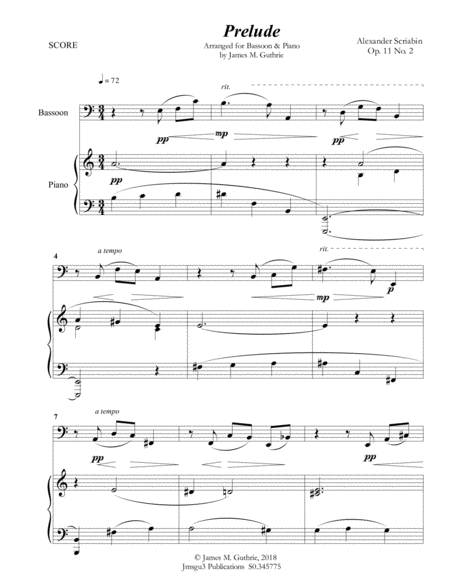
Scriabin: Prelude Op. 11 No. 2 for Bassoon & Piano
Basson, Piano (duo)

$19.95 17.04 € Basson, Piano (duo) PDF SheetMusicPlus

Bassoon,Piano - Level 2 - Digital Download SKU: A0.1310502 Composed by J S Bach-Gounod. Arranged by Colin Kirkpatrick. Easter,Sacred,Wedding. Score and part. 6 pages. Colin Kirkpatrick Publications #899560. Published by Colin Kirkpatrick Publications (A0.1310502). This ever-popular piece is often performed at weddings, funerals and many other solemn ceremonial events. It has always been a favorite among instrumental players and often used in recitals or concert encores. This arrangement by Colin Kirkpatrick is ideal for the intermediate bassoon player. It is in concert C and range is from G on the lowest line of the bass clef to the E just above the staff. In 1853, the well-known French composer Charles Gounod added his own melody over a rippling keyboard accompaniment which was a slightly adapted version of the Prelude No. 1 in C major, BWV846, from Book I of J. S. Bach's The Well-Tempered Clavier, published in 1722. The title of the “combined†piece was Méditation sur le Premier Prélude de Piano de S. Bach. Gounod’s original arrangement transposed Bach’s keyboard part from C major into F major and it was scored for violin (or cello), organ and piano. In 1859, the French music publishing company Jacques-Léopold Heugel brought out a vocal version based on the familiar Latin text. Ave Maria (Hail Mary) is a traditional Catholic prayer addressed to the Virgin Mary.The version of Bach's prelude which Gounod used included the so-called Schwencke measure (m. 27 in this arrangement), a measure (bar) allegedly added by the German composer and pianist Christian Friedrich Gottlieb Schwencke (1767-1822) in an attempt to correct what was considered a harmonic weakness in the original. Whether there actually was a “harmonic weakness†(or possibly an error in the manuscript) remains a matter of conjecture but the fact remains that the most familiar-sounding version of this piece, recorded countless times by both singers and instrumentalists includes this Schwencke measure. It is therefore included in this arrangement.Some published arrangements show minor inconsistencies in the rhythm of the melody. This arrangement uses the familiar rhythm of the Ave Maria version as it appeared in the 1859 edition.
Bach-Gounod: Ave Maria for Bassoon and Piano
Basson, Piano (duo)

$7.95 6.79 € Basson, Piano (duo) PDF SheetMusicPlus


Partitions Gratuites
Acheter des Partitions Musicales
Acheter des Partitions Digitales à Imprimer
Acheter des Instruments de Musique

© 2000 - 2026

Accueil - Version intégrale





