EUROPE
462 articles
USA
1 articles
DIGITAL
5 articles (à imprimer)
Partitions Digitales
Partitions à imprimer
5 partitions trouvées


Brass Ensemble Trombone - Level 4 - Digital Download SKU: A0.810975 Composed by Anton Bruckner. Arranged by Sauer, Ralph. Romantic Period,Sacred. Score and parts. 12 pages. Gordon Cherry #4313323. Published by Gordon Cherry (A0.810975). Ralph Sauer has arranged three Bruckner chorales for four-part Trombone Ensemble, taken from three of his lesser-known choral works. 1. Iam lucis orto sidere (Now that the daylight fills the sky) WAB 18 2. In jener letzten der Nächte (In this last of nights) WAB 17 3. Dir, Herr, dir will ich mich ergeben (You, Lord, I want to surrender to you) WAB 12 They are beautiful examples of the magical harmonies of the great master. For intermediate level performers.
Three Chorales for Trombone Quartet
Quatuor de cuivres: 4 trombones

$20.00 16.89 € Quatuor de cuivres: 4 trombones PDF SheetMusicPlus

Trombone Quartet - Level 3 - Digital Download SKU: A0.1261845 Composed by Ludwig van Beethoven. Arranged by Ander. 19th Century,Classical,Film/TV,March,Romantic Period. 13 pages. Woods Only, Arrangements #854928. Published by Woods Only, Arrangements (A0.1261845). This arrangement adapted for trombone quartet was written keeping the characteristics of the original work, in order to be performed by young music students who want to enter the symphonic music. Besides, it can also be used by professional musicians, for recitals, repertoire, academic presentations and didactic material. As much as it is a funeral march, it is well suited for any musical performance occasion. The transcription is faithful to the structure, with only one change of key, so that it is comfortable for all the instruments in the formation, as well as for use in ensemble practice between musicians of different traditions. Ludwig van Beethoven began concentrated work on his Symphony No. 7 in A major Op. 92 in 1811, it was completed in 1812, and was dedicated to Count Moritz von Fries, and premiered in Vienna on December 8, 1813. It is considered a remarkable example of the more ebullient side of Beethoven's compositional personality and evidence that even after the onset of deafness, he still found cause for musical optimism. The second movement Allegretto is a funeral march in everything but name. Often several contrasting melodic ideas are made to coexist, as if Beethoven were imagining several processions converging on the cemetery at the same time. As he was working on this symphony during the years of the Napoleonic Wars, this experience was probably within his experience. It was also used as the soundtrack to the film Knowing, by director Alex Proyas and starring Nicolas Cage, where it is used in the final scene of the film. Beethoven called Symphony No. 7 his most excellent symphony, and a music critic of the time reported, this symphony is the most melodically rich and the most pleasing and comprehensible of all Beethoven's symphonies..
Symphony No. 7 by Beethoven for Trombone Quartet
Quatuor de cuivres: 4 trombones

$7.99 6.75 € Quatuor de cuivres: 4 trombones PDF SheetMusicPlus

Trombone Quartet Trombone - Level 2 - Digital Download SKU: A0.1269033 Composed by Solage. Arranged by James M. Guthrie. Chamber,Contest,Early Music,Festival,Historic,Medieval. 6 pages. Jmsgu3 #861565. Published by jmsgu3 (A0.1269033). Plusers gens voy is a ballade by the late 14th-century French composer Solage. The song is written for four voices: tenor, contra tenor, cantus, and triplum. The lyrics of the song are Plusers gens voy qui leur pensee / A leur dame ne sont pas nee / Car ele est de si grant beaute / Que nus ne la puet veoir sans faille which translates to More people have seen in their thoughts / That they were not born for their lady / For she is of such great beauty / That no one can see her without failing.The overall message of Plusers gens voy is a declaration of love and admiration for a lady of great beauty. The lyrics suggest that the lady is so beautiful that no one can see her without failing. The song is a tribute to the lady's beauty and likely reflects the composer's feelings towards her. The song is a beautiful example of medieval French music and poetry and is still performed and studied today.
Solage: Plusers gens voy for Trombone Quartet
Quatuor de cuivres: 4 trombones

$24.95 21.07 € Quatuor de cuivres: 4 trombones PDF SheetMusicPlus

Trombone Quartet - Level 2 - Digital Download SKU: A0.1264239 Composed by Ludwig van Beethoven. Arranged by Ander. 19th Century,Classical,March,Opera,Romantic Period. 11 pages. Woods Only, Arrangements #857102. Published by Woods Only, Arrangements (A0.1264239). This trombone quartet arrangement was written to maintain the characteristics of the original work, inspiring and significant to Beethoven’s well-known choral symphony. Suitable for young music students and professional musicians, for recitals, repertoire, academic presentations, and didactic material. The transcription is faithful to the structure, with only one key change, maintaining the essence of the striking melody. Beethoven’s Ninth Symphony Op. 125 incorporates part of the poem An die Freude (“To Joyâ€), a hymn written by Friedrich Schiller, with the text sung by soloists and a choir in its last movement. It was the first example of a major composer using the human voice as prominently as instruments in a symphony, creating a far-reaching work that set the tone for the symphonic form adopted by Romantic composers. This is Ludwig van Beethoven’s last complete symphony. The choral symphony, better known as the Ninth Symphony or The Ninth, is one of the best-known works in the Western repertoire, considered an icon and predecessor of Romantic music and one of Beethoven’s great masterpieces. It was first performed on May 7, 1824 at the Kärntnertortheater in Vienna, Austria.
Ode to Joy by Beethoven for Trombone Quartet
Quatuor de cuivres: 4 trombones

$7.99 6.75 € Quatuor de cuivres: 4 trombones PDF SheetMusicPlus

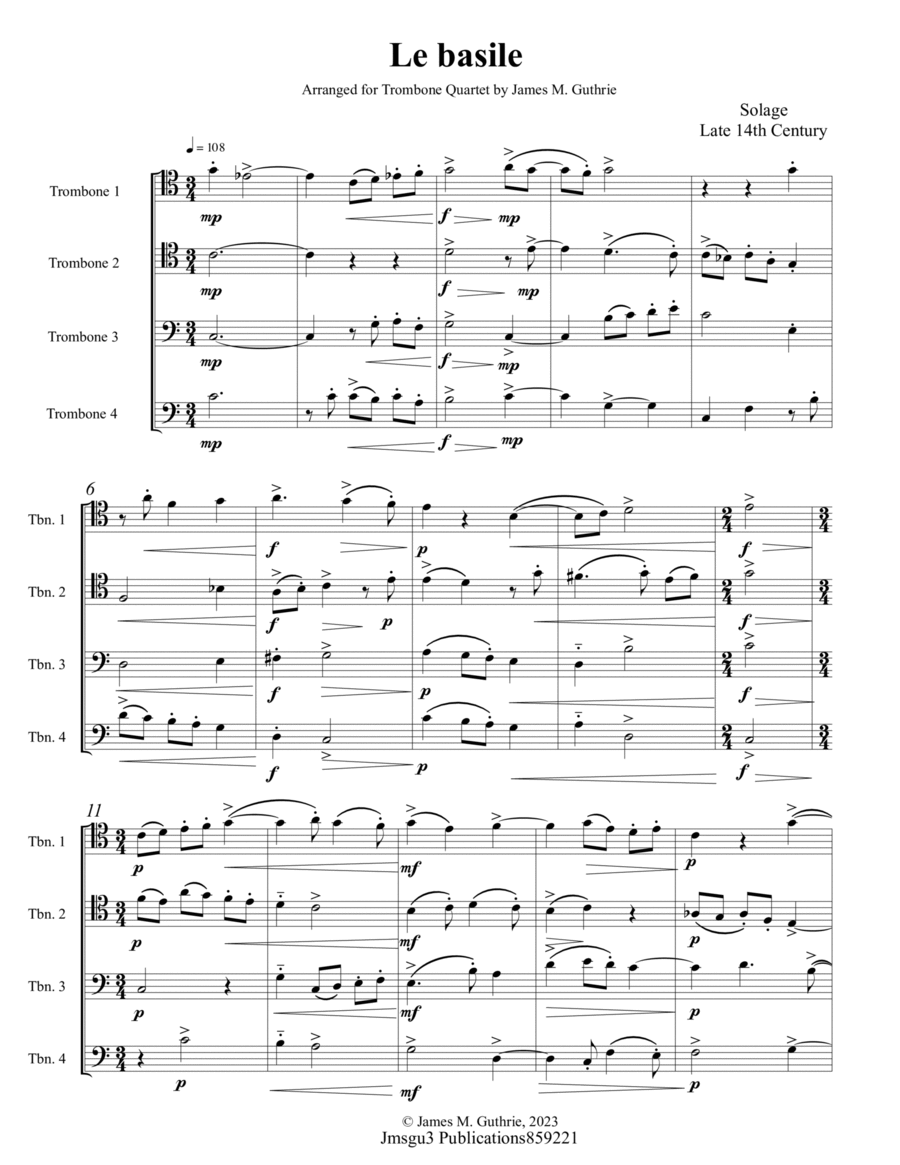
Trombone Quartet Trombone - Level 2 - Digital Download SKU: A0.1266548 Composed by Solage. Arranged by James M. Guthrie. Chamber,Contest,Early Music,Festival,Historic,Medieval. 8 pages. Jmsgu3 #859221. Published by jmsgu3 (A0.1266548). Solage's ballade Le basile de sa propre nature is a significant work in the history of medieval music. Here are some of its historical significances:1. It is one of the twelve surviving works attributed to Solage, a French composer who lived in the late 14th century. Solage's works are known for their complex rhythms, intricate harmonies, and expressive melodies.2. Le basile de sa propre nature is a four-voice ballade that features a text about the mythical creature known as the basilisk. The lyrics describe the basilisk as a monster that kills everything it sees with its deadly venom. The music is characterized by its intricate rhythms and harmonies, which reflect the text's vivid imagery.3. The ballade is preserved in the Chantilly Codex, a manuscript that contains a collection of French secular music from the late 14th century. The Chantilly Codex is one of the most important sources of medieval music, and it provides valuable insights into the musical practices of the time.4. Le basile de sa propre nature is an example of the Ars subtilior style, which was a highly experimental and complex musical style that emerged in the late 14th century. This style was characterized by its use of intricate rhythms, complex harmonies, and unusual notational practices. The Ars subtilior style was highly influential in the development of later musical styles, and it remains an important part of the medieval musical canon.Overall, Solage's ballade Le basile de sa propre nature is a significant work that reflects the complex and experimental musical practices of the late 14th century. Its vivid imagery, intricate rhythms, and complex harmonies make it a valuable contribution to the medieval musical canon.Lyrics:All those he sees he kills suddenly,For his venom is deadly.He is a basilisk by his own nature,And he has no other way of being. He is a monster of great power,And he is feared by all who know him.He is a creature of the earth,And he is a master of death. He is a basilisk by his own nature,And he has no other way of being.All those he sees he kills suddenly,For his venom is deadly. He is a creature of the night,And he is a master of the dark.He is a monster of great might,And he is feared by all who hear his name. He is a basilisk by his own nature,And he has no other way of being.All those he sees he kills suddenly,For his venom is deadly.Solage was a French composer and probably also a poet who lived in the late 14th century. He composed the most pieces in the Chantilly Codex, which is the principal source of music of the ars subtilior, a manneristic compositional school centered on Avignon at the end of the century. Solage is an obscure composer, and aside from what can be deduced from the pieces attributed to him in the Chantilly Codex, nothing else is known about him. There are several interpretations of his name, and it is not clear whether his first name was Jean or Charles. The ars subtilior was a manneristic compositional school centered on Avignon at the end of the 14th century. It was characterized by complex rhythms and pitch, and it was a transitional period between the late medieval and Renaissance periods. Solage was one of the composers who fit into this school, and he composed the most pieces in the Chantilly Codex, which is the principal source of music of the ars subtilior. Stylistically, Solage's works exhibit two distinctly different characters: a relatively simple one usually associated with his great predecessor and elder contemporary Guillaume de Machaut, and a more recherché one, complex in the areas of both pitch and rhythm, characteristic of the ars subtilior. 
Solage: Le basile for Trombone Quartet
Quatuor de cuivres: 4 trombones

$32.95 27.83 € Quatuor de cuivres: 4 trombones PDF SheetMusicPlus


Partitions Gratuites
Acheter des Partitions Musicales
Acheter des Partitions Digitales à Imprimer
Acheter des Instruments de Musique

© 2000 - 2026

Accueil - Version intégrale