EUROPE
7348 articles
USA
7 articles
DIGITAL
35 articles (à imprimer)
Partitions Digitales
Partitions à imprimer
35 partitions trouvées


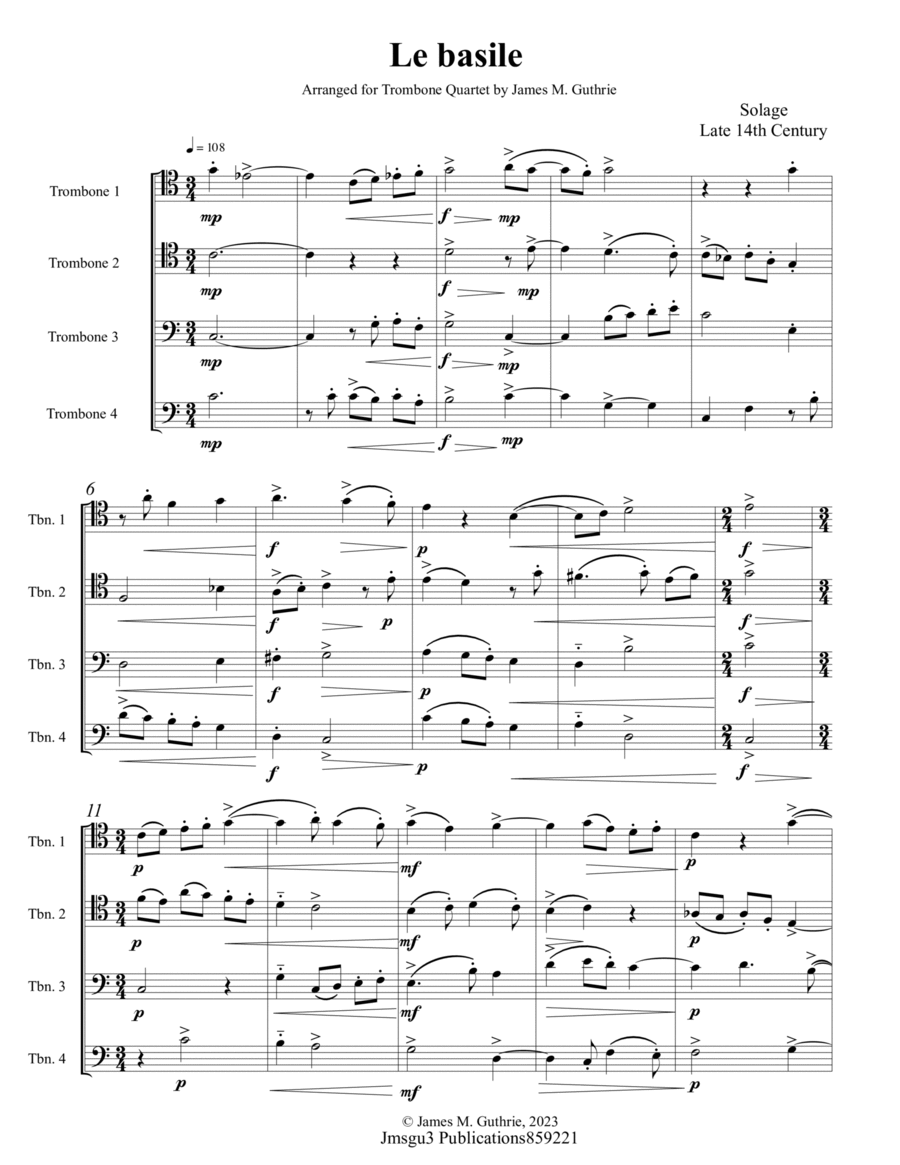
Trombone Quartet Trombone - Level 2 - Digital Download SKU: A0.1266548 Composed by Solage. Arranged by James M. Guthrie. Chamber,Contest,Early Music,Festival,Historic,Medieval. 8 pages. Jmsgu3 #859221. Published by jmsgu3 (A0.1266548). Solage's ballade Le basile de sa propre nature is a significant work in the history of medieval music. Here are some of its historical significances:1. It is one of the twelve surviving works attributed to Solage, a French composer who lived in the late 14th century. Solage's works are known for their complex rhythms, intricate harmonies, and expressive melodies.2. Le basile de sa propre nature is a four-voice ballade that features a text about the mythical creature known as the basilisk. The lyrics describe the basilisk as a monster that kills everything it sees with its deadly venom. The music is characterized by its intricate rhythms and harmonies, which reflect the text's vivid imagery.3. The ballade is preserved in the Chantilly Codex, a manuscript that contains a collection of French secular music from the late 14th century. The Chantilly Codex is one of the most important sources of medieval music, and it provides valuable insights into the musical practices of the time.4. Le basile de sa propre nature is an example of the Ars subtilior style, which was a highly experimental and complex musical style that emerged in the late 14th century. This style was characterized by its use of intricate rhythms, complex harmonies, and unusual notational practices. The Ars subtilior style was highly influential in the development of later musical styles, and it remains an important part of the medieval musical canon.Overall, Solage's ballade Le basile de sa propre nature is a significant work that reflects the complex and experimental musical practices of the late 14th century. Its vivid imagery, intricate rhythms, and complex harmonies make it a valuable contribution to the medieval musical canon.Lyrics:All those he sees he kills suddenly,For his venom is deadly.He is a basilisk by his own nature,And he has no other way of being. He is a monster of great power,And he is feared by all who know him.He is a creature of the earth,And he is a master of death. He is a basilisk by his own nature,And he has no other way of being.All those he sees he kills suddenly,For his venom is deadly. He is a creature of the night,And he is a master of the dark.He is a monster of great might,And he is feared by all who hear his name. He is a basilisk by his own nature,And he has no other way of being.All those he sees he kills suddenly,For his venom is deadly.Solage was a French composer and probably also a poet who lived in the late 14th century. He composed the most pieces in the Chantilly Codex, which is the principal source of music of the ars subtilior, a manneristic compositional school centered on Avignon at the end of the century. Solage is an obscure composer, and aside from what can be deduced from the pieces attributed to him in the Chantilly Codex, nothing else is known about him. There are several interpretations of his name, and it is not clear whether his first name was Jean or Charles. The ars subtilior was a manneristic compositional school centered on Avignon at the end of the 14th century. It was characterized by complex rhythms and pitch, and it was a transitional period between the late medieval and Renaissance periods. Solage was one of the composers who fit into this school, and he composed the most pieces in the Chantilly Codex, which is the principal source of music of the ars subtilior. Stylistically, Solage's works exhibit two distinctly different characters: a relatively simple one usually associated with his great predecessor and elder contemporary Guillaume de Machaut, and a more recherché one, complex in the areas of both pitch and rhythm, characteristic of the ars subtilior. 
Solage: Le basile for Trombone Quartet
Quatuor de cuivres: 4 trombones

$32.95 27.75 € Quatuor de cuivres: 4 trombones PDF SheetMusicPlus

Brass Ensemble,Trombone Quartet - Level 2 - Digital Download SKU: A0.1194164 Composed by John Allison. Arranged by John Allison. Jazz,Latin. Score and parts. 23 pages. John Allison #793585. Published by John Allison (A0.1194164). Caribbean Holiday is a short suite of three pieces for trombone quartet in three well-known Latin styles. The pieces can be performed separately or together. The suite begins with the relaxed 'Bossa Beach' where trombones two and three share the tune as gentle waves of harmony roll onto the beach. Next, 'Moonlight Mambo' features trombone one in a romantic ballad supported by the swaying rhythms of the accompanying parts. Finally in 'Calypso Cocktail' each part in turn gets to step forward into the limelight in a spirited finale.Parts 1 and 4 are a little more demanding than 2 and 3, but the whole suite is very accessible for easy intermediate level players.
Caribbean Holiday
Quatuor de cuivres: 4 trombones

$3.00 2.53 € Quatuor de cuivres: 4 trombones PDF SheetMusicPlus

Brass Ensemble Trombone - Level 4 - Digital Download SKU: A0.792151 Composed by Various. Arranged by Gazda, Frank. Baroque,Classical,Renaissance,Romantic Period,Sacred. Score and parts. 27 pages. Gordon Cherry #3679567. Published by Gordon Cherry (A0.792151). Ave Maria is a traditional Catholic prayer asking for intercession from the Virgin Mary. The prayer has often been set to music.Frank Gazda has beautifully arranged four musical settings of the prayer for Trombone Quartet by: Jacob Arcadelt (Renaissance), Johann Joseph Fux (Baroque), Wolfgang Amadeus Mozart (Classical) and Giuseppe Verdi (Romantic).Although originally composed as four-part choral settings, they work perfectly for the Trombone. Each piece stands on its own as a work of beauty, or the four can be performed as a whole. They are at a moderately advanced level of difficulty.
Four Ave Marias for Trombone Quartet
Quatuor de cuivres: 4 trombones

$17.50 14.74 € Quatuor de cuivres: 4 trombones PDF SheetMusicPlus

Brass Ensemble,Trombone Quartet Trombone - Level 3 - Digital Download SKU: A0.1092487 Composed by Francesco Durante. Arranged by Regis Bookshar. Baroque,Instructional,Sacred. Score and parts. 7 pages. Regis Bookshar #696578. Published by Regis Bookshar (A0.1092487). Kyrie - by Francesco Durante; Trombone Quartet – Intermediate – Digital Download. “Kyrieâ€, originally written for a four-part vocal ensemble by Francesco Durante, has now been transcribed, edited and arranged by Regis Bookshar, for a Trombone Quartet. It would be a welcomed addition to any music library. This short composition, which lasts less than two minutes, will provide many students with the opportunity to practice breath control because of its long phrases, and to help them to continue to develop good intonation because many of the phrases cadence on a unison note. This selection could be performed for concerts, recitals and church services. It is suitable for high school and college students but professional musicians would also enjoy playing this selection. Included are a score and a complete set of parts (7 pages). This selection is one of the many arrangements from the Regis Bookshar Trumpet Ensemble’s extensive music library which are being made available for the first time. We have performed the Trumpet Quartet version of this composition for many church services, especially funerals, when we were asked to supply something more somber and introspective rather than the louder, more festive music which many people come to expect from a Trumpet Ensemble. Francesco Durante was an Italian composer who was born on March 31, 1684 at Frattamaggiore, in the Kingdom of Naples. At an early age he entered the Conservatorio dei poveri di Gesu Cristo, in Naples, where he received lessons from Gaetano Greco. Later he became a pupil of Alessandro Scarlatti at the Conservatorio di Sant’Onofrio. He is said to have succeeded Scarlatti in 1725 at Sant’Onofrio and to have remained there until 1742, when he succeeded Nicola Porpora as head of the Conservatorio di Santa Maria de Loreto, also in Naples. He held this post for thirteen years, until his death on September 30, 1755. His fame as a teacher was considerable, and, unlike his Neapolitan contemporaries, who attracted international notice with their operas, Francesco Durante achieved recognition through his church music, along with some vocal chamber and instrumental works. His concern was not quantity. A complete collection of Durante’s works, consisting almost exclusively of sacred music, was presented by Gaspare Selveggi, a Neapolitan art collector and music theorist, to the Bibliotheque Nationale in Paris. The imperial library of Vienna also preserves a valuable collection of Durante’s manuscripts. The fact that Durante never composed for the stage brought him an exaggerated reputation as a composer of sacred music. He was considered one of the best church composers of his style and period. In his masses, requiems, litanies and Lamentations, he could provide strong expressive moments, as he does in this “Kyrieâ€. In addition to this arrangement for a Trombone Quartet, Regis Bookshar has also made other arrangements of this selection. There are Quartets readily available for a wide variety of instrumental ensembles. Please take the time to look for other versions of this composition. You may find something else that may also suit your needs. I would also encourage you to search for other arrangements by Regis Bookshar, as well, as there are numerous arrangements in a variety of styles, also available for purchase. You may find something else which might interest you. Please continue to check periodically because new arrangements are being added as often as possible. I’m certain that this beautiful arrangement of Francesco Durante’s “Kyrie†will continue to entertain both performers and audiences alike for years to come.
Kyrie (Durante) (Trombone Quartet)
Quatuor de cuivres: 4 trombones

$10.00 8.42 € Quatuor de cuivres: 4 trombones PDF SheetMusicPlus

Trombone - Level 4 - Digital Download SKU: A0.811261 Composed by David F. Wilborn. 20th Century,Contemporary. 27 pages. Gordon Cherry #6624625. Published by Gordon Cherry (A0.811261). Here is a detailed description of the work by composer, David F. Wilborn.Elysian Fields was written for the Elysian Trombone Consort. Members of the ensemble include: Timothy Anderson, Chad Arnow, Nathan Siler, and Brett Shuster. The work was created as part of a recital feature that took place at the 2021 International Trombone Festival entitled A New Initiative II: Trombone Quartet Music by Composers of Color. The Elysian Trombone Consort created the New Initiative concert series as a vehicle to promote new and existing works by composers from under-represented gender, ethnic and social communities. The concert series aims to highlight the creative scholarship of under-represented artists. The ultimate goal is to encourage the programming and creation of more compositions by these scholars.The title Elysian Fields (also known as Elysium) is a venue in mythology that references a final resting place in the afterlife for the Greek Gods. Although Elysium was originally designated for Greek Gods and mortals who may have been related to the Gods, the venue was also accessible to certain mortals by the Gods for their heroic deeds or by those who enjoyed favor with the Gods. Images of Elysium are said to have radiant sunshine, rolling hills and, according to Homer in his Odyssey, the most pleasant weather conditions – no snow, nor heavy storm, nor ever rain.The music Elysian Fields attempts to capture the frivolity of living in Elysium. It portrays the radiant sunshine and the spirit of joy. The place is by all accounts a surreal landscape where sun rays softly beam down on the fields and, in some cases, it emanates as a heavenly backdrop. It is a place of everlasting happiness, serenity, and peace. This 5-minute work is accessible by intermediate to moderately advanced performers.The track below is from a live performance by the Elysian Trombone Consort at the International Trombone Festival in 2021.
Elysian Fields for Trombone Quartet
Quatuor de cuivres: 4 trombones

$27.50 23.16 € Quatuor de cuivres: 4 trombones PDF SheetMusicPlus

Trombone Quartet - Level 2 - Digital Download SKU: A0.1261707 Composed by Ludwig van Beethoven. Arranged by Ander. 19th Century,Classical,Folk,March,Romantic Period. 9 pages. Woods Only, Arrangements #854782. Published by Woods Only, Arrangements (A0.1261707). This arrangement adapted for trombone quartet was written keeping the characteristics of the original work, in order to be performed by young music students who want to enter the symphonic music. Besides, it can also be used by professional musicians for recitals, repertoire, academic presentations and didactic material. The transcription remains faithful to the structure, with only one change in tone, so that it is comfortable for all the instruments in the formation, as well as being used as an activity in ensemble practice among musicians of different traditions. Beethoven's Turkish March (Op. 113) is the 4th movement of the operatic work: The Ruins of Athens, a set of incidental pieces written in 1812 by Ludwig van Beethoven, where the melody was originally written in 1809 as Theme with Six Variations for Piano, Op. 76. The work was written to accompany the play of the same name by August von Kotzebue, for the dedication of a new theater in Pest. Perhaps the best known part of the composition is the Marcia alla turca, In Latin America, this movement became known in Jean-Jacques Perrey's version (who titled it The Elephant never Forgets) since it was used as the opening theme of the successful Mexican TV comedy El Chavo del Ocho. The opening and the turkish march are often performed separately, and the other pieces in this set are not often heard.
Turkish March by Beethoven for Trombone Quartet
Quatuor de cuivres: 4 trombones

$7.99 6.73 € Quatuor de cuivres: 4 trombones PDF SheetMusicPlus

Trombone Quartet - Level 3 - Digital Download SKU: A0.1262047 Composed by Ludwig van Beethoven. Arranged by Ander. 19th Century,Christmas,Classical,March,Romantic Period. 13 pages. Woods Only, Arrangements #855103. Published by Woods Only, Arrangements (A0.1262047). This arrangement adapted for trombone quartet was designed to make its listeners weep with emotion, because the adaptation preserves the original essence of the work, keeping its integrity faithful to what Beethoven wanted to transmit, with only a slight change in tone and addition of harmonic resources in the structure of the arrangement. Even though it is a funeral march, it is well suited for any musical performance occasion, being intended for beginner students who want to immerse themselves in the universe of romantic music, and nothing better than starting with the transitional composer of this period, which also does not prevent professional teachers from using it for recitals, academic presentations or didactic material in their classes as an ensemble practice. Ludwig van Beethoven's Piano Sonata No. 14 in C minor sharp, Op. 27, No. 2, is one of his most popular compositions and was an audience favorite even in his day. Written when Beethoven was 31, the Moonlight Sonata (Mondscheinsonate in German) was composed after he finished some commissioned works, but there is no evidence that he was hired to write this work. It did not receive its nickname until 1832, five years after Beethoven's death. It was the critic Ludwig Rellstab who compared the music to a moonlighting on Lake Lucerne. This comparison was adopted as a nickname for the work. Called Quasi una fantasia by the author - like its companion Op. 27, No. 1 - the piece was completed in 1801 and dedicated the following year to one of the composer's pupils. Beethoven chose to open the sonata with a slow, hypnotic arpeggio movement, the best known of the entire work. The dotted rhythm of its minimal melody evokes the tradition of 'Trauermusik' (funeral music).
Moonlight Sonata by Beethoven for Trombone Quartet
Quatuor de cuivres: 4 trombones

$7.99 6.73 € Quatuor de cuivres: 4 trombones PDF SheetMusicPlus

Trombone Quartet Bass Trombone - Digital Download SKU: A0.1304007 By EnsembleSheetMusic. By Edward Elgar. Arranged by Sjoerd van der Veen. 20th Century,Chamber,Classical,Wedding. 6 pages. Sjoerd van der Veen #893599. Published by Sjoerd van der Veen (A0.1304007). Nimrod, variation IX from Elgar’s Enigma Variations was dedicated to Augustus J. Jaeger who was employed as music editor by the London publisher Novello & Co. He was a close friend of Elgar’s, giving him useful advice but also severe criticism, something Elgar greatly appreciated. Elgar later related how Jaeger had encouraged him as an artist and had stimulated him to continue composing despite setbacks. The name of the variation refers to Nimrod, an Old Testament patriarch described as “a mighty hunter before the Lord†– Jäger being German for hunter. (Wikipedia).
Nimrod from Enigma Variations
Quatuor de cuivres: 4 trombones
EnsembleSheetMusic
$11.90 10.02 € Quatuor de cuivres: 4 trombones PDF SheetMusicPlus

Trombone Quartet Bass Trombone - Level 4 - Digital Download SKU: A0.792329 Composed by Traditional Christmas. Arranged by Kempton, Jeremy. Christmas,Folk,Multicultural,World. 14 pages. Gordon Cherry #4804627. Published by Gordon Cherry (A0.792329). The Holly and the Ivy and What Child Is This (same melody as Greensleeves) are two beautiful traditional English Christmas carols, expertly arranged by Jeremy Niles Kempton for Trombone Quartet. The use of Holly and Ivy have been traditional in English Christmas decorations since the fifteenth century. What Child Is This? was written as a hymn in 1865 by William Chatterton Dix who was inspired to write the carol after recovering from a near fatal illness. This four minute arrangement is for moderately advanced performers.
Holly and the Ivy and What Child Is This for Trombone Quartet
Quatuor de cuivres: 4 trombones

$22.50 18.95 € Quatuor de cuivres: 4 trombones PDF SheetMusicPlus

Trombone Quartet Trombone - Level 3 - Digital Download SKU: A0.1283667 Composed by Richard Wagner. Arranged by César Madeira. 19th Century,Classical,Opera,Romantic Period,Wedding. 9 pages. Sheet Music To Play Editions #874859. Published by Sheet Music To Play Editions (A0.1283667). Wedding March (Bridal Chorus from Lohengrin) by Wagner. Arrangement for Trombone Quartet. With Full Score and Individual Parts. Enjoy it!Richard Wagner (1813 – 1883) was a German composer, theatre director, polemicist, and conductor who is chiefly known for his operas. His major works included The Flying Dutchman, Tannhäuser, Lohengrin, Tristan und Isolde, Parsifal, and his great tetralogy, The Ring of the Nibelung.For Tutorials, Play Alongs or request New Arrangements, visit the YouTube Channel: Sheet Music To Play
Wedding March (Bridal Chorus) - Trombone Quartet (Full Score and Parts)
Quatuor de cuivres: 4 trombones

$12.99 10.94 € Quatuor de cuivres: 4 trombones PDF SheetMusicPlus

Brass Ensemble,Trombone Quartet - Level 3 - Digital Download SKU: A0.1503868 Composed by Camille Saint-Saens. Arranged by ??? ???. 19th Century,Chamber,Romantic Period,Wedding. 10 pages. Simple Chamber???????? #1079320. Published by Simple Chamber???????? (A0.1503868). Discover this arrangement of The Swan by Camille Saint-Saens, Ratner 125 in a version for Trombone Quartet, accompanied by chord symbols, ideal for beginner-level musicians. This arrangement has been simplified while preserving the essence and beauty of the original composition, making it suitable for both professionals and students. Music teachers will find in this sheet music a valuable educational tool, facilitating the introduction of students to chamber music with an arrangement that, although simplified, maintains the harmonic charm and emotional depth of the piece. Additionally, this version is perfect for parents who wish to encourage their children to dive into the world of string quartets, offering a piece that is both accessible and captivating for young musicians. With this sheet music, you will have the opportunity to create a unique musical experience, combining learning and the emotional richness of Saint-Saens. Don’t miss the chance to acquire it, as it will not only enrich your repertoire but also serve as an excellent resource for teaching chamber music and inspiring future generations of musicians.
The Swan for Trombone Quartet by Saint-Saens, Ratner 125
Quatuor de cuivres: 4 trombones

$9.99 8.41 € Quatuor de cuivres: 4 trombones PDF SheetMusicPlus


Partitions Gratuites
Acheter des Partitions Musicales
Acheter des Partitions Digitales à Imprimer
Acheter des Instruments de Musique

© 2000 - 2026

Accueil - Version intégrale