EUROPE
7348 articles
USA
5 articles
DIGITAL
143 articles (à imprimer)
Partitions Digitales
Partitions à imprimer
143 partitions trouvées

1 16 31 ....136

Saxophone Quintet,Woodwind Ensemble Alto Saxophone,Baritone Saxophone,Soprano Saxophone,Tenor Saxophone - Level 3 - Digital Download SKU: A0.569281 Composed by Joe Goodwin, Larry Shay, and Mark Fisher. Arranged by Thomas Graf. Broadway,Film/TV,Jazz,Musical/Show,Pop. 19 pages. Thomas Graf - the-hit-factory.com #4332711. Published by Thomas Graf - the-hit-factory.com (A0.569281). This famous pop song from 1928 has become one of the most played jazz standards ever - it will make your audience smile! A must for your band book!    Instrumentation:  Part I (Soprano/Alto), Part II (Alto), Part III (Alto/Tenor), Part IV (Tenor), Part V(Baritone/Bass Sax)            Listen to the recording - a challenge for your ensemble.  Please don't forget to review your purchase - you will help other musicians to choose the perfect arrangement for their ensemble. Thank you very much!              Check out our latest uploads:  http://www.sheetmusicplus.com/publishers/thomas-graf-the-hit-factory-com/smp-press/3001412+1303131?N...                      Any individual arrangement and substitute parts are available on request. Call +49 (0) 172 2515987 E-Mail: info@the-hit-factory.com. www.the-hit-factory.com facebook: https://www.facebook.com/hitfactorymusic              Video: https://www.youtu.be/  - no video.
When You're Smiling (the Whole World Smiles With You)
Quintette de Saxophone: 5 saxophones

$15.00 12.58 € Quintette de Saxophone: 5 saxophones PDF SheetMusicPlus

Saxophone Quintet,Woodwind Ensemble Alto Saxophone,Baritone Saxophone,Bass Saxophone,Soprano Saxophone,Tenor Saxophone - Level 4 - Digital Download SKU: A0.1404856 Composed by Johann Sebastian Bach. Arranged by James M. Guthrie. Baroque,Chamber,Contest,Festival,Historic,Standards. 36 pages. Jmsgu3 #987886. Published by jmsgu3 (A0.1404856). The importance of Bach's French Suites lies in their unique blend of French and Italian styles despite the misleading title. These suites, composed between 1722 and 1725 for the clavier, showcase Bach's mastery in stylizing traditional dances like allemandes, courantes, sarabandes, and gigues. While named French Suites by later sources like Johann Nikolaus Forkel, they follow Italian conventions with some French influences. The suites offer a rich musical experience, bridging different European styles and serving as valuable teaching pieces. Despite the misleading title, Bach's French Suites are a testament to his compositional genius and continue to be cherished by musicians and audiences alike.The history behind Bach's French Suites is intertwined with a bittersweet period in Bach's life. In May 1720, Bach embarked on a trip, leaving his wife, Maria Barbara, and four children. Tragically, upon his return, he discovered that Maria Barbara had passed away. This loss led to a significant change in Bach's personal life as he became a single father mourning his wife. Despite this tragedy, Bach found love again with Anna Magdalena Wülcken, whom he married. As a gesture of affection and to cultivate her musical skills, Bach composed music for Anna Magdalena, including what would later become the French Suites. These suites were likely performed at court and reflected the couple's intimate musical companionship. The French Suites were not published during Bach's lifetime, possibly because he did not deem it challenging enough. Today, these suites offer an accessible path to Bach's music and are cherished for their stylized dance movements inspired by French and Italian forms.
Bach: French Suite No. 1, BWV 812, for Saxophone Quintet
Quintette de Saxophone: 5 saxophones

$52.95 44.42 € Quintette de Saxophone: 5 saxophones PDF SheetMusicPlus

Saxophone Quintet,Woodwind Ensemble Alto Saxophone,Baritone Saxophone,Bass Saxophone,Soprano Saxophone - Level 3 - Digital Download SKU: A0.568773 Composed by G.F.Händel. Arranged by Thomas Graf. Christmas,Classical,Jazz. 39 pages. Thomas Graf - the-hit-factory.com #3242829. Published by Thomas Graf - the-hit-factory.com (A0.568773). This concert piece starts with a classic choral auf Händel’s masterpiece, then comes the big surprise: A funky Back Beat with jazzy chords starts and will make your whole audience clap and dance.  All parts are feature and even a solo for the bass part is included. It ends up in a cool finale. Drums are optional and may be substituted by a Cachon or even only clapping. A must for your upcoming concerts during holiday season!   Instrumentation:  Part I (Soprano/Alto), Part II (Alto), Part III (Alto/Tenor), Part IV (Tenor), Part V(Baritone/Bass Sax), Drums (optional)             Listen to the recording - a challenge for your ensemble.  Check out our latest uploads:  http://www.sheetmusicplus.com/publishers/thomas-graf-the-hit-factory-com/smp-press/3001412+1303131?N...                                Any individual arrangement and substitute parts are available on request. Call +49 (0) 172 2515987 E-Mail: info@the-hit-factory.com. www.the-hit-factory.com facebook: https://www.facebook.com/hitfactorymusic              Video: https://www.youtu.be/h7kGeXn0Epw   2017 Holiday Contest Entry.
Tochter Zion - Choral & Shuffle - Saxophone Quintet
Quintette de Saxophone: 5 saxophones

$18.99 15.93 € Quintette de Saxophone: 5 saxophones PDF SheetMusicPlus

Saxophone Quintet,Woodwind Ensemble Alto Saxophone,Baritone Saxophone,Soprano Saxophone,Tenor Saxophone - Level 3 - Digital Download SKU: A0.1413812 By Wolfgang Amadeus Mozart. By Wolfgang Amadeus Mozart. Arranged by Sean Sullivan. Classical,Religious,Sacred. 17 pages. Sean Sullivan #995598. Published by Sean Sullivan (A0.1413812). This beautiful and haunting piece is perfect for saxophone ensembles looking to showcase their talents and captivate audiences with the timeless music of Mozart. The arrangement stays true to the original composition while also providing unique and exciting challenges for each member of the quintet. Whether you're a seasoned saxophonist or looking to expand your repertoire, this arrangement of Benedictus is sure to impress both performers and listeners alike. Don't miss out on this opportunity to add a touch of classical elegance to your next performance. Order your sheet music for Benedictus from Mozart's Requiem for saxophone quintet today and elevate your ensemble's musical offerings to a whole new level.
Benedictus
Quintette de Saxophone: 5 saxophones
Wolfgang Amadeus Mozart
$14.99 12.58 € Quintette de Saxophone: 5 saxophones PDF SheetMusicPlus

Woodwind Ensemble,Woodwind Quintet Alto Saxophone,Baritone Saxophone,Soprano Saxophone,Tenor Saxophone - Level 2 - Digital Download SKU: A0.1416624 By Adele. By Adele Adkins and Tobias Jesso Jr. Arranged by Guilherme Assunção. 21st Century,Pop,Singer/Songwriter,Wedding. 19 pages. Guilherme A. #998286. Published by Guilherme A. (A0.1416624). Enchanting Saxophone Quintet Arrangement of Adele's 'When We Were Young' - Elevate Your Event with Timeless Elegance! ð??·ð??¶ Immerse yourself in the soul-stirring melodies of Adele's classic hit, expertly arranged for a captivating saxophone quintet. Perfect for weddings, soirées, or intimate gatherings, this arrangement adds a touch of sophistication and emotional depth to any occasion.With the seamless harmonies and intricate melodies of our talented ensemble, experience the beauty and emotion of 'When We Were Young' in a whole new light. Don't miss the chance to elevate your event with the timeless allure of this unforgettable rendition. Order now and let the magic of music create unforgettable memories!
When We Were Young
Quintette de Saxophone: 5 saxophones
Adele
$14.99 12.58 € Quintette de Saxophone: 5 saxophones PDF SheetMusicPlus

Saxophone Quintet,Woodwind Ensemble Alto Saxophone,Baritone Saxophone,Soprano Saxophone,Tenor Saxophone - Level 3 - Digital Download SKU: A0.1236000 Composed by Ferris Tozer (1858-1943). Arranged by Andrew Lamb. 19th Century,Chamber. 37 pages. Andrew Lamb #831506. Published by Andrew Lamb (A0.1236000). This arrangement introduces an exhilarating twist to the renowned composition The Village March by Ferris Tozer, now adapted for a Saxophone Quintet. Prepare to embark on a captivating musical journey with this dynamic ensemble.Immerse yourself in the vibrant fusion of saxophones - soprano, alto, tenor, and baritone - as they breathe new life into the spirited melodies and infectious rhythms of The Village March. The distinctive timbre of each saxophone blends harmoniously, creating a powerful and expressive sound that will captivate both performers and audiences alike.Designed with careful attention to detail, this Saxophone Quintet arrangement maintains the original energy and character of the piece while showcasing the unique capabilities of the saxophone family. The interplay between the different voices and the seamless transitions between sections contribute to an exhilarating and cohesive performance.Experience the magic of The Village March in a whole new light with this Saxophone Quintet arrangement. Let the dynamic saxophone ensemble take you on an exhilarating musical adventure that will leave you wanting more. Unleash the power of the saxophones and let the spirit of this arrangement inspire and invigorate your performances.
The Village March (by Ferris Tozer, arr. for Saxophone Quintet)
Quintette de Saxophone: 5 saxophones

$8.00 6.71 € Quintette de Saxophone: 5 saxophones PDF SheetMusicPlus

Saxophone Quintet,Woodwind Ensemble Alto Saxophone,Baritone Saxophone,Bass Saxophone,Soprano Saxophone,Tenor Saxophone - Level 2 - Digital Download SKU: A0.1402580 By David Archuleta. By John Lennon. Arranged by Glauco Fernandes. Chamber,Pop,Rock,Wedding. 8 pages. Glauco Fernandes #985802. Published by Glauco Fernandes (A0.1402580). Discover a new musical universe with our exclusive arrangement of John Lennon's iconic song Imagine. Meticulously designed for musicians of easy to intermediate levels, this arrangement stands out for its versatility and beauty, making it a valuable addition to any musician's repertoire.Ideal for a wide range of musicians, from students seeking challenges to expand their techniques and musicality, to teachers looking for rich and stimulating sheet music for their music and chamber music classes, this arrangement offers a unique experience. Professionals will also find in our Imagine arrangement a perfect choice to diversify their performances, especially suited for special events such as weddings, where the demand for heart-touching music is always high.This arrangement was created with practicality and beauty in mind, offering an easy yet professional execution. It's an incredible opportunity for musicians who wish not only to perform one of the most emblematic songs of the 20th century but also to impress their audience with a unique and memorable version.Moreover, music teachers will find in this arrangement a valuable pedagogical tool, capable of motivating students with well-known repertoire while developing important skills. Similarly, students in search of artistic growth will delight in learning and performing this arrangement, elevating their performances to a new level.For professionals, this arrangement means versatility, allowing them to stand out in a variety of musical contexts. Whether in recitals, corporate events, or celebrations, Imagine in our special arrangement promises to enchant all listeners, creating unforgettable moments.Now available on our online sheet music selling platform, this arrangement of Imagine is the perfect choice for musicians who value quality, beauty, and practicality. Don't miss the chance to add this masterpiece to your musical repertoire. Purchase it today and transform the way you experience music.Tags: Imagine sheet music, John Lennon, music for events, wedding repertoire, easy intermediate arrangement, chamber music, music class material, musical techniques, musicality, piano sheet music, repertoire for teachers, professional sheet music, sheet music for students, repertoire expansion, iconic music, musical performance, special events, music for recitals, Imagine arrangement, piano.
Imagine
Quintette de Saxophone: 5 saxophones
David Archuleta
$19.99 16.77 € Quintette de Saxophone: 5 saxophones PDF SheetMusicPlus

Woodwind Ensemble,Woodwind Quintet Baritone Saxophone - Level 1 - Digital Download SKU: A0.957296 Composed by Bach, Martin Luther. Arranged by Ander. Baroque,Easter,Renaissance,Sacred,Wedding. 51 pages. Woods Only, Arrangements #6748249. Published by Woods Only, Arrangements (A0.957296). This album contains 5 of Johann Sebastian Bach's most famous and versatile pieces for baritone sax quintet, all very well suited for the beginners who want to get to know the baroque repertoire. They are also suitable for performances at events such as: weddings, Christian and church ceremonies, Easter, and academic recitals or concerts. They can be used in music institutions and by teachers as repertoire material and study methods, either for performance or instrumental technique. This collection includes a totally free bonus for you to enjoy: Martin Luther's A Mighty Fortress is Our God, a Renaissance sacred song for choir, which has been adapted for this set. You can also buy each one individually by checking right at the end of each description of each work.1: Air on the G String - The original piece is part of Johann Sebastian Bach's Suite No. 3 for orchestra, in D Major, BWV 1068, written for Prince Leopold of Anhalt. The so-called Air on the G String dates from one of these latter employments. In the service of the Prince of Cöthen, Bach composed not only the famous Brandenburg Concertos, but also several orchestral suites, from the third of which comes the Air on the G String. This curious title derives from a later arrangement of this piece for violin solo, in which the melody is played entirely on the lower, higher string of the instrument. ID: S0.11897772: Arioso - The Cantata 156 (BWV 156) was written for the third Sunday after Epiphany in 1729, and was first performed on January 23 of that year. The text is by Picander, one of Bach's favorite librettists. Of the four cantatas written by Bach for the feast, it was the last and only one scored for solo voice. This is a choral cantata, employing a choral melody in several movements. Cantata 156, in fact, employs two different choral melodies and texts in the second and sixth movements. A cantata is a sung symphony consisting of several parts, one of which is the Arioso, which is the initial instrumental part. ID: S0.11899833: Jesu, joy of man's desiring - This is one of Bach's most beautiful cantatas, made famous by the Jesus the Joy of Men chorus. It was originally composed for Advent 1716 in Weimar. Years later, already in Leipzig, Advent was tempus clausum, there was no music in the churches. Bach then reworked it for the Feast of Mary's Visitation. It is the final chorale of the cantata Herz und Mund und Tat und Leben. Although it is the 32nd cantata composed by Bach, of those that have survived, it was given BWV 147 in the complete catalog of his works. ID: S0.11900374: O Jesulein süss, o Jesulein mild - The Jesulein süß, the Jesulein mild is an original traditional German choral melody for voice and continuous bass arranged by Johann Sebastian Bach around 1735. With lyrics by Valentin Thilo, O Jesulein süss is a sacred melody adapted and catalogued as BWV 493. The first translation is by Dirk van Hogendorp, who made it more of a song for the time of suffering. ID: S0.11901695: Minuet in G major - This famous piece has traditionally been attributed to Johann Sebastian Bach, as it appears in the Notebook for Anna Magdalena , a notebook that Bach gave to his wife Anna Magdalena in 1725 and which was to be filled with the favorite selections of Bach family members. However, recent research has concluded that this minuet, sometimes referred to as BWV Anhang 114. was probably composed by Christian Petzold, a German composer and organist contemporary with Bach. ID: S0.1190375Bonuses: A Mighty Fortress is Our God, by Martin Luther - Ein feste Burg ist unser Gott is a hymn written by Martin Luther probably before 1529. The melody was also considered his work for a long time, but it was created at least with the collaboration of Johann Walter. The song is of great symbolic power for Protestant.
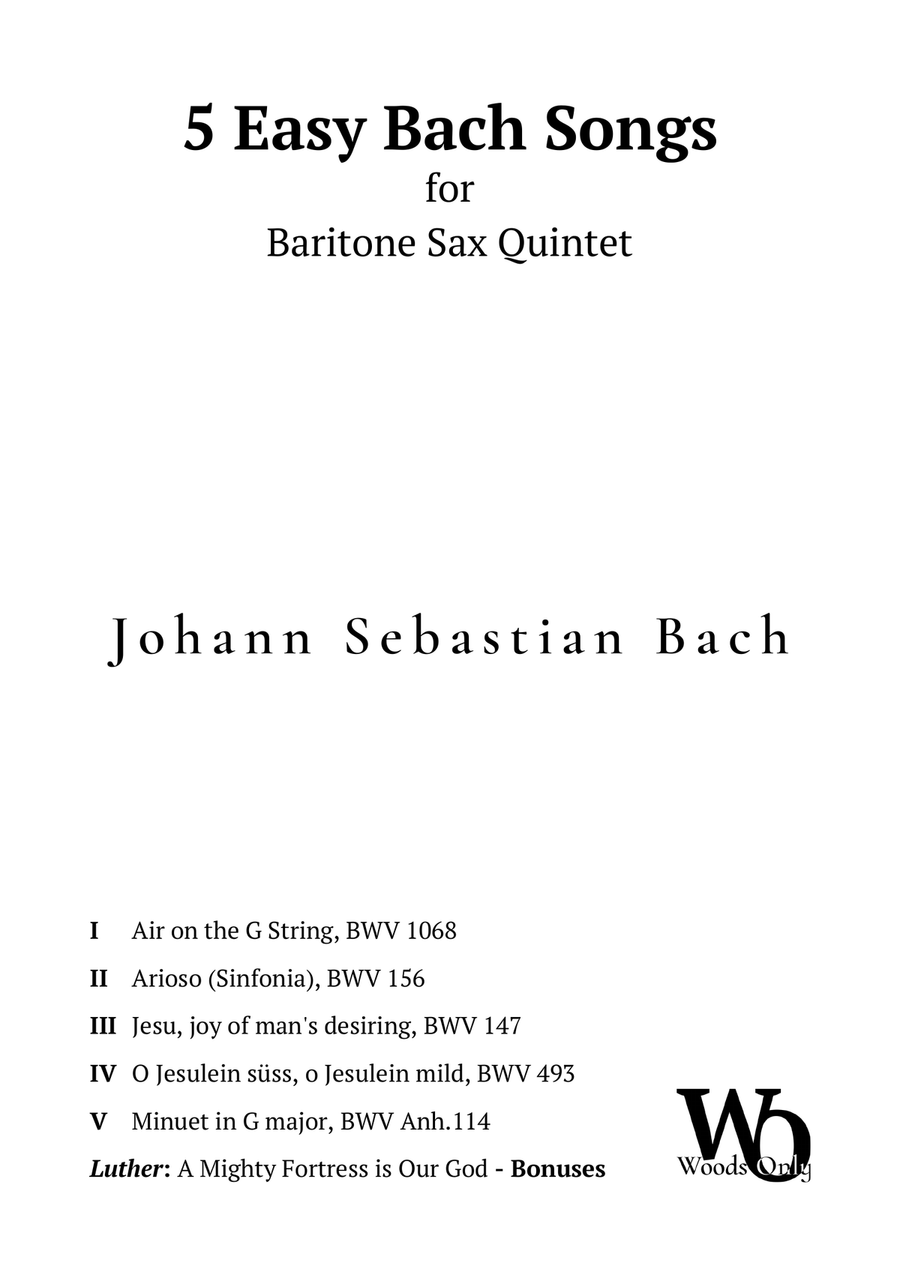
5 Famous Songs by Bach for Baritone Sax Quintet
Quintette de Saxophone: 5 saxophones

$39.99 33.55 € Quintette de Saxophone: 5 saxophones PDF SheetMusicPlus

Woodwind Ensemble,Woodwind Quintet Alto Saxophone - Level 1 - Digital Download SKU: A0.957294 Composed by Bach, Martin Luther. Arranged by Ander. Baroque,Easter,Renaissance,Sacred,Wedding. 51 pages. Woods Only, Arrangements #6748245. Published by Woods Only, Arrangements (A0.957294). This album contains 5 of Johann Sebastian Bach's most famous and versatile pieces for alto sax quintet, all very well suited for the beginners who want to get to know the baroque repertoire. They are also suitable for performances at events such as: weddings, Christian and church ceremonies, Easter, and academic recitals or concerts. They can be used in music institutions and by teachers as repertoire material and study methods, either for performance or instrumental technique. This collection includes a totally free bonus for you to enjoy: Martin Luther's A Mighty Fortress is Our God, a Renaissance sacred song for choir, which has been adapted for this set. You can also buy each one individually by checking right at the end of each description of each work.1: Air on the G String - The original piece is part of Johann Sebastian Bach's Suite No. 3 for orchestra, in D Major, BWV 1068, written for Prince Leopold of Anhalt. The so-called Air on the G String dates from one of these latter employments. In the service of the Prince of Cöthen, Bach composed not only the famous Brandenburg Concertos, but also several orchestral suites, from the third of which comes the Air on the G String. This curious title derives from a later arrangement of this piece for violin solo, in which the melody is played entirely on the lower, higher string of the instrument. ID: S0.11897632: Arioso - The Cantata 156 (BWV 156) was written for the third Sunday after Epiphany in 1729, and was first performed on January 23 of that year. The text is by Picander, one of Bach's favorite librettists. Of the four cantatas written by Bach for the feast, it was the last and only one scored for solo voice. This is a choral cantata, employing a choral melody in several movements. Cantata 156, in fact, employs two different choral melodies and texts in the second and sixth movements. A cantata is a sung symphony consisting of several parts, one of which is the Arioso, which is the initial instrumental part. ID: S0.11899793: Jesu, joy of man's desiring - This is one of Bach's most beautiful cantatas, made famous by the Jesus the Joy of Men chorus. It was originally composed for Advent 1716 in Weimar. Years later, already in Leipzig, Advent was tempus clausum, there was no music in the churches. Bach then reworked it for the Feast of Mary's Visitation. It is the final chorale of the cantata Herz und Mund und Tat und Leben. Although it is the 32nd cantata composed by Bach, of those that have survived, it was given BWV 147 in the complete catalog of his works. ID: S0.11900294: O Jesulein süss, o Jesulein mild - The Jesulein süß, the Jesulein mild is an original traditional German choral melody for voice and continuous bass arranged by Johann Sebastian Bach around 1735. With lyrics by Valentin Thilo, O Jesulein süss is a sacred melody adapted and catalogued as BWV 493. The first translation is by Dirk van Hogendorp, who made it more of a song for the time of suffering. ID: S0.11901615: Minuet in G major - This famous piece has traditionally been attributed to Johann Sebastian Bach, as it appears in the Notebook for Anna Magdalena , a notebook that Bach gave to his wife Anna Magdalena in 1725 and which was to be filled with the favorite selections of Bach family members. However, recent research has concluded that this minuet, sometimes referred to as BWV Anhang 114. was probably composed by Christian Petzold, a German composer and organist contemporary with Bach. ID: S0.1190371Bonuses: A Mighty Fortress is Our God, by Martin Luther - Ein feste Burg ist unser Gott is a hymn written by Martin Luther probably before 1529. The melody was also considered his work for a long time, but it was created at least with the collaboration of Johann Walter. The song is of great symbolic power for Protestantism;.
5 Famous Songs by Bach for Alto Sax Quintet
Quintette de Saxophone: 5 saxophones

$39.99 33.55 € Quintette de Saxophone: 5 saxophones PDF SheetMusicPlus

Saxophone Quintet,Woodwind Ensemble Alto Saxophone - Level 3 - Digital Download SKU: A0.813820 Composed by Antonin Dvorak. Arranged by Regis Bookshar. Contemporary,Folk,Romantic Period,Standards. 18 pages. Regis Bookshar #6533331. Published by Regis Bookshar (A0.813820). Largo (from Symphony No. 9 in E minor) (From the New World) (Alto Saxophone Quintet) - Intermediate - Digital Download. This marvelous arrangement of the Largo, based on the second movement of Antonin Dvorak's Symphony No. 9 in E minor, would be a fabulous addition to any music library and could be performed for concerts, recitals and church services, especially Funerals, but would be appropriate any time during the church year. This arrangement is suitable for high school and college students but professional musicians would also enjoy playing this selection. Included are a score and a complete set of parts (18 pages). This selection is one of the many arrangements from the The Regis Bookshar Trumpet Ensemble's extensive music library which are being made available for the first time.Symphony No. 9 in E minor, Op. 95 (subtitled From the New World and popularly know as the New World Symphony), was composed by Antonin Dvorak in 1893 while he was the director of the National Conservatory of Music of America from 1892 to 1895. It premiered at Carnegie Hall in New York City on December 16, 1893 and has been described as one of the most popular of all symphonies. The second movement of the symphony, upon which this arrangement is based, is marked Largo, and begins with a harmonic progression of chords which is then followed by a solo instrument playing the famous main theme.Dvorak was interested in Native American music and the African-American spirituals he heard in North America. While director of the National Conservatory he encountered an African-American student, Harry T. Burleigh, who sang traditional spirituals to him. Burleigh, later a composer himself, said that Dvorak had absorbed their spirit before writing his own melodies. Dvorak stated:    I am convinced that the future music of this country must be founded on what are called Negro melodies. These can be the foundation of a serious and original school of composition to be developed in the United States. These beautiful and varied themes are the product of the soil. They are folk songs of America and your composers must turn to them.He further explained how Native American music influenced his symphony:  I have not actually used any of these (Native American) melodies. I have simply written original themes embodying the peculiarities of the Indian music, and, using these themes as subjects, have developed them with all the resources of modern rhythms, counterpoint, and orchestral colour.In 1893, a newspaper interview quoted Dvorak as saying, I found that the music of the negroes and of the Indians was practically identical, and that the music of the two races bore a remarkable similarity to the music of Scotland. Most historians agree that Dvorak is referring to the pentatonic scale, which is typical of each of these musical traditions.Dvorak was influenced not only by music he heard, but also by what he had seen, in America. He wrote that he would not have composed his American pieces as he had if he had not seen America. It has been said that Dvorak was inspired by the wide open spaces of America, such as the prairies he may have seen on his trip to Iowa in the summer of 1893. Notices about several performances of the symphony include the phrase wide open spaces about what inspired the symphony and/or about the feelings it conveys to listeners.The theme from the Largo was adapted into the spiritual Goin' Home (often mistakenly considered a folk song or traditional spiritual) by Dvorak's pupil, William Arms Fisher, who wrote the lyrics in 1922. Regis Bookshar thought it would be wonderful if other instrumentalists could have the opportunity to play this beautiful melody, so, in addition to this version for an Alto Saxophone Quintet, he has made quite a few other arrangements of this selection which are readily available for a wide variety o.
Largo (from "Symphony No. 9") ("From the New World") (Db) (Alto Saxophone Quintet)
Quintette de Saxophone: 5 saxophones

$15.00 12.58 € Quintette de Saxophone: 5 saxophones PDF SheetMusicPlus

Saxophone Quintet,Woodwind Ensemble Alto Saxophone,Baritone Saxophone,Tenor Saxophone - Level 3 - Digital Download SKU: A0.813832 Composed by Antonin Dvorak. Arranged by Regis Bookshar. Contemporary,Folk,Romantic Period,Standards. 19 pages. Regis Bookshar #6533927. Published by Regis Bookshar (A0.813832). Largo (from Symphony No. 9 in E minor) (From the New World) (Db) (Saxophone Quintet) - Intermediate - Digital Download. This marvelous arrangement of the Largo, based on the second movement of Antonin Dvorak's Symphony No. 9 in E minor, would be a fabulous addition to any music library and could be performed for concerts, recitals and church services, especially Funerals, but would be appropriate any time during the church year. This arrangement is suitable for high school and college students but professional musicians would also enjoy playing this selection. Included are a score and a complete set of parts (19 pages). This selection is one of the many arrangements from the The Regis Bookshar Trumpet Ensemble's extensive music library which are being made available for the first time.Symphony No. 9 in E minor, Op. 95 (subtitled From the New World and popularly know as the New World Symphony), was composed by Antonin Dvorak in 1893 while he was the director of the National Conservatory of Music of America from 1892 to 1895. It premiered at Carnegie Hall in New York City on December 16, 1893 and has been described as one of the most popular of all symphonies. The second movement of the symphony, upon which this arrangement is based, is marked Largo, and begins with a harmonic progression of chords which is then followed by a solo instrument playing the famous main theme.Dvorak was interested in Native American music and the African-American spirituals he heard in North America. While director of the National Conservatory he encountered an African-American student, Harry T. Burleigh, who sang traditional spirituals to him. Burleigh, later a composer himself, said that Dvorak had absorbed their spirit before writing his own melodies. Dvorak stated:    I am convinced that the future music of this country must be founded on what are called Negro melodies. These can be the foundation of a serious and original school of composition to be developed in the United States. These beautiful and varied themes are the product of the soil. They are folk songs of America and your composers must turn to them.He further explained how Native American music influenced his symphony:  I have not actually used any of these (Native American) melodies. I have simply written original themes embodying the peculiarities of the Indian music, and, using these themes as subjects, have developed them with all the resources of modern rhythms, counterpoint, and orchestral colour.In 1893, a newspaper interview quoted Dvorak as saying, I found that the music of the negroes and of the Indians was practically identical, and that the music of the two races bore a remarkable similarity to the music of Scotland. Most historians agree that Dvorak is referring to the pentatonic scale, which is typical of each of these musical traditions.Dvorak was influenced not only by music he heard, but also by what he had seen, in America. He wrote that he would not have composed his American pieces as he had if he had not seen America. It has been said that Dvorak was inspired by the wide open spaces of America, such as the prairies he may have seen on his trip to Iowa in the summer of 1893. Notices about several performances of the symphony include the phrase wide open spaces about what inspired the symphony and/or about the feelings it conveys to listeners.The theme from the Largo was adapted into the spiritual Goin' Home (often mistakenly considered a folk song or traditional spiritual) by Dvorak's pupil, William Arms Fisher, who wrote the lyrics in 1922. Regis Bookshar thought it would be wonderful if other instrumentalists could have the opportunity to play this beautiful melody, so, in addition to this version for a Saxophone Quintet, consisting of 2 Alto Saxophones, 2 Tenor Saxophones and 1 Baritone Saxophone, he has made quite a few other arrangements.
Largo (from "Symphony No. 9") ("From the New World") (Db) (Saxophone Quintet - 2 Alto, 2 Tenor, 1 Ba
Quintette de Saxophone: 5 saxophones

$15.00 12.58 € Quintette de Saxophone: 5 saxophones PDF SheetMusicPlus


1 16 31 ....136


Partitions Gratuites
Acheter des Partitions Musicales
Acheter des Partitions Digitales à Imprimer
Acheter des Instruments de Musique

© 2000 - 2026

Accueil - Version intégrale





