EUROPE
2962 articles
USA
0 articles
DIGITAL
11 articles (à imprimer)
Partitions Digitales
Partitions à imprimer
11 partitions trouvées


Flute Choir,Woodwind Ensemble Alto Flute,Bass Flute - Level 3 - Digital Download SKU: A0.1256790 By Jax. By Dan Henig, Jacqueline Miskanic, and Mark Nilan Jr. Arranged by Lisa Ochoco. Contemporary,Pop. 28 pages. Lisa L Ochoco #850162. Published by Lisa L Ochoco (A0.1256790). This song by Jax has a catchy tune and fun beat.  It's a song that talks about the beauty standards that women are faced with in our everyday lives.  Having struggled with body image issues herself, Jax wrote this song that directly calls out the lingerie company, Victoria's Secret, for cashing in on body issues, selling skin and bones with big boobs. The song has been an international hit. This arrangement is just so that people who love the song can play it.  I will admit that it is repetitious, but it's just a catchy tune! Scored for flute choir - 3 C, alto, bass, and contrabass flutes. If your choir doesn't have a contrabass, then it can be substituted by another bass, or any C instrument in a similar range, but it is a part that needs to be covered, as it has important (but quite simple bass lines).  There is an optional upright string bass part that doubles the contrabass an octave below.   There are 2 body percussion parts that are quite simple, but particularly important.  It's a stomp and clap (or snap).  You could also use 2 different drums, buckets, etc.  Substitute a low pitch for the stomp and a higher one for the clap. Duration: 3 minutes.
Victoria's Secret
Ensemble de Flûtes
Jax
$15.00 12.98 € Ensemble de Flûtes PDF SheetMusicPlus

Flute Choir,Woodwind Ensemble Alto Flute,Bass Flute - Level 3 - Digital Download SKU: A0.1261527 By Jax. By Dan Henig, Jacqueline Miskanic, and Mark Nilan Jr. Arranged by Lisa Ochoco. Contemporary,Pop. 28 pages. Lisa L Ochoco #854605. Published by Lisa L Ochoco (A0.1261527). This song by Jax has a catchy tune and fun beat.  It's a song that talks about the beauty standards that women are faced with in our everyday lives.  Having struggled with body image issues herself, Jax wrote this song that directly calls out the lingerie company, Victoria's Secret, for cashing in on body issues, selling skin and bones with big boobs. The song has been an international hit. This arrangement is just so that people who love the song can play it.  I will admit that it is repetitious, but it's just a catchy tune! Scored for low flute choir - 3 altos, bass, and contrabass flutes. There is an optional contra alto (in G) part that is a mix between the bass and contrabass flute parts. There is also an optional upright string bass part that doubles the contrabass.  There are 2 body percussion parts that are quite simple, but particularly important.  It's a stomp and clap (or snap).  You could also use 2 different drums, buckets, etc.  Substitute a low pitch for the stomp and a higher one for the clap. Duration: 3 minutes.
Victoria's Secret
Ensemble de Flûtes
Jax
$15.00 12.98 € Ensemble de Flûtes PDF SheetMusicPlus

Flute Choir - 4 flutes, alto, bass - Intermediate-Advanced - Digital Download SKU: F2.FM036 Composed by Edvard Grieg. Arranged by Robert Rainford. Score and parts. 10 pages. Forton Music - Digital #FM036. Published by Forton Music - Digital (F2.FM036). ISBN 9790708085355.Flute Choir/Ensemble - 4 Flutes, alto flute, bass flute. An ideal piece for the less experienced flute choir. 44 bars long in G major with an Allegretto tempo marking, this was originally a choral piece which has been transcribed for flute choir. Flute one and two reach top G, whilst the third and fourth part go no higher than 2nd octave D (although there are some A#'s to deal with). The alto and bass parts are very simple, allowing players less certain on these instruments to find their feet. The second half of this piece is an identical repeat of the first half, with flute one changing material with flute two, and flute three changing with flute 4. A useful concert piece.
Ave Maris Stella
Ensemble de Flûtes

$9.95 8.61 € Ensemble de Flûtes PDF SheetMusicPlus

Woodwind Ensemble Flute - Level 3 - Digital Download SKU: A0.549201 Composed by Gabrieli. Arranged by James M. Guthrie, ASCAP. Renaissance,Standards. 58 pages. Jmsgu3 #3460719. Published by jmsgu3 (A0.549201). Instrumentation: 2 piccolos, 3 concert flutes, 1 alto flute, 1 bass flute, 1 cello. Arranged in two antiphonal choirs. Full Score: 28 pg. Study Score: 14 pg. Parts: 2 pg ea. Duration: ca. 3:00 Innovations First of all, Gabrieli preferred sacred vocal and certainly instrumental music. Hence, he concentrated on music that consequently took advantage of resonance and likewise reverberation for maximum effect. Seems like Gabrieli may have invented dynamics – or was rather the first to indicate them such as in his Sonata Pian’ e Forte. Consequently, he was also a pioneer in spatial techniques. He therefore developed and used very specific notation to indicate instrumentation. Gabrieli experimented with assembling massive instrumental forces into isolated groups separated by space. In this way, he consequently contributed heavily to the Baroque Concertato style. Polychoral Works Gabrieli probably used the layout of the San Marco church for his experiments. This is because he worked there as a musician and composer. Furthermore, the church had two choir lofts facing each other. He certainly used these to create striking spatial effects between instrumental forces. Certainly, many of his works are composed such that a choir or instrumental group could first be heard on one side, then consequently followed by a response from the group on the other side. Sometimes there was probably a third group positioned near the main altar as well. Spatial Music Above all, Gabrieli studied carefully detailed groups of instruments and singers. Furthermore, it seems like he created precise directions for instrumentation in rather more than two groups. The instruments, because they could be appropriately situated, could consequently be heard with perfect clearness at distant locations. As a result, arrangements which seem bizarre on paper, can in contrast sound perfectly in-balance. First Works Finally, Gabrieli published his first motets along with his uncle Andrea's compositions in Concerti (1587). These compositions furthermore indicate considerable usage of dialogue and echo effects. Consequently, here we see low and high choirs with the variance between their ranges indicated by instrumental accompaniment. Seems like Gabrieli’s later motets Sacrae Symphoniae (1597) move away from close antiphony. In contrast, he moves towards not simply echoing the material, but developing it by sequential choral entrances. Even more, he takes this procedure to the extreme in the Motet Omnes Gentes. Unlike earlier works, here the instruments are certainly an essential part of the presentation. Also, only parts marked: Capella are supposed to be sung. Homophony Hence, after 1605, Gabrieli moves to a much more homophonic style. He writes sections purely for instruments – which calls Sinfonia – and smaller sections for vocal soloists, accompanied by a basso continuo.
Gabrieli: Canzon Septimi Toni Ch 172 for Flute Choir
Ensemble de Flûtes

$47.95 41.49 € Ensemble de Flûtes PDF SheetMusicPlus

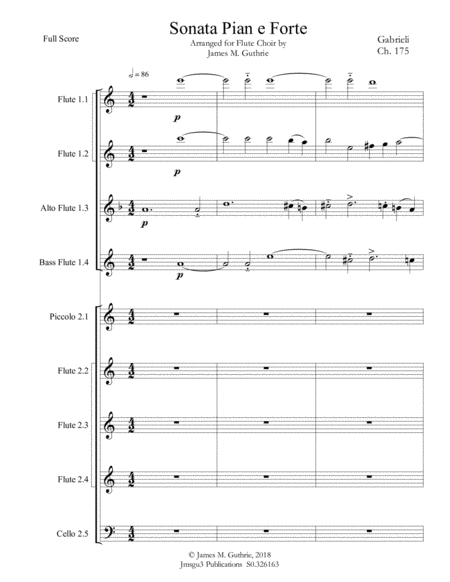
Woodwind Ensemble Flute - Level 3 - Digital Download SKU: A0.549210 Composed by Gabrieli. Arranged by James M. Guthrie, ASCAP. Renaissance,Standards. 59 pages. Jmsgu3 #3464701. Published by jmsgu3 (A0.549210). A musical monument: the first composition to employ dynamics. Instrumentation: 1 piccolo, 5 concert flutes, 1 alto flute, 1 bass flute 1 cello. Arranged in two antiphonal choirs. Full Score: 27 pg. 81 ms 4/2, Study Score: 14 pg., Instrumental parts: 2 pg. Duration: 3:45 at half-note = 86. Innovations First of all, Gabrieli preferred sacred vocal and certainly instrumental music. Hence, he concentrated on music that consequently took advantage of resonance and likewise reverberation for maximum effect. Seems like Gabrieli may have invented dynamics – or was rather the first to indicate them such as in his Sonata Pian’ e Forte. Consequently, he was also a pioneer in spatial techniques. He therefore developed and used very specific notation to indicate instrumentation. Gabrieli experimented with assembling massive instrumental forces into isolated groups separated by space. In this way, he consequently contributed heavily to the Baroque Concertato style. Polychoral Works Gabrieli probably used the layout of the San Marco church for his experiments. This is because he worked there as a musician and composer. Furthermore, the church had two choir lofts facing each other. He certainly used these to create striking spatial effects between instrumental forces. Certainly, many of his works are composed such that a choir or instrumental group could first be heard on one side, then consequently followed by a response from the group on the other side. Sometimes there was probably a third group positioned near the main altar as well. Spatial Music Above all, Gabrieli studied carefully detailed groups of instruments and singers. Furthermore, it seems like he created precise directions for instrumentation in rather than two groups. The instruments, because they could be appropriately situated, could consequently be heard with perfect clearness at distant locations. As a result, arrangements that seem bizarre on paper, can in contrast sound perfectly in balance. First Works Finally, Gabrieli published his first motets along with his uncle Andrea's compositions in Concerti (1587). These compositions furthermore indicate considerable usage of dialogue and echo effects. Consequently, here we see low and high choirs with the variance between their ranges indicated by instrumental accompaniment. Seems like Gabrieli’s later motets Sacrae Symphoniae (1597) move away from close antiphony. In contrast, he moves towards not simply echoing the material, but developing it through sequential choral entrances. Even more, he takes this procedure to the extreme in the Motet Omnes Gentes. Unlike earlier works, here the instruments are certainly an essential part of the presentation. Also, only parts marked: Capella are supposed to be sung. Homophony Hence, after 1605, Gabrieli moves to a much more homophonic style. He writes sections purely for instruments – which calls Sinfonia – and smaller sections for vocal soloists, accompanied by a basso continuo.
Gabrieli: Sonata Pian e Forte Ch. 175 for Flute Choir
Ensemble de Flûtes

$47.95 41.49 € Ensemble de Flûtes PDF SheetMusicPlus

Flute Choir,Woodwind Ensemble Flute - Level 4 - Digital Download SKU: A0.1449852 Composed by William Byrd. Arranged by Regis Bookshar. Chamber,Early Music,Historic,Instructional,Renaissance. 27 pages. Regis Bookshar #1029616. Published by Regis Bookshar (A0.1449852). Sing Joyfully - William Byrd - Flute Sextet - Advanced/Intermediate - Digital Download.William Byrd was the greatest British composer of the late Renaissance, and just maybe, the greatest Bristish composer ever. He wrote a huge body of choral music, some of it profound and timeless. He also composed brilliant, virtuoso pieces and his motet-like anthem, Sing Joyfully, a polyphonic setting of Psalm 81, written in 1590, is perhaps his best-known one, It is enchanting to listen to and is fun to sing. Regis Bookshar thought that instrumental performers should have the same opportunity that singers have experienced for years so he has now transcribed, edited and arranged this wonderful selection for a Flute Sextet.Since no tempo is indicated and there are no written dynamic or phrase markings in William Byrd's original score, Regis Bookshar has taken the liberty to add them in order to provide direction and life to the piece. This arrangement is suitable for high school and college students and is perfect for concerts and recitals and perhaps even church services, but could be performed for any occasion. Included are a score and a complete set of parts (27 pages).This selection is readily available for a wide variety of instrumental ensembles. Please take the time to look for other versions of this composition. You may find something else that may also suit your needs. Also, please feel free to search for other arrangements by Regis Bookshar as there are numeous selections in a variety of styles also available for purchase. You may find something else which might interest you. Please continue to check back periodically because new arrangements are being added as often as possible. I'm certain that this wonderful arrangement of William Byrd's delightful, Sing Joyfully', will continue to entertain both peformers and audiences alike for many years to come.
Sing Joyfully (Eb) (Flute Sextet)
Ensemble de Flûtes

$30.00 25.96 € Ensemble de Flûtes PDF SheetMusicPlus

Flute Choir,Woodwind Ensemble Alto Flute,Bass Flute - Level 3 - Digital Download SKU: A0.1037658 Composed by Giovanni Gabrieli (c.1554/7 - 1612). Arranged by Adrian Dee. Renaissance. 27 pages. Adrian Dee #642563. Published by Adrian Dee (A0.1037658). Here is one for the big flutes. Arranged for 3 C-flutes, 2 alto flutes, 2 bass flutes, and 2 contrabass flutes. Each voice is unique, so all parts are required, including both contra parts. You may add piccolo players (one on each part) to double the first and second flute parts. This piece is a typical example of Gabrieli’s masterful counterpoint. Keep all notes cleanly separated as though they were marked staccato, especially repeated notes. Bring out the moving notes and drop back on longer notes.
Canzon Duodecimi Toni a 10, Ch. 177
Ensemble de Flûtes

$10.99 9.51 € Ensemble de Flûtes PDF SheetMusicPlus

Flute Choir,Woodwind Ensemble Alto Flute,Bass Flute,Piccolo - Level 4 - Digital Download SKU: A0.1309628 By Dua Lipa. By Andrew Wyatt Blakemore, Caroline Ailin, Dua Lipa, and Mark Ronson. Arranged by Joel Scianna. Contemporary,Film/TV,Pop. 28 pages. Joel William Music #898795. Published by Joel William Music (A0.1309628).  If you didn't hear Dua Lipa's latest bop during the Barbie movie, you've probably heard it on the radio recently! Add something modern to your Flute Choir setlist with this intricate and dynamic arrangement, scored for piccolo, four flute parts, alto flute, bass flute, and optional contrabass and contra alto flute parts.  This arrangement has quick runs, spicy syncopations, great dynamic contrast, and a breakdown (Rehearsal mark E) that makes sure to feature each flute voice. Your audience will be bobbing their heads along to this recognizable dance track, and each part has its own moment to shine.  
Dance The Night
Ensemble de Flûtes
Dua Lipa
$25.00 21.63 € Ensemble de Flûtes PDF SheetMusicPlus

Flute Choir,Woodwind Ensemble Alto Flute,Bass Flute - Level 3 - Digital Download SKU: A0.1167899 By Kevin MacLeod. By Kevin MacLeod. Arranged by Lisa Ochoco. Comedy,Contemporary. 31 pages. Lisa L Ochoco #768254. Published by Lisa L Ochoco (A0.1167899). If you’ve ever seen a funny video on YouTube, Facebook, TikTok, etc., chances are that you’ve heard this tune before…many many times.  It makes cute and funny videos, well, cuter and funnier.Kevin Macleod wrote this cute and funny tune, and it’s written to loop until the video ends.  The longer the video, the higher it goes (I think, although having a cute video last more than 5 minutes may wear you out.)  While I could have modulated it 5 times, I didn’t.  There is one key change, and after that key change, this cute and funny tune goes Radio City Rockette-ish before definitely coming to an end at around the 2 minute mark.Scored for flute choir – 4 C, alto, bass, and contrabass flutes.  There is an optional cello part that can help bring out the staccato notes in the contrabass, which can also be played by any C instrument in a similar range, such as a bassoon.This would be a great recital opener, closer, or filler.  Or, you could have a few members of your group act out a cute and funny scene to it.  The possibilities are endless!Duration: 2 minutes.
Monkeys Spinning Monkeys
Ensemble de Flûtes
Kevin MacLeod
$15.00 12.98 € Ensemble de Flûtes PDF SheetMusicPlus


Partitions Gratuites
Acheter des Partitions Musicales
Acheter des Partitions Digitales à Imprimer
Acheter des Instruments de Musique

© 2000 - 2026

Accueil - Version intégrale





