EUROPE
3015 articles
USA
0 articles
DIGITAL
53 articles (à imprimer)
Partitions Digitales
Partitions à imprimer
53 partitions trouvées


Woodwind Ensemble Flute - Level 3 - Digital Download SKU: A0.549210 Composed by Gabrieli. Arranged by James M. Guthrie, ASCAP. Renaissance,Standards. 59 pages. Jmsgu3 #3464701. Published by jmsgu3 (A0.549210). A musical monument: the first composition to employ dynamics. Instrumentation: 1 piccolo, 5 concert flutes, 1 alto flute, 1 bass flute 1 cello. Arranged in two antiphonal choirs. Full Score: 27 pg. 81 ms 4/2, Study Score: 14 pg., Instrumental parts: 2 pg. Duration: 3:45 at half-note = 86. Innovations First of all, Gabrieli preferred sacred vocal and certainly instrumental music. Hence, he concentrated on music that consequently took advantage of resonance and likewise reverberation for maximum effect. Seems like Gabrieli may have invented dynamics – or was rather the first to indicate them such as in his Sonata Pian’ e Forte. Consequently, he was also a pioneer in spatial techniques. He therefore developed and used very specific notation to indicate instrumentation. Gabrieli experimented with assembling massive instrumental forces into isolated groups separated by space. In this way, he consequently contributed heavily to the Baroque Concertato style. Polychoral Works Gabrieli probably used the layout of the San Marco church for his experiments. This is because he worked there as a musician and composer. Furthermore, the church had two choir lofts facing each other. He certainly used these to create striking spatial effects between instrumental forces. Certainly, many of his works are composed such that a choir or instrumental group could first be heard on one side, then consequently followed by a response from the group on the other side. Sometimes there was probably a third group positioned near the main altar as well. Spatial Music Above all, Gabrieli studied carefully detailed groups of instruments and singers. Furthermore, it seems like he created precise directions for instrumentation in rather than two groups. The instruments, because they could be appropriately situated, could consequently be heard with perfect clearness at distant locations. As a result, arrangements that seem bizarre on paper, can in contrast sound perfectly in balance. First Works Finally, Gabrieli published his first motets along with his uncle Andrea's compositions in Concerti (1587). These compositions furthermore indicate considerable usage of dialogue and echo effects. Consequently, here we see low and high choirs with the variance between their ranges indicated by instrumental accompaniment. Seems like Gabrieli’s later motets Sacrae Symphoniae (1597) move away from close antiphony. In contrast, he moves towards not simply echoing the material, but developing it through sequential choral entrances. Even more, he takes this procedure to the extreme in the Motet Omnes Gentes. Unlike earlier works, here the instruments are certainly an essential part of the presentation. Also, only parts marked: Capella are supposed to be sung. Homophony Hence, after 1605, Gabrieli moves to a much more homophonic style. He writes sections purely for instruments – which calls Sinfonia – and smaller sections for vocal soloists, accompanied by a basso continuo.
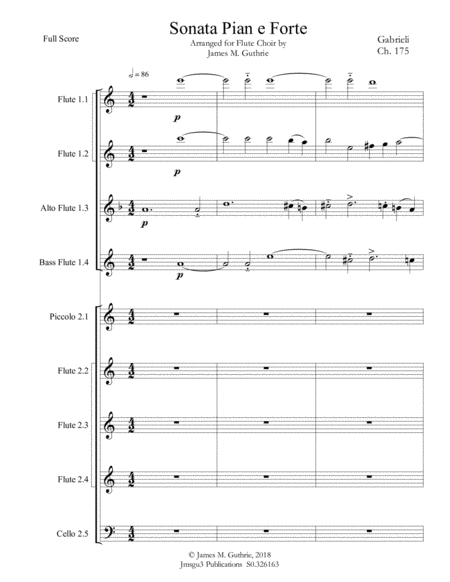
Gabrieli: Sonata Pian e Forte Ch. 175 for Flute Choir
Ensemble de Flûtes

$47.95 40.66 € Ensemble de Flûtes PDF SheetMusicPlus

Woodwind Ensemble Flute - Level 3 - Digital Download SKU: A0.549201 Composed by Gabrieli. Arranged by James M. Guthrie, ASCAP. Renaissance,Standards. 58 pages. Jmsgu3 #3460719. Published by jmsgu3 (A0.549201). Instrumentation: 2 piccolos, 3 concert flutes, 1 alto flute, 1 bass flute, 1 cello. Arranged in two antiphonal choirs. Full Score: 28 pg. Study Score: 14 pg. Parts: 2 pg ea. Duration: ca. 3:00 Innovations First of all, Gabrieli preferred sacred vocal and certainly instrumental music. Hence, he concentrated on music that consequently took advantage of resonance and likewise reverberation for maximum effect. Seems like Gabrieli may have invented dynamics – or was rather the first to indicate them such as in his Sonata Pian’ e Forte. Consequently, he was also a pioneer in spatial techniques. He therefore developed and used very specific notation to indicate instrumentation. Gabrieli experimented with assembling massive instrumental forces into isolated groups separated by space. In this way, he consequently contributed heavily to the Baroque Concertato style. Polychoral Works Gabrieli probably used the layout of the San Marco church for his experiments. This is because he worked there as a musician and composer. Furthermore, the church had two choir lofts facing each other. He certainly used these to create striking spatial effects between instrumental forces. Certainly, many of his works are composed such that a choir or instrumental group could first be heard on one side, then consequently followed by a response from the group on the other side. Sometimes there was probably a third group positioned near the main altar as well. Spatial Music Above all, Gabrieli studied carefully detailed groups of instruments and singers. Furthermore, it seems like he created precise directions for instrumentation in rather more than two groups. The instruments, because they could be appropriately situated, could consequently be heard with perfect clearness at distant locations. As a result, arrangements which seem bizarre on paper, can in contrast sound perfectly in-balance. First Works Finally, Gabrieli published his first motets along with his uncle Andrea's compositions in Concerti (1587). These compositions furthermore indicate considerable usage of dialogue and echo effects. Consequently, here we see low and high choirs with the variance between their ranges indicated by instrumental accompaniment. Seems like Gabrieli’s later motets Sacrae Symphoniae (1597) move away from close antiphony. In contrast, he moves towards not simply echoing the material, but developing it by sequential choral entrances. Even more, he takes this procedure to the extreme in the Motet Omnes Gentes. Unlike earlier works, here the instruments are certainly an essential part of the presentation. Also, only parts marked: Capella are supposed to be sung. Homophony Hence, after 1605, Gabrieli moves to a much more homophonic style. He writes sections purely for instruments – which calls Sinfonia – and smaller sections for vocal soloists, accompanied by a basso continuo.
Gabrieli: Canzon Septimi Toni Ch 172 for Flute Choir
Ensemble de Flûtes

$47.95 40.66 € Ensemble de Flûtes PDF SheetMusicPlus

Flute Choir,Woodwind Ensemble Alto Flute,Bass Flute,Piccolo - Level 3 - Digital Download SKU: A0.1163640 Composed by Simon Franglen. Arranged by Lisa Ochoco. Contemporary,Film/TV. 20 pages. Lisa L Ochoco #763982. Published by Lisa L Ochoco (A0.1163640). Avatar: The Way of Water, is the long-awaited sequel to the award-winning film from 2009.  The soundtrack for the new film was written by Simon Franglen, who originally wrote 5 hours of music to cover any and all situations in the almost 3-hour movie.The Songcord is a beautiful song that is heard twice in the film – at the beginning and at the end.  A songcord is a mnemonic device used by the Na’vi that assists them in storytelling.  In this song, Neytiri is thanking Eywa – the Great Mother - for her family.This arrangement is scored for flute choir – piccolo with 4 C, alto, bass, and contrabass flutes.  There is an optional cello part that doubles the contrabass that can be played by any bass clef C instrument in a similar range.One of the most important parts of this piece is what helps create the mood, which is where the part called “Shimmer†comes in.  In an interview, Simon Franglen said that an important part of the music is the feeling of light, and he achieved that by including shimmering sounds into his tunes.  The “Shimmer†part can be played by hanging a few keys (house keys, car keys, etc.) that have different pitches on short lengths of string.  Use a small metal or wooden object to lightly hit the keys to create little “dingsâ€. You can also use wind chimes, a little xylophone, bells, etc.  The idea is to create a magical mood without overpowering the music.  Play this part wherever there is a note in the measure. Always keep the melody prominent.  The piccolo should always be played softly - at the equivalent volume of the group’s piano.  Play this slowly and freely, with a lot of rubato.  Duration: 3.75 minutes.
The Songcord
Ensemble de Flûtes

$16.00 13.57 € Ensemble de Flûtes PDF SheetMusicPlus

Flute Choir,Woodwind Ensemble Alto Flute,Bass Flute - Level 3 - Digital Download SKU: A0.1169424 Composed by Simon Franglen. Arranged by Lisa Ochoco. Contemporary,Film/TV. 21 pages. Lisa L Ochoco #769781. Published by Lisa L Ochoco (A0.1169424). Avatar: The Way of Water, is the long-awaited sequel to the award-winning film from 2009. The soundtrack for the new film was written by Simon Franglen, who originally wrote 5 hours of music to cover any and all situations in the almost 3-hour movie.  The Songcord is a beautiful song that is heard twice in the film – at the beginning and at the end. A songcord is a mnemonic device used by the Na’vi that assists them in storytelling. In this song, Neytiri is thanking Eywa – the Great Mother - for her family. This arrangement is scored for low flute choir – 4 altos, 3 basses, contra alto in G, and contrabass. There is an optional cello part that doubles the contrabass that can be played by any bass clef C instrument in a similar range. One of the most important parts of this piece is what helps create the mood, which is where the part called “Shimmer†comes in.  In an interview, Simon Franglen said that an important part of the music is the feeling of light, and he achieved that by including shimmering sounds into his tunes.  The “Shimmer†part can be played by hanging a few keys (house keys, car keys, etc.) that have different pitches on short lengths of string.  Use a small metal or wooden object to lightly hit the keys to create little “dingsâ€. You can also use wind chimes, a little xylophone, bells, etc.  The idea is to create a magical mood without overpowering the music.  Play this part wherever there is a note in the measure. Always keep the melody prominent.  Play this slowly and freely, with a lot of rubato.  Duration: 3.75 minutes.
The Songcord
Ensemble de Flûtes

$16.00 13.57 € Ensemble de Flûtes PDF SheetMusicPlus

Woodwind Ensemble Flute - Level 3 - Digital Download SKU: A0.874245 Composed by Johann Sebastion Bach , J S Bach. Arranged by Ray-Michael Kauffman. Baroque,Concert,Sacred,Standards,Wedding. 17 pages. As do Ray meflute studio production #3591641. Published by as do Ray meflute studio production (A0.874245). https://www.youtube.com/watch?v=EKPo0RPP-E4&feature=youtu.beAir from Suite in D by J. S. Bacharranged for flute choir / ensemble by me Ray-Michael Kauffman.  I know there is a lot of versions of this , but unhappy with most of them and lack of over all music musicality I decided to create one that was interesting to play and hear a swell as make good musical sense. After much debate, I decided changing the key to E flat would be most appropriate for either small group of players ( minimum 7) or larger groups . In the piece there is even additional divisions to help create more texture and colors in parts 3 & 4, yet remaining simple and true but sounding beautiful , what flutes should sound like.Great for studying flutist, to high school and college students. Flute choir groups, etcwould be a great addition for your ensemble, whether playing at a recital, concert, church and other spiritual events, graduation, weddings, etc. This would also be a great tool or warm up for balance and shaping sound, volume, color, blending, phrasing and other important technique builders for your group.You'll love this arrangement   ,and so will the flutists and your audience!
Air from Suite in D by Bach for flute choir / flute ensemble
Ensemble de Flûtes

$13.99 11.86 € Ensemble de Flûtes PDF SheetMusicPlus


Partitions Gratuites
Acheter des Partitions Musicales
Acheter des Partitions Digitales à Imprimer
Acheter des Instruments de Musique

© 2000 - 2026

Accueil - Version intégrale





