EUROPE
63 articles
USA
0 articles
DIGITAL
10 articles (à imprimer)
Partitions Digitales
Partitions à imprimer
10 partitions trouvées


Piano Solo - Level 3 - Digital Download SKU: A0.1096204 Composed by Johann Pachelbel. Arranged by James M. Guthrie. Baroque,Classical,Standards,Traditional,Wedding. Score. 4 pages. Jmsgu3 #700167. Published by jmsgu3 (A0.1096204). Score: 4 pages. Duration: 2:27. The famous Pachelbel Canon arranged for Solo Piano. A great choice for weddings & receptions! Pachelbel's Canon Pachelbel's Canon is, in fact, the traditional title for a composition by the German composer Johann Pachelbel. Other names for the work include namely: Canon and Gigue for 3 violins and basso continuo, Canon and Gigue in D, and of course Canon in D. We do not know when or why in particular it was written. The oldest copy is surprisingly from the 19th century. It is important to realize that it was a common routine for organists to practice improvisation on the chord progression underlying the canon. Pachelbel originally scored the Canon notably for three violins and continuo. He also in fact paired the Canon with a gigue. The movements are homotonal, to clarify, both are in the key of D major. History In due time, Pachelbel's Canon went out of style and remained in virtual oblivion for centuries. The Jean-François Paillard chamber orchestra, however, recorded an arrangement of it in 1968. As a result, it gained approval. Many ensembles began likewise to record the piece in the 1970s and by the 1980s became ubiquitous as background music. From the 1970s to the early 2000s, pop songs correspondingly used elements of the piece. The chord progression, in particular, was used this way. Also, since the 1980s, it has been not only wildly popular for weddings, but also for funeral ceremonies in the USA and Europe. Pachelbel Background Johann Pachelbel (1653 –1706) was a German composer, as well as an organist. He was furthermore instrumental in bringing the south German organ school to its apex. He wrote a large body of music, both sacred and, equally important, secular. In particular, he uniquely helped develop the chorale prelude and fugue. For this, he has, in fact, earned a rightful place in the company of the most significant composers of the mid-Baroque period. Works Pachelbel's music was certainly popular. With this in mind, he also consequently had many pupils. His music expressly developed into a model for south German composers. Nowadays, Pachelbel is most famous, particularly for the Canon in D, as well as the F minor Chaconne, the Toccata in E minor, and of course the Hexachordum Apollinis, a set of variations for the keyboard. Influences Johann Jakob Froberger and Johann Caspar Kerll were south German composers who significantly influenced Pachelbel. Furthermore, he was especially influenced by Italians such as Frescobaldi and Poglietti. He frequently preferred an articulate, simple contrapuntal style that highlighted clarity. His music is markedly less extravagant and harmonically adventurous than that of Dieterich Buxtehude. However, as a point often overlooked, like Buxtehude, Pachelbel experimented with different instrumental combinations in his chamber music. Legacy All in all, Pachelbel was most famous as a composer for the keyboard. He composed over two hundred pieces specifically for the instrument. Pachelbel was also surprisingly a prolific composer of vocal music. All in all, about a hundred vocal works survive, including 40 or so large-scale works.
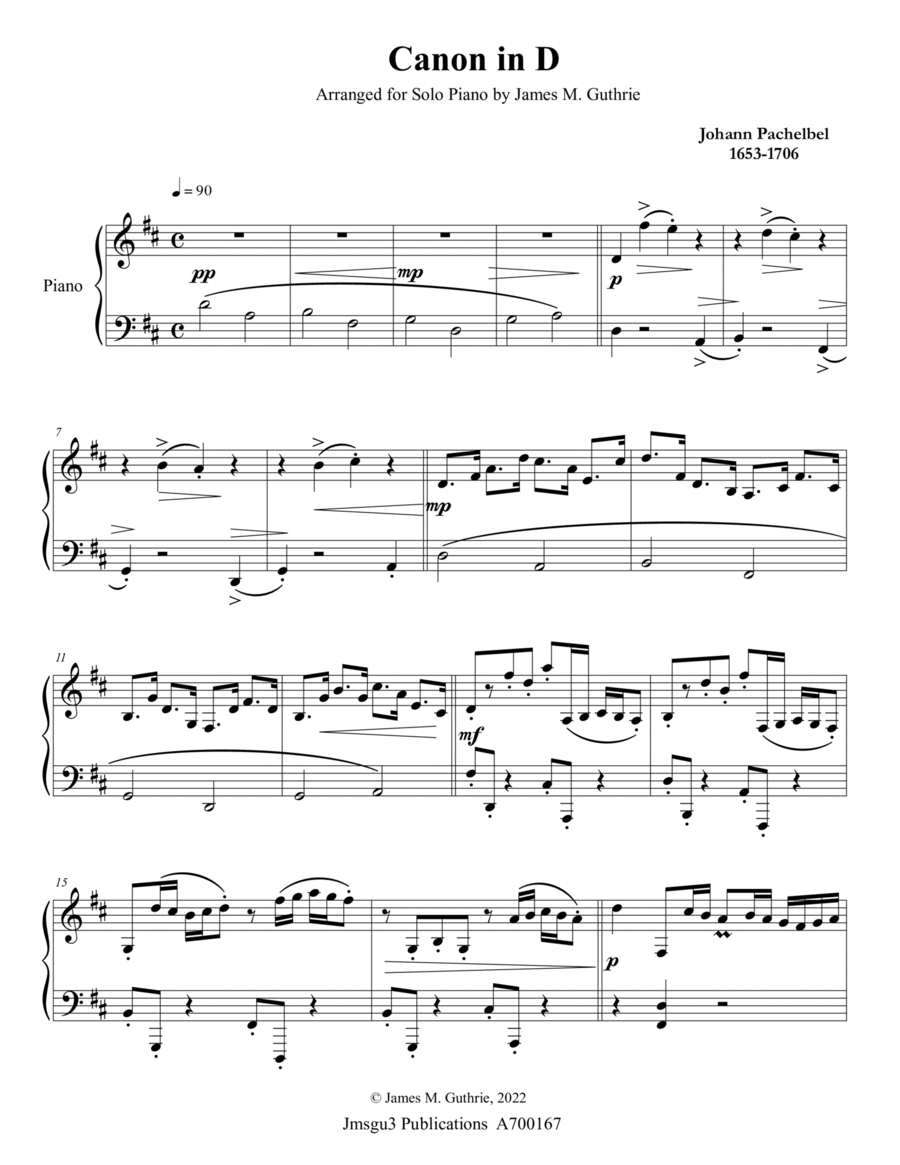
Pachelbel: Canon in D for Solo Piano
Piano seul

$32.95 28.15 € Piano seul PDF SheetMusicPlus

Piano Solo - Level 3 - Digital Download SKU: A0.1178016 Composed by Johann Pachelbel. Arranged by César Madeira. Baroque,Children,Early Music,Film/TV,Instructional. Score. 6 pages. Sheet Music To Play Editions #777975. Published by Sheet Music To Play Editions (A0.1178016). Pachelbel's Canon in D. Arrangement for Piano Solo. With Full Score. Enjoy it!Johann Pachelbel (1653 – 1706) was a German composer, organist, and teacher who brought the south German organ schools to their peak. He composed a large body of sacred and secular music, and his contributions to the development of the chorale prelude and fugue have earned him a place among the most important composers of the middle Baroque era.For Tutorials, Play Alongs or request New Arrangements, visit the YouTube Channel: Sheet Music To Play
Pachelbel's Canon in D - Piano Solo (Full Score)
Piano seul

$5.99 5.12 € Piano seul PDF SheetMusicPlus

Piano Solo - Level 2 - Digital Download SKU: A0.942970 Composed by Jan-Frerk Jelend. Children,Christmas,Instructional. Score. 3 pages. Jan-Frerk Jelend #3919041. Published by Jan-Frerk Jelend (A0.942970). ABOUT THE PIECEIf you play the piano and you like the famous Christmas song We wish you a merry Christmas this could be an interesting composition for you! You can explore the theme throughout different variations: discover what it sounds like- in a canonic style- as a Sad Christmas-Version in a minor key- as a traditional German waltz- in a quick dancing 2/4-beatThe difficulty level of the piece is 2-3, which makes of it an easy early-intermediate piano piece. So you don't have to be a great pianist to play this charming piece of Christmas piano music! If you would like to contact me, you can send me an e-mail: jf.burmester(AT)web.de
We wish you a merry Christmas - Theme and Easy Variations for piano solo
Piano seul

$3.99 3.41 € Piano seul PDF SheetMusicPlus

Piano Solo - Level 5 - Digital Download SKU: A0.828227 Composed by John Hatton. Arranged by Paul Thurmond. 20th Century,Baroque,Christian,Sacred. Score. 7 pages. Paul Thurmond #4968929. Published by Paul Thurmond (A0.828227). Tune: DUKE STREETUse: Prelude, PostludeOne Sunday my church was singing Jesus Shall Reign Where’er the Sun as the opening hymn. It’s our tradition that the last stanza of a hymn is sung in unison, so that I as the organist can change the harmonization and keep things interesting. Sometimes I know ahead of time what I’m going to do, and sometimes I make it up on the spot.On this particular morning I planned on being spontaneous. (Can spontaneity be planned?) When we got to the final stanza, I threw on the 16′ pedal reed and went to town.I don’t know if this is the case for all musicians, but while I’m playing my brain is working on several different levels. Most of these are involved in actually playing the music, but there’s also a running commentary on how things are going. This commentary is usually really boring: It’s going okay. It’s going okay. It’s going okay. Sometimes the messages are more interesting: Uh-oh. She just dropped her mute. I missed that chord; remember to circle it when we’re done. My page turner appears to be on fire.So: We’re in the final stanza of Jesus Shall Reign Where’er the Sun. Big, majestic hymn. Over a hundred congregants and choir members are enthusiastically singing in unison. I’m leading them from the organ with an improvised accompaniment that involves all of my limbs. It’s fair to say that I was concentrating hard.Suddenly the commentary part of my brain breaks in: Dude, your feet are totally playing Canon in D. Cool!Canon in D is the most famous work of Johann Pachelbel, a German composer who preceded Bach by a few decades. It’s overused at weddings, but it’s actually a really good piece of music. The original is for three violins and a basso continuo part, which would usually have been played by harpsichord and cello. In this case, the basso continuo plays the same eight measures again and again throughout the piece. This technique of repetition is called a ground bass. While that’s going on, the violins play several different themes on top of it.When I was improvising that Sunday, my feet had accidentally wandered into that ground bass part, which happened to fit nicely with the melody we were singing. During the sermon (sorry Pastor!) I started going through the violin themes in my head, seeing if any of them could also match up with the hymn tune. Some of them worked and some didn’t. I decided to write a sort of theme and variations, where the hymn tune appears in various forms. Sometimes it’s played along with one of the violin themes, and sometimes a violin theme serves as an interlude on its own. And except for one passage, the left hand is always playing some version of the basso continuo theme. I also changed the meter from 4/4 to 3/4 to make it more interesting. It culminates in a climax worthy of a king. I hope you enjoy it.
Jesus Shall Reign Where'er the Sun
Piano seul

$4.99 4.26 € Piano seul PDF SheetMusicPlus

Piano - Digital Download SKU: A0.1053215 By Stephen DeCesare. By Stephen DeCesare. Praise & Worship,Sacred. Accompaniment. Duration 220. Exultet Music #6929533. Published by Exultet Music (A0.1053215). For a Vocal Trio (SAB) and Piano. It starts off as a chorale with the words of: If there's to be peace in the world, there must be peace in the nations. If there's to be peace in the nations, there must be peace in the cities. If there's to be peace in the cities, there must be peace between neighbors. If there's to be peace between neighbors, there must be peace in the home. If there's peace in the home, there must be peace in the heart. Then it develops into a 4 part canon with the choir singing in many languages the word peace (Spanish, Italian, French, Hebrew, Arabic, Russian, German, Latin, Japanese, Chinese, Polish, Portuguese, Swahili, Dutch, Finish and Indonesian).
If There's To Be Peace In The World (Accompaniment Track - SATB version only)
Piano seul
Stephen DeCesare
$3.99 3.41 € Piano seul PDF SheetMusicPlus


Partitions Gratuites
Acheter des Partitions Musicales
Acheter des Partitions Digitales à Imprimer
Acheter des Instruments de Musique

© 2000 - 2026

Accueil - Version intégrale





