EUROPE
0 articles
USA
0 articles
DIGITAL
4 articles (ŕ imprimer)
Partitions Digitales
Partitions à imprimer
4 partitions trouvées


Easy Piano - Level 2 - Digital Download SKU: A0.596592 Composed by Juan MarĂ­a Solare. 20th Century,Contemporary,Sacred,Standards. Score. 8 pages. Juan Maria Solare #5799759. Published by Juan Maria Solare (A0.596592). About the music Both pieces of this diptych are miniatures with a structure quite similar to each of the pieces of the Album fĂĽr die Jugend Opus 68 by Robert Schumann. The melodies are strongly rooted in Japanese music (particularly obvious in the second piece). Aesthetically, this is neoclassical music (a quite broad concept nowadays). Fans of Erik Satie, Ludovico Einaudi or Joep Beving will possibly feel at home. Both pieces were composed on 6 June 2020 (the first one with my daughter Laura sleeping on my breast). Find this music soon on Spotify, Apple Music, YouTube or any other streaming platform (either under my name or performed by other pianists, possibly Iannis Eralos). Total duration: ca. 5:15.https://open.spotify.com/album/27MbJnfPjcolbQZAmNs8tKWeep Because Its Over: https://www.youtube.com/watch?v=SWflYuEoLy8Smile Because It Happened: https://www.youtube.com/watch?v=7SQFUlb7lFgAbout the titlesIn a poem by the German Romantic poet Ludwig Jacobowski titled Leuchtende Tage (Radiant Days) and published in August 1899, he writes:Nicht weinen, weil sie vorĂĽber!Lächeln, weil sie gewesen!Literally:Don't cry because they are over (they: the radiant days)Smile because they happened.Usually it is quoted this way:Don't cry because it’s overSmile because it happened. For my piece, I adapted this idea und -not quite humbly- think that is better now: Do weep because it’s overBut also smile because it happened Why is it better now? Because… where is the issue with weeping? The first step is to accept that pain exists. Nobody has the moral authority to deny you the possibility of crying. Weeping is not a shame or a disgrace. Besides, only he who weeps is credible when he laughs.  By the way, these words are sometimes attributed to Confucius. I leave to you the task of determining whether Jacobowski borrowed this thought from him.
Weep And Smile [piano solo]
Piano seul
the way, these words are sometimes attributed to Confucius I leave to you the task of determining whether Jacobowski borrowed this thought from him
$3.33 2.89 € Piano seul PDF SheetMusicPlus

Piano Solo - Level 4 - Digital Download SKU: A0.1127867 Composed by Philip Le Bas. Chamber,Classical,Folk,Multicultural,World. Score. 9 pages. Philip Le Bas #728476. Published by Philip Le Bas (A0.1127867). Incidental music composed for piano in four parts by Philip Le Bas to accompany the Japanese folk tale (ghost story) Yuki-Onna (Snow Woman). This work developed out of a cross-cultural project initiated at Morley College, London, in early 2019, aiming to create a melodrama for piano solo and spoken voice to be performed in northern Japan later in the year by young students of the piano. It is based on the ghost-story above, which is widely known in Japan. The tale was transcribed and published by Lafcadio Hearn (Koizumi Yakumo) in 1904 as part of his book “Kwaidan: Stories and Studies of Strange Things”, a collection that has been highly influential in expressing popular Japanese culture over the past century. Synopsis of the tale of Yuki-Onna: Two wood-cutters, Mosaku and his apprentice Minokichi, encounter a terrible snow-storm and take shelter in an empty hut by a river. The storm gets worse and worse, but they both finally fall asleep. When Minokichi wakes, he sees a woman all in white bending over Mosaku breathing bright white smoke onto his face. She then approaches Minokichi. She is very beautiful, but her eyes make him afraid. After a while she says, “I intended to do the same to you as I did to the old man, but I feel pity for you because you are a pretty young man. If you ever tell anybody what you have seen, however, I will kill you too.” And she vanishes into the snow storm. It is then that Minokichi discovers Mosaku dead on the floor of the hut. Years later Minokichi meets a beautiful girl, who calls herself O-Yuki. He falls in love with her and they live together in his house, along with his mother, who fortunately takes a liking to her new “honourable daughter-in-law.” Over the years O-Yuki gives birth to ten children and the villagers all agree that she is a wonderful person. But she is somehow different from them, as she continues to look young and fresh, despite the passing years. Minokichi often thinks of telling O-Yuki about the events of years ago, and eventually, as he is gazing at her beauty one night, he can resist it no more. He begins to tell her about the snow storm and the terrifying snow-woman. To his horror O-Yuki becomes more and more angry, and she finally says: “It was me, it was me,… and I said I would kill you if you ever told anyone! But for these children asleep here, I would do so this very moment! You had better take very good care of them; for if ever they have reason to complain of you, I will treat you as you deserve!” As she screams at him her voice becomes thin, like the crying of the wind, and she melts into a bright white mist spiraling into the roof-beams. At that moment it starts to snow, but O-Yuki is never seen again.
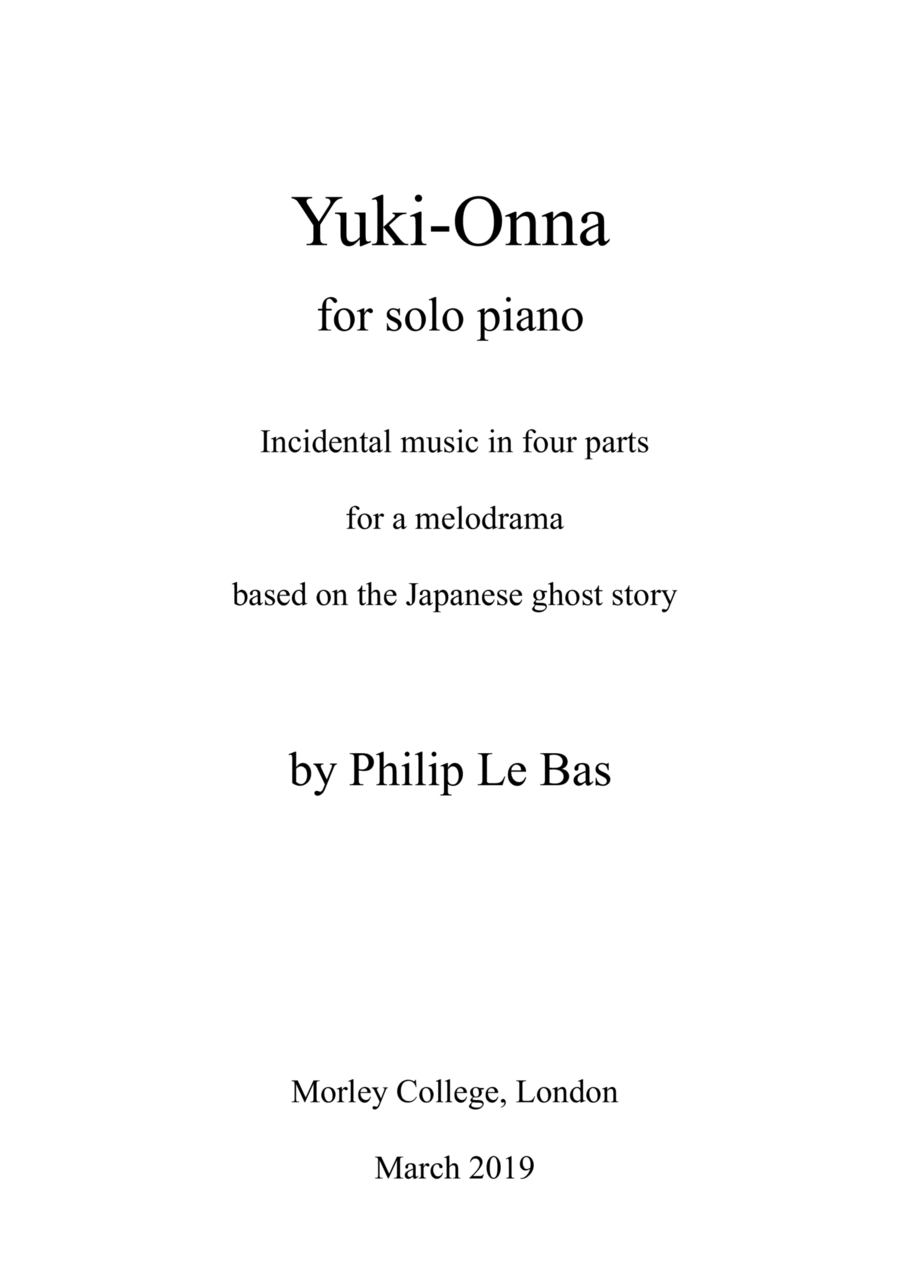
Yuki-Onna (piano solo)
Piano seul

$5.99 5.2 € Piano seul PDF SheetMusicPlus

Piano Solo - Level 5 - Digital Download SKU: A0.1011044 Composed by Daniel Alexander Apátiga. Contemporary,Instructional,Latin. Score. 17 pages. Daniel Alexander Apátiga #2967889. Published by Daniel Alexander Apátiga (A0.1011044). For virtuosic pianists who like to listen to Flamenco.Great for public concerts at concert halls, venues, pianist competitions, or for the purpose of impressing a lot of people.This piece is not appropriate for ill-equipped students and it is a great substitution to pieces created by the virtuosos of the Romantic period.This piece is designed to be performed at Churches because of its lifting-up, dance-like quality.  Perfect for weddings, but less so during sermons.To perform this piece up to tempo, start slow repeating measures two-three times until it is in all three memory groups: muscular, visual, and auditory.  Tweak your interpretation as you go along thinking about how what came before affected what comes after.This was composed in 2016, December, and on the piano.Approx. 5:15 minutes long.I have Soundcloud, but I do not have a recording of myself playing it yet.  If you make a recording of yourself playing it, please let me know!  Please message me on Soundcloud, email me, or call me with information about you and a link to your undoubtably fabulous interpretation!  Thank you!My contact information:daniel-apatiga@uiowa.eduSoundcloud URL is https://soundcloud.com/daniel-alexander-ap-tigaTelephone # is 1-(319)-594-6456.
Harmonic Étude V
Piano seul

$2.59 2.25 € Piano seul PDF SheetMusicPlus


Partitions Gratuites
Acheter des Partitions Musicales
Acheter des Partitions Digitales à Imprimer
Acheter des Instruments de Musique

© 2000 - 2026

Accueil - Version intégrale





