EUROPE
1070 articles
USA
1 articles
DIGITAL
58 articles (à imprimer)
Partitions Digitales
Partitions à imprimer
58 partitions trouvées


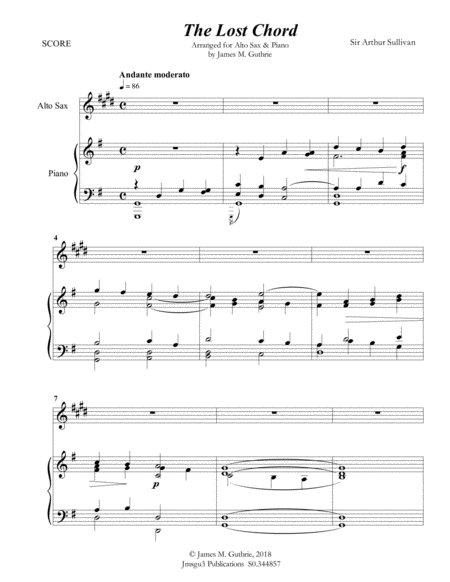
Alto Saxophone,Piano - Level 4 - Digital Download SKU: A0.549443 Composed by Sir Arthur Seymour Sullivan. Arranged by James M. Guthrie, ASCAP. Instructional,Romantic Period,Sacred,Standards. Score and part. 15 pages. Jmsgu3 #3494751. Published by jmsgu3 (A0.549443). Score: 10 pages, solo part: 2 pages, piano part: 3 pages. Duration: 4:25. Not difficult, but requires sensitivity & dynamic control. Suitable for recitals, church meditations, or school programs. School Years First of all, Sullivan attended music school at the Royal Academy of Music. Because Sullivan was so talented, the Academy awarded him the Mendelssohn Scholarship for two years in a row. He, therefore, studied with John Goss, who studied with Thomas Atwood, who in turn studied with Mozart. Sullivan similarly studied the piano at the Academy with Arthur O’Leary. Study Abroad During his first year, he also earned money by singing solos in the Chapel Royal. At the end of his second year, the Academy consequently continued his scholarship and sent him to study at the Leipzig Conservatoire. He certainly studied composition, and likewise counterpoint and piano. Hence, during his final year in Leipzig, Sullivan finally completed his graduation composition project: Incidental Music for Shakespeare’s The Tempest. Association with Gilbert It seems like Sullivan built the bulk of his composing career largely in the 1860s. As a result, he became famous for his incidental music for the Tempest and his Irish Symphony. He, therefore, began collaborating with the poet W. S. Gilbert in the 1870s. Rather than focus on serious opera, Gilbert and Sullivan, in contrast, concentrated on comic operas such as H. M. S. Pinafore, the Pirates of Penzance, and the Mikado. Therefore, certainly as a result of his education and experience, Sullivan composed a total of 24 operas, 11 symphonic works, and 10 choral pieces. Even more, he wrote a large number of noteworthy hymns such as Onward Christian Soldiers. Lost Chord Winds The general style of his music is maybe similar to Mendelssohn, Schumann, and perhaps Liszt. It seems like Sullivan was fond of writing distinct melodies for each character in his operettas. His melodies combine together as the characters did. Furthermore, he was a master orchestrator, and therefore played the flute, clarinet, trumpet, and trombone fluently. The Lost Chord Sullivan wrote his most noteworthy song the Lost Chord in 1877. As a result, it was a great success and was certainly performed all over the world by a variety of singers such as Enrico Caruso. Because Sullivan was the most famous composer in England, the Lost Chord became the most famous of all British or American songs of the 1870s and 1890s. Consequently, in 1888 Thomas Edison recorded The Lost Chord for the phonograph. It was one of the first songs ever recorded. Furthermore, Queen Victoria knighted Sullivan in 1883.  
Sullivan: The Lost Chord for Alto Sax & Piano
Saxophone Alto et Piano

$26.95 23.18 € Saxophone Alto et Piano PDF SheetMusicPlus

Alto Saxophone,Piano - Level 3 - Digital Download SKU: A0.722420 Composed by Traditional. Arranged by Anne L Christopherson GRSM ARCM. Holiday,Love,Opera,Patriotic. Score and part. 5 pages. Music-Scores.com #6505847. Published by Music-Scores.com (A0.722420). The Last Rose of Summer, a romantic ballad for Alto Sax and Piano, with 2nd and 3rd verses being improvisational in nature.The original poem by Thomas Moore was set to the music of an old Irish ballad, The Groves of Blarney, which dates back to the 18th century, and the opera, Martha by Von Flottov, features this song. Duration about 2 mins, 45 seconds.Arranged by Anne L Christopherson ARCM GRSM at www.music-scores.com.
The Last Rose of Summer - Alto Sax and Piano
Saxophone Alto et Piano

$5.95 5.12 € Saxophone Alto et Piano PDF SheetMusicPlus

Alto Saxophone,Piano - Level 1 - Digital Download SKU: A0.1108456 Composed by Sir Arthur Seymour Sullivan. Arranged by Piacere Music Sheets. Instructional,Romantic Period,Standards. Score and part. 13 pages. Piacere Music Sheets #711098. Published by Piacere Music Sheets (A0.1108456). Opus/Catalog Number: IAS 42 Key/Tone: B-flat Major Movements/Sections: Andante moderato Year/Date of Composition: 1858/1877 Difficulty: Grade 3/12 (Easy) Obs.: Sir Arthur Sullivan composed this song at the bedside of his brother Fred during Fred's last illness. Fred Sullivan died five days after, on January 18. This song has been recorded by many singers, including Enrico Caruso, who sang it at the Metropolitan Opera House on 29 April 1912 at a benefit concert for families of victims of the Titanic disaster. The Lost Chord is one of Sullivan's best-known songs, and it is still performed nowadays. This is an arrangement for Alto Saxophone with piano accompaniment. Included: Full score and separated parts for each instrument.
Sullivan - The Lost Chord in B flat Major - Easy
Saxophone Alto et Piano

$8.95 7.7 € Saxophone Alto et Piano PDF SheetMusicPlus

Instrumental Duet,Piano Alto Saxophone,Baritone Saxophone,Instrumental Duet,Piano - Level 5 - Digital Download SKU: A0.786362 Composed by Richard Wagner, S. Trevor Francis, and Thomas John Williams. Arranged by Beka Wilson. Celtic,Christian,Opera,Sacred. Score and parts. 10 pages. Beka Wilson #4335315. Published by Beka Wilson (A0.786362). This exciting duet is a Wagner-inspired version of an old Celtic-style hymn. Both parts will stretch the player to the limits of their instrument’s range, and includes 2-on-3 rhythms and chromatic runs. For different instrumentation, this arrangement is compatible with products S0. 523329 (B flat), S0. 523327 (alto clef), S0. 523325 (C), S0. 523323 (C bass clef), or S0. 523319 (F).This would be the perfect contest piece for advanced high schoolers, or an energetic offertory for a church service. The song is approximately 2’30 in length and includes two parts and a piano score (10 pages total).Want this arrangement for a different set of instruments or in a different key? Shoot me an email at bekmars10@gmail.com for a custom version of this arrangement that I can post on Sheet Music Plus for you.
Oh the Deep, Deep Love of Jesus--E flat instrument duet
Saxophone Alto et Piano

$9.99 8.59 € Saxophone Alto et Piano PDF SheetMusicPlus

Alto Saxophone,Piano - Level 3 - Digital Download SKU: A0.1179845 Composed by Scott Joplin. Arranged by César Madeira. 20th Century,Children,Film/TV,Multicultural,Ragtime,World. Score and part. 12 pages. Sheet Music To Play Editions #779793. Published by Sheet Music To Play Editions (A0.1179845). The Entertainer by Scott Joplin. Arrangement for Alto Sax and Piano. With Full Score and Individual Parts. Enjoy it!Scott Joplin (c. 1868 - 1917) was an American composer and pianist. Joplin achieved fame for his ragtime compositions and was dubbed the King of Ragtime. During his brief career, he wrote over 100 original ragtime pieces, one ragtime ballet, and two operas. One of his first and most popular pieces, the Maple Leaf Rag, became ragtime's first and most influential hit, and has been recognized as the archetypal rag.For Tutorials, Play Alongs or request New Arrangements, visit the YouTube Channel: Sheet Music To Play
The Entertainer by Joplin - Alto Sax and Piano (Full Score and Parts)
Saxophone Alto et Piano

$7.99 6.87 € Saxophone Alto et Piano PDF SheetMusicPlus

Alto Saxophone,Piano - Level 2 - Digital Download SKU: A0.1155646 Composed by Ludwig van Beethoven. Arranged by Ander. Classical,Folk,March,Opera,Romantic Period. Score and part. 4 pages. Woods Only, Arrangements #755950. Published by Woods Only, Arrangements (A0.1155646). This arrangement adapted for alto saxophone and piano was written keeping the characteristics of the original work, in order to be performed by young music students who want to enter the symphonic music. Besides, it can also be used by professional musicians for recitals, repertoire, academic presentations and didactic material. The transcription remains faithful to the structure, with only one change in tone, so that it is comfortable for all the instruments in the formation, as well as being used as an activity in ensemble practice among musicians of different traditions. Beethoven's Turkish March (Op. 113) is the 4th movement of the operatic work: The Ruins of Athens, a set of incidental pieces written in 1812 by Ludwig van Beethoven, where the melody was originally written in 1809 as Theme with Six Variations for Piano, Op. 76. The work was written to accompany the play of the same name by August von Kotzebue, for the dedication of a new theater in Pest. Perhaps the best known part of the composition is the Marcia alla turca, In Latin America, this movement became known in Jean-Jacques Perrey's version (who titled it The Elephant never Forgets) since it was used as the opening theme of the successful Mexican TV comedy El Chavo del Ocho. The opening and the turkish march are often performed separately, and the other pieces in this set are not often heard.
Turkish March by Beethoven for Alto Sax
Saxophone Alto et Piano

$1.99 1.71 € Saxophone Alto et Piano PDF SheetMusicPlus

Alto Saxophone,Piano - Level 3 - Digital Download SKU: A0.533497 Composed by Ali Ben Sou Alle. Concert,Romantic Period,Standards. Score and part. 19 pages. Musik Fabrik Music Publishing #3000441. Published by Musik Fabrik Music Publishing (A0.533497). Meyerbeer’s Opera Le Prophète was one of the most influential works of the 19th century, inspiring Verdi, Wagner, Liszt andothers with its dramatic score. Caprice sur Le Prophète de Meyerbeer begins with an extended Aria with several cadenzas. The work ends with a Polka in Rondo form which has a brillant variation.One of the most enigmatic figures in the history of Wind Music, Ali Ben Sou Alle (Charles-Valentin Soualle) was born in 1820 in Arras, France. After receiving his first prize in Clarinet at the Paris Conservatory in 1844. he served as the director of music of The French Marine Band in Senegal, and then was named first clarinet solo at the Opéra-Comique in Paris. However, after the Revolution of 1848, Soualle was forced to flee France to England where he settled in London, playing in the Orchestra of the Queen's Theatre. His songs and piano pieces were published in London.While in London, Soualle met another exiled French musician, Louis Antoine Jullien, who conducted a light music series in London. Jullien encouraged Soualle to take up the saxophone, and after modifying the instrument by adding a single octave mechanism (the modern system used today) and keys for the lower register, Soualle became known as a virtuoso and began touring performing solo recitals (or mono-concerts, as they were called at the time) calling his modified saxophone the «turcophone ». He performed in all the European capitals and then traveled to Australia, New Zealand, Manilla, Java, through China and then to India where he finally settled in Mysore, becoming the director of the Royal Music for the Maharadjah. It was during this period that he converted to Islam and changed his nmae to Ali ben Sou Alle (or Ali, son of Soualle). He subsequently travaled to Ile Maurice, to French Polynesia, the Cap of Natal and the Cap of Good Hope. All of these voyages were subjects of musical works which Soualle entitled Souvenirs de... and may perhaps have been part of a collectionknown as The Royal Album which was presented to the Prince of Wales after a royal concert. Soualle returned to Mysore in 1858 and was almost killed in the Indian Revolution.Around 1860, Soualle returned to France for health reasons and began publishing his own music. On March 27 1865, he performed a command performance for the Emperor Napoleon III at the Tuileries Palace in the presence of the entire Imperial Family. After 1865, nothing more is known about him.
Ali Ben Sou Alle: Caprice sur La Prophète de Meyerbeer for alto saxophone and piano
Saxophone Alto et Piano

$11.95 10.28 € Saxophone Alto et Piano PDF SheetMusicPlus

Alto Saxophone,Piano - Level 4 - Digital Download SKU: A0.533499 Composed by Ali Ben Sou Alle. Concert,Romantic Period,Standards. Score and part. 28 pages. Musik Fabrik Music Publishing #3000445. Published by Musik Fabrik Music Publishing (A0.533499). Meyerbeer’s Opera Le Prophète was one of the most influential works of the 19th century, inspiring Verdi, Wagner, Liszt and others with its dramatic score. Caprice sur Le Prophète de Meyerbeer begins with an extended Aria with several cadenzas. The work ends with a Polka in Rondo form which has a brillant variation.One of the most enigmatic figures in the history of Wind Music, Ali Ben Sou Alle (Charles-Valentin Soualle) was born in 1820 in Arras, France. After receiving his first prize in Clarinet at the Paris Conservatory in 1844. he served as the director of music of The French Marine Band in Senegal, and then was named first clarinet solo at the Opéra-Comique in Paris. However, after the Revolution of 1848, Soualle was forced to flee France to England where he settled in London, playing in the Orchestra of the Queen's Theatre. His songs and piano pieces were published in London.While in London, Soualle met another exiled French musician, Louis Antoine Jullien, who conducted a light music series in London. Jullien encouraged Soualle to take up the saxophone, and after modifying the instrument by adding a single octave mechanism (the modern system used today) and keys for the lower register, Soualle became known as a virtuoso and began touring performing solo recitals (or mono-concerts, as they were called at the time) calling his modified saxophone the «turcophone ». He performed in all the European capitals and then traveled to Australia, New Zealand, Manilla, Java, through China and then to India where he finally settled in Mysore, becoming the director of the Royal Music for the Maharadjah. It was during this period that he converted to Islam and changed his nmae to Ali ben Sou Alle (or Ali, son of Soualle). He subsequently travaled to Ile Maurice, to French Polynesia, the Cap of Natal and the Cap of Good Hope. All of these voyages were subjects of musical works which Soualle entitled Souvenirs de... and may perhaps have been part of a collectionknown as The Royal Album which was presented to the Prince of Wales after a royal concert. Soualle returned to Mysore in 1858 and was almost killed in the Indian Revolution.Around 1860, Soualle returned to France for health reasons and began publishing his own music. On March 27 1865, he performed a command performance for the Emperor Napoleon III at the Tuileries Palace in the presence of the entire Imperial Family. After 1865, nothing more is known about him.
Ali Ben Sou Alle: Fantaisie sur Robert le Diable for alto saxophone and piano
Saxophone Alto et Piano

$19.95 17.16 € Saxophone Alto et Piano PDF SheetMusicPlus

Alto Saxophone,Piano - Level 4 - Digital Download SKU: A0.533354 Composed by Ali Ben Sou Alle, Gioachino Rossini. Arranged by Paul Wehage. Concert,Opera,Romantic Period,Standards. Score and part. 30 pages. Musik Fabrik Music Publishing #2363209. Published by Musik Fabrik Music Publishing (A0.533354). One of the most enigmatic figures in the history of the Saxophone, Ali Ben Sou Alle (Charles-Valentin Soualle) was born in1820 in Arras, France. After receiving his first prize in Clarinet at the Paris Conservatory in 1844. he served as the director ofmusic of The French Marine Band in Senegal, and then was named first clarinet solo at the Opéra-Comique in Paris. However, after the Revolution of 1848, Soualle was forced to flee France to England where he settled in London, playing in the Orchestra of the Queen's Theatre. His songs and piano pieces were published in London.While in London, Soualle met another exiled French musician, Louis Antoine Jullien, who conducted a light music series inLondon. Jullien encouraged Soualle to take up the saxophone, and after modifying the instrument by adding a single octavemechanism (the modern system used today) and keys for the lower register, Soualle became known as a virtuoso and begantouring performing solo recitals (or mono-concerts, as they were called at the time) calling his modified saxophone the«turcophone ». He performed in all the European capitals and then traveled to Australia, New Zealand, Manilla, Java, throughChina and then to India where he finally settled in Mysore, becoming the director of the Royal Music for the Maharadjah. It wasduring this period that he converted to Islam and changed his nmae to Ali ben Sou Alle (or Ali, son of Soualle). Hesubsequently travaled to Ile Maurice, to French Polynesia, the Cap of Natal and the Cap of Good Hope. All of these voyageswere subjects of musical works which Soualle entitled Souvenirs de... and may perhaps have been part of a collection knownas The Royal Album which was presented to the Prince of Wales after a royal concert. Soualle returned to Mysore in 1858 and was almost killed in the Indian Revolution.Around 1860, Soualle returned to France for health reasons and began publishing his own music. On March 27 1865, heperformed a command performance for the Emperor Napoleon III at the Tuileries Palace in the presence of the entire ImperialFamily. After 1865, nothing more is known about him.Fantaisie sur Le Barbier de Séville begins with the Count's 1st act cavatina Ecco ridente in cielà This is followed by a seriesof variations sur Rosina's Cabaletta Io sono docile. The second act finale Fredda ed immobile is then presented in a number of variations. Finally, the second part of the Count and Figaros first act duo (Ah che d'amore) brings the work to a brilliant finish.
Ali Ben Sou Alle: Fantaisie sur le Barbier de Séville de Rossin for alto saxophone and piano
Saxophone Alto et Piano

$19.95 17.16 € Saxophone Alto et Piano PDF SheetMusicPlus

Alto Saxophone,Piano - Level 3 - Digital Download SKU: A0.533345 Composed by Ali Ben Sou Alle. Arranged by Paul Wehage. Concert,Romantic Period,Standards. Score and part. 10 pages. Musik Fabrik Music Publishing #2348193. Published by Musik Fabrik Music Publishing (A0.533345). Ali Ben Sou Alle was born Jean-Baptiste SOUALLE in 1824 in Arras, France. He first studied the clarinet, winning a first prize in Clarinet in the class of Klosé at the Paris Conservatory. He then entered the Paris Opera orchestra, but left France in 1848 because of the revolution, fleeing to London. In 1850, he met Louis JUILLIEN, another early saxophonist, who encouraged Soualle to take up the saxophone. Soualle made several modifications to the instrument, including changes to the octave mechanism and the other keys for trills and alternative fingerings, many of which are used in modern saxophones.He named his hybrid creation the turcophone and began composing works for the instrument, which included fantasies on operatic themes, character pieces and a series of descriptive works which document several concert tours in Europe, Australia and the Orient which Soualle undertook.  Upon his return to France around 1861, after his conversion to Islam, he changed his name to Ali Ben Sou Alle. Under that name, he performe recitals for the Prince of Wales and for the Emperor Napoleon III and his family in 1865. After this date, no trace of his career has currently been uncovered and it is though that he probably died around 1867. This work is .in two large sections, the first in the form of a lyrical aria, the second a lively schezando.
Ali Ben Sou Alle: Caprice : Souvenir de la Nouvelle-Zélande for alto saxophone and piano
Saxophone Alto et Piano

$10.35 8.9 € Saxophone Alto et Piano PDF SheetMusicPlus

Alto Saxophone,Piano - Level 2 - Digital Download SKU: A0.1379100 Composed by Giacomo Puccini. Arranged by Rodrigo Faleiros. 19th Century,Contest,Festival,Opera,Romantic Period. Score and part. 3 pages. Rodrigo Faleiros #963395. Published by Rodrigo Faleiros (A0.1379100). Enjoy the timeless beauty of Giacomo Puccini's opera Gianni Schicchi with our arrangement of the aria O Mio Babbino Caro for solo alto sax. This beloved aria, known for its tender expression of love and longing, is now reimagined for alto sax, allowing the melodic lines to shine with the accompaniment of a piano. With included chord symbols, this arrangement invites players to explore harmonies and add their personal touch to the performance, creating a captivating musical experience.Key Features: Alto Sax Showcase: Tailored for a solo alto sax, allowing for a captivating and expressive performance of the iconic aria. Piano Accompaniment: Enhance your performance and explore harmonies with included fully notated piano accompaniment with chord symbols. Instant Digital Download: Begin your musical exploration promptly with our easy-to-access PDF download. Whether you're preparing for a recital, a concert, or simply savoring the beauty of Puccini's operatic masterpiece, this arrangement of O Mio Babbino Caro for alto sax and piano offers a poignant and unforgettable musical experience.Check out every other arrangement I've made for this and numerous other arias by clicking here.
O Mio Babbino Caro - for alto sax solo (with piano accompaniment and chords)
Saxophone Alto et Piano

$2.99 2.57 € Saxophone Alto et Piano PDF SheetMusicPlus

Alto Saxophone,Piano - Level 2 - Digital Download SKU: A0.1379071 Composed by Giacomo Puccini. Arranged by Rodrigo Faleiros. 19th Century,Contest,Festival,Opera,Romantic Period. Score and part. 3 pages. Rodrigo Faleiros #963428. Published by Rodrigo Faleiros (A0.1379071). Enjoy the timeless beauty of Giacomo Puccini's opera Gianni Schicchi with our arrangement of the aria O Mio Babbino Caro for solo alto sax. This beloved aria, known for its tender expression of love and longing, is now reimagined for alto sax, allowing the melodic lines to shine with the accompaniment of a piano. This arrangement invites players to add their personal touch to the performance, creating a captivating musical experience.Key Features: Alto Sax Showcase: Tailored for a solo alto sax, allowing for a captivating and expressive performance of the iconic aria. Piano Accompaniment: Enhance your performance and explore harmonies with included fully notated piano accompaniment. Instant Digital Download: Begin your musical exploration promptly with our easy-to-access PDF download. Whether you're preparing for a recital, a concert, or simply savoring the beauty of Puccini's operatic masterpiece, this arrangement of O Mio Babbino Caro for alto sax and piano offers a poignant and unforgettable musical experience.Check out every other arrangement I've made for this and numerous other arias by clicking here.
O Mio Babbino Caro - for alto sax solo (with piano accompaniment)
Saxophone Alto et Piano

$2.99 2.57 € Saxophone Alto et Piano PDF SheetMusicPlus

Alto Saxophone,Piano - Level 3 - Digital Download SKU: A0.1046936 By Keith Terrett. By Giacomo Puccini. Arranged by Keith Terrett. Classical,Opera,Romantic Period. Score and part. 5 pages. Keith Terrett #651276. Published by Keith Terrett (A0.1046936). An arrangement of one of Puccini’s greatest arias for Eb Alto Saxophone & Piano. Great piece to improve your bell canto style of playing. Take a listen to Conrad Gozzo’s playing on the Tutti Trumpet CD for a fine example! Quando me'n vo', also known as Musetta's Waltz, is a soprano aria, a waltz in act two of Puccini's 1896 opera La bohème. It is sung by Musetta, in the presence of her bohemian friends, hoping to reclaim the attention of her occasional boyfriend Marcello. This scene takes place at the Café Momus [fr]. Shortly after Mimì, Rodolfo, and their friends have taken seats for a drink, Marcello's former girlfriend, Musetta, shows up with her current patron, the elderly Alcindoro. They quarrel for a bit, then the episode begins as Musetta initiates her move on Marcello. She grabs the spotlight, musically speaking, for a short self-promoting aria (Quando me'n vo'). It is a song directed at the people in the café as much as at the audience in the theater. Popular renditions of the melody were produced during the 1950s, including an American Top 40 hit by Sammy Kaye (You) and a version by Della Reese (Don't You Know?), which reached number two on the U.S. Billboard Hot 100. You will find more Italian arias and Neapolitan songs in my Sibelius & ArrangeMe stores.
Quando Me'n Vo for Eb Alto Saxophone & Piano
Saxophone Alto et Piano
Keith Terrett
$4.99 4.29 € Saxophone Alto et Piano PDF SheetMusicPlus


Partitions Gratuites
Acheter des Partitions Musicales
Acheter des Partitions Digitales à Imprimer
Acheter des Instruments de Musique

© 2000 - 2026

Accueil - Version intégrale