EUROPE
594 articles
USA
1 articles
DIGITAL
79 articles (à imprimer)
Partitions Digitales
Partitions à imprimer
79 partitions trouvées

1 16 31 ....76

Alto Saxophone,Piano - Level 1 - Digital Download SKU: A0.522194 Composed by Colin Kirkpatrick. Instructional,Standards. Score and part. 28 pages. Colin Kirkpatrick Publications #3134129. Published by Colin Kirkpatrick Publications (A0.522194). My Saxophone and Me consists of fourteen short and delightful pieces written especially for absolute beginners up to students at elementary level. The book comes in two versions, one for B flat saxophones and the other for E flat instruments. However, for obvious reasons you cannot mix B flat and E flat instruments in the same group.   The pieces are intended as supplementary material to your usual tutor books. The music can be used with any number of players and the pieces remain in the lower register. Several early pieces use only the notes B, A and G and the key of G major predominates. Six of the pieces use only half notes (minims) and quarter notes (crotchets). The low C, a tricky note for some beginners, has been avoided almost completely. On the one occasion it appears, the note C an octave above is given as optional. Although the pieces are arranged in approximate order of difficulty you can play them in any order you want, depending on the musical needs of the student. Your students are sure to enjoy these pieces, which are both easy on the fingers and easy on the ear! Several pieces have a few measures (bars) rest in the middle not only to give the player a break and add musical contrast but also to give the experience of counting empty bars during the music. When space allows, piano cues appear in the solo part. Some of the later pieces in the book have good performing potential and could be strung together in any order to create a small suite. Every piece has a short piano introduction so that the student can sense the tempo and musical style before playing. The keyboard accompaniments have been kept as simple as possible with the minimum number of notes. Dynamic markings (e.g. piano and mezzo-forte) are used from the start, but phrasing has been omitted from the solo part. This is because the teacher is usually in the best position to suggest phrasing within the physical capabilities of each student. Slurs have been employed sparingly and only when necessary. An MP3 file of all the piano accompaniments is also available as a separate item. You can find it here: https://www.sheetmusicplus.com/title/20679821The book includes a well-known folk lullaby from Wales and a lively folk song from Thailand which is known by all Thai people because it’s taught in elementary schools throughout the country. The music has been converted into pdf files at 1,200 dpi which will produce professional looking printed copies of high quality. However, the output quality will also depend on your own printer settings and capabilities. The publication consists of a teacher's book (18 pages) and a student's book (8 pages) both contained in the same pdf file. The sample MP3 (click on the “Listen†button above) contains recordings of Nice ‘n Easy  (No 2); Lazy Days (No 4); Waltzing Around (No 7); Just a Minuet (No 11) and Donkey Trot (No 12). Colin Kirkpatrick studied at London’s Royal College of Music. He followed a career in music education. He was a High School Music Director in London for about fifteen years and later became a Music Education Adviser for local government, with responsibility for training teachers and directing the instrumental teaching service. The work in education gave him many opportunities for composing. He has published a great deal of music and his publishers include Boosey & Hawkes, Novello, Paxton, Schott, Oxford University Press, Chester, Belwin Mills and Intrada (Netherlands). His music has been performed and broadcast all over Europe as well as in Japan, Thailand, Australia and the USA. He holds MA and PhD degrees. He was a High School Music Director for about fifteen years and then became a Music Education Adviser for local government, with the added responsibility for training teachers and overseeing the instrumental service. He has writte.
My Saxophone and Me (E flat version)
Saxophone Alto et Piano

$5.95 5.11 € Saxophone Alto et Piano PDF SheetMusicPlus

Alto Saxophone,Piano - Level 2 - Digital Download SKU: A0.587925 Composed by G F Handel. Arranged by David McKeown. Baroque,Concert,Opera,Standards. Score and part. 4 pages. David McKeown #5044837. Published by David McKeown (A0.587925). Lascia ch’io Pianga is a beautiful aria from Handel’s Opera Rinaldo The opera premiered in London in 1711 and during his lifetime was the most successful of Handel’s operas. However, following his death there were no further productions until a school in London revived it in 1933. Handel used the melody of Lascia ch’io Pianga in two other works, but it is the version from Rinaldo that has achieved a deserved place in the concert hall, and a starring role in films like Farinelli.This version of Lascia ch’io Pianga is arranged as a Solo for Alto Saxophone and Piano and both parts are reasonably simple; the performance time is around three and a half minutes. The pdf file contains both the piano score and a separate solo part. You can listen to a full performance of this arrangement on Alto Saxophone via the YouTube link above.Musicians at an early intermediate level and above will find Lascia ch’io Pianga ideal for formal and informal performances, with both the solo and accompaniment enjoying melodic interest. Teachers will enjoy using this arrangement as a fun way to help with developing tone, phrasing and expression. There are many more top quality arrangements and compositions by David McKeown for you to browse at http://www.sheetmusicplus.com/publishers/david-mckeown/6203 
Lascia Ch'io Pianga, Aria from Rinaldo, by G F Handel, for Alto Saxophone and Piano
Saxophone Alto et Piano

$4.60 3.95 € Saxophone Alto et Piano PDF SheetMusicPlus

Alto Saxophone,Piano - Level 2 - Digital Download SKU: A0.587913 Composed by G F Handel. Arranged by David McKeown. Baroque,Concert,Contemporary,Opera,Standards. Score and part. 5 pages. David McKeown #5042587. Published by David McKeown (A0.587913). Ombra Mai Fù is the beautiful opening aria from Handel’s Opera Serse, (Xerxes). The opera was not well received when it premiered in London in 1736 and sank into immediate obscurity, only to re-emerged as one of Handel’s best-loved works nearly two hundred years later. Ombra Mai Fù is often referred to as Handel’s Largo. In 1906 Ombra Mai Fù gained the distinction of being the first piece of music ever broadcast on radio. This full version of Ombra Mai Fù is arranged as a Solo for Alto Saxophone and Piano and both parts are reasonably simple; the performance time is around three minutes. The pdf file contains both the piano score and a separate solo part. You can listen to a full performance of this arrangement on Alto Saxophone via the YouTube link above.Musicians at an early intermediate level and above will find Ombra Mai Fù ideal for formal and informal performances, with both the solo and accompaniment enjoying melodic interest. Teachers will enjoy using this arrangement as a fun way to help with developing tone, phrasing and expression. There are many more top quality arrangements and compositions by David McKeown for you to browse at http://www.sheetmusicplus.com/publishers/david-mckeown/6203
Handel's Largo from Xerxes, Ombra Mai Fù, for solo Alto Saxophone and Piano
Saxophone Alto et Piano

$4.60 3.95 € Saxophone Alto et Piano PDF SheetMusicPlus

Alto Saxophone,Piano - Level 2 - Digital Download SKU: A0.587889 Composed by Various. Arranged by David McKeown. Christian,Easter,Sacred. Score and part. 26 pages. David McKeown #5037729. Published by David McKeown (A0.587889). 16 Favourite Easter Hymns for Solo Alto Saxophone and Piano is a beautiful collection of well-known traditional Easter hymns. Both the Piano score and separate Alto Saxophone part are included in the single PDF file.16 Favourite Easter Hymns for Solo Alto Saxophone and Piano are simply arranged in easy keys and are fun to play for soloists with a year or two’s experience and above. The piano part is a little more difficult. Teachers and students alike will find 16 Favourite Easter Hymns for Solo Alto Saxophone and Piano useful for building ensemble, reading and rhythmic skills.The hymns are in alphabetical order and are as follows…·     All Creatures of Our God and King, (Lasst Uns Erfreuen)·     All Hail the Power of Jesus Name, (Coronation)·     Before the Throne of God Above, (Before the Throne)·     Blessed Assurance, (Blessed Assurance)·     Christ the Lord is Risen Today, (Easter Hymn)·     Crown Him with Many Crowns, (Diademata)·     The Day of Resurrection, (Ellacombe)·     Just as I Am, (Woodworth)·     I Know that My Redeemer Lives, (Bradford)·     It is Well with My Soul, (Ville du Havre)·     A Mighty Fortress is Our God, (Ein Feste Burg)·     Nothing But the Blood of Jesus, (What Can Wash Away My Sin)·     There is a Green Hill Far Away, (The Green Hill)·     Thine Be the Glory, (Judas Maccabeus)·     Were You There? (Were You There?)·     When I Survey the Wondrous Cross, (Hamburg) There are many more top quality arrangements and compositions by David McKeown for you to browse at http://www.sheetmusicplus.com/publishers/david-mckeown/6203 
16 Favourite Easter Hymns for Solo Alto Saxophone and Piano
Saxophone Alto et Piano

$7.60 6.53 € Saxophone Alto et Piano PDF SheetMusicPlus

Alto Saxophone,Piano - Level 3 - Digital Download SKU: A0.549639 Composed by Ludwig van Beethoven. Arranged by James M. Guthrie, ASCAP. Concert,Instructional,Romantic Period,Sacred,Standards. Score and part. 16 pages. Jmsgu3 #3516567. Published by jmsgu3 (A0.549639). Duration: ca 5:20, Score: 8 pages, solo part: 3 pages, piano part: 4 pages.One of Beethoven's finest and most famous works. Program for a recital, church meditation or school program.Bring your best espressivo and plan to rehearse the many subtle dynamic changes.Sonata Pathétique Op. 13 First of all, this is an arrangement of the second movement of Beethoven’s Sonata Pathétique. It seems like Beethoven wrote this piece before becoming troubled by deafness. Published in 1799, it consequently remains one of the most celebrated pieces Beethoven ever wrote. As a result of its popularity, the movement was therefore performed by Karl Haas. Hass recorded it for a popular radio show called: Adventures in Good Music. Beethoven Background Ludwig van Beethoven (1770 –1827) was certainly a German pianist. Above all, he was probably one of the greatest composers in history. As a result, he is a pivotal character in the progress between the Classical and Romantic periods. He is certainly one of the most famous and hence important of all composers. Seems like his most familiar and noteworthy works include symphonies 1-9; piano concertos 1-5; and furthermore, the violin concerto. Also, certainly of extreme importance are the noteworthy 32 sonatas for the piano; the string quartets 1-16; the Missa solemnis; and likewise, his only opera, Fidelio. Beethoven Overview First of all, Beethoven was born and consequently raised in Bonn. Upon turning 21 he moved to Vienna probably to study composition with Haydn. That’s when he consequently grew a reputation as a brilliant pianist. Furthermore, he probably stayed in Vienna for the rest of his life. In his late 20s, it seems like his hearing certainly began to decline. It slowly declined until consequently, he was nearly totally deaf probably by the last decade of his life. As a result, he stopped conducting and performing. Nevertheless, he continued to compose. As a result, some of his greatest works probably come from this period. First Period Seems like we often divide Beethoven’s life into three periods. Period 1 begins with Beethoven’s arrival in Vienna. Hence, during this period, he mastered the Viennese style of Haydn & Mozart. He consequently began increasing the size and scale of his works. Furthermore, he experimented with extreme dynamics, and likewise extreme tempi. He worked similarly with chromatic harmony. His First and Second Symphonies, therefore, belong to this period. Other important works also belong here: the first six string quartets and the Sonata Pathétique, Op. 13. Second Period His second period probably began as soon as he realized that he was going deaf. During this period, it seems like he became obsessed with the idea of heroism. His works consequently become even larger and more massive. The most noteworthy of these include the symphonies 3 – 8, piano concertos 5& 6, 5 string quartets, several important piano sonatas (Waldstein and Appassionata), the Kreutzer violin sonata, the violin concerto and his only opera: Fidelio. Third Period In contrast, Beethoven's third period is branded above all by works of incredible intellectual depth, formal innovation, and penetrating expression. It seems like he continued to expand his works. Consequently, the string quartet Op. 131 spills over into seven connected movements. Likewise, in the Ninth Symphony, he adds choral forces to his orchestra probably for the first time in history. Even more, other works from this period include his Missa solemnis, the final 5 string quartets (including the enormous Große Fuge) and the final five sonatas for piano.    Register for free lifetime revisions and updates at www.jamesguthrie.co.
Beethoven: Adagio from Sonata Pathetique for Alto Sax & Piano
Saxophone Alto et Piano

$24.95 21.43 € Saxophone Alto et Piano PDF SheetMusicPlus

Alto Saxophone,Piano - Level 2 - Digital Download SKU: A0.1217562 Composed by Colin Kirkpatrick. Holiday,Instructional. Score and part. 5 pages. Colin Kirkpatrick Publications #814115. Published by Colin Kirkpatrick Publications (A0.1217562). Cloud Nine is a stand-alone piece for E flat alto saxophone and piano. It's written in concert E flat major, which modulates to C major. The top note for the alto sax is the written C sharp above the staff and this occurs only a three times in the same measure. The piece is around UK Associated Board Grade 3-4 and the piano part is quite accessible. Its a slow, dreamy piece which is ideal for the intermediate saxophone player. The piece uses a full dynamic range.
Cloud Nine (for alto sax and piano)
Saxophone Alto et Piano

$7.95 6.83 € Saxophone Alto et Piano PDF SheetMusicPlus

Alto Saxophone,Piano - Level 3 - Digital Download SKU: A0.522293 Composed by G F Handel. Arranged by Colin Kirkpatrick. Christmas,Easter,Holiday. Score and part. 6 pages. Colin Kirkpatrick Publications #6637671. Published by Colin Kirkpatrick Publications (A0.522293). This piece is probably Handel’s best-known melody, although it began life as an operatic aria. The opera was called Xerxes, sometimes written Serses and pronounced something like “ZERT-seesâ€. It was commissioned by The King’s Theater in London and composed by Handel (who had become naturalized British and lived in London at the time) around 1737 and 1738. The opera is loosely based on the historical figure King Xerxes, who ruled from around 522-486 BC and was the fourth king of the Achaemenid Empire, a vast region that covered most of the present-day Middle East.   The melody is often known simply as Handel’s Largo (despite being marked “Larghetto†in the musical score) and is the opening aria in the opera. The aria, known by its opening line Ombra mai fu is sung by Xerxes to a plane tree: “Tender and beautiful fronds of my beloved plane tree, let fate smile upon you...†Although this lovely melody has survived over the years, the opera itself was a complete failure when it was first performed in London in 1738. This arrangement is in E flat major concert (alto sax in C major) and the top note is the C above the treble clef and the piece generally requires the use of a long and sustained tone quality. The piano part has been kept as simple as possible. Being so well-known, this piece would make a popular encore number for a recital. The audio sample was performed by Alastair Penman https://www.alastairpenman.co.uk
Handel: Largo (from Xerxes) for alto sax and piano
Saxophone Alto et Piano

$7.95 6.83 € Saxophone Alto et Piano PDF SheetMusicPlus

Alto Saxophone,Piano - Level 3 - Digital Download SKU: A0.1314328 Composed by Camille Saint-Saens. Arranged by James M. Guthrie. 19th Century,Chamber,Contest,Festival,Historic,Romantic Period. Score and part. 11 pages. Jmsgu3 #903072. Published by jmsgu3 (A0.1314328). Saint-Saëns: The Swan (Le Cygne) movement 13 from the Carnival of the Animals Suite. One of his most popular and widely recognized works, it is the only movement from the Carnival Suite that Saint-Saëns permitted to be performed publicly during his lifetime. This is an excellent recital encore to demonstrate melodic playing and strategic phrasing.The Carnival of the AnimalsThe Carnival of the Animals is an entertaining musical suite of fourteen movements by Camille Saint-Saëns. The work was composed for private performance by an ensemble of two pianos and solo instruments. The Swan (No. 13) is among the fourteen most famous movements. In its entirety, it lasts about 25 minutes.Saint-Saëns BackgroundCharles-Camille Saint-Saëns 1835 – 1921) was, by all means, in particular, a famous French composer, brilliant organist, and significant musical mastermind of the Romantic era. Indeed, his most famous compositions, in the long run, include his Piano Concerto No. 2 (1868), Cello Concerto No. 1 (1872), and the Danse macabre (1874). Notwithstanding, we must also add Violin Concerto No. 3 (1880), Symphony No. 3 (the Organ Symphony, 1886), and, it must be remembered, Carnival of the Animals (1886) to the list.ChildhoodIt is essential to realize that Saint-Saëns was undoubtedly, in fact, a child musical prodigy. Consequently, with this in mind, he made his concert debut, albeit at ten years old. Another critical point to remember is that he expressly studied at the Paris Conservatoire, then, despite reality, conversely followed a traditional career path as a church organist. Nevertheless, twenty years later, on the other hand, he left to become a successful freelance pianist and composer despite, as has been noted, his former employment situation. Furthermore, his performances were, after all, markedly in demand - not only in Europe but, above all, in the Americas all in all as well.YouthA point often overlooked is that in his youth, Saint-Saëns was undoubtedly excited about the modern music of the day. He was, in essence, fond of the music of his contemporaries, particularly Schumann, Liszt, and, for the most part, Wagner. In contrast, however, his compositions seemed, in fact, primarily confined within the conservative classical tradition. Be that as it may, he was, at the same time, nevertheless, a scholar of musical history.CriticismOn the whole, his conservatism, in fact, ultimately brought him into frequent conflict in his later years with composers of the impressionist and, in particular, the dodecaphonic schools of musical thought. A point often overlooked is that he included neoclassical elements in his music, contrary to some critics. Furthermore, in so doing, he provided the most compelling evidence that he predicted the techniques and works by Stravinsky and Les Six. To put it another way, given these points, he was regarded, perhaps for the most part unfairly, as a non-progressive reactionary henceforth around the time of his passing.LegacySaint-Saëns taught briefly in Paris, where his students included Gabriel Fauré. Maurice Ravel later studied with Fauré. In conclusion, both Ravel and Fauré were powerfully influenced by Saint-Saëns, whom they respected as a musical mastermind.
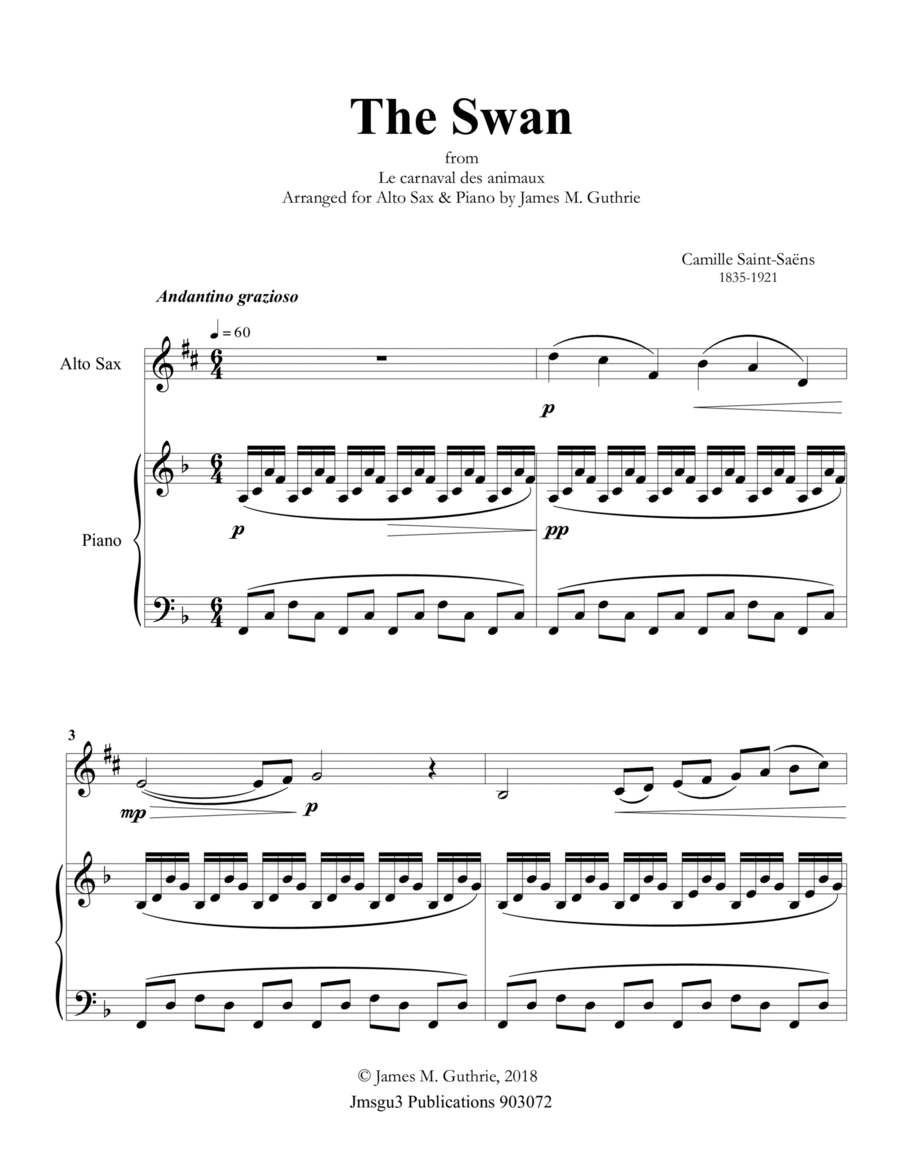
Saint-Saëns: The Swan for Alto Sax & Piano
Saxophone Alto et Piano

$32.95 28.3 € Saxophone Alto et Piano PDF SheetMusicPlus

Alto Saxophone,Piano - Level 3 - Digital Download SKU: A0.1169092 Composed by George Frideric Handel. Arranged by Austin Ralphson. Baroque,Classical,Wedding. Score and part. 5 pages. Austin Ralphson #769440. Published by Austin Ralphson (A0.1169092). Handel wrote this aria as the opening to the 1738 opera 'Serse'. Initially, the opera was a commercial failure, before it was later rediscovered and going on to become one of Handel's best-loved works. It is presented here as an intermediate-level solo with piano.This piece can either be played with a live pianist, or can be played along with the free backing track which is available from https://youtu.be/fAWXlZ9hn0g and also in the video screen above.You can also purchase all 5 beautiful solos together in a digital book for $9.99: https://armusiconline.com/b/GbPNz
Largo from 'Xerxes' (Handel) - alto sax and piano with FREE BACKING TRACK
Saxophone Alto et Piano

$3.99 3.43 € Saxophone Alto et Piano PDF SheetMusicPlus

Alto Saxophone,Piano - Level 5 - Digital Download SKU: A0.1173500 Composed by Claude Debussy. Arranged by Austin Ralphson. 20th Century,Classical,Romantic Period,Wedding. Score and part. 12 pages. Austin Ralphson #773645. Published by Austin Ralphson (A0.1173500). Clair de lune means moonlight in French, and Debussy took this title from Verlaine's poem Clair de lune. The beautiful melody works very well for solo instrument with piano and requires good breath control. The rhythms are particularly tricky in this piece, regularly moving from triplets to duplets and back again. Despite this, however, it should always flow smoothly and be played with feeling.This piece can either be played with a live pianist, or can be played along with the free backing track which is available from https://youtu.be/DfLNLG_6ch4 and also in the video screen above.You can also purchase all 5 beautiful solos together in a digital book for $9.99: https://armusiconline.com/b/GbPNz
Clair De Lune (Debussy) - alto sax and piano with FREE BACKING TRACK
Saxophone Alto et Piano

$3.99 3.43 € Saxophone Alto et Piano PDF SheetMusicPlus

Alto Saxophone,Piano - Level 4 - Digital Download SKU: A0.1422221 Composed by Samuel Coleridge-Taylor. Arranged by Steven Nunes. 19th Century,Classical,Romantic Period. Score and part. 14 pages. Nagamon Publications #1003567. Published by Nagamon Publications (A0.1422221). Samuel Coleridge-Taylor (15 August 1875 – 1 September 1912) was a British composer and conductor. Of mixed-race descent, Coleridge-Taylor achieved such success that he was referred to by white musicians in New York City as the African Mahler when he had three tours of the United States in the early 1900s. He was particularly known for his three cantatas on the epic 1855 poem The Song of Hiawatha by American Henry Wadsworth Longfellow.This melodic and challenging work is suitable advanced intermediate players, or for players of a ABRSM Grade 8 standard and above.  The PDF contains the piano score and the solo part.
Lament
Saxophone Alto et Piano

$15.00 12.88 € Saxophone Alto et Piano PDF SheetMusicPlus

Alto Saxophone,Piano - Level 3 - Digital Download SKU: A0.549750 Composed by Peter Ilyich Tchaikovsky. Arranged by James M. Guthrie, ASCAP. Children,Christmas,Romantic Period,Standards. Score and part. 17 pages. Jmsgu3 #3532695. Published by jmsgu3 (A0.549750). Duration: ca. 3:15 Score: 10 pages, solo part: 2 pages, piano part: 4 pages. Tchaikovsky paints a very mysterious mood in this favorite masterpiece from the Nutcracker Suite. It is also a Christmas favorite. Pyotr Ilyich Tchaikovsky Tchaikovsky is probably the most popular of the great composers in America. His music certainly appeals to musicians. Likewise, it appeals even to folks who don’t normally listen to serious music. This is probably because of his most noteworthy melodies. Above all, he writes with great emotion. This certainly makes a most noteworthy if not an unforgettable impact. Education First of all, He attended classes at the Russian Musical Society. Even more, He also attended the St. Petersburg Conservatory. There he studied music theory with Nikolai Zaremba. He also consequently studied composition with Anton Rubenstein. It seems like Rubenstein came under criticism from a group of Russian composers known as the Five. The Five The Five certainly rejected Western musical influences. They rather sought to use elements from Russian music. They furthermore wanted to use more exotic musical materials. Western Techniques More than other Russian composers, Tchaikovsky studied modern Western music. He certainly develops his music like the European masters. So, rather than repeating a motive, he moves to a new key. He then introduces a different theme in the new key. Hence, he maintained his independence from the Five. Even more, he became the first Russian composer of international stature. Influences Tchaikovsky was probably influenced in his ballet scoring by Léo Delibes. Richard Wagner influenced his symphonic writing. Tchaikovsky’s most famous works include the 1812 Overture, The Nutcracker Suite, and Swan Lake. Also famous are the Violin Concerto in D and the six symphonies. The greatest of the six symphonies may be No. 6, the Pathétique. Nutcracker Suite, Op. 71a The Nutcracker Suite is a ballet that was performed for the first time in December 1892 in St. Petersburg. To begin with, the original ballet failed to attract a positive reception. However, the ballet suite became probably one of the most popular of all of Tchaikovsky’s works. The ballet suite became even more famous in the 1960s. It is now performed all over the world, particularly during the Christmas season.
Tchaikovsky: Arabian Dance from Nutcracker Suite for Alto Sax & Piano
Saxophone Alto et Piano

$32.95 28.3 € Saxophone Alto et Piano PDF SheetMusicPlus


1 16 31 ....76


Partitions Gratuites
Acheter des Partitions Musicales
Acheter des Partitions Digitales à Imprimer
Acheter des Instruments de Musique

© 2000 - 2026

Accueil - Version intégrale





