EUROPE
276 articles
USA
0 articles
DIGITAL
6 articles (à imprimer)
Partitions Digitales
Partitions à imprimer
6 partitions trouvées


Alto Saxophone,Piano - Level 3 - Digital Download SKU: A0.844328 Composed by Lyrics: Charles Wesley, Music: Thomas Campbell, published 1738, and published 1825. Arranged by Dan Cutchen. Easter,Gospel,Sacred,Spiritual. Score and part. 15 pages. Dan Cutchen Music #3115903. Published by Dan Cutchen Music (A0.844328). This arrangement of And Can It Be That I Should Gain? is for alto saxophone solo and piano.A theme and variation treatment is used.  For a piano background Mp3 track, search for: Alto Sax - And Can It Be? Theme and Variations-Accompaniment Track, Dan CutchenTime: approximately 6:00And Can It Be That I Should Gain? is a Christian hymn written by Charles Wesley. And Can It Be was written in 1738 to celebrate Wesley's conversion, which he regarded as having taken place on May 21 of that year. This beautiful hymn has been popular and enduring.And Can It Be That I Should Gain is perhaps one of the most joyfully poignant hymns penned by Charles Wesley (1707-1788). On Whitsunday (Pentecost), May 21, 1738, three days before his brother John experienced his heart strangely warmed,’ Charles was convalescing in the home of John Bray, a poor mechanic, when he heard a voice saying, In the name of Jesus of Nazareth, arise, and believe, and thou shalt be healed of all thy infirmities. The voice was most likely Mr. Bray’s sister who felt commanded to say these words in a dream.Anglican hymn writer Timothy Dudley-Smith, notes that the following then happened:Charles got out of bed and opening his Bible read from the Psalms: He have put a new song in my mouth, even praise unto our God, followed by the first verse of Isaiah 40, Comfort ye, comfort ye my people, saith your God. He wrote in his journal, I have found myself at peace with God, and rejoiced in the hope of love Christ (Dudley-Smith, 1987, 1).The statement from Mr. Bray’s sister sparked within Charles a conviction like he had never felt before. Moved and convicted in spirit, Charles wrestled with these words until he came to rest in his faith, knowing that it is by faith we are saved (Ephesians 2:8).Soon after this conversion experience, he wrote two hymns in celebration of the amazing love he had come to know: And Can It Be that I Should Gain and Where Shall My Wondering Soul Begin? (United Methodist Hymnal, 342)There has been some debate as to which hymn was written first, but most current scholarship accepts the latter as the first hymn written by Charles after his conversion experience. No matter its place in the chronology of Wesley's output, And Can It Be has been and remains one of his most remarkable hymns, expressing like no other the rapturous joy of receiving salvation.And Can It Be That I Should Gain. Hymnary.org, https://hymnary.org/text/and_can_it_be_that_i_should_gainDudley-Smith, Timothy. A Flame of Love: A Personal Choice of Charles Wesley’s Verse. London: Triangle SPCK, 1987.Timothy Dudley-Smith. And can it be that I should gain. The Canterbury Dictionary of Hymnology. Canterbury Press, accessed May 29, 2018, http://www.hymnology.co.uk/a/and-can-it-be-that-i-should-gain.Young, Carlton R. And Can It Be That I Should Gain. Companion to the United Methodist Hymnal. Abingdon Press, 1993.(Taken from: History of Hymns: And Can It Be That I Should Gain by DeAndre Johnson found at https://www.umcdiscipleship.org/resources)https://youtu.be/BSX9yYcNY2E
Alto Sax - "And Can It Be?" Theme and Variations
Saxophone Alto et Piano

$7.00 5.87 € Saxophone Alto et Piano PDF SheetMusicPlus

Alto Saxophone,Piano - Level 2 - Digital Download SKU: A0.912787 By The Ventures. By Johnny Smith. Arranged by Challena Zellick. Rock. Score and part. 5 pages. Challena Zellick #6202413. Published by Challena Zellick (A0.912787). Surf's up and the waves are high!!! This classic surf rock instrumental by the Ventures is for later beginners, early intermediate, with the speed providing a challenge, along with some syncopation and rhythm challenges. Transposed to key of D (Concert F), includes full piano accompaniment. This arrangement can be played with my other arrangements of the song to create your own Ensemble. The rocking piano accompaniment uses octaves and close position chords.Find me as @StarsongMusic on Instagram, for new released music, music musings, and anything else music that I put out there. Send me a request, and I accept commissions.
Walk Don't Run
Saxophone Alto et Piano
The Ventures
$6.99 5.86 € Saxophone Alto et Piano PDF SheetMusicPlus

Alto Saxophone,Piano - Digital Download SKU: A0.912780 Composed by Alexander Courage, Gene Roddenberry, and Jerry Goldsmith. Arranged by Challena Zellick. Contemporary. Score and part. 5 pages. Challena Zellick #6198293. Published by Challena Zellick (A0.912780). Intermediate Alto Sax with full piano Accompaniment for the Star Trek: The Next Generation from the hit TV series. This arrangement works with my other arrangements in woodwinds. 4/4 intro into 6/8 main melody and 5 key changes make this piece an exciting challenge. Arranged by a lifelong fan.With hundreds of episodes, over a dozen feature length and documentary films, and a legacy of over 50 years of boundary breaking fandom around the world, Star Trek can now be brought to life by your own instruments in your own home. Live Long and Prosper. Find me as @StarsongMusic on Instagram, for new released music, music musings, and anything else music that I put out there. Send me a request, and I accept commissions.
Star Trek - The Next Generation(r)
Saxophone Alto et Piano

$6.99 5.86 € Saxophone Alto et Piano PDF SheetMusicPlus

Alto Saxophone,Piano - Level 2 - Digital Download SKU: A0.912775 Composed by Dennis McCarthy. Arranged by Challena Zellick. Contemporary. Score and part. 4 pages. Challena Zellick #5731155. Published by Challena Zellick (A0.912775). Relieve the majestic wonder of setting eyes on the Bajoran Celestial Temple of the Prophets opening near the lone object spinning in space, Terok Nor, Deep Space Nine. Arrangement for intermediate Alto Sax and piano, covers a range from Low D to High D in key of G Major. Piano part has a drone left hand and supporting harmonies in Bb. All versions work together with or without the piano part.With hundreds of episodes, over a dozen feature length and documentary films, and a legacy of over 50 years of boundary breaking fandom around the world, Star Trek can now be brought to life by your own instruments in your own home. Live Long and Prosper. Find me as @StarsongMusic on Instagram, for new released music, music musings, and anything else music that I put out there. Send me a request, and I accept commissions.
Star Trek - Deep Space Nine(r)
Saxophone Alto et Piano

$6.99 5.86 € Saxophone Alto et Piano PDF SheetMusicPlus

Alto Saxophone,Piano - Level 4 - Digital Download SKU: A0.549727 Composed by Gabriel Faure. Arranged by James M. Guthrie, ASCAP. Contemporary,Multicultural,Romantic Period,Standards,World. Score and part. 22 pages. Jmsgu3 #3531403. Published by jmsgu3 (A0.549727). Duration: ca. 7:00, Score: 12 pages, solo part: 2 pages, piano: 7 pages. An epic choice for a recital or funeral. Fauré Background: In the first place, Gabriel Fauré 1845 –1924) was a famous French composer, musician, and educator. Furthermore, his musical ideas influenced numerous 20th-century composers. Therefore, historians regard him as one of the leading French composers of his time. Famous Works: Among his most famous compositions, by and large, are the Pavane, Elegie (op. 24), Requiem, Sicilienne, Nocturnes for piano and the songs Après un rêve and Clair de lune. Inasmuch as his early works are well-known and relatively easy to perform, Faure’s music seems to have become gradually more difficult during his later life. In other words, his later works are somewhat esoteric and complex. Early Home Life: Fauré was in fact born into a well-cultivated family. His aptitude for music became particularly clear early on - when he was still a boy. Under these circumstances, his parents sent him to a music institution in Paris. Consequently, the training he received there prepared him for a career as a church organist and choirmaster. Middle Life: It is important to realize that Fauré studied music composition with the French musical mastermind Camille Saint-Saëns, who became his lifelong friend. Fauré eventually graduated from college and earned a living as an organist and educator. During this period, he had, on the whole, little time to compose. He consequently became more successful in his middle age, becoming organist of the Église de la Madeleine and director of the Paris Conservatoire. However, he still needed time on balance for composing. Therefore, given these points, he withdrew to the countryside during the summer to focus on composing. Later Life: Fauré was, in the final analysis, recognized in France as the foremost French composer of his time. The French government held a national musical tribute particularly for him in Paris. The French President notably headed the ceremony. Elsewhere, on the contrary, Fauré's music was slow to become accepted, except of course, in England. Legacy: Historians often describe Fauré's music in general as a transition between the end of Romanticism and the beginning of modernism. As an illustration, when Fauré was born, Chopin was still composing. However, by the time of Fauré's death, jazz and atonal music, in particular, had come to fruition. Fauré, by all means, suffered from increasing deafness in his later years. Some musicologists believe this to be indeed the cause of the esoteric nature of Faure’s final works.
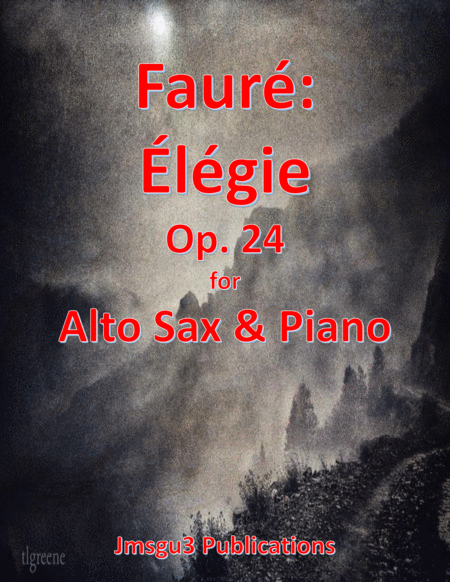
Fauré: Élégie Op. 24 for Alto Sax & Piano
Saxophone Alto et Piano

$32.95 27.64 € Saxophone Alto et Piano PDF SheetMusicPlus

Alto Saxophone,Piano - Level 3 - Digital Download SKU: A0.1041586 Composed by Edward Elgar. Arranged by Diego Marani. Classical,Instructional,Patriotic,Romantic Period,Standards. Score and part. 15 pages. Diego Marani #646345. Published by Diego Marani (A0.1041586). The best known March of the set, it had its premiere in Liverpool on 19 October 1901, with Elgar conducting the Liverpool Orchestral Society. The Trio contains the tune known as Land of Hope and Glory. In 1902 the tune was re-used, in modified form, for the Land of hope and glory section of his Coronation Ode for King Edward VII. The words were further modified to fit the original tune, and the result has since become a fixture at the Last Night of the Proms, and an English sporting anthem. In the United States, the Trio section Land of Hope and Glory of March No. 1 is often known simply as Pomp and Circumstance or as The Graduation March and is played as the processional tune at virtually all high school and some college graduation ceremonies. It was first played at such a ceremony on 28 June 1905, at Yale University, where the Professor of Music Samuel Sanford had invited his friend Elgar to attend commencement and receive an honorary doctorate of music. Elgar accepted, and Sanford made certain he was the star of the proceedings, engaging the New Haven Symphony Orchestra, the College Choir, the Glee Club, the music faculty members, and New York musicians to perform two parts from Elgar's oratorio The Light of Life and, as the graduates and officials marched out, Pomp and Circumstance March No. 1. Elgar repaid the compliment by dedicating his Introduction and Allegro to Sanford later that year. The tune soon became de rigueur at American graduations, used primarily as a processional at the opening of the ceremony. This arrangement for alto sax with piano is suitable for classroom, repertoire and recital.
Pomp and Circumstance March No. 1 for Alto Saxophone and Piano
Saxophone Alto et Piano

$9.99 8.38 € Saxophone Alto et Piano PDF SheetMusicPlus


Partitions Gratuites
Acheter des Partitions Musicales
Acheter des Partitions Digitales à Imprimer
Acheter des Instruments de Musique

© 2000 - 2026

Accueil - Version intégrale





