EUROPE
200 articles
USA
2 articles
DIGITAL
19 articles (à imprimer)
Partitions Digitales
Partitions à imprimer
19 partitions trouvées


Alto Saxophone,Piano - Level 3 - Digital Download SKU: A0.1314328 Composed by Camille Saint-Saens. Arranged by James M. Guthrie. 19th Century,Chamber,Contest,Festival,Historic,Romantic Period. Score and part. 11 pages. Jmsgu3 #903072. Published by jmsgu3 (A0.1314328). Saint-Saëns: The Swan (Le Cygne) movement 13 from the Carnival of the Animals Suite. One of his most popular and widely recognized works, it is the only movement from the Carnival Suite that Saint-Saëns permitted to be performed publicly during his lifetime. This is an excellent recital encore to demonstrate melodic playing and strategic phrasing.The Carnival of the AnimalsThe Carnival of the Animals is an entertaining musical suite of fourteen movements by Camille Saint-Saëns. The work was composed for private performance by an ensemble of two pianos and solo instruments. The Swan (No. 13) is among the fourteen most famous movements. In its entirety, it lasts about 25 minutes.Saint-Saëns BackgroundCharles-Camille Saint-Saëns 1835 – 1921) was, by all means, in particular, a famous French composer, brilliant organist, and significant musical mastermind of the Romantic era. Indeed, his most famous compositions, in the long run, include his Piano Concerto No. 2 (1868), Cello Concerto No. 1 (1872), and the Danse macabre (1874). Notwithstanding, we must also add Violin Concerto No. 3 (1880), Symphony No. 3 (the Organ Symphony, 1886), and, it must be remembered, Carnival of the Animals (1886) to the list.ChildhoodIt is essential to realize that Saint-Saëns was undoubtedly, in fact, a child musical prodigy. Consequently, with this in mind, he made his concert debut, albeit at ten years old. Another critical point to remember is that he expressly studied at the Paris Conservatoire, then, despite reality, conversely followed a traditional career path as a church organist. Nevertheless, twenty years later, on the other hand, he left to become a successful freelance pianist and composer despite, as has been noted, his former employment situation. Furthermore, his performances were, after all, markedly in demand - not only in Europe but, above all, in the Americas all in all as well.YouthA point often overlooked is that in his youth, Saint-Saëns was undoubtedly excited about the modern music of the day. He was, in essence, fond of the music of his contemporaries, particularly Schumann, Liszt, and, for the most part, Wagner. In contrast, however, his compositions seemed, in fact, primarily confined within the conservative classical tradition. Be that as it may, he was, at the same time, nevertheless, a scholar of musical history.CriticismOn the whole, his conservatism, in fact, ultimately brought him into frequent conflict in his later years with composers of the impressionist and, in particular, the dodecaphonic schools of musical thought. A point often overlooked is that he included neoclassical elements in his music, contrary to some critics. Furthermore, in so doing, he provided the most compelling evidence that he predicted the techniques and works by Stravinsky and Les Six. To put it another way, given these points, he was regarded, perhaps for the most part unfairly, as a non-progressive reactionary henceforth around the time of his passing.LegacySaint-Saëns taught briefly in Paris, where his students included Gabriel Fauré. Maurice Ravel later studied with Fauré. In conclusion, both Ravel and Fauré were powerfully influenced by Saint-Saëns, whom they respected as a musical mastermind.
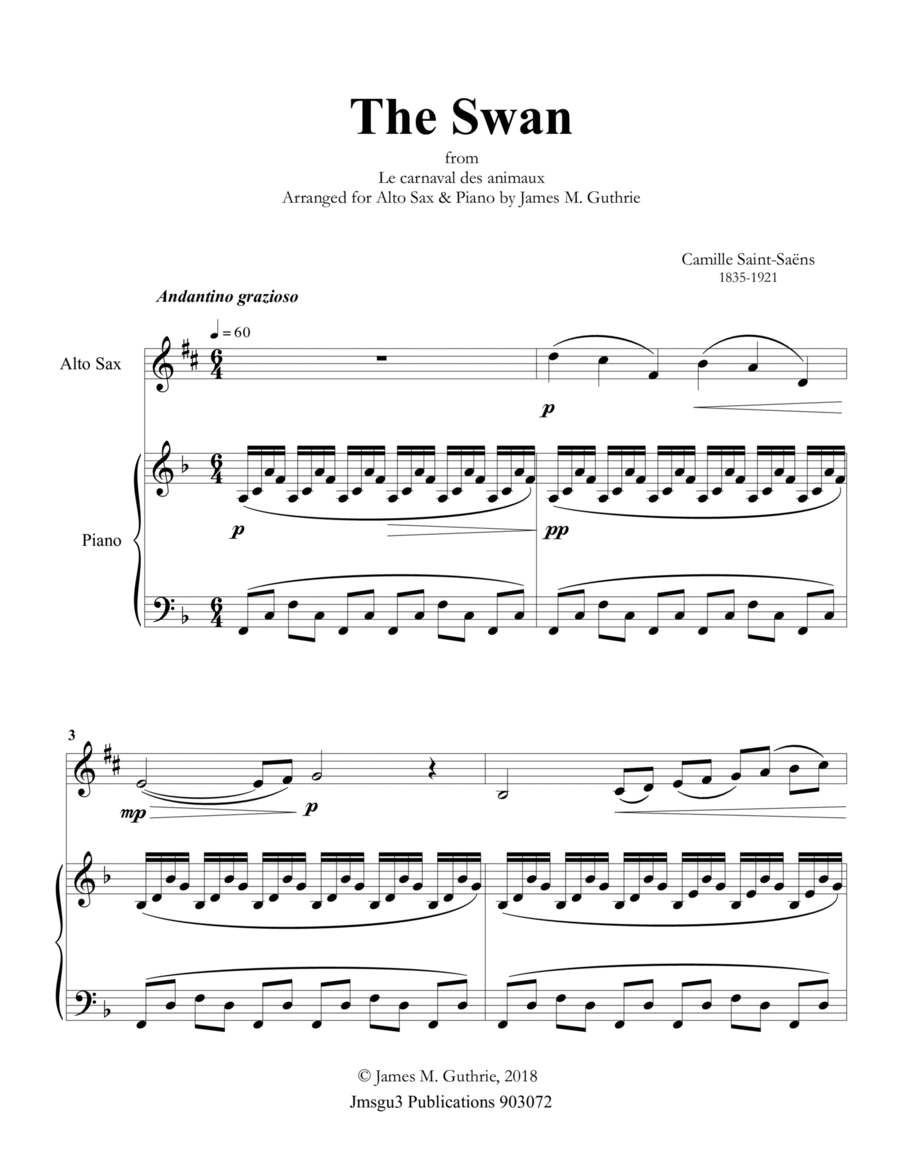
Saint-Saëns: The Swan for Alto Sax & Piano
Saxophone Alto et Piano

$32.95 27.69 € Saxophone Alto et Piano PDF SheetMusicPlus

Alto Saxophone,Piano - Level 2 - Digital Download SKU: A0.549423 Composed by Antonin Dvorak. Arranged by James M. Guthrie, ASCAP. Instructional,Romantic Period,Sacred,Standards. Score and part. 12 pages. Jmsgu3 #3494005. Published by jmsgu3 (A0.549423). Score: 7 pages, solo part: 2 pages, piano part: 3 pages. Duration: 4:25. Not difficult, but requires sensitivity & dynamic control. Suitable for recitals, church meditations, or school programs. Dvořák Background Antonín Dvořák (1841 –1904) was, of course, a composer from Czechoslovakia. As a matter of fact, he was among the first Bohemian composers to attain universal recognition. It is important to realize that the late Romantic Nationalist period featured composers who used traditional and folk elements to portray the character of their nation. In particular, we see this in the music of Grieg (Norway), Finland (Sibelius), and Smetana (Bohemia).  Dvořák relied markedly on rhythms and other characteristics of Moravian and Bohemian folk music. Ascent to Fame Dvořák was truly a child musical prodigy on the violin. The premiere performances of his compositions notably occurred in 1872 and 1873. He submitted his First Symphony in particular to a German competition, but it failed to win. Consequently, in 1874 he presented two more symphonies to the Austrian State Prize for Composition. Johannes Brahms was the principal of the jury and was accordingly very impressed. They forthwith awarded the prize to Dvořák in 1874, 1876, and 1877. At this point, Brahms thereupon endorsed Dvořák to the publisher Simrock. Later, the publisher commissioned Dvořák to compose the Slavonic Dances, Op. 46. These became popular overnight and, as a result, Dvořák's worldwide status was launched. International Status Dvořák visited England upon invitation nine times. On each visit, he frequently conducted performances of his own compositions. He conducted concerts of his music, especially in Moscow and St. Petersburg. Eventually, the Prague Conservatory in fact appointed Dvořák as a professor. There, to be sure, he wrote his famous Dumky Trio. United States Consequently, the National Conservatory of Music of America appointed him as director in 1892. As a result, Dvořák composed his two most famous symphonic works: the Symphony No. 9 (From the New World), which spread his name universally, and his Concerto for Cello and Orchestra, one of the most famous of all cello works. Moreover, he wrote his most celebrated American String Quartet during this time. At the same time, because of his growing recognition in Europe and his homesickness for his own country, he left to return to Bohemia in 1895.  
DvoÅ™ák: Largo from the New World Symphony for Alto Sax & Piano
Saxophone Alto et Piano

$32.95 27.69 € Saxophone Alto et Piano PDF SheetMusicPlus

Alto Saxophone,Piano - Level 4 - Digital Download SKU: A0.549443 Composed by Sir Arthur Seymour Sullivan. Arranged by James M. Guthrie, ASCAP. Instructional,Romantic Period,Sacred,Standards. Score and part. 15 pages. Jmsgu3 #3494751. Published by jmsgu3 (A0.549443). Score: 10 pages, solo part: 2 pages, piano part: 3 pages. Duration: 4:25. Not difficult, but requires sensitivity & dynamic control. Suitable for recitals, church meditations, or school programs. School Years First of all, Sullivan attended music school at the Royal Academy of Music. Because Sullivan was so talented, the Academy awarded him the Mendelssohn Scholarship for two years in a row. He, therefore, studied with John Goss, who studied with Thomas Atwood, who in turn studied with Mozart. Sullivan similarly studied the piano at the Academy with Arthur O’Leary. Study Abroad During his first year, he also earned money by singing solos in the Chapel Royal. At the end of his second year, the Academy consequently continued his scholarship and sent him to study at the Leipzig Conservatoire. He certainly studied composition, and likewise counterpoint and piano. Hence, during his final year in Leipzig, Sullivan finally completed his graduation composition project: Incidental Music for Shakespeare’s The Tempest. Association with Gilbert It seems like Sullivan built the bulk of his composing career largely in the 1860s. As a result, he became famous for his incidental music for the Tempest and his Irish Symphony. He, therefore, began collaborating with the poet W. S. Gilbert in the 1870s. Rather than focus on serious opera, Gilbert and Sullivan, in contrast, concentrated on comic operas such as H. M. S. Pinafore, the Pirates of Penzance, and the Mikado. Therefore, certainly as a result of his education and experience, Sullivan composed a total of 24 operas, 11 symphonic works, and 10 choral pieces. Even more, he wrote a large number of noteworthy hymns such as Onward Christian Soldiers. Lost Chord Winds The general style of his music is maybe similar to Mendelssohn, Schumann, and perhaps Liszt. It seems like Sullivan was fond of writing distinct melodies for each character in his operettas. His melodies combine together as the characters did. Furthermore, he was a master orchestrator, and therefore played the flute, clarinet, trumpet, and trombone fluently. The Lost Chord Sullivan wrote his most noteworthy song the Lost Chord in 1877. As a result, it was a great success and was certainly performed all over the world by a variety of singers such as Enrico Caruso. Because Sullivan was the most famous composer in England, the Lost Chord became the most famous of all British or American songs of the 1870s and 1890s. Consequently, in 1888 Thomas Edison recorded The Lost Chord for the phonograph. It was one of the first songs ever recorded. Furthermore, Queen Victoria knighted Sullivan in 1883.  
Sullivan: The Lost Chord for Alto Sax & Piano
Saxophone Alto et Piano

$26.95 22.65 € Saxophone Alto et Piano PDF SheetMusicPlus

Alto Saxophone,Piano - Level 4 - Digital Download SKU: A0.971651 Composed by Jeffrey Hoover. 20th Century,Contemporary,World. Score and part. 57 pages. Musicart Publications #4627679. Published by Musicart Publications (A0.971651). Winner of the 2019 SMP Press Contemporary Composition award, Wu Xing - Sonata for Five Elements (5 movements, 15 min. 30 sec) was composed by Jeffrey Hoover for Yusheng Li, who initiated the first professional university saxophone degree in China.  A work for alto saxophone and piano, Wu Xing reflects a fusion of American and Chinese musical aesthetics and compositional techniques.  Each movement represents an element in the traditional Wu Xing generative cycle.  Musical elements of one movement carry into the next, in the same way these traditional Chinese elements evolve into the next: Wood, Fire, Earth, Metal, and Water.  The fourth movement, Metal, is for unaccompanied saxophone, and includes extended techniques including microtones, multiphonics, and altered tone colors.  As with other compositions by Jeffrey Hoover, Hoover has also created a series of paintings that visually interpret the music: Dancing in the Trees, The Ancient Lance, The Dragon's Creation, Temple Bells and Swords, and Life of the Earth.  In the way the music is a fusion of American and Chines techniques, the paintings incorporate the Wu Xing philosophy approach.  Images of the paintings may be projected during performance and are available directly from the composer.Jeffrey Hoover's compositions- music ranging from soloist to symphony orchestra -have received recognition through the prestigious Trieste prize, the international Luigi Russolo competition, awards from Mu Phi Epsilon, the Lancaster Fine Arts Festival, grants, publications fellowships and more than 20 commissions. He is a member of the ACME roster of Mu Phi Epsilon, recognized for distinguished achievement as a composer. One unique aspect of Hoover’s work is when he combines composition with his paintings, creating synergetic art that intrigues and captivate audiences and performers alike. His paintings are seen in exhibitions and in concerts where his paintings are projected while musicians perform his music. Hoover’s background as a performer includes both classical and jazz music, as saxophonist and conductor. His book The Arts and Society: Making New Worlds is published by Kendall Hunt Publishing.Hoover was born on September 11, 1959, in Anderson, Indiana. He holds a Ph.D. in Fine Arts (Composition and Interdisciplinary Fine Arts) from Texas Tech University, as well as  and .Sc. from Ball State University. His career in higher education has included both faculty and arts administration appointments. For more information about his compositions, availability for appearance and festivals, and commissions, please contact him through his website.https://jeffreyhooverart.wixsite.com/mysite
Wu Xing - Sonata for Five Elements (alto saxophone and piano)
Saxophone Alto et Piano

$24.95 20.97 € Saxophone Alto et Piano PDF SheetMusicPlus

Alto Saxophone,Piano - Level 3 - Digital Download SKU: A0.774088 Arranged by Anthony Giamanco. Concert,Easter,Folk,Sacred. Score and part. 11 pages. Whole Tone Press #6666929. Published by Whole Tone Press (A0.774088). This haunting Early American hymn tune offers players an arrangement of great depth and a rich harmonic palette, appropriate for worship during the church year but especially useful during Lent/Holy Week. 8 pp.Anthony Giamanco is a member of ASCAP. His many piano, organ, choir, and chamber works are in the catalogs of numerous publishers including GIA, Shawnee Press, Alfred, Augsburg Fortress, Lorenz, and others. His music also can be purchased through sheetmusicplus.com, Sheet Music Marketplace, and JW Pepper.Anthony's music can be heard on his website, anthonygiamanco.com,https://www.anthonygiamanco.com,on SoundCloudhttps://soundcloud.com/tony-giamanco,and on his YouTube channel.
WHAT WONDROUS LOVE IS THIS - alto saxophone and piano
Saxophone Alto et Piano

$4.75 3.99 € Saxophone Alto et Piano PDF SheetMusicPlus

Alto Saxophone,Piano - Level 3 - Digital Download SKU: A0.549750 Composed by Peter Ilyich Tchaikovsky. Arranged by James M. Guthrie, ASCAP. Children,Christmas,Romantic Period,Standards. Score and part. 17 pages. Jmsgu3 #3532695. Published by jmsgu3 (A0.549750). Duration: ca. 3:15 Score: 10 pages, solo part: 2 pages, piano part: 4 pages. Tchaikovsky paints a very mysterious mood in this favorite masterpiece from the Nutcracker Suite. It is also a Christmas favorite. Pyotr Ilyich Tchaikovsky Tchaikovsky is probably the most popular of the great composers in America. His music certainly appeals to musicians. Likewise, it appeals even to folks who don’t normally listen to serious music. This is probably because of his most noteworthy melodies. Above all, he writes with great emotion. This certainly makes a most noteworthy if not an unforgettable impact. Education First of all, He attended classes at the Russian Musical Society. Even more, He also attended the St. Petersburg Conservatory. There he studied music theory with Nikolai Zaremba. He also consequently studied composition with Anton Rubenstein. It seems like Rubenstein came under criticism from a group of Russian composers known as the Five. The Five The Five certainly rejected Western musical influences. They rather sought to use elements from Russian music. They furthermore wanted to use more exotic musical materials. Western Techniques More than other Russian composers, Tchaikovsky studied modern Western music. He certainly develops his music like the European masters. So, rather than repeating a motive, he moves to a new key. He then introduces a different theme in the new key. Hence, he maintained his independence from the Five. Even more, he became the first Russian composer of international stature. Influences Tchaikovsky was probably influenced in his ballet scoring by Léo Delibes. Richard Wagner influenced his symphonic writing. Tchaikovsky’s most famous works include the 1812 Overture, The Nutcracker Suite, and Swan Lake. Also famous are the Violin Concerto in D and the six symphonies. The greatest of the six symphonies may be No. 6, the Pathétique. Nutcracker Suite, Op. 71a The Nutcracker Suite is a ballet that was performed for the first time in December 1892 in St. Petersburg. To begin with, the original ballet failed to attract a positive reception. However, the ballet suite became probably one of the most popular of all of Tchaikovsky’s works. The ballet suite became even more famous in the 1960s. It is now performed all over the world, particularly during the Christmas season.
Tchaikovsky: Arabian Dance from Nutcracker Suite for Alto Sax & Piano
Saxophone Alto et Piano

$32.95 27.69 € Saxophone Alto et Piano PDF SheetMusicPlus

Alto Saxophone,Piano - Level 3 - Digital Download SKU: A0.549772 Composed by Peter Ilyich Tchaikovsky. Arranged by James M. Guthrie, ASCAP. Children,Christmas,Romantic Period,Standards. Score and part. 11 pages. Jmsgu3 #3534981. Published by jmsgu3 (A0.549772). Duration: ca 1:00 Score: 5 pages, Solo part: 2 pages, piano part: 3 pages. Short but fascinating Chinese Dance from the Nutcracker Suite. Program this for a recital encore or Christmas pageant. Pyotr Ilyich Tchaikovsky Tchaikovsky is probably the most popular of the great composers in America. His music certainly appeals to musicians. Likewise, it appeals even to folks who don’t normally listen to serious music. This is probably because of his most noteworthy melodies. Above all, he writes with great emotion. This certainly makes a most noteworthy if not an unforgettable impact. Education First of all, He attended classes at the Russian Musical Society. Even more, He also attended the St. Petersburg Conservatory. There he studied music theory with Nikolai Zaremba. He also consequently studied composition with Anton Rubenstein. It seems like Rubenstein came under criticism from a group of Russian composers known as the Five. The Five The Five certainly rejected Western musical influences. They rather sought to use elements from Russian music. They furthermore wanted to use more exotic musical materials. Western Techniques More than other Russian composers, Tchaikovsky studied modern Western music. He certainly develops his music like the European masters. So, rather than repeating a motive, he moves to a new key. He then introduces a different theme in the new key. Hence, he maintained his independence from the Five. Even more, he became the first Russian composer of international stature. Influences Tchaikovsky was probably influenced in his ballet scoring by Léo Delibes. Richard Wagner influenced his symphonic writing. Tchaikovsky’s most famous works include the 1812 Overture, The Nutcracker Suite, and Swan Lake. Also famous are the Violin Concerto in D and the six symphonies. The greatest of the six symphonies may be No. 6, the Pathétique. Nutcracker Suite, Op. 71a The Nutcracker Suite is a ballet that was performed for the first time in December 1892 in St. Petersburg. To begin with, the original ballet failed to attract a positive reception. However, the ballet suite became probably one of the most popular of all of Tchaikovsky’s works. The ballet suite became even more famous in the 1960s. It is now performed all over the world, particularly during the Christmas season.
Tchaikovsky: Chinese Dance from Nutcracker Suite for Alto Sax & Piano
Saxophone Alto et Piano

$32.95 27.69 € Saxophone Alto et Piano PDF SheetMusicPlus

Alto Saxophone,Piano - Level 3 - Digital Download SKU: A0.549597 Composed by Peter Ilyich Tchaikovsky. Arranged by James M. Guthrie, ASCAP. Instructional,Romantic Period,Standards. Score and part. 16 pages. Jmsgu3 #3512825. Published by jmsgu3 (A0.549597). Duration: 2:30, score: 8 pages, solo part: 2 pages, piano part: 5 pages. A well-known favorite masterpiece suitable for a recital or school program. Pyotr Ilyich Tchaikovsky Tchaikovsky is probably the most popular of the great composers in America. His music certainly appeals to musicians. Likewise, it appeals even to folks who don’t normally listen to serious music. This is probably because of his most noteworthy melodies. Above all, he writes with great emotion. This certainly makes a most noteworthy if not an unforgettable impact. Education First of all, He attended classes at the Russian Musical Society. Even more, He also attended the St. Petersburg Conservatory. There he studied music theory with Nikolai Zaremba. He also consequently studied composition with Anton Rubenstein. It seems like Rubenstein came under criticism from a group of Russian composers known as the Five. The Five The Five certainly rejected Western musical influences. They rather sought to use elements from Russian music. They furthermore wanted to use more exotic musical materials. Western Techniques More than other Russian composers, Tchaikovsky studied modern Western music. He certainly develops his music like the European masters. So, rather than repeating a motive, he moves to a new key. He then introduces a different theme in the new key. Hence, he maintained his independence from the Five. Even more, he became the first Russian composer of international stature. Influences Tchaikovsky was probably influenced in his ballet scoring by Léo Delibes. Richard Wagner influenced his symphonic writing. Tchaikovsky’s most famous works include the 1812 Overture, The Nutcracker Suite, and Swan Lake. Also famous are the Violin Concerto in D and the six symphonies. The greatest of the six symphonies may be No. 6, the Pathétique. Swan Lake Op. 20 Tchaikovsky composed Swan Lake in 1875-76. To begin with, most noteworthy the ballet failed to attract a positive reception. Over time, however, the ballet became probably one of the most popular of all of Tchaikovsky’s works. The ballet was certainly first performed by the Bolshoi Ballet in Moscow.
Tchaikovsky: Scene 10 from Swan Lake for Alto Sax & Piano
Saxophone Alto et Piano

$32.95 27.69 € Saxophone Alto et Piano PDF SheetMusicPlus

Alto Saxophone,Piano - Level 2 - Digital Download SKU: A0.1155646 Composed by Ludwig van Beethoven. Arranged by Ander. Classical,Folk,March,Opera,Romantic Period. Score and part. 4 pages. Woods Only, Arrangements #755950. Published by Woods Only, Arrangements (A0.1155646). This arrangement adapted for alto saxophone and piano was written keeping the characteristics of the original work, in order to be performed by young music students who want to enter the symphonic music. Besides, it can also be used by professional musicians for recitals, repertoire, academic presentations and didactic material. The transcription remains faithful to the structure, with only one change in tone, so that it is comfortable for all the instruments in the formation, as well as being used as an activity in ensemble practice among musicians of different traditions. Beethoven's Turkish March (Op. 113) is the 4th movement of the operatic work: The Ruins of Athens, a set of incidental pieces written in 1812 by Ludwig van Beethoven, where the melody was originally written in 1809 as Theme with Six Variations for Piano, Op. 76. The work was written to accompany the play of the same name by August von Kotzebue, for the dedication of a new theater in Pest. Perhaps the best known part of the composition is the Marcia alla turca, In Latin America, this movement became known in Jean-Jacques Perrey's version (who titled it The Elephant never Forgets) since it was used as the opening theme of the successful Mexican TV comedy El Chavo del Ocho. The opening and the turkish march are often performed separately, and the other pieces in this set are not often heard.
Turkish March by Beethoven for Alto Sax
Saxophone Alto et Piano

$1.99 1.67 € Saxophone Alto et Piano PDF SheetMusicPlus

Alto Saxophone,Piano - Level 1 - Digital Download SKU: A0.548472 Composed by Mueller. Arranged by James M. Guthrie. Christian,Christmas. Score and part. 3 pages. Jmsgu3 #3386519. Published by jmsgu3 (A0.548472). Traditional Christmas song arranged for alto sax & piano. Final verse features an alternate harmonization.Score: 2 pages. Part: 1 page.Away in a Manger – Alto Sax Away in a Manger is a popular Christmas song published originally sometime in the later 19th century and performed throughout the world. In England, it is considered one of the two most popular carols of all time; a 1996 poll ranked it as a tie for second place. To begin with, many thought it was written by Martin Luther, but now the song is considered to be absolutely American. The most common musical arrangements are by William Kirkpatrick (1895) and James R. Murray (1887). The melody was first published, as Luther's Cradle Hymn, by James R. Murray. Then, came a confusing series of explanations about how Martin Luther wrote the song. Murray even went so far as to suggest that Luther wrote it for his children. As a result, the song has become known as simply Mueller. Nobody knows who this Mueller actually is, but the name stuck. Popularity By the 1880’s the cradle song was being performed in church. By the 1990’s the song was becoming the most popular Christmas song of all time. It was sung in school, in church, and at home by nearly everyone. Other musical settings The first musical setting published with the lyrics appeared in the Little Children's Book for Schools and Families (1885). The title was Away in a Manger. This edition is the first one not to attribute the song to Martin Luther.   Charles H. Gabriel was the first arranger to present the third verse. He also composed and published a large number of different arrangements of the song. In one of his settings, he supplies a chorus for each verse with asleep sung in canon. Another prevalent preparation uses the lyrics to the melody Flow Gently, Sweet Afton. Yet another arrangement dating uses the lyrics to an old Normandy Carol. 
Away In A Manger: for Alto Sax & Piano
Saxophone Alto et Piano
the 1880’s the cradle song was being performed in church
$24.95 20.97 € Saxophone Alto et Piano PDF SheetMusicPlus

Instrumental Duet,Piano Alto Saxophone,Instrumental Duet,Piano - Level 3 - Digital Download SKU: A0.1301789 Composed by Hugh Martin. Arranged by Ken Naidu. 20th Century,Christmas. 4 pages. Scores by Ken #891381. Published by Scores by Ken (A0.1301789). Have Yourself A Merry Little Christmas | Scores by Ken About the PieceThe song was first published in 1943 with lyrics by Ralph Blane and music by Hugh Martin. The song brought comfort to many American soldiers who were fighting overseas during World War II. One of the most popular versions of this song was recorded by the Carpenters and released in 1978 on their Christmas Portrait, the bittersweet lyrics falling right in Karen Carpenter's wheelhouse.  About the ComposerFrom the breathtaking landscapes of New Zealand, Ken weaves melodies and harmonies that captivate and transport listeners to another realm. Specialising in screen composition, and versatile jazz renditions, each piece is a unique auditory experience, meticulously crafted to resonate with the soul. Whether you're seeking a composition that tells a profound story or a vibrant jazz chart that dances with energy, Scores by Ken promises unparalleled originality and precision in every note.
Have Yourself A Merry Little Christmas
Saxophone Alto et Piano

$24.99 21 € Saxophone Alto et Piano PDF SheetMusicPlus

Alto Saxophone,Piano - Level 3 - Digital Download SKU: A0.773712 By Chris Tomlin. By Chris Tomlin, Louie Giglio, and Traditional American Melody. Arranged by Anthony Giamanco. Christian. Score and part. 10 pages. Whole Tone Press #3692357. Published by Whole Tone Press (A0.773712). This arrangement of the popular praise song works beautifully for alto sax (with piano accompaniment), appropriate for intermediate players. It maintains the feel of the original Chris Tomlin recording, with the sax taking the lead vocal part. The piano is very supportive, keeping a strong quarter note pulse. Great for any contemporary or blended worship service, this piece also makes a fine concert or recital selection. Anthony Giamanco is a member of ASCAP. His many piano, organ, choir, and chamber works are in the catalogs of numerous publishers including GIA, Shawnee Press, Alfred, Augsburg Fortress, Lorenz, and others. His pieces also can be purchased through sheetmusicplus.com and JW Pepper. Anthony's music can be heard on his website, anthonygiamanco.com, and on YouTube. Contact info: tony@shalomlife.org.
Amazing Grace (my Chains Are Gone)
Saxophone Alto et Piano
Chris Tomlin
$4.99 4.19 € Saxophone Alto et Piano PDF SheetMusicPlus


Partitions Gratuites
Acheter des Partitions Musicales
Acheter des Partitions Digitales à Imprimer
Acheter des Instruments de Musique

© 2000 - 2026

Accueil - Version intégrale





