EUROPE
127217 articles
USA
161 articles
DIGITAL
2282 articles (à imprimer)
Partitions Digitales
Partitions à imprimer
2282 partitions trouvées


Alto Saxophone,Piano - Level 3 - Digital Download SKU: A0.533348 Composed by Ali Ben Sou Alle, Gaetano Donizetti. Arranged by Paul Wehage. Concert,Opera,Romantic Period,Standards. Score and part. 23 pages. Musik Fabrik Music Publishing #2348199. Published by Musik Fabrik Music Publishing (A0.533348). One of the most enigmatic figures in the history of the Saxophone, Ali Ben Sou Alle (Charles-Valentin Soualle) was born in 1820 in Arras, France. After receiving his first prize in Clarinet at the Paris Conservatory in 1844. he served as the director ofmusic of The French Marine Band in Senegal, and then was named first clarinet solo at the Opéra-Comique in Paris. However, after the Revolution of 1848, Soualle was forced to flee France to England where he settled in London, playing in the Orchestra of the Queen's Theatre. His songs and piano pieces were published in London. While in London, Soualle met another exiled French musician, Louis Antoine Jullien, who conducted a light music series in London. Jullien encouraged Soualle to take up the saxophone, and after modifying the instrument by adding a single octave mechanism (the modern system used today) and keys for the lower register, Soualle became known as a virtuoso and began touring performing solo recitals (or mono-concerts, as they were called at the time) calling his modified saxophone the «turcophone ». He performed in all the European capitals and then traveled to Australia, New Zealand, Manilla, Java, through China and then to India where he finally settled in Mysore, becoming the director of the Royal Music for the Maharadjah. It was during this period that he converted to Islam and changed his nmae to Ali ben Sou Alle (or Ali, son of Soualle). He subsequently travaled to Ile Maurice, to French Polynesia, the Cap of Natal and the Cap of Good Hope. All of these voyages were subjects of musical works which Soualle entitled Souvenirs de... and may perhaps have been part of a collection known as The Royal Album which was presented to the Prince of Wales after a royal concert. Soualle returned to Mysore in 1858 and was almost killed in the Indian Revolution.  Around 1860, Soualle returned to France for health reasons and began publishing his own music. On March 27 1865, he performed a command performance for the Emperor Napoleon III at the Tuileries Palace in the presence of the entire Imperial Family. After 1865, nothing more is known about him.Soualle not only performed on the clarinet, saxophone and piano, but also frequently sang during his concerts. He also wrotesongs while he was in London. His opera fantasies are usually written for the Alto saxophone. This particular fantasy usesthemes from the Third and fourth act sung by the hero et heroine which are marked in the score.
Ali Ben Sou Alle: Fantaisie sur La Favorita de Donizetti for alto saxophone and piano
Saxophone Alto et Piano

$11.95 10.22 € Saxophone Alto et Piano PDF SheetMusicPlus

Alto Saxophone,Piano - Level 3 - Digital Download SKU: A0.1123963 By Taylor Swift. By Jack Antonoff and Taylor Swift. Arranged by Henrique F Mangoni. Pop. Score and part. 8 pages. Henrique Franke Mangoni #724727. Published by Henrique Franke Mangoni (A0.1123963). Anti-hero by Taylor Swift, from her new album Midnights. Arranged for alto sax and piano accompaniment. Intermediate level arrangement. Clean sheet music edition. Learn how to play Anti-hero on the alto sax! Subscribe to my YouTube channel to know more about my work! anti-hero alto sax sheet music, antihero alto sax sheet music, anti-hero alto sax and piano sheet music, antihero alto sax and piano sheet music, anti-hero sheet music, antihero sheet music, anti-hero by taylor swift sheet music, antihero by taylor swift sheet music, anti-hero chords, antihero chords, anti-hero piano chords, antihero piano chords, midnights, taylor swift new album.
Anti-hero
Saxophone Alto et Piano
Taylor Swift
$5.99 5.12 € Saxophone Alto et Piano PDF SheetMusicPlus

Alto Saxophone,Piano - Level 4 - Digital Download SKU: A0.533353 Composed by Ali Ben Sou Alle, Vincenzo Bellini. Arranged by Paul Wehage. Concert,Opera,Romantic Period,Standards. Score and part. 28 pages. Musik Fabrik Music Publishing #2363203. Published by Musik Fabrik Music Publishing (A0.533353). One of the most enigmatic figures in the history of the Saxophone, Ali Ben Sou Alle (Charles-Valentin Soualle) was born in1820 in Arras, France. After receiving his first prize in Clarinet at the Paris Conservatory in 1844. he served as the director ofmusic of The French Marine Band in Senegal, and then was named first clarinet solo at the Opéra-Comique in Paris. However, after the Revolution of 1848, Soualle was forced to flee France to England where he settled in London, playing in the Orchestra of the Queen's Theatre. His songs and piano pieces were published in London.While in London, Soualle met another exiled French musician, Louis Antoine Jullien, who conducted a light music series inLondon. Jullien encouraged Soualle to take up the saxophone, and after modifying the instrument by adding a single octavemechanism (the modern system used today) and keys for the lower register, Soualle became known as a virtuoso and begantouring performing solo recitals (or mono-concerts, as they were called at the time) calling his modified saxophone the«turcophone ». He performed in all the European capitals and then traveled to Australia, New Zealand, Manilla, Java, throughChina and then to India where he finally settled in Mysore, becoming the director of the Royal Music for the Maharadjah. It wasduring this period that he converted to Islam and changed his nmae to Ali ben Sou Alle (or Ali, son of Soualle). Hesubsequently travaled to Ile Maurice, to French Polynesia, the Cap of Natal and the Cap of Good Hope. All of these voyageswere subjects of musical works which Soualle entitled Souvenirs de... and may perhaps have been part of a collection knownas The Royal Album which was presented to the Prince of Wales after a royal concert. Soualle returned to Mysore in 1858 and was almost killed in the Indian Revolution.Around 1860, Soualle returned to France for health reasons and began publishing his own music. On March 27 1865, heperformed a command performance for the Emperor Napoleon III at the Tuileries Palace in the presence of the entire ImperialFamily. After 1865, nothing more is known about him.This fantasy begins with motifs from the 1st act chorus « Sempre Felc’Amina » ». The Count’s first act aria « Vi ravisso, o loughi ameni » is followed by an extended cadenza and leads to Amina and Elvino’s first act duo « Prendi l’amel ti dono ». Amina’s second act aria « Ah non guige! » is presented with a brilliant variation to bring the work to a close.
Ali Ben Sou Alle: Fantaisie sur la Somnambule de Bellini for alto saxophone and piano
Saxophone Alto et Piano

$16.95 14.5 € Saxophone Alto et Piano PDF SheetMusicPlus

Alto Saxophone,Piano - Level 4 - Digital Download SKU: A0.533508 Composed by Ali Ben Sou Alle. Concert,Romantic Period,Standards. Score and part. 35 pages. Musik Fabrik Music Publishing #3002551. Published by Musik Fabrik Music Publishing (A0.533508). This fantasy uses motifs from Donizetti's opera. After the opening which uses motives from the Overture, the main melody of the famous Sextet is presented. The tenor aria from the last act is presented with several vrariations. Finally, motifs form the fmaous mad scene end the work in a brilliant valse.One of the most enigmatic figures in the history of the Saxophone, Ali Ben Sou Alle (Charles-Valentin Soualle) was born in 1820 in Arras, France. After receiving his first prize in Clarinet at the Paris Conservatory in 1844. he served as the director of music of The French Marine Band in Senegal, and then was named first clarinet solo at the Opéra-Comique in Paris. However, after the Revolution of 1848, Soualle was forced to flee France to England where he settled in London, playing in the Orchestra of the Queen's Theatre. His songs and piano pieces were published in London.  While in London, Soualle met another exiled French musician, Louis Antoine Jullien, who conducted a light music series in London. Jullien encouraged Soualle to take up the saxophone, and after modifying the instrument by adding a single octave mechanism (the modern system used today) and keys for the lower register, Soualle became known as a virtuoso and began touring performing solo recitals (or mono-concerts, as they were called at the time) calling his modified saxophone the «turcophone ». He performed in all the European capitals and then traveled to Australia, New Zealand, Manilla, Java, through China and then to India where he finally settled in Mysore, becoming the director of the Royal Music for the Maharadjah. It was during this period that heconverted to Islam and changed his nmae to Ali ben Sou Alle (or Ali, son of Soualle).   He subsequently travaled to Ile Maurice, to French Polynesia, the Cap of Natal and the Cap of Good Hope. All of these voyages were subjects of musical works which Soualle entitled Souvenirs de... and may perhaps have been part of a collection known as The Royal Album which was presented to the Prince of Wales after a royal concert.  Soualle returned to Mysore in 1858 and was almost killed in the Indian Revolution.  Around 1860, Soualle returned to France for health reasons and began publishing his own music. OnMarch 27 1865, he performed a command performance for the Emperor Napoleon III at the Tuileries Palace in the presence of the entire Imperial Family. After 1865, nothing more is known about him.
Ali Ben Sou Alle: Grande Fantaisie Variée sur "Lucia di Lammermoor" for alto saxophone and piano
Saxophone Alto et Piano

$19.95 17.06 € Saxophone Alto et Piano PDF SheetMusicPlus

Alto Saxophone,Piano - Level 1 - Digital Download SKU: A0.1135019 By Taylor Swift. By Jack Antonoff and Taylor Swift. Arranged by Henrique F Mangoni. Pop. Score and part. 8 pages. Henrique Franke Mangoni #735063. Published by Henrique Franke Mangoni (A0.1135019). Anti-hero by Taylor Swift, from her new album Midnights. Arranged for alto sax and piano accompaniment. Easy/Beginner level arrangement. Clean sheet music edition. Learn how to play Anti-hero on the alto sax! Perfect for students, beginners, preschoolers, music teachers, alto sax teachers and piano teachers. Subscribe to my YouTube channel to know more about my work! anti-hero easy alto sax sheet music, antihero easy alto sax sheet music, anti-hero easy sheet music, antihero easy sheet music, anti-hero by taylor swift easy sheet music, antihero by taylor easy swift sheet music, anti-hero easy chords, antihero easy chords, anti-hero easy piano chords, antihero easy piano chords, midnights, taylor swift new album.
Anti-hero
Saxophone Alto et Piano
Taylor Swift
$5.99 5.12 € Saxophone Alto et Piano PDF SheetMusicPlus

Alto Saxophone,Piano - Level 1 - Digital Download SKU: A0.1135018 By Taylor Swift. By Jack Antonoff and Taylor Swift. Arranged by Henrique F Mangoni. Pop. Score and part. 8 pages. Henrique Franke Mangoni #735062. Published by Henrique Franke Mangoni (A0.1135018). Anti-hero by Taylor Swift, from her new album Midnights. Arranged for alto sax and piano accompaniment. Easy/Beginner level arrangement. This edition includes the chords of the song. Learn how to play Anti-hero on the alto sax! Perfect for students, beginners, preschoolers, music teachers, alto sax teachers and piano teachers. Subscribe to my YouTube channel to know more about my work! anti-hero easy alto sax sheet music, antihero easy alto sax sheet music, anti-hero easy sheet music, antihero easy sheet music, anti-hero by taylor swift easy sheet music, antihero by taylor easy swift sheet music, anti-hero easy chords, antihero easy chords, anti-hero easy piano chords, antihero easy piano chords, midnights, taylor swift new album.
Anti-hero
Saxophone Alto et Piano
Taylor Swift
$5.99 5.12 € Saxophone Alto et Piano PDF SheetMusicPlus

Alto Saxophone,Piano - Level 3 - Digital Download SKU: A0.533347 Composed by Ali Ben Sou Alle, Wolfgang Amadeus Mozart. Arranged by Paul Wehage. Concert,Opera,Romantic Period,Standards. Score and part. 22 pages. Musik Fabrik Music Publishing #2348197. Published by Musik Fabrik Music Publishing (A0.533347). One of the most enigmatic figures in the history of the Saxophone, Ali Ben Sou Alle (Charles-Valentin Soualle) was born in 1820 in Arras, France. After receiving his first prize in Clarinet at the Paris Conservatory in 1844. he served as the director ofmusic of The French Marine Band in Senegal, and then was named first clarinet solo at the Opéra-Comique in Paris. However, after the Revolution of 1848, Soualle was forced to flee France to England where he settled in London, playing in the Orchestra of the Queen's Theatre. His songs and piano pieces were published in London. While in London, Soualle met another exiled French musician, Louis Antoine Jullien, who conducted a light music series in London. Jullien encouraged Soualle to take up the saxophone, and after modifying the instrument by adding a single octave mechanism (the modern system used today) and keys for the lower register, Soualle became known as a virtuoso and began touring performing solo recitals (or mono-concerts, as they were called at the time) calling his modified saxophone the «turcophone ». He performed in all the European capitals and then traveled to Australia, New Zealand, Manilla, Java, through China and then to India where he finally settled in Mysore, becoming the director of the Royal Music for the Maharadjah. It was during this period that he converted to Islam and changed his nmae to Ali ben Sou Alle (or Ali, son of Soualle). He subsequently travaled to Ile Maurice, to French Polynesia, the Cap of Natal and the Cap of Good Hope. All of these voyages were subjects of musical works which Soualle entitled Souvenirs de... and may perhaps have been part of a collection known as The Royal Album which was presented to the Prince of Wales after a royal concert. Soualle returned to Mysore in 1858 and was almost killed in the Indian Revolution. Around 1860, Soualle returned to France for health reasons and began publishing his own music. On March 27 1865, he performed a command performance for the Emperor Napoleon III at the Tuileries Palace in the presence of the entire Imperial Family. After 1865, nothing more is known about him. Soualle not only performed on the clarinet, saxophone and piano, but also frequently sang during his concerts. He also wrote songs while he was in London. His opera fantasies are usually written for the Alto saxophone and are generally in the form of an introductory aria with cadenza, a theme with one or more variations and then a final waltz movement in rondo form with a final brillant variation. This specific work opens with motives from the Opera‘s overture, leading to Donna Anna’s 1st act aria Or sai, chi l'onore. The duet Là ci darem la mano is the subject of two variations followed by a brief interlude using Zerlina’s aria Batti, batti, o bel Masetto and then the final section is the duo Andiam’ Andiam ‘ Mio Bene between Don Giovanni and Zerlina which ends the Act I duet. The work ends with a brillant coda
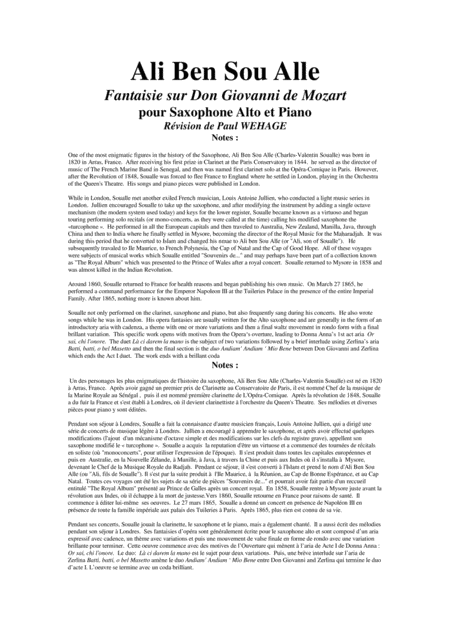
Ali Ben Sou Alle: Fantaisie sur Don Giovanni de Mozart for alto saxophone and piano
Saxophone Alto et Piano

$11.95 10.22 € Saxophone Alto et Piano PDF SheetMusicPlus

Alto Saxophone,Piano - Level 4 - Digital Download SKU: A0.755042 Composed by Sy Brandon. 20th Century,Contemporary. Score and part. 23 pages. Sy Brandon #3249479. Published by Sy Brandon (A0.755042). Fantasie Variation on Mazurek Dabrowskiego was commissioned in 2010 by David Wozniak. Wozniak suggested using the Polish National Anthem as the basis of a composition that can serve as a fiery opener to a concert. After a short introduction, the anthem is stated using a repetitive rhythmic motif in the piano. Variation one is a minor variant that has a chromatic obligato in the saxophone on the repeat. After a two measure interlude in 4/4 that breaks up the 3/4 meter of the mazurka, Variation two begins. This variation uses motives from the anthem to create a new saxophone melody. Variation three changes meter often and is more technical and angular. A repeat of the minor variant brings the first fast section to a close. After a transition to a slower tempo, a mysterious variation with sudden outbursts occurs. It uses a lot of feminine endings that are characteristic of some Polish music. The tempo slows once again before variation seven which is a lyrical and romantic treatment of motives from the anthem. The final fast section begins with a rhythmic 5/8 variation that changes to 6/8 for the second part of the anthem’s structure. An ornamental version of the anthem with the mazurka rhythm returns at the end before a rousing coda brings the work to a close. This composition is recorded by David Wozniak and Krista Wallace-Boaz on the Emeritus label American Fusion CD.
Fantasie Variations on Mazurek Dabrowskiego
Saxophone Alto et Piano

$9.99 8.54 € Saxophone Alto et Piano PDF SheetMusicPlus

Alto Saxophone,Piano - Level 4 - Digital Download SKU: A0.533354 Composed by Ali Ben Sou Alle, Gioachino Rossini. Arranged by Paul Wehage. Concert,Opera,Romantic Period,Standards. Score and part. 30 pages. Musik Fabrik Music Publishing #2363209. Published by Musik Fabrik Music Publishing (A0.533354). One of the most enigmatic figures in the history of the Saxophone, Ali Ben Sou Alle (Charles-Valentin Soualle) was born in1820 in Arras, France. After receiving his first prize in Clarinet at the Paris Conservatory in 1844. he served as the director ofmusic of The French Marine Band in Senegal, and then was named first clarinet solo at the Opéra-Comique in Paris. However, after the Revolution of 1848, Soualle was forced to flee France to England where he settled in London, playing in the Orchestra of the Queen's Theatre. His songs and piano pieces were published in London.While in London, Soualle met another exiled French musician, Louis Antoine Jullien, who conducted a light music series inLondon. Jullien encouraged Soualle to take up the saxophone, and after modifying the instrument by adding a single octavemechanism (the modern system used today) and keys for the lower register, Soualle became known as a virtuoso and begantouring performing solo recitals (or mono-concerts, as they were called at the time) calling his modified saxophone the«turcophone ». He performed in all the European capitals and then traveled to Australia, New Zealand, Manilla, Java, throughChina and then to India where he finally settled in Mysore, becoming the director of the Royal Music for the Maharadjah. It wasduring this period that he converted to Islam and changed his nmae to Ali ben Sou Alle (or Ali, son of Soualle). Hesubsequently travaled to Ile Maurice, to French Polynesia, the Cap of Natal and the Cap of Good Hope. All of these voyageswere subjects of musical works which Soualle entitled Souvenirs de... and may perhaps have been part of a collection knownas The Royal Album which was presented to the Prince of Wales after a royal concert. Soualle returned to Mysore in 1858 and was almost killed in the Indian Revolution.Around 1860, Soualle returned to France for health reasons and began publishing his own music. On March 27 1865, heperformed a command performance for the Emperor Napoleon III at the Tuileries Palace in the presence of the entire ImperialFamily. After 1865, nothing more is known about him.Fantaisie sur Le Barbier de Séville begins with the Count's 1st act cavatina Ecco ridente in cielà This is followed by a seriesof variations sur Rosina's Cabaletta Io sono docile. The second act finale Fredda ed immobile is then presented in a number of variations. Finally, the second part of the Count and Figaros first act duo (Ah che d'amore) brings the work to a brilliant finish.
Ali Ben Sou Alle: Fantaisie sur le Barbier de Séville de Rossin for alto saxophone and piano
Saxophone Alto et Piano

$19.95 17.06 € Saxophone Alto et Piano PDF SheetMusicPlus

Alto Saxophone,Piano - Level 5 - Digital Download SKU: A0.533263 Composed by Emanuele Krakamp. Arranged by Paul Wehage. Concert,Opera,Romantic Period,Standards. Score and part. 32 pages. Musik Fabrik Music Publishing #2151147. Published by Musik Fabrik Music Publishing (A0.533263). Emanuele Krakamp was born in Messina in 1813. He began studying music with his father. In 1841 he was named first flute in the royal orchestra of Naples and was also named flute professor of San Pietro a Majella Conservatory in 1860. Krakamp performed concerts in Europe, America, the Middle East and North Africa. The Fantasy Opus 248 based on themes from Verdi's Opera La Traviata is part of a group of three fantasies called La triade verdiana, first published in 1865. Krakamp died in Naples in 1883.The version for saxophone remains close to the original version for flute, with only a few register changes because of range issues. Some passages in the piano part have been re-enforced harmonically and the ending has been slightly changed, to create a more definitive ending. .
Emanuele Krakamp: Fantaisie sur la Traviata de Verdi, arranged for alto saxophone and piano by Paul
Saxophone Alto et Piano

$19.95 17.06 € Saxophone Alto et Piano PDF SheetMusicPlus

Alto Saxophone,Piano - Level 4 - Digital Download SKU: A0.533499 Composed by Ali Ben Sou Alle. Concert,Romantic Period,Standards. Score and part. 28 pages. Musik Fabrik Music Publishing #3000445. Published by Musik Fabrik Music Publishing (A0.533499). Meyerbeer’s Opera Le Prophète was one of the most influential works of the 19th century, inspiring Verdi, Wagner, Liszt and others with its dramatic score. Caprice sur Le Prophète de Meyerbeer begins with an extended Aria with several cadenzas. The work ends with a Polka in Rondo form which has a brillant variation.One of the most enigmatic figures in the history of Wind Music, Ali Ben Sou Alle (Charles-Valentin Soualle) was born in 1820 in Arras, France. After receiving his first prize in Clarinet at the Paris Conservatory in 1844. he served as the director of music of The French Marine Band in Senegal, and then was named first clarinet solo at the Opéra-Comique in Paris. However, after the Revolution of 1848, Soualle was forced to flee France to England where he settled in London, playing in the Orchestra of the Queen's Theatre. His songs and piano pieces were published in London.While in London, Soualle met another exiled French musician, Louis Antoine Jullien, who conducted a light music series in London. Jullien encouraged Soualle to take up the saxophone, and after modifying the instrument by adding a single octave mechanism (the modern system used today) and keys for the lower register, Soualle became known as a virtuoso and began touring performing solo recitals (or mono-concerts, as they were called at the time) calling his modified saxophone the «turcophone ». He performed in all the European capitals and then traveled to Australia, New Zealand, Manilla, Java, through China and then to India where he finally settled in Mysore, becoming the director of the Royal Music for the Maharadjah. It was during this period that he converted to Islam and changed his nmae to Ali ben Sou Alle (or Ali, son of Soualle). He subsequently travaled to Ile Maurice, to French Polynesia, the Cap of Natal and the Cap of Good Hope. All of these voyages were subjects of musical works which Soualle entitled Souvenirs de... and may perhaps have been part of a collectionknown as The Royal Album which was presented to the Prince of Wales after a royal concert. Soualle returned to Mysore in 1858 and was almost killed in the Indian Revolution.Around 1860, Soualle returned to France for health reasons and began publishing his own music. On March 27 1865, he performed a command performance for the Emperor Napoleon III at the Tuileries Palace in the presence of the entire Imperial Family. After 1865, nothing more is known about him.
Ali Ben Sou Alle: Fantaisie sur Robert le Diable for alto saxophone and piano
Saxophone Alto et Piano

$19.95 17.06 € Saxophone Alto et Piano PDF SheetMusicPlus


Partitions Gratuites
Acheter des Partitions Musicales
Acheter des Partitions Digitales à Imprimer
Acheter des Instruments de Musique

© 2000 - 2026

Accueil - Version intégrale





