EUROPE
363 articles
USA
1 articles
DIGITAL
10 articles (à imprimer)
Partitions Digitales
Partitions à imprimer
10 partitions trouvées


Alto Saxophone,Piano - Level 3 - Digital Download SKU: A0.549639 Composed by Ludwig van Beethoven. Arranged by James M. Guthrie, ASCAP. Concert,Instructional,Romantic Period,Sacred,Standards. Score and part. 16 pages. Jmsgu3 #3516567. Published by jmsgu3 (A0.549639). Duration: ca 5:20, Score: 8 pages, solo part: 3 pages, piano part: 4 pages.One of Beethoven's finest and most famous works. Program for a recital, church meditation or school program.Bring your best espressivo and plan to rehearse the many subtle dynamic changes.Sonata Pathétique Op. 13 First of all, this is an arrangement of the second movement of Beethoven’s Sonata Pathétique. It seems like Beethoven wrote this piece before becoming troubled by deafness. Published in 1799, it consequently remains one of the most celebrated pieces Beethoven ever wrote. As a result of its popularity, the movement was therefore performed by Karl Haas. Hass recorded it for a popular radio show called: Adventures in Good Music. Beethoven Background Ludwig van Beethoven (1770 –1827) was certainly a German pianist. Above all, he was probably one of the greatest composers in history. As a result, he is a pivotal character in the progress between the Classical and Romantic periods. He is certainly one of the most famous and hence important of all composers. Seems like his most familiar and noteworthy works include symphonies 1-9; piano concertos 1-5; and furthermore, the violin concerto. Also, certainly of extreme importance are the noteworthy 32 sonatas for the piano; the string quartets 1-16; the Missa solemnis; and likewise, his only opera, Fidelio. Beethoven Overview First of all, Beethoven was born and consequently raised in Bonn. Upon turning 21 he moved to Vienna probably to study composition with Haydn. That’s when he consequently grew a reputation as a brilliant pianist. Furthermore, he probably stayed in Vienna for the rest of his life. In his late 20s, it seems like his hearing certainly began to decline. It slowly declined until consequently, he was nearly totally deaf probably by the last decade of his life. As a result, he stopped conducting and performing. Nevertheless, he continued to compose. As a result, some of his greatest works probably come from this period. First Period Seems like we often divide Beethoven’s life into three periods. Period 1 begins with Beethoven’s arrival in Vienna. Hence, during this period, he mastered the Viennese style of Haydn & Mozart. He consequently began increasing the size and scale of his works. Furthermore, he experimented with extreme dynamics, and likewise extreme tempi. He worked similarly with chromatic harmony. His First and Second Symphonies, therefore, belong to this period. Other important works also belong here: the first six string quartets and the Sonata Pathétique, Op. 13. Second Period His second period probably began as soon as he realized that he was going deaf. During this period, it seems like he became obsessed with the idea of heroism. His works consequently become even larger and more massive. The most noteworthy of these include the symphonies 3 – 8, piano concertos 5& 6, 5 string quartets, several important piano sonatas (Waldstein and Appassionata), the Kreutzer violin sonata, the violin concerto and his only opera: Fidelio. Third Period In contrast, Beethoven's third period is branded above all by works of incredible intellectual depth, formal innovation, and penetrating expression. It seems like he continued to expand his works. Consequently, the string quartet Op. 131 spills over into seven connected movements. Likewise, in the Ninth Symphony, he adds choral forces to his orchestra probably for the first time in history. Even more, other works from this period include his Missa solemnis, the final 5 string quartets (including the enormous Große Fuge) and the final five sonatas for piano.    Register for free lifetime revisions and updates at www.jamesguthrie.co.
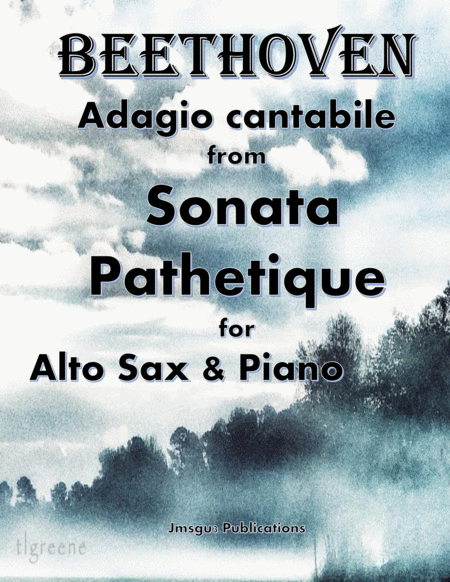
Beethoven: Adagio from Sonata Pathetique for Alto Sax & Piano
Saxophone Alto et Piano

$24.95 21.15 € Saxophone Alto et Piano PDF SheetMusicPlus

Alto Saxophone,Piano - Level 5 - Digital Download SKU: A0.1048927 Composed by An-lun Huang. 20th Century,Contemporary,Multicultural,Traditional,World. Score and part. 25 pages. DoReMi Edition #653319. Published by DoReMi Edition (A0.1048927). Chinese Rhapsody No.3 was composed e in Toronto, Canada , 1988. Huang dedicated the piece to the Canadian Saxophonist Paul Brodie who premiered it in Parry sound of Ontario in the same year. Written in Saibei Folk Style, the music is divided into 5 movements without stop. As usual, Huang didn‘t use any folk song . But the typical taste of Huang’s “Zhang Jia Kou[張家å£] accent†is pretty easy to be identified. With the concert virtuosity, the 1st movement is composed as an emotional Cadenza which expresses the profound affections to the land of Saibei. Using the same Alto Sax., the lyric 2nd movement is followed by a folk dance, the 3rd movement. Chang to a Soprano Saxophone, the 4th movement is sound like a dreamy nocturne which is interrupted by the percussions of the fiery 5th movement. The whole Rhapsody ends on a climax of the Chinese Northern west “wind and percussion “styleâ€. Brodie found more than 300 trills in this piece. Perhaps this is the key to perform the music in real Chinese style. Huang has composed 5 versions of these pieces for different ensembles: saxophone solo with piano, or strings, or winds/brasses, or Chinese traditional orchestra, or symphony orchestra. The attached mp3 was performed by the German saxophonist Jurgen Demmler with pianist Peter Grabinger in 1996. Duration: 20’.
CHINESE RHAPSODY No.3 For Saxophone and Piano, Op.46 (1988) [Piano score]
Saxophone Alto et Piano

$19.99 16.95 € Saxophone Alto et Piano PDF SheetMusicPlus

Alto Saxophone,Piano - Level 3 - Digital Download SKU: A0.533505 Composed by Ali Ben Sou Alle. Concert,Romantic Period,Standards. Score and part. 21 pages. Musik Fabrik Music Publishing #3001087. Published by Musik Fabrik Music Publishing (A0.533505). The concert waltz Adieu begins with an introduction in the style of a Bel Canto aria. The Valse which follows is divided into several sections of contrasting styles and tonalites. The coda brings the piece to a calm and quiet close which is broken by a final fortissimo outburst.One of the most enigmatic figures in the history of the Saxophone, Ali Ben Sou Alle (Charles-Valentin Soualle) was born in 1820 in Arras, France. After receiving his first prize in Clarinet at the Paris Conservatory in 1844. he served as the director of music of The French Marine Band in Senegal, and then was named first clarinet solo at the Opéra-Comique in Paris. However, after the Revolution of 1848, Soualle was forced to flee France to England where he settled in London, playing in the Orchestra of the Queen's Theatre. His songs and piano pieces were published in London. While in London, Soualle met another exiled French musician, Louis Antoine Jullien, who conducted a light music series in London. Jullien encouraged Soualle to take up the saxophone, and after modifying the instrument by adding a single octave mechanism (the modern system used today) and keys for the lower register, Soualle became known as a virtuoso and began touring performing solo recitals (or mono-concerts, as they were called at the time) calling his modified saxophone the «turcophone ». He performed in all the European capitals and then traveled to Australia, New Zealand, Manilla, Java, through China and then to India where he finally settled in Mysore, becoming the director of the Royal Music for the Maharadjah. It was during this period that heconverted to Islam and changed his nmae to Ali ben Sou Alle (or Ali, son of Soualle). He subsequently travaled to Ile Maurice, to French Polynesia, the Cap of Natal and the Cap of Good Hope. All of these voyages were subjects of musical works which Soualle entitled Souvenirs de... and may perhaps have been part of a collection known as The Royal Album which was presented to the Prince of Wales after a royal concert. Soualle returned to Mysore in 1858 and was almost killed in the Indian Revolution. Around 1860, Soualle returned to France for health reasons and began publishing his own music. On March 27 1865, he performed a command performance for the Emperor Napoleon III at the Tuileries Palace in the presence of the entire Imperial Family. After 1865, nothing more is known about him.
Ali Ben Sou Alle: Adieu, Valse de Concert for alto saxophone and piano
Saxophone Alto et Piano

$12.95 10.98 € Saxophone Alto et Piano PDF SheetMusicPlus

Alto Saxophone,Piano - Level 4 - Digital Download SKU: A0.533503 Composed by Ali Ben Sou Alle. Arranged by Paul Wehage. Concert,Romantic Period,Standards. Score and part. 32 pages. Musik Fabrik Music Publishing #3001081. Published by Musik Fabrik Music Publishing (A0.533503). Bade was the name of an independant Duchy which bordered France and Switzerland which existed until the Second World War. The name Bade is derived from the town of Baden-Baden. The work is divided into four sections: an introduction and Aria, and a sert of two variations on an unidentified theme which is probably a folktune from the region, a Gaellic Romance and a final Valse Brillante. The work was originally written for the clarinet, but a transcription for the alto saxophone has been made to allow saxophonistes to perform the entire cycle of Souvenirs de pieces.
Ali Ben Sou Alle: Souvenirs de Bade for alto saxophone and piano
Saxophone Alto et Piano

$19.95 16.92 € Saxophone Alto et Piano PDF SheetMusicPlus

Alto Saxophone, Piano - Grade 1 - Digital Download SKU: FX.FX071553 Composed by Alain Lopez. Classical, Educational. Score and Set of Parts. FLEX Editions - Digital Sheet Music #FX071553. Published by FLEX Editions - Digital Sheet Music (FX.FX071553). Latin music divided into three parts of 32 mes. each: the first is for students with 1-2 years of experience (only long values and small chromatisms are used), the second is for those who have 2 or 3 (add dotted quarter / eighth notes and intervals of fourths), the third is for those at the end of the first cycle (flow from eighth in addition). This piece can follow the students for three years and / or allow 3 students with different levels to play together.
Quartes en Couleurs
Saxophone Alto et Piano

$8.95 7.59 € Saxophone Alto et Piano PDF SheetMusicPlus


Partitions Gratuites
Acheter des Partitions Musicales
Acheter des Partitions Digitales à Imprimer
Acheter des Instruments de Musique

© 2000 - 2026

Accueil - Version intégrale





