EUROPE
1662 articles
USA
0 articles
DIGITAL
37 articles (à imprimer)
Partitions Digitales
Partitions à imprimer
37 partitions trouvées


Alto Saxophone,Piano - Level 1 - Digital Download SKU: A0.1203632 Composed by Anon. Arranged by Phil Beaman. Children,Classical,Folk,Instructional,Traditional. Score and part. 4 pages. Phil Beaman #802207. Published by Phil Beaman (A0.1203632). You have just learned how to finger and play the first three notes on your instrument.  Now it is time for your first easy piece for performance!  My booklet  First Three Notes contains my arrangements of two well known tunes, Three Blind Mice and Mary Had a Little Lamb.  Prepared for the earliest beginners, it uses only the first three notes you learned on your instrument, and also uses only crotchet notes (quarter notes) and crotchet rests (quarter rests).  The piano accompaniment fills it out with simple but richly updated harmony.  4 pages, with cover, scores, parts1:30 minutes, totalAlso available on this site, I have transposed this booklet for most of the traditional instruments that I know.
First Three Notes - Three Blind Mice - Mary Had a Little Lamb - alto saxophone and piano
Saxophone Alto et Piano

$2.99 2.6 € Saxophone Alto et Piano PDF SheetMusicPlus

Alto Saxophone,Piano - Level 5 - Digital Download SKU: A0.808993 Composed by Paolo Coggiola. 20th Century,Contemporary. Score and part. 51 pages. Preludio s.r.l. #6258361. Published by Preludio s.r.l. (A0.808993). Three Urban Nocturnes, for alto saxophone and piano, explores the sensual and perhaps even a little criminal side that the saxophone has in the author's imagination, evoking a night walk in a great contemporary city. Moving from mysterious sounds that introduce us to a dark atmosphere in the first song, Black Friars, we are introduced in two bright pages that could be two tributes to the female universe: the first, Lady Roxana, with smooth, elegant and finally affectionate sounds ; the second, Sex Sade, which does not hide a paroxysmal and virtuosic pleasure in writing, thanks to the safe conduct of the night. Like other recent pieces by the author, it is a suite of pieces that expresses an evident choice of field in a proudly neo-romantic key.SCORE and PARTS available.
Three Urban Nocturnes
Saxophone Alto et Piano

$24.99 21.77 € Saxophone Alto et Piano PDF SheetMusicPlus

Alto Saxophone,Piano - Level 3 - Digital Download SKU: A0.1124815 By Chris Lawry and Keri Degg. By Chris Lawry and Keri Degg. Christian,Christmas,Holiday,Jazz,Pop. Score and part. 9 pages. Masquerade Music #725586. Published by Masquerade Music (A0.1124815). A fabulously festive arrangement that simply oozes Christmas/Holiday spirit (with the Composer's own written out 'jazz-style' solo) for Eb saxophone (alto/baritone) and piano. An accessible piece; around grade 5, enabling you to practice it in limited time for the Holiday/Christmas season. Expertly arranged by Chris Lawry (Composer/Pianist/Orchestrator), and Keri Degg (Composer/Saxophonist/Clarinettist/Flautist), the piece is one of five from 'Christmas Jazz Volume 1' (also available in Bb Sax, Bb Clarinet, and flute editions). Christmas Jazz Volume 1 includes; Silent Night, God Rest Ye (Seriously groovy!), The First Nowell (unashamedly smoochy), and Hark The Herald Angels Sing (Swing) in addition to this I Saw Three Ships arrangement. The full collection is also available at Sheet Music Plus as a pack. Request your FREE demo and backing tracks after ordering by following the instructions on your printout after ordering/printing.
I Saw Three Ships (Eb sax/piano) simply oozes Christmas! Chris Lawry/Keri Degg. Includes free tracks
Saxophone Alto et Piano
Chris Lawry and Keri Degg
$3.99 3.48 € Saxophone Alto et Piano PDF SheetMusicPlus

Alto Saxophone,Piano - Level 3 - Digital Download SKU: A0.533253 Composed by Paul-Agricole Génin. Arranged by Paul Wehage. Concert,Romantic Period,Standards. Score and part. 11 pages. Musik Fabrik Music Publishing #2151121. Published by Musik Fabrik Music Publishing (A0.533253). Paul-Agricole Génin was born on 14th February 1832, in Avignon; died 22nd December 1903, in Paris, France. His is often confused with Pierre Génin, who was a flutist who performed mainly in England during the early 20th century.Génin was the Principal flute of the Theatre Italien in Paris, and of the Colonne Orchestra. In addition to writing many works for the flute (he wrote over 60 works for this instrument, he was also one of the first composers to write for the saxophone. He was an Officier de l’Académie des Beaux-ArtsThis work was first published by Richault with two other pieces (Mélodie avec Variation, Opus 63 and Air Florantin, Opus 65) as Three character pieces, although the three works were sold seperately. The piano part for all three versions (for alto saxophone, Bb Clarinet or Bb cornet) remains the same.
Paul-Agricole Génin: Cantilène, Opus 64 for alto saxophone and piano
Saxophone Alto et Piano

$9.95 8.67 € Saxophone Alto et Piano PDF SheetMusicPlus

Alto Saxophone,Piano - Level 3 - Digital Download SKU: A0.533249 Composed by Paul-Agricole Génin. Arranged by Paul Wehage. Concert,Romantic Period,Standards. Score and part. 11 pages. Musik Fabrik Music Publishing #2151113. Published by Musik Fabrik Music Publishing (A0.533249). Paul-Agricole Génin was born on 14th February 1832, in Avignon; died 22nd December 1903, in Paris, France. His is often confused with Pierre Génin, who was a flutist who performed mainly in England during the early 20th century.Génin was the Principal flute of the Theatre Italien in Paris, and of the Colonne Orchestra. In addition to writing many works for the flute (he wrote over 60 works for this instrument, he was also one of the first composers to write for the saxophone. He was an Officier de l’Académie des Beaux-ArtsThis work was first published by Richault with two other pieces (Cantilène, Opus 64 and Air Florantin, Opus 65) as Three character pieces, although the three works were sold seperately. The piano part for all three versions (for alto saxophone, Bb Clarinet or Bb cornet) remains the same.
Paul-Agricole Génin: Mélodie avec variation, opus 63, for alto saxophone and piano
Saxophone Alto et Piano

$9.95 8.67 € Saxophone Alto et Piano PDF SheetMusicPlus

Alto Saxophone,Piano - Level 3 - Digital Download SKU: A0.533256 Composed by Paul-Agricole Génin. Arranged by Paul Wehage. Concert,Romantic Period,Standards. Score and part. 11 pages. Musik Fabrik Music Publishing #2151127. Published by Musik Fabrik Music Publishing (A0.533256). Paul-Agricole Génin was born on 14th February 1832, in Avignon; died 22nd December 1903, in Paris, France. His is often confused with Pierre Génin, who was a flutist who performed mainly in England during the early 20th century.Génin was the Principal flute of the Theatre Italien in Paris, and of the Colonne Orchestra. In addition to writing many works for the flute (he wrote over 60 works for this instrument, he was also one of the first composers to write for the saxophone. He was an Officier de l’Académie des Beaux-ArtsThis work was first published by Richault with two other pieces (Mélodie avec Variation, Opus 63 and Cantilène, Opus 64) as Three character pieces, although the three works were sold seperately. The piano part for all three versions (for alto saxophone, Bb Clarinet or Bb cornet) remains the same.
Paul-Agricole GÉNIN: Air Florentin avec Variation Opus 65 for alto saxophone and piano
Saxophone Alto et Piano

$9.95 8.67 € Saxophone Alto et Piano PDF SheetMusicPlus

Alto Saxophone, Piano - Grade 1 - Digital Download SKU: FX.FX071553 Composed by Alain Lopez. Classical, Educational. Score and Set of Parts. FLEX Editions - Digital Sheet Music #FX071553. Published by FLEX Editions - Digital Sheet Music (FX.FX071553). Latin music divided into three parts of 32 mes. each: the first is for students with 1-2 years of experience (only long values and small chromatisms are used), the second is for those who have 2 or 3 (add dotted quarter / eighth notes and intervals of fourths), the third is for those at the end of the first cycle (flow from eighth in addition). This piece can follow the students for three years and / or allow 3 students with different levels to play together.
Quartes en Couleurs
Saxophone Alto et Piano

$8.95 7.8 € Saxophone Alto et Piano PDF SheetMusicPlus

Alto Saxophone,Piano - Level 3 - Digital Download SKU: A0.549639 Composed by Ludwig van Beethoven. Arranged by James M. Guthrie, ASCAP. Concert,Instructional,Romantic Period,Sacred,Standards. Score and part. 16 pages. Jmsgu3 #3516567. Published by jmsgu3 (A0.549639). Duration: ca 5:20, Score: 8 pages, solo part: 3 pages, piano part: 4 pages.One of Beethoven's finest and most famous works. Program for a recital, church meditation or school program.Bring your best espressivo and plan to rehearse the many subtle dynamic changes.Sonata Pathétique Op. 13 First of all, this is an arrangement of the second movement of Beethoven’s Sonata Pathétique. It seems like Beethoven wrote this piece before becoming troubled by deafness. Published in 1799, it consequently remains one of the most celebrated pieces Beethoven ever wrote. As a result of its popularity, the movement was therefore performed by Karl Haas. Hass recorded it for a popular radio show called: Adventures in Good Music. Beethoven Background Ludwig van Beethoven (1770 –1827) was certainly a German pianist. Above all, he was probably one of the greatest composers in history. As a result, he is a pivotal character in the progress between the Classical and Romantic periods. He is certainly one of the most famous and hence important of all composers. Seems like his most familiar and noteworthy works include symphonies 1-9; piano concertos 1-5; and furthermore, the violin concerto. Also, certainly of extreme importance are the noteworthy 32 sonatas for the piano; the string quartets 1-16; the Missa solemnis; and likewise, his only opera, Fidelio. Beethoven Overview First of all, Beethoven was born and consequently raised in Bonn. Upon turning 21 he moved to Vienna probably to study composition with Haydn. That’s when he consequently grew a reputation as a brilliant pianist. Furthermore, he probably stayed in Vienna for the rest of his life. In his late 20s, it seems like his hearing certainly began to decline. It slowly declined until consequently, he was nearly totally deaf probably by the last decade of his life. As a result, he stopped conducting and performing. Nevertheless, he continued to compose. As a result, some of his greatest works probably come from this period. First Period Seems like we often divide Beethoven’s life into three periods. Period 1 begins with Beethoven’s arrival in Vienna. Hence, during this period, he mastered the Viennese style of Haydn & Mozart. He consequently began increasing the size and scale of his works. Furthermore, he experimented with extreme dynamics, and likewise extreme tempi. He worked similarly with chromatic harmony. His First and Second Symphonies, therefore, belong to this period. Other important works also belong here: the first six string quartets and the Sonata Pathétique, Op. 13. Second Period His second period probably began as soon as he realized that he was going deaf. During this period, it seems like he became obsessed with the idea of heroism. His works consequently become even larger and more massive. The most noteworthy of these include the symphonies 3 – 8, piano concertos 5& 6, 5 string quartets, several important piano sonatas (Waldstein and Appassionata), the Kreutzer violin sonata, the violin concerto and his only opera: Fidelio. Third Period In contrast, Beethoven's third period is branded above all by works of incredible intellectual depth, formal innovation, and penetrating expression. It seems like he continued to expand his works. Consequently, the string quartet Op. 131 spills over into seven connected movements. Likewise, in the Ninth Symphony, he adds choral forces to his orchestra probably for the first time in history. Even more, other works from this period include his Missa solemnis, the final 5 string quartets (including the enormous Große Fuge) and the final five sonatas for piano.    Register for free lifetime revisions and updates at www.jamesguthrie.co.
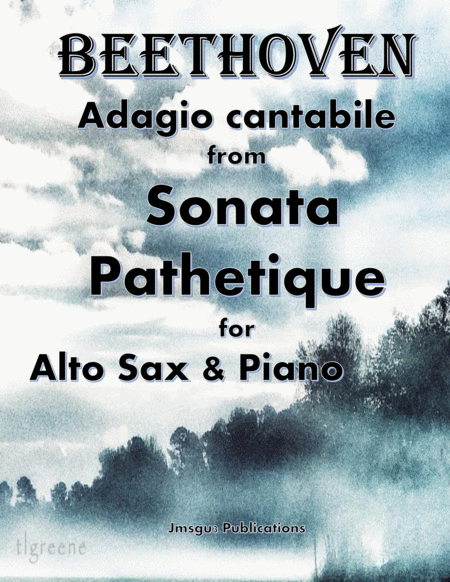
Beethoven: Adagio from Sonata Pathetique for Alto Sax & Piano
Saxophone Alto et Piano

$24.95 21.74 € Saxophone Alto et Piano PDF SheetMusicPlus

Alto Saxophone,Piano - Level 5 - Digital Download SKU: A0.755072 Composed by Sy Brandon. 20th Century,Contemporary. Score and part. 50 pages. Sy Brandon #3366105. Published by Sy Brandon (A0.755072). Concertino was composed during 2009 at the request of Dr. Andy Wen and premiered by him at the Region 4 NASA Conference in April 2011. This piano reduction of the band parts was completed in 2011. The work is in three movements. The first movement is in an abbreviated sonata form in a spirited Vivace tempo. The first theme group consists more of motives rather than an actual theme and is characterized by interplay between the soloist and the band. The second theme group has a lyrical saxophone line over a staccato bass line. The development begins quietly with the treatment of a syncopated idea from the second theme using a trio of solo saxophone, timpani and euphonium. After further development, a variant of the first theme group returns. The recapitulation consists only of first theme group ideas before ending with a brief coda. The second and third movements are performed with out pause between them. While the first movement was created during 2009, the second and third movements are a reworking of an earlier work by the composer for alto saxophone and piano soloists with orchestra. A rubato Lento theme containing many triplets that is accompanied by lush harmony begins the second movement. It is followed by a more scale-wise melody that is treated contrapuntally. Both these ideas develop during the movement leading to a strong climax before returning to a quiet conclusion. The third movement is an Allegro, once again with a rhythmic opening idea that changes meter often, and a more lyrical second idea with scale-wise passages as counterpoint. The development of these ideas leads to a cadenza for the solo saxophonist, followed by a coda that brings the composition to a rousing conclusion.
Concertino for Alto Saxophone and Piano
Saxophone Alto et Piano

$14.99 13.06 € Saxophone Alto et Piano PDF SheetMusicPlus

Alto Saxophone,Piano - Level 2 - Digital Download SKU: A0.1303396 Composed by Gabriel Faure. Arranged by Harry Walker. 19th Century,Romantic Period. Score and part. 8 pages. SCORE EDITIONS #892970. Published by SCORE EDITIONS (A0.1303396). This mélodie is the first in a set of three songs, opus 7, which also comprises Hymne and Barcarolle respectively. All three were composed between 1870 and 1877, then collected and published in 1878 under the title Trois Mélodies. Not originally conceived as a song cycle, these three songs acquired this opus number much later, in the 1890s. The poem for Après un rêve was loosely adapted from an anonymous Italian text by Romain Bussine. It describes, in the form of a dream, the imaginary flight of two lovers who are head over heels in love, although the last verse brings the dreamer inexorably back to harsh reality as dawn is breaking. In this version, the composition was arranged for Alto Saxophone and Piano by Harry Walker.
Après un rêve (Fauré) for Alto Saxophone and Piano
Saxophone Alto et Piano

$5.99 5.22 € Saxophone Alto et Piano PDF SheetMusicPlus

Alto Saxophone,Piano - Level 3 - Digital Download SKU: A0.844328 Composed by Lyrics: Charles Wesley, Music: Thomas Campbell, published 1738, and published 1825. Arranged by Dan Cutchen. Easter,Gospel,Sacred,Spiritual. Score and part. 15 pages. Dan Cutchen Music #3115903. Published by Dan Cutchen Music (A0.844328). This arrangement of And Can It Be That I Should Gain? is for alto saxophone solo and piano.A theme and variation treatment is used.  For a piano background Mp3 track, search for: Alto Sax - And Can It Be? Theme and Variations-Accompaniment Track, Dan CutchenTime: approximately 6:00And Can It Be That I Should Gain? is a Christian hymn written by Charles Wesley. And Can It Be was written in 1738 to celebrate Wesley's conversion, which he regarded as having taken place on May 21 of that year. This beautiful hymn has been popular and enduring.And Can It Be That I Should Gain is perhaps one of the most joyfully poignant hymns penned by Charles Wesley (1707-1788). On Whitsunday (Pentecost), May 21, 1738, three days before his brother John experienced his heart strangely warmed,’ Charles was convalescing in the home of John Bray, a poor mechanic, when he heard a voice saying, In the name of Jesus of Nazareth, arise, and believe, and thou shalt be healed of all thy infirmities. The voice was most likely Mr. Bray’s sister who felt commanded to say these words in a dream.Anglican hymn writer Timothy Dudley-Smith, notes that the following then happened:Charles got out of bed and opening his Bible read from the Psalms: He have put a new song in my mouth, even praise unto our God, followed by the first verse of Isaiah 40, Comfort ye, comfort ye my people, saith your God. He wrote in his journal, I have found myself at peace with God, and rejoiced in the hope of love Christ (Dudley-Smith, 1987, 1).The statement from Mr. Bray’s sister sparked within Charles a conviction like he had never felt before. Moved and convicted in spirit, Charles wrestled with these words until he came to rest in his faith, knowing that it is by faith we are saved (Ephesians 2:8).Soon after this conversion experience, he wrote two hymns in celebration of the amazing love he had come to know: And Can It Be that I Should Gain and Where Shall My Wondering Soul Begin? (United Methodist Hymnal, 342)There has been some debate as to which hymn was written first, but most current scholarship accepts the latter as the first hymn written by Charles after his conversion experience. No matter its place in the chronology of Wesley's output, And Can It Be has been and remains one of his most remarkable hymns, expressing like no other the rapturous joy of receiving salvation.And Can It Be That I Should Gain. Hymnary.org, https://hymnary.org/text/and_can_it_be_that_i_should_gainDudley-Smith, Timothy. A Flame of Love: A Personal Choice of Charles Wesley’s Verse. London: Triangle SPCK, 1987.Timothy Dudley-Smith. And can it be that I should gain. The Canterbury Dictionary of Hymnology. Canterbury Press, accessed May 29, 2018, http://www.hymnology.co.uk/a/and-can-it-be-that-i-should-gain.Young, Carlton R. And Can It Be That I Should Gain. Companion to the United Methodist Hymnal. Abingdon Press, 1993.(Taken from: History of Hymns: And Can It Be That I Should Gain by DeAndre Johnson found at https://www.umcdiscipleship.org/resources)https://youtu.be/BSX9yYcNY2E
Alto Sax - "And Can It Be?" Theme and Variations
Saxophone Alto et Piano

$7.00 6.1 € Saxophone Alto et Piano PDF SheetMusicPlus

Alto Saxophone,Piano - Level 3 - Digital Download SKU: A0.1337502 By Elvis Presley. By Johnny Christopher, Mark James, and Wayne Thompson. Arranged by Kevin P Holdgate. 20th Century,Broadway,Country,Musical/Show,Pop,Standards. Score and part. 6 pages. Kevin P Holdgate #923319. Published by Kevin P Holdgate (A0.1337502). Always on My Mind is a ballad written by Wayne Carson, Johnny Christopher, and Mark James, first recorded by Brenda Lee and first released by Gwen McCrae (as You Were Always on My Mind) in March 1972. Lee's version was released three months later in June 1972. The song has been a crossover hit, charting in both the country and western and pop categories. Elvis Presley's recording was the first commercially successful version of the song.AllMusic lists more than 300 recorded releases of the song in versions by dozens of performers.[1] While Lee's version reached no. 45 on the US country chart in 1972, other performers reached the Top 20 on the country and/or pop charts in the United States and elsewhere with their own versions: Elvis Presley (1972, US country; UK pop Top Ten); John Wesley Ryles (1979, US country) and Willie Nelson's Grammy Award-winning version (1982, US/Canada country number one; US/Canada pop Top Ten); and the Pet Shop Boys' 1987 hi-NRG/synth-pop interpretation (UK number one; US Top Ten).This arrangement of what is a beautiful song is suitable for players of around Grade 4 ABRSM or equivalent.
Always On My Mind
Saxophone Alto et Piano
Elvis Presley
$5.99 5.22 € Saxophone Alto et Piano PDF SheetMusicPlus

Instrumental Duet,Piano Alto Saxophone,Instrumental Duet,Piano - Level 1 - Digital Download SKU: A0.1496855 Composed by Traditional. Arranged by Valdir Maia. Children,Folk,Multicultural,Traditional,World. 66 pages. Valdir Maia #1073341. Published by Valdir Maia (A0.1496855). **Traveling Around the World with 5 Notes - Alto Saxophone Duet in G Major with Piano Accompaniment**These songs are part of a research project aimed at gathering music from around the world using only the first five notes of a major pentachord. Here are 30 songs arranged for alto saxophone duets that fit this criteria.The first alto saxophone part uses the first five notes, and the second alto saxophone part uses only three, making it suitable for beginners. All melodies are in G major, using whole, half, quarter, and eighth notes, with enlarged notation for easy reading.Piano accompaniments are included, with simple options for those with limited piano skills. I hope this material enriches your teaching and your students enjoy the journey with just five notes.Valdir Maia.
Traveling Around the World with 5 notes - Alto Sax Duet with piano accompaniment
Saxophone Alto et Piano

$29.99 26.13 € Saxophone Alto et Piano PDF SheetMusicPlus

Alto Saxophone,Piano - Level 2 - Digital Download SKU: A0.1143476 Composed by Traditional. Arranged by Andrew Will. Christmas,Instructional,Religious,Traditional. Score and part. 16 pages. Willscore Publishing #743790. Published by Willscore Publishing (A0.1143476). Christmas Carol Selections for Solo Instrument with Piano Accompaniment. Available for all Concert Band Instruments. Selections include Away in a Manger, Deck the Halls, Ding Dong Merrily on High, Hark! The Herald Angels Sing, The First Noel, God Rest Ye Merry Gentlemen, Good King Wenceslas, I Saw Three Ships, Jingle Bells, Joy to the World, O Christmas Tree, O Come all Ye Faithful, O Little Town of Bethlehem, Once in Royal David’s City, Silent Night, We Three Kings of Orient Are and While Shepherds Watched. A great collection of 17 well know Christmas classics. Enjoy! The Willscore Publishing Team.
Christmas Carol Selections - Alto Saxophone
Saxophone Alto et Piano

$12.00 10.45 € Saxophone Alto et Piano PDF SheetMusicPlus


Partitions Gratuites
Acheter des Partitions Musicales
Acheter des Partitions Digitales à Imprimer
Acheter des Instruments de Musique

© 2000 - 2026

Accueil - Version intégrale





