EUROPE
3889 articles
USA
2 articles
DIGITAL
12 articles (à imprimer)
Partitions Digitales
Partitions à imprimer
12 partitions trouvées


Alto Saxophone,Piano - Level 4 - Digital Download SKU: A0.534527 Composed by Jean-Thierry Boisseau. 20th Century,Concert,Contemporary,Standards,World. Score and part. 27 pages. Musik Fabrik Music Publishing #3604007. Published by Musik Fabrik Music Publishing (A0.534527). It was in the process of preparing the publication of the works of Demersseman and of Ali Ben Sou Alle that suggested to me the idea of the typical 19th century practice of the Fantasy and Variations on well-known themes.The saxophone lends itself perfectly for this stylistic exercise. I therefore chose to write for this instrument, which the piano supports seriously.My republican roots (in the French sense) suggested that I set several revolutionary songs from 1789. I therefore chose the emblematic “ Ah ça ira ! â€, after having seen the famous sequence of “Si Versailles l’était conté†where Piaf sings this song hanging of the grill of the Palace of Versailles, in the superbe version by Jean Françaix.I added at the end “ La Carmagnole †and the famous “ Il pleut bergère †a foreshadowing of the destiny of Marie-Antoinette who is said to have enjoyed singing this air. One will find, a bit hidden, a short citation of a work for organ by Bach.This isn’t a pastiche but rather a sort of modern update to this form in respecting its codes, its forms of this type of work which disappeared temporarily due to forced musical austerity.
Jean-Thierry Boisseau: Fantaisie Révolutionaire for alto saxophone and piano
Saxophone Alto et Piano

$16.95 14.36 € Saxophone Alto et Piano PDF SheetMusicPlus

Alto Saxophone,Piano - Level 3 - Digital Download SKU: A0.533345 Composed by Ali Ben Sou Alle. Arranged by Paul Wehage. Concert,Romantic Period,Standards. Score and part. 10 pages. Musik Fabrik Music Publishing #2348193. Published by Musik Fabrik Music Publishing (A0.533345). Ali Ben Sou Alle was born Jean-Baptiste SOUALLE in 1824 in Arras, France. He first studied the clarinet, winning a first prize in Clarinet in the class of Klosé at the Paris Conservatory. He then entered the Paris Opera orchestra, but left France in 1848 because of the revolution, fleeing to London. In 1850, he met Louis JUILLIEN, another early saxophonist, who encouraged Soualle to take up the saxophone. Soualle made several modifications to the instrument, including changes to the octave mechanism and the other keys for trills and alternative fingerings, many of which are used in modern saxophones.He named his hybrid creation the turcophone and began composing works for the instrument, which included fantasies on operatic themes, character pieces and a series of descriptive works which document several concert tours in Europe, Australia and the Orient which Soualle undertook.  Upon his return to France around 1861, after his conversion to Islam, he changed his name to Ali Ben Sou Alle. Under that name, he performe recitals for the Prince of Wales and for the Emperor Napoleon III and his family in 1865. After this date, no trace of his career has currently been uncovered and it is though that he probably died around 1867. This work is .in two large sections, the first in the form of a lyrical aria, the second a lively schezando.
Ali Ben Sou Alle: Caprice : Souvenir de la Nouvelle-Zélande for alto saxophone and piano
Saxophone Alto et Piano

$10.35 8.77 € Saxophone Alto et Piano PDF SheetMusicPlus

Alto Saxophone,Piano - Level 4 - Digital Download SKU: A0.534135 Composed by Louis Adolphe Mayeur. Arranged by Paul Wehage. Concert,Opera,Romantic Period,Standards. Score and part. 29 pages. Musik Fabrik Music Publishing #3133401. Published by Musik Fabrik Music Publishing (A0.534135). Louis Adolphe Mayeur (1837 - 1894), was a Belgium clarinetist, saxophonist, composer and conductor who spent most of his musical career in France; Entering the French Military in 1855, he was a clarinetist in the Second Régiment of the Cuirassiers (Mounted Calvary) of the Garde Impériale. A student of Klosé at the Paris Conservatory, he received his First Prize in Clarinet in 1860. One of the inner circle of Adolphe Sax (along with fellow Belgiums Jules Demersseman and Jean-Baptiste Singelée, whose “Quartet for Saxophones“ was premièred with Mayeur playing and Demersseman conducting), Mayeur took up the saxophone and was quickly engaged as the saxophone soloist in the Opera House of Brussels, La Monnaie (the Mint). Sax commissioned a number of works from Mayeur for the saxophone, which were published by his company and used in his class at the Paris Conservatory.By 1871, Mayeur was also named Saxophone Solo with the Paris Opera, performing in opears and ballets by Halévy, Meyerbeer, Thomas, Saint-Saens, Massenet,   Délibes and Paladlihe. It would appear that sometime during this period, his relations with Sax became difficult, culminating in his publications of works by Buffet-Crampon, one of Sax’s rival companies and one of the main protagonists in the series of lawsuits which led to Sax’s bankrupcy. Mayeur’s own declining health lead to his death in 1894.The Grande Fantaisie de Concert sur Rigoletto dates from 1877. The contrasting sections use motifs from arias and duets from Verdi’s opera. Florid cadenzas seperate the various sections, but those passages should be played in the manner of “bel canto†ornamentation, always lyrical and songlike.  Versions are available from Musik Fabrik for Symhony Orchestra (on rental : 2222/2000/Timp/hp/strings) and for Concert Band (for sale).  The score plus solo part for each of the versions is available for sale, as well as the individual parts for the concert band version
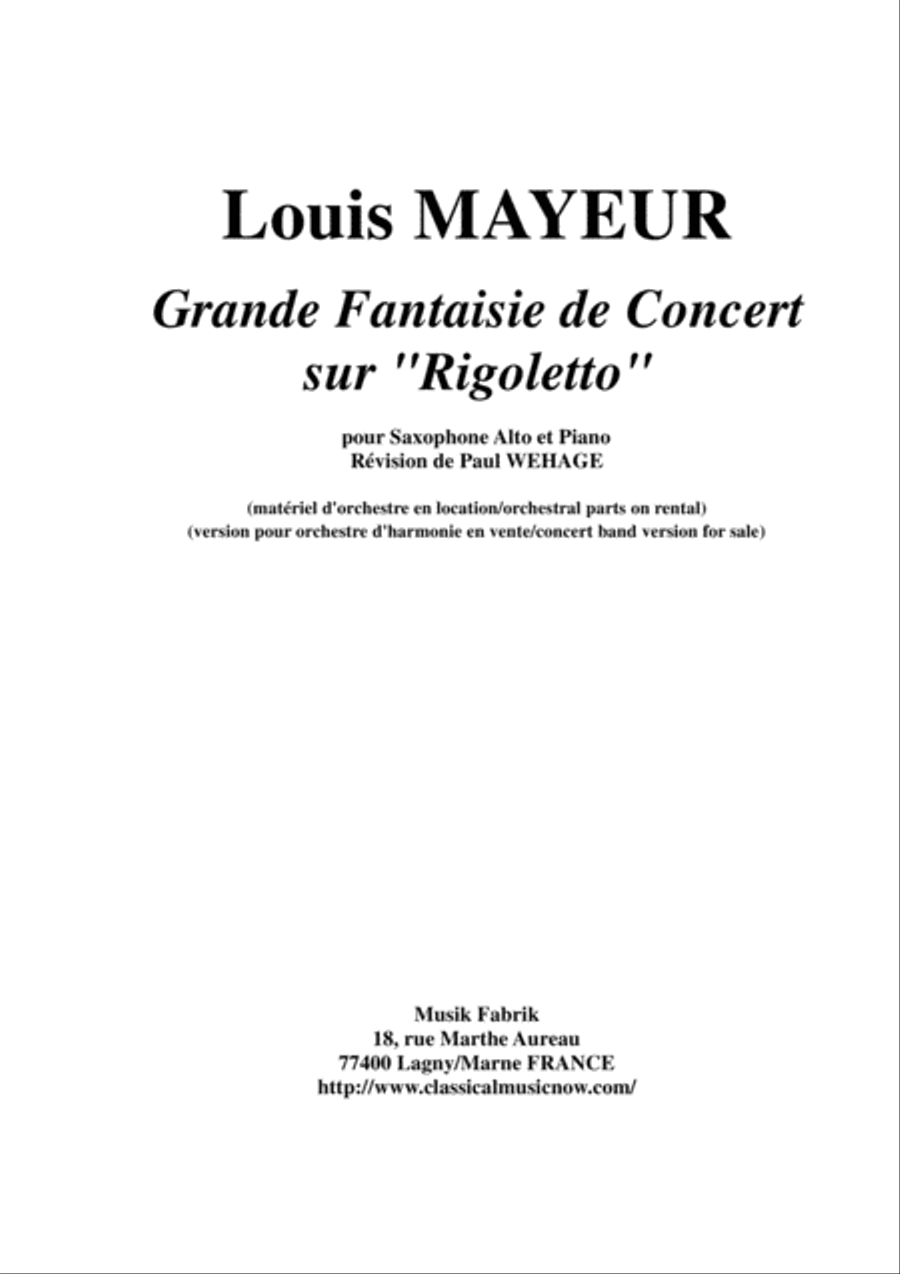
Louis Mayeur: Grande Fantaisie de Concert sur Rigoletto (de Verdi) for alto saxophone and piano
Saxophone Alto et Piano
1871, Mayeur was also named Saxophone Solo with the Paris Opera, performing in opears and ballets by Halévy, Meyerbeer, Thomas, Saint-Saens, Massenet,   Délibes and Paladlihe It would appear that sometime during this period, his relations with Sax became difficult, culminating in his publications of works by Buffet-Crampon, one of Sax’s rival companies and one of the main protagonists in the series of lawsuits which led to Sax’s bankrupcy
$16.95 14.36 € Saxophone Alto et Piano PDF SheetMusicPlus

Alto Saxophone,Piano - Level 4 - Digital Download SKU: A0.534438 Composed by Jules Demersseman. Arranged by Paul Wehage. Concert,Romantic Period,Standards. Score and part. 19 pages. Musik Fabrik Music Publishing #3493579. Published by Musik Fabrik Music Publishing (A0.534438). One of the first original compositions written for the saxophone, by one of Sax's closest associates. Jules Demersseman was born on January 9, 1833 in Hondschoote, a small town in the north of France now near the border of Belgium. He entered the Paris Conservatory in 1844 in the class of Jean-Louis Tulou and won a first prize in flute in 1845. Demersseman had a career as a pedogogue and soloist, often performing his own compositions. A close friend of Adolphe Sax, he wrote some of the first works ever written for the saxophone, as well as for the saxhorn and for Sax‘s valved trombone, most of which were published by Sax himself.. Demersseman died in Paris on December 1, 1866 at the age of 33. The work is in the form of a long lyrical episode punctuated with more florid passages which serve as counterpoint  to the main melody.. It is important to listen to vocal performances in this style, especially in performing the solo cadenzas, which (in spite of the notation) are not necessarily meant to be performed as virtuoso effects., but rather as a means of displaying expression and beautiful tone.
Jules Deersseman: Sérénade, Opus 33 for alto saxophone and piano
Saxophone Alto et Piano

$11.95 10.13 € Saxophone Alto et Piano PDF SheetMusicPlus


Partitions Gratuites
Acheter des Partitions Musicales
Acheter des Partitions Digitales à Imprimer
Acheter des Instruments de Musique

© 2000 - 2026

Accueil - Version intégrale





