EUROPE
18427 articles
USA
17 articles
DIGITAL
136 articles (à imprimer)
Partitions Digitales
Partitions à imprimer
136 partitions trouvées

1 16 31 ....136

Alto Saxophone,Piano - Level 1 - Digital Download SKU: A0.548668 Composed by Adam. Arranged by James M. Guthrie, ASCAP. Christian,Christmas. Score and part. 10 pages. Jmsgu3 #3410421. Published by jmsgu3 (A0.548668). O Holy Night arranged for alto sax & piano. Duration: 4:56, 44 ms. Score: 5 pg Part: 2 pg, piano part: 3 pg.Cantique de Noël The French composer Adolphe Adam was already famous as a composer of many successful ballets and operas. Then, in the 1840’s he wrote his most famous work - O Holy Night. The original song title was Minuit Chretiens or Cantique de Noël.  Placide Cappeau provided the original song lyrics. The song was first performed in Roquemaure by the opera singer Emily Laurey at midnight mass in 1847. It became very popular among the French, much the way that Silent Night was famous elsewhere. In the 1850’s John S. Dwight, a Unitarian minister and music teacher translated the song into English.   Adolphe Adam In his younger years, Adam studied organ and composition at the Paris Conservatoire. He also played the timpani in the Conservatoire orchestra. Adam used his savings and borrowed money to open a new opera house - the fourth opera house in Paris in 1847. Unfortunately, the Revolution of 1848 forced him to close. He taught composition at the Paris Conservatoire from 1849 until his death in 1856. Placide Cappeau The poet Cappeau was an advocate of the French Enlightenment philosopher Voltaire.  Voltaire was renowned for criticizing the Catholic church, religious intolerance, and dogma in general. Consequently, Cappeau made the Redeemer figure in his song a kind of reformer of injustices, in particular, the problem of original sin. To begin with, people recognized Cappeau’s theology as eccentric, probably even doubtful. Theology In the earlier form of Minuit, the Christ figure descends to intervene with His Father’s plan to punish mankind.  Traditional doctrine pronounces that Christ came from love, not to intervene. This version also declares that Christ appeared to expunge the original sin of Adam. Cappeau removed this part from him poem years later, because he just didn’t believe it.  He preferred to portray Christ as the reformer of disparity and unfairness. Before long, the writer/politician Alphonse de Lamartine referred to the Minuit as the the Marseillaise of religion. Most French churchmen agreed with this idea but certainly did not consider it a tribute.  Register for free lifetime updates and revisions at www.jamesguthrie.com
O Holy Night for Alto Sax & Piano
Saxophone Alto et Piano

$24.95 21.34 € Saxophone Alto et Piano PDF SheetMusicPlus

Alto Saxophone,Piano - Level 1 - Digital Download SKU: A0.548709 Composed by Martin Luther. Arranged by James M. Guthrie. Easter,Instructional,Standards. Score and part. 4 pages. Jmsgu3 #3411721. Published by jmsgu3 (A0.548709). Out of the Depths I Cry to You by Martin Luther arranged for alto sax & piano. The first verses feature modified counterpoint and harmony proceeding at quarter = 82. The final verse is reharmonized for maximum dramatic effect at a more contemplative tempo such as quarter = 64. Features the entire range of the instrument. Very powerful selection for Lent or Easter. Duration (3 verses) 3:05, 36 ms. Score: 3 pg. Solo part: 1 pg. The piano reads from the score. Out of the Depths Aus tiefer Not schrei ich zu dir (From deep affliction I cry out to you), is, of course, a hymn composed by Martin Luther. Moreover, Luther also wrote the lyrics, essentially a paraphrase of Psalm 130. First published in 1524, it is also one of eight songs in the original Lutheran hymnal. It appears likewise in many hymnals and in different translations. The lyrics furthermore stimulated compositions from the Renaissance to the contemporary. Consequently, composers such as Johann Sebastian Bach built an entire chorale cantata on it. Other composers similarly contributed pieces, such as Felix Mendelssohn and Max Reger. Luther Background Martin Luther, (1483 –1546) was a German professor of theology, composer, priest, and moreover, an influential character in the Protestant Reformation. Luther had a momentous impact on church and society due to his contributions to the musical arts. He wanted to disseminate the gospel among mankind and with this intention thought that the best way to do that was through music. Influence It is important to realize that other musicians, and their descendants, were encouraged by Luther’s songs and wrote their own hymns. Luther, to be sure, had a thorough musical education. For example, he knew secular and sacred songs from an early age. He, in particular, played the lute well and sang in the monastery when he was a monk. That is to say, music was an essential part of his life. He in fact first began writing songs in 1523, sometimes writing the melody as well as the lyrics. Luther was certainly able to evaluate the composers of his time. He thought especially highly of Josquin des and Ludwig Senfl. He was also acquainted, with this in mind, with other composers and their works. Legacy The Lutheran musical ethos soon covered all of Germany and later significantly fashioned Protestant musical culture. Heinrich Schütz and Johann Sebastian Bach are the most compelling evidence of this Protestant musical culture. Additionally, as a point often overlooked, the pedal organ, first refined in northern Germany, became universally prevalent. As a matter of fact, Dieterich Buxtehude established a regular evening organ concert series in Lübeck. Another key point is that this concert series, in turn, spread North German Musical ideas worldwide. Luther was especially convinced that music is a beautiful and exclusive offering of the divine.
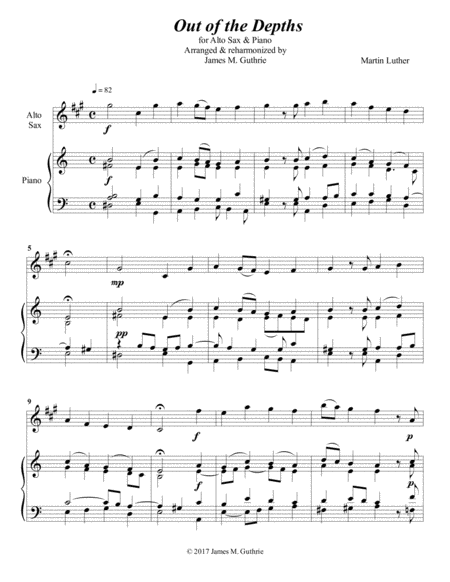
Luther: Out of the Depths for Alto Sax & Piano
Saxophone Alto et Piano

$24.95 21.34 € Saxophone Alto et Piano PDF SheetMusicPlus

Alto Saxophone,Piano - Level 4 - Digital Download SKU: A0.809188 By Glenn Martin. By Glenn Martin. Arranged by Glenn Martin. 20th Century,Instructional,Standards. Score and part. 11 pages. Cornelius edition #6304773. Published by Cornelius edition (A0.809188). Czardas composed in 1904 by Italian violinist and composer Vittorio Monti has become one of the most well know encores for the violin virtuoso to perform. Monti wrote many pieces for the violin and also a method for mandolin. This arrangement of Czardas for alto saxophone and piano will suit the aspiring and technically adventurous alto saxophone performer and with a performance time of approximately four and a half minutes the arrangement would make a useful final piece or encore for a concert or recital.   .
Monti Czardas Alto Saxophone
Saxophone Alto et Piano
Glenn Martin
$7.75 6.63 € Saxophone Alto et Piano PDF SheetMusicPlus


1 16 31 ....136


Partitions Gratuites
Acheter des Partitions Musicales
Acheter des Partitions Digitales à Imprimer
Acheter des Instruments de Musique

© 2000 - 2026

Accueil - Version intégrale





