EUROPE
8 articles
USA
0 articles
DIGITAL
27 articles (à imprimer)
Partitions Digitales
Partitions à imprimer
27 partitions trouvées


Alto Saxophone,Piano - Level 2 - Digital Download SKU: A0.549015 Composed by Franz Schubert. Arranged by James M. Guthrie, ASCAP. Holiday,Romantic Period,Sacred,Standards. Score and part. 10 pages. Jmsgu3 #3447439. Published by jmsgu3 (A0.549015). Alto Sax version of Moment Musicaux, Op. 94 (D. 780) No. 3 by Franz Schubert, published in 1828. Duration: 1:53 Score 6 pg. 54 ms. Alto Sax 1 pg. Piano part 3 pg. One of Schubert's most well-known pieces. This is an effective recital encore due to its brevity and range of expression. Could work well for a variety of occasions: wedding receptions, church services (Easter), and anniversaries. It seems like a pleasant dance, unlike some previous dance music. Schubert improvised these dances at parties for his friends.  Although conceived on-the-fly, these dances are the work of a genius. Composers have similarly elevated dance music to artistic status. As a result, they freed it from the original purpose of dancing. Certainly, the older masters used the dance forms as vehicles for complex treatments. Here, however, Schubert retains the dance-like quality while finally expressing his innermost thoughts and emotions. The dance is certainly filled with a doleful expression, yet the texture remains even more light and refined. Therefore, to perform these with sensitivity we probably need to use a light but accurate touch. The accompaniment pattern needs to be crisp and delicate – probably even in the more forceful parts. The piano pedal should also be used very carefully so as a result not to blur the outline. Instead, it should contribute to the dynamic quality of the piece. Schubert Franz Schubert (1797–1828) was, in fact, a famous Austrian composer. Moreover, he composed during the late Classical and early Romantic periods. Schubert was comparatively prolific. He wrote more than 600 secular vocal works, seven symphonies, and, correspondingly, a massive amount of piano and chamber music. Critics agree, as a matter of fact, that his most famous works include his Piano Quintet in A major, D. 667 (also known as the Trout Quintet), the Symphony No. 8 in B minor, D. 759 (Unfinished Symphony), the last sonatas for piano (D. 958–960), and the song cycles Die schöne Müllerin (D. 795) and Winterreise (D. 911). Education Schubert was furthermore a musical child prodigy. He studied violin with his father as well as piano with his older brother. In addition, when Schubert was eleven he studied at Stadtkonvikt school, where he became familiar with the orchestral music of Haydn, Mozart, and likewise Beethoven. In due time he left school and returned home where he studied to become an educator; nevertheless, he continued studying composition with Antonio Salieri. Performance Eventually, Schubert was admitted to the Gesellschaft der Musikfreunde as a performer. This appointment straightaway established his name in Vienna as a composer and pianist. Finally, he gave his only composition recital in 1828. He died suddenly a few months later probably due to typhoid fever. Legacy Schubert’s music was by and large underappreciated while he was alive. There were all in all only a few enthusiasts in Vienna. After he died, however, interest in his work in fact increased. Felix Mendelssohn, Robert Schumann, Franz Liszt, Johannes Brahms, and other famous composers in due time discovered his compositions. Nowadays, historians rank Schubert expressly among the greatest composers of the era, and his music remains in general very popular.
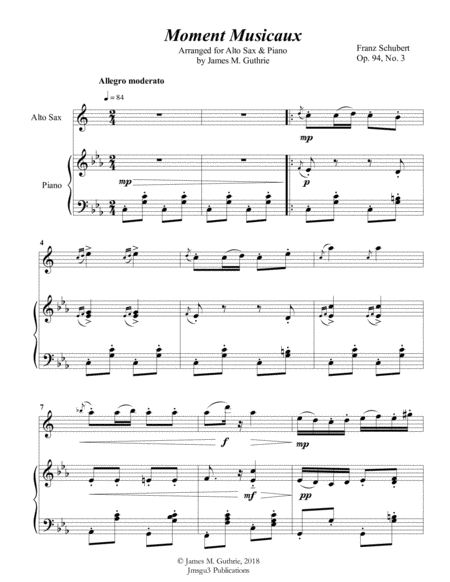
Schubert: Moment Musicaux for Alto Sax & Piano
Saxophone Alto et Piano

$32.95 28.71 € Saxophone Alto et Piano PDF SheetMusicPlus

Alto Saxophone,Piano - Level 3 - Digital Download SKU: A0.711950 Composed by Warren, Dykes. Arranged by Sandra Zylstra. Christian,Holiday,Patriotic,Sacred. Score and part. 6 pages. Sandra dee zylstra #27581. Published by sandra dee zylstra (A0.711950). God of Our Fathers and Eternal Father Strong to Save are used in this medley to convey the mighty power of God. This piece could be used as a prelude or special music on a patriotic holiday or Father's Day. Our Eternal Father is arranged as an intermediate treble Eb instrument solo with piano accompaniment and a separate instrument part. (Approximately 2 minutes, 5 pages) You can look at other arrangements by Sandra Zylstra on Sheet Music Plus: http://www.sheetmusicplus.com/formats/singles/sandra-zylstra/600092+3001855 and at Piano Pronto: Composers Community https://pianopronto.com/composers-community/sandra-zylstra/ .
Our Eternal Father (treble Eb instrument solo)
Saxophone Alto et Piano

$3.75 3.27 € Saxophone Alto et Piano PDF SheetMusicPlus

Alto Saxophone,Piano - Level 5 - Digital Download SKU: A0.549254 Composed by Nikolay Andreyevich Rimsky-Korsakov. Arranged by James M. Guthrie, ASCAP. Instructional,Romantic Period,Standards. Score and part. 15 pages. Jmsgu3 #3473685. Published by jmsgu3 (A0.549254). Flight of the Bumblebee Flight of the Bumblebee is, to be sure, an orchestral interlude composed by Nikolai Rimsky-Korsakov for his opera The Tale of Tsar Saltan. Of course, Korsakov intended to portray a bumblebee's chaotic flying pattern musically. Nowadays, this piece is one of the comparatively more famous classical works because it frequently appears occasionally in popular culture. The piece appears notably in the opera at the close of Act III, Tableau 1. This is when the magic Swan-Bird changes the Prince (the son of the Tsar) into a bee so he can fly away to visit his father. Interestingly, at this point in the drama, his father, in effect, does not know that he is alive. Korsakov Background Nikolai Rimsky-Korsakov (1844 –1908) was a uniquely famous composer from Russia. He was likewise a member of an infamous assembly of composers called The Five. Korsakov was furthermore an expert in orchestration. His correspondingly most famous orchestral compositions- Capriccio Espagnol, the Russian Easter Festival Overture, and the Scheherazade suite- are essential monuments of the standard music repertoire.  Also comparatively very important are his suites and excerpts from his 15 operas. Korsakov used Russian folklore and fairy tales, such as Scheherazade, in his music.  Nationalistic Style Like fellow outspoken composer Balakirev, Korsakov believed in creating a nationalistic, Russia-centric style of classical music. The new style was called Orientalism. It similarly relied on native Russian materials, exotic scales, and experimental harmonic, melodic, and rhythmic procedures. This practice, conversely, ran counter to the developments in Western musical culture. Musical Developments Nevertheless, Korsakov developed an appreciation of Western musical techniques after he became a professor of musical composition, harmony, and orchestration at the Saint Petersburg Conservatory in 1871. Moreover, he undertook a rigorous three-year program of self-education. He mastered Western methods, incorporating them with the influences of Mikhail Glinka and other members of The Five. His techniques of composition and orchestration were additionally enriched by his exposure to the works of Richard Wagner. Naval Service Korsakov combined his music career accordingly with a career in the Russian military. He was in the first place an officer in the Russian Navy. In due time, he was appointed a civilian Inspector of Naval Bands. As a result, Korsakov expanded his knowledge of woodwind and brass playing, which heightened his orchestration capabilities. Legacy In due time, Korsakov contributed a significant number of Russian nationalist works. He also prepared, occasionally, compositions by The Five for presentation. This brought their works straightaway into the active classical repertoire as well. He also shaped an entire generation of younger composers as a music educator. Therefore, music historians consider Korsakov the foremost engineer of what the public considers the Russian composition style. He served as a transitional figure between The Five and the classically trained composers who became the norm over time. In addition to the Russians, he influenced non-Russian composers such as Ravel, Debussy, Dukas, and Respighi.  
Korsakov: Flight of the Bumblebee for Alto Sax & Piano
Saxophone Alto et Piano

$32.95 28.71 € Saxophone Alto et Piano PDF SheetMusicPlus

Alto Saxophone,Piano - Level 5 - Digital Download SKU: A0.786557 Composed by Maltbie D. Babcock, Franklin L. Sheppard. Arranged by Beka Wilson. Celtic,Christian,Gospel,Sacred. Score and part. 8 pages. Beka Wilson #6257169. Published by Beka Wilson (A0.786557). This Celtic-style advanced instrumental solo of This Is My Father’s World is perfect for a prelude, offertory, or other special music piece for church. This arrangement is also available as a solo for flute, oboe, clarinet, bassoon, tenor sax, F horn, trumpet, trombone, violin, viola, and cello, and as a duet for harp/flute, harp/violin, harp/viola, and harp/cello. A vocal version of this arrangement will be made available soon. Length: approximately 3 minutes Key: Concert D (E for B flat instruments, B for E flat instruments, A for F instruments)8 pages (includes score and separate solo part)Want this arrangement in a different key or for a different set of instruments? Shoot me an email at bekmars10@gmail.com for a custom version of this arrangement that I can post on Sheet Music Plus for you.
This Is My Father's World--alto sax solo
Saxophone Alto et Piano

$6.99 6.09 € Saxophone Alto et Piano PDF SheetMusicPlus

Alto Saxophone,Piano - Level 3 - Digital Download SKU: A0.711956 Composed by Conrad Kocher, English Melody, and Sheppard. Arranged by Sandra Zylstra. Christian,Praise & Worship,Sacred. Score and part. 7 pages. Sandra dee zylstra #35379. Published by sandra dee zylstra (A0.711956). This medley of hymns illustrates God's beautiful world with- This is My Father's World, For the Beauty of the Earth and All Things Bright and Beautiful. God's Beautiful World is arranged as an intermediate treble Eb instrument solo with piano accompaniment and a separate instrument part. (Approximately 3 minutes, 6 pages) You can look at other arrangements by Sandra Zylstra on Sheet Music Plus: http://www.sheetmusicplus.com/formats/singles/sandra-zylstra/600092+3001855 and at Piano Pronto: Composers Community https://pianopronto.com/composers-community/sandra-zylstra/ .
God's Beautiful World Medley (treble Eb instrument solo)
Saxophone Alto et Piano

$3.75 3.27 € Saxophone Alto et Piano PDF SheetMusicPlus

Alto Saxophone,Piano - Level 4 - Digital Download SKU: A0.1493037 Composed by Clémence de Grandval. Arranged by Paul Wehage. 19th Century,Chamber,Classical,Romantic Period. Score and part. 36 pages. Musik Fabrik Music Publishing #1069727. Published by Musik Fabrik Music Publishing (A0.1493037). Maria-Félicie-Clémence de Grandval (1828–1907) was born on January 28, 1828 at Saint-Rémy-des-Monts, France and died on January 15, 1907 in Paris.After the death of her mother, Louise Adèle du Temple de Mésières, her father the Baron de Reiset, a military officer remarried with an Englishwoman and moved his family to London. After beginning her musical studies privately, she studied the piano with the German composer Friedrich von Flotow, who was a family friend. Returning to France, she studied the piano briefly with Chopin and composition with Camille Saint-Saëns, who remember their first meeting: “I was 12 when I heard the vicomtesse de Grandval for the first time, who was 18. It was at a musical morning concert at the home of the violinist de Cuvillon. She sang a song of her own composition ‚La Source, in which she accompanied herself. I was struck by the fluidity of her playing, which purely and without useless inflections, was quite close to my way of viewing music. This unified and tranquil style came out of her studies with Chopin.” Camille Saint-Saëns: Quelques mots sur l’exécution des œuvres de Chopin, in: “Le courrier musical de Paris” 13 [1910], S. 386).  At first writing mostly sacred music, most of her public success was due to her comic operas: la Comtesse Eva, la Pénitente, Piccolino and Mazeppa. She also wrote orchestral music, chamber music, and over 60 songs (to poets such as Sully Prudhomme, Michel Carré, Henri Meilhac, Georges Hartmann, Charles Grandmougin and Louis Gallet.) She is chiefly known today for her music for wind instruments, especially for the oboe.
Trois pièces : Andante, Sérénade et Chant Serbe
Saxophone Alto et Piano

$18.95 16.51 € Saxophone Alto et Piano PDF SheetMusicPlus

Alto Saxophone,Piano - Level 4 - Digital Download SKU: A0.862413 Composed by Clemence de Grandval. Arranged by Paul Wehage (editor). Classical,Contest,Festival. Score and part. 24 pages. Musik Fabrik Music Publishing #468893. Published by Musik Fabrik Music Publishing (A0.862413). Maria-Félicie-Clémence de Grandval (1828–1907) was born on January 28, 1828 at Saint- Rémy-des-Monts, France and died on January 15, 1907 in Paris.After the death of her mother, Louise Adèle du Temple de Mésières, her father the Baron de Reiset, a military officer remarried with an Englishwoman and moved his family to London. After beginning her musical studies privately, she studied the piano with the German composer Friedrich von Flotow, who was a family friend. Returning to France, she studied the piano briefly with Chopin and composition with Camille Saint-Saëns. At first writing mostly sacred music, most of her public success was due to her comic operas: la Comtesse Eva, la Pénitente, Piccolino and Mazeppa. She also wrote orchestral music, chamber music, and over 60 songs (to poets such as Sully Prudhomme, Michel Carré, Henri Meilhac, Georges Hartmann, Charles Grandmougin and Louis Gallet.) She is chiefly known today for her music for wind instruments, especially for the oboe.
Deux Pièces : Invocation et Air Slave
Saxophone Alto et Piano

$20.00 17.42 € Saxophone Alto et Piano PDF SheetMusicPlus


Partitions Gratuites
Acheter des Partitions Musicales
Acheter des Partitions Digitales à Imprimer
Acheter des Instruments de Musique

© 2000 - 2026

Accueil - Version intégrale





