EUROPE
32 articles
USA
0 articles
DIGITAL
4 articles (à imprimer)
Partitions Digitales
Partitions à imprimer
4 partitions trouvées


Alto Saxophone,Piano - Level 2 - Digital Download SKU: A0.933817 Composed by Traditional. Arranged by William Pagan-Perez. Children,Concert,Standards. Score and part. 22 pages. William Pagan-Perez #3024439. Published by William Pagan-Perez (A0.933817). Four Hispanic Children’s Songs Doña Ana (Madame Ana) El patio de mi casa (The Garden Of My House) ¡Que Llueva! (Let It Rain!) San Serení About the piece: Many times, great musicians transcribed and perform art song cycles by Brahms, Schubert, Schumann, or Rachmaninoff in order to express lyricism with their musical instruments like a singer does. Practicing and performing Four Hispanic Children’s Songs, give young music students a good opportunity to start expressing lyricism or to start playing beautiful melodic lines imitating the expressiveness of the human voice. Four Hispanic Children’s Songs can be programmed on student concerts, or solo music recitals in schools. Also, professional musician can perform Four Hispanic Children’s Songs on recitals, educative concerts or entertainment concerts programmed for children.     Four Hispanic Children’s Songs is a four movements piece based on 18th Century children songs from Spain that became parts of the Hispano American heritage. It was arranged as a song cycle, with march textures that accompany the melody to allow a better learning and rehearsing process in class.  ------------------------------------------- Sobre la pieza: En muchas ocasiones, los grandes músicos transcriben y ejecutan ciclos de canciones de artes compuestos por Brahms, Schubert, Schumann, or Rachmaninoff con la intención de expresar lirismo o tocar bellas líneas melódicas imitando la expresividad de la voz humana con sus instrumentos musicales. El practicar y tocar la música de Four Hispanic Children’s Songs (Cuatro Canciones Infantiles Hispanas) brinda a los jóvenes estudiantes de música, una buena oportunidad para comenzar a expresar lirismo o de tocar melodías expresivas como si fuera un cantante. Four Hispanic Children’s Songs puede ser programada y presentada en conciertos de estudiantes, o recitales de música solista en escuelas. También la pieza puede se ejecutada por músicos profesionales en recitales, conciertos educativos o concierto de entretenimiento programados para la niñez.  Four Hispanic Children’s Songs es una pieza con cuatro movimientos; basadas en canciones infantiles del siglo XVIII y oriundas de España, pero que fueron adoptadas dentro de las tradiciones hispanoamericanas. El arreglista utilizó texturas de marcha para acompañar las canciones, facilitar el proceso de aprendizaje y de ensayo del estudiante en el salón de clases. Note: The MP3 sound is the midi version for flute and piano.
Four Hispanic Children’s Songs for Alto Sax. in Eb and Piano
Saxophone Alto et Piano

$8.95 7.79 € Saxophone Alto et Piano PDF SheetMusicPlus

Alto Saxophone,Piano - Level 3 - Digital Download SKU: A0.844328 Composed by Lyrics: Charles Wesley, Music: Thomas Campbell, published 1738, and published 1825. Arranged by Dan Cutchen. Easter,Gospel,Sacred,Spiritual. Score and part. 15 pages. Dan Cutchen Music #3115903. Published by Dan Cutchen Music (A0.844328). This arrangement of And Can It Be That I Should Gain? is for alto saxophone solo and piano.A theme and variation treatment is used.  For a piano background Mp3 track, search for: Alto Sax - And Can It Be? Theme and Variations-Accompaniment Track, Dan CutchenTime: approximately 6:00And Can It Be That I Should Gain? is a Christian hymn written by Charles Wesley. And Can It Be was written in 1738 to celebrate Wesley's conversion, which he regarded as having taken place on May 21 of that year. This beautiful hymn has been popular and enduring.And Can It Be That I Should Gain is perhaps one of the most joyfully poignant hymns penned by Charles Wesley (1707-1788). On Whitsunday (Pentecost), May 21, 1738, three days before his brother John experienced his heart strangely warmed,’ Charles was convalescing in the home of John Bray, a poor mechanic, when he heard a voice saying, In the name of Jesus of Nazareth, arise, and believe, and thou shalt be healed of all thy infirmities. The voice was most likely Mr. Bray’s sister who felt commanded to say these words in a dream.Anglican hymn writer Timothy Dudley-Smith, notes that the following then happened:Charles got out of bed and opening his Bible read from the Psalms: He have put a new song in my mouth, even praise unto our God, followed by the first verse of Isaiah 40, Comfort ye, comfort ye my people, saith your God. He wrote in his journal, I have found myself at peace with God, and rejoiced in the hope of love Christ (Dudley-Smith, 1987, 1).The statement from Mr. Bray’s sister sparked within Charles a conviction like he had never felt before. Moved and convicted in spirit, Charles wrestled with these words until he came to rest in his faith, knowing that it is by faith we are saved (Ephesians 2:8).Soon after this conversion experience, he wrote two hymns in celebration of the amazing love he had come to know: And Can It Be that I Should Gain and Where Shall My Wondering Soul Begin? (United Methodist Hymnal, 342)There has been some debate as to which hymn was written first, but most current scholarship accepts the latter as the first hymn written by Charles after his conversion experience. No matter its place in the chronology of Wesley's output, And Can It Be has been and remains one of his most remarkable hymns, expressing like no other the rapturous joy of receiving salvation.And Can It Be That I Should Gain. Hymnary.org, https://hymnary.org/text/and_can_it_be_that_i_should_gainDudley-Smith, Timothy. A Flame of Love: A Personal Choice of Charles Wesley’s Verse. London: Triangle SPCK, 1987.Timothy Dudley-Smith. And can it be that I should gain. The Canterbury Dictionary of Hymnology. Canterbury Press, accessed May 29, 2018, http://www.hymnology.co.uk/a/and-can-it-be-that-i-should-gain.Young, Carlton R. And Can It Be That I Should Gain. Companion to the United Methodist Hymnal. Abingdon Press, 1993.(Taken from: History of Hymns: And Can It Be That I Should Gain by DeAndre Johnson found at https://www.umcdiscipleship.org/resources)https://youtu.be/BSX9yYcNY2E
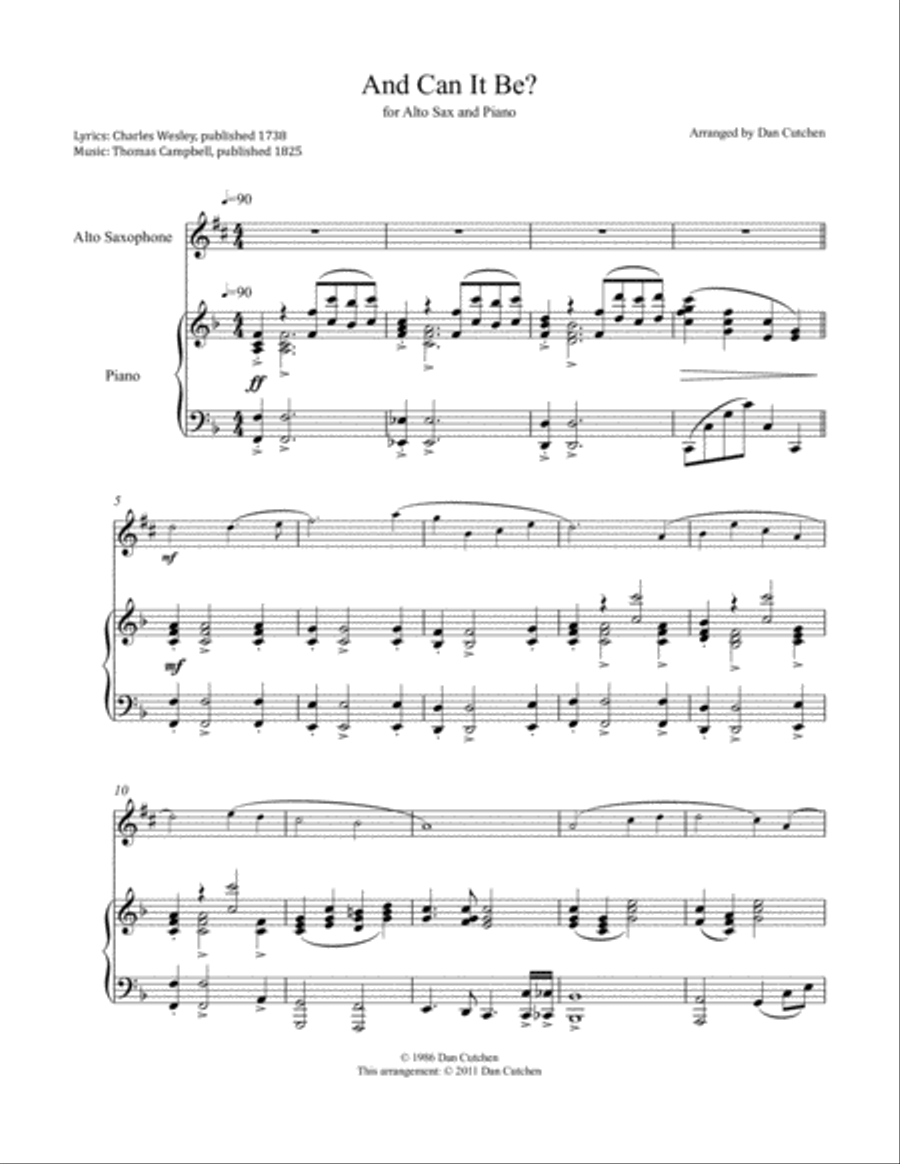
Alto Sax - "And Can It Be?" Theme and Variations
Saxophone Alto et Piano

$7.00 6.09 € Saxophone Alto et Piano PDF SheetMusicPlus

Alto Saxophone,Piano - Level 1 - Digital Download SKU: A0.548709 Composed by Martin Luther. Arranged by James M. Guthrie. Easter,Instructional,Standards. Score and part. 4 pages. Jmsgu3 #3411721. Published by jmsgu3 (A0.548709). Out of the Depths I Cry to You by Martin Luther arranged for alto sax & piano. The first verses feature modified counterpoint and harmony proceeding at quarter = 82. The final verse is reharmonized for maximum dramatic effect at a more contemplative tempo such as quarter = 64. Features the entire range of the instrument. Very powerful selection for Lent or Easter. Duration (3 verses) 3:05, 36 ms. Score: 3 pg. Solo part: 1 pg. The piano reads from the score. Out of the Depths Aus tiefer Not schrei ich zu dir (From deep affliction I cry out to you), is, of course, a hymn composed by Martin Luther. Moreover, Luther also wrote the lyrics, essentially a paraphrase of Psalm 130. First published in 1524, it is also one of eight songs in the original Lutheran hymnal. It appears likewise in many hymnals and in different translations. The lyrics furthermore stimulated compositions from the Renaissance to the contemporary. Consequently, composers such as Johann Sebastian Bach built an entire chorale cantata on it. Other composers similarly contributed pieces, such as Felix Mendelssohn and Max Reger. Luther Background Martin Luther, (1483 –1546) was a German professor of theology, composer, priest, and moreover, an influential character in the Protestant Reformation. Luther had a momentous impact on church and society due to his contributions to the musical arts. He wanted to disseminate the gospel among mankind and with this intention thought that the best way to do that was through music. Influence It is important to realize that other musicians, and their descendants, were encouraged by Luther’s songs and wrote their own hymns. Luther, to be sure, had a thorough musical education. For example, he knew secular and sacred songs from an early age. He, in particular, played the lute well and sang in the monastery when he was a monk. That is to say, music was an essential part of his life. He in fact first began writing songs in 1523, sometimes writing the melody as well as the lyrics. Luther was certainly able to evaluate the composers of his time. He thought especially highly of Josquin des and Ludwig Senfl. He was also acquainted, with this in mind, with other composers and their works. Legacy The Lutheran musical ethos soon covered all of Germany and later significantly fashioned Protestant musical culture. Heinrich Schütz and Johann Sebastian Bach are the most compelling evidence of this Protestant musical culture. Additionally, as a point often overlooked, the pedal organ, first refined in northern Germany, became universally prevalent. As a matter of fact, Dieterich Buxtehude established a regular evening organ concert series in Lübeck. Another key point is that this concert series, in turn, spread North German Musical ideas worldwide. Luther was especially convinced that music is a beautiful and exclusive offering of the divine.
Luther: Out of the Depths for Alto Sax & Piano
Saxophone Alto et Piano

$24.95 21.72 € Saxophone Alto et Piano PDF SheetMusicPlus


Partitions Gratuites
Acheter des Partitions Musicales
Acheter des Partitions Digitales à Imprimer
Acheter des Instruments de Musique

© 2000 - 2026

Accueil - Version intégrale





