EUROPE
125 articles
USA
0 articles
DIGITAL
292 articles (à imprimer)
Partitions Digitales
Partitions à imprimer
292 partitions trouvées

1 16 31 ....286

Alto Saxophone,Piano - Level 2 - Digital Download SKU: A0.549015 Composed by Franz Schubert. Arranged by James M. Guthrie, ASCAP. Holiday,Romantic Period,Sacred,Standards. Score and part. 10 pages. Jmsgu3 #3447439. Published by jmsgu3 (A0.549015). Alto Sax version of Moment Musicaux, Op. 94 (D. 780) No. 3 by Franz Schubert, published in 1828. Duration: 1:53 Score 6 pg. 54 ms. Alto Sax 1 pg. Piano part 3 pg. One of Schubert's most well-known pieces. This is an effective recital encore due to its brevity and range of expression. Could work well for a variety of occasions: wedding receptions, church services (Easter), and anniversaries. It seems like a pleasant dance, unlike some previous dance music. Schubert improvised these dances at parties for his friends.  Although conceived on-the-fly, these dances are the work of a genius. Composers have similarly elevated dance music to artistic status. As a result, they freed it from the original purpose of dancing. Certainly, the older masters used the dance forms as vehicles for complex treatments. Here, however, Schubert retains the dance-like quality while finally expressing his innermost thoughts and emotions. The dance is certainly filled with a doleful expression, yet the texture remains even more light and refined. Therefore, to perform these with sensitivity we probably need to use a light but accurate touch. The accompaniment pattern needs to be crisp and delicate – probably even in the more forceful parts. The piano pedal should also be used very carefully so as a result not to blur the outline. Instead, it should contribute to the dynamic quality of the piece. Schubert Franz Schubert (1797–1828) was, in fact, a famous Austrian composer. Moreover, he composed during the late Classical and early Romantic periods. Schubert was comparatively prolific. He wrote more than 600 secular vocal works, seven symphonies, and, correspondingly, a massive amount of piano and chamber music. Critics agree, as a matter of fact, that his most famous works include his Piano Quintet in A major, D. 667 (also known as the Trout Quintet), the Symphony No. 8 in B minor, D. 759 (Unfinished Symphony), the last sonatas for piano (D. 958–960), and the song cycles Die schöne Müllerin (D. 795) and Winterreise (D. 911). Education Schubert was furthermore a musical child prodigy. He studied violin with his father as well as piano with his older brother. In addition, when Schubert was eleven he studied at Stadtkonvikt school, where he became familiar with the orchestral music of Haydn, Mozart, and likewise Beethoven. In due time he left school and returned home where he studied to become an educator; nevertheless, he continued studying composition with Antonio Salieri. Performance Eventually, Schubert was admitted to the Gesellschaft der Musikfreunde as a performer. This appointment straightaway established his name in Vienna as a composer and pianist. Finally, he gave his only composition recital in 1828. He died suddenly a few months later probably due to typhoid fever. Legacy Schubert’s music was by and large underappreciated while he was alive. There were all in all only a few enthusiasts in Vienna. After he died, however, interest in his work in fact increased. Felix Mendelssohn, Robert Schumann, Franz Liszt, Johannes Brahms, and other famous composers in due time discovered his compositions. Nowadays, historians rank Schubert expressly among the greatest composers of the era, and his music remains in general very popular.
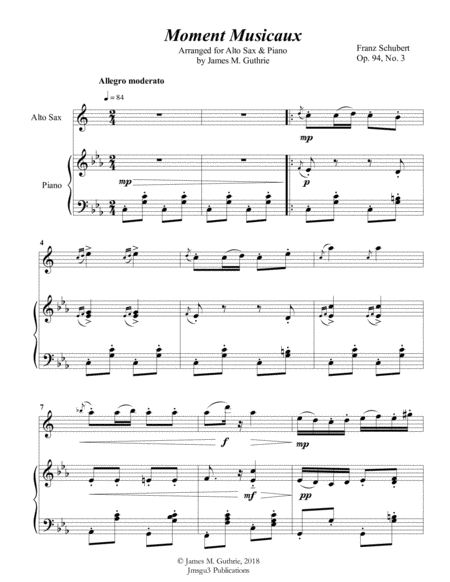
Schubert: Moment Musicaux for Alto Sax & Piano
Saxophone Alto et Piano

$32.95 28.71 € Saxophone Alto et Piano PDF SheetMusicPlus

Alto Saxophone,Piano - Level 4 - Digital Download SKU: A0.971650 Composed by Jeffrey Hoover. 20th Century,Contemporary. Score and part. 25 pages. Musicart Publications #4628067. Published by Musicart Publications (A0.971650). Ruby and Steel (duration 7 min.) is a fantasy work for alto saxophone and piano, reflecting on the physical qualities and contrasts between an unlikely pairing of materials – nature's precious gemstone ruby and the manmade material steel. The ideas of the red glow of molten steel and the red light of ruby are held in common. Establishing a modern yet Romantic atmosphere, an extended piano solo opens the work. The music is developed through a thematic transformation process: gestures of earlier music reappears as transformations of its previous selves. The interaction (both musical dialogue and subsequent agreement) between piano and saxophone is a prominent characteristic, along with ebb-and-flow of tempo. As with several other compositions by Jeffrey Hoover, there is an abstract painting–Ruby and Steel–created by Hoover as a visual interpretation of the musicJeffrey Hoover's work– music ranging from soloist to symphony orchestra –has received recognition through the prestigious Trieste prize, awards from Mu Phi Epsilon, the Lancaster Fine Arts Festival, grants, publications fellowships and more than 20 commissions. He is a member of the ACME roster of Mu Phi Epsilon, recognized for distinguished achievement as a composer. One unique aspect of Hoover’s work is when he combines composition with his paintings, creating synergetic art that intrigues and captivate audiences and performers alike. His paintings are seen in exhibitions and in concerts where his paintings are projected while musicians perform his music. Whether making interdisciplinary works, or traditional stand-alone sonic or visual art, Hoover shapes his work through inner vision and practical experience. Jeffrey Hoover’s background as a performer includes both classical and jazz music, as saxophonist and conductor. His book The Arts and Society: Making New Worlds is published by Kendall Hunt Publishing.Jeffrey Hoover was born on September 11, 1959, in Anderson, Indiana. He holds a Ph.D. in Fine Arts (Composition and Interdisciplinary Fine Arts) from Texas Tech University, as well as a M.M. and Bch.Sc. from Ball State University. His career in higher education has included both music faculty and arts administrative appointments.
Ruby and Steel (for alto saxophone and piano)
Saxophone Alto et Piano

$19.95 17.38 € Saxophone Alto et Piano PDF SheetMusicPlus

Alto Saxophone,Piano - Level 3 - Digital Download SKU: A0.533505 Composed by Ali Ben Sou Alle. Concert,Romantic Period,Standards. Score and part. 21 pages. Musik Fabrik Music Publishing #3001087. Published by Musik Fabrik Music Publishing (A0.533505). The concert waltz Adieu begins with an introduction in the style of a Bel Canto aria. The Valse which follows is divided into several sections of contrasting styles and tonalites. The coda brings the piece to a calm and quiet close which is broken by a final fortissimo outburst.One of the most enigmatic figures in the history of the Saxophone, Ali Ben Sou Alle (Charles-Valentin Soualle) was born in 1820 in Arras, France. After receiving his first prize in Clarinet at the Paris Conservatory in 1844. he served as the director of music of The French Marine Band in Senegal, and then was named first clarinet solo at the Opéra-Comique in Paris. However, after the Revolution of 1848, Soualle was forced to flee France to England where he settled in London, playing in the Orchestra of the Queen's Theatre. His songs and piano pieces were published in London. While in London, Soualle met another exiled French musician, Louis Antoine Jullien, who conducted a light music series in London. Jullien encouraged Soualle to take up the saxophone, and after modifying the instrument by adding a single octave mechanism (the modern system used today) and keys for the lower register, Soualle became known as a virtuoso and began touring performing solo recitals (or mono-concerts, as they were called at the time) calling his modified saxophone the «turcophone ». He performed in all the European capitals and then traveled to Australia, New Zealand, Manilla, Java, through China and then to India where he finally settled in Mysore, becoming the director of the Royal Music for the Maharadjah. It was during this period that heconverted to Islam and changed his nmae to Ali ben Sou Alle (or Ali, son of Soualle). He subsequently travaled to Ile Maurice, to French Polynesia, the Cap of Natal and the Cap of Good Hope. All of these voyages were subjects of musical works which Soualle entitled Souvenirs de... and may perhaps have been part of a collection known as The Royal Album which was presented to the Prince of Wales after a royal concert. Soualle returned to Mysore in 1858 and was almost killed in the Indian Revolution. Around 1860, Soualle returned to France for health reasons and began publishing his own music. On March 27 1865, he performed a command performance for the Emperor Napoleon III at the Tuileries Palace in the presence of the entire Imperial Family. After 1865, nothing more is known about him.
Ali Ben Sou Alle: Adieu, Valse de Concert for alto saxophone and piano
Saxophone Alto et Piano

$12.95 11.28 € Saxophone Alto et Piano PDF SheetMusicPlus

Alto Saxophone,Piano - Level 4 - Digital Download SKU: A0.971651 Composed by Jeffrey Hoover. 20th Century,Contemporary,World. Score and part. 57 pages. Musicart Publications #4627679. Published by Musicart Publications (A0.971651). Winner of the 2019 SMP Press Contemporary Composition award, Wu Xing - Sonata for Five Elements (5 movements, 15 min. 30 sec) was composed by Jeffrey Hoover for Yusheng Li, who initiated the first professional university saxophone degree in China.  A work for alto saxophone and piano, Wu Xing reflects a fusion of American and Chinese musical aesthetics and compositional techniques.  Each movement represents an element in the traditional Wu Xing generative cycle.  Musical elements of one movement carry into the next, in the same way these traditional Chinese elements evolve into the next: Wood, Fire, Earth, Metal, and Water.  The fourth movement, Metal, is for unaccompanied saxophone, and includes extended techniques including microtones, multiphonics, and altered tone colors.  As with other compositions by Jeffrey Hoover, Hoover has also created a series of paintings that visually interpret the music: Dancing in the Trees, The Ancient Lance, The Dragon's Creation, Temple Bells and Swords, and Life of the Earth.  In the way the music is a fusion of American and Chines techniques, the paintings incorporate the Wu Xing philosophy approach.  Images of the paintings may be projected during performance and are available directly from the composer.Jeffrey Hoover's compositions- music ranging from soloist to symphony orchestra -have received recognition through the prestigious Trieste prize, the international Luigi Russolo competition, awards from Mu Phi Epsilon, the Lancaster Fine Arts Festival, grants, publications fellowships and more than 20 commissions. He is a member of the ACME roster of Mu Phi Epsilon, recognized for distinguished achievement as a composer. One unique aspect of Hoover’s work is when he combines composition with his paintings, creating synergetic art that intrigues and captivate audiences and performers alike. His paintings are seen in exhibitions and in concerts where his paintings are projected while musicians perform his music. Hoover’s background as a performer includes both classical and jazz music, as saxophonist and conductor. His book The Arts and Society: Making New Worlds is published by Kendall Hunt Publishing.Hoover was born on September 11, 1959, in Anderson, Indiana. He holds a Ph.D. in Fine Arts (Composition and Interdisciplinary Fine Arts) from Texas Tech University, as well as  and .Sc. from Ball State University. His career in higher education has included both faculty and arts administration appointments. For more information about his compositions, availability for appearance and festivals, and commissions, please contact him through his website.https://jeffreyhooverart.wixsite.com/mysite
Wu Xing - Sonata for Five Elements (alto saxophone and piano)
Saxophone Alto et Piano

$24.95 21.74 € Saxophone Alto et Piano PDF SheetMusicPlus

Alto Saxophone,Piano - Level 3 - Digital Download SKU: A0.533347 Composed by Ali Ben Sou Alle, Wolfgang Amadeus Mozart. Arranged by Paul Wehage. Concert,Opera,Romantic Period,Standards. Score and part. 22 pages. Musik Fabrik Music Publishing #2348197. Published by Musik Fabrik Music Publishing (A0.533347). One of the most enigmatic figures in the history of the Saxophone, Ali Ben Sou Alle (Charles-Valentin Soualle) was born in 1820 in Arras, France. After receiving his first prize in Clarinet at the Paris Conservatory in 1844. he served as the director ofmusic of The French Marine Band in Senegal, and then was named first clarinet solo at the Opéra-Comique in Paris. However, after the Revolution of 1848, Soualle was forced to flee France to England where he settled in London, playing in the Orchestra of the Queen's Theatre. His songs and piano pieces were published in London. While in London, Soualle met another exiled French musician, Louis Antoine Jullien, who conducted a light music series in London. Jullien encouraged Soualle to take up the saxophone, and after modifying the instrument by adding a single octave mechanism (the modern system used today) and keys for the lower register, Soualle became known as a virtuoso and began touring performing solo recitals (or mono-concerts, as they were called at the time) calling his modified saxophone the «turcophone ». He performed in all the European capitals and then traveled to Australia, New Zealand, Manilla, Java, through China and then to India where he finally settled in Mysore, becoming the director of the Royal Music for the Maharadjah. It was during this period that he converted to Islam and changed his nmae to Ali ben Sou Alle (or Ali, son of Soualle). He subsequently travaled to Ile Maurice, to French Polynesia, the Cap of Natal and the Cap of Good Hope. All of these voyages were subjects of musical works which Soualle entitled Souvenirs de... and may perhaps have been part of a collection known as The Royal Album which was presented to the Prince of Wales after a royal concert. Soualle returned to Mysore in 1858 and was almost killed in the Indian Revolution. Around 1860, Soualle returned to France for health reasons and began publishing his own music. On March 27 1865, he performed a command performance for the Emperor Napoleon III at the Tuileries Palace in the presence of the entire Imperial Family. After 1865, nothing more is known about him. Soualle not only performed on the clarinet, saxophone and piano, but also frequently sang during his concerts. He also wrote songs while he was in London. His opera fantasies are usually written for the Alto saxophone and are generally in the form of an introductory aria with cadenza, a theme with one or more variations and then a final waltz movement in rondo form with a final brillant variation. This specific work opens with motives from the Opera‘s overture, leading to Donna Anna’s 1st act aria Or sai, chi l'onore. The duet Là ci darem la mano is the subject of two variations followed by a brief interlude using Zerlina’s aria Batti, batti, o bel Masetto and then the final section is the duo Andiam’ Andiam ‘ Mio Bene between Don Giovanni and Zerlina which ends the Act I duet. The work ends with a brillant coda
Ali Ben Sou Alle: Fantaisie sur Don Giovanni de Mozart for alto saxophone and piano
Saxophone Alto et Piano

$11.95 10.41 € Saxophone Alto et Piano PDF SheetMusicPlus

Alto Saxophone,Piano - Level 4 - Digital Download SKU: A0.533499 Composed by Ali Ben Sou Alle. Concert,Romantic Period,Standards. Score and part. 28 pages. Musik Fabrik Music Publishing #3000445. Published by Musik Fabrik Music Publishing (A0.533499). Meyerbeer’s Opera Le Prophète was one of the most influential works of the 19th century, inspiring Verdi, Wagner, Liszt and others with its dramatic score. Caprice sur Le Prophète de Meyerbeer begins with an extended Aria with several cadenzas. The work ends with a Polka in Rondo form which has a brillant variation.One of the most enigmatic figures in the history of Wind Music, Ali Ben Sou Alle (Charles-Valentin Soualle) was born in 1820 in Arras, France. After receiving his first prize in Clarinet at the Paris Conservatory in 1844. he served as the director of music of The French Marine Band in Senegal, and then was named first clarinet solo at the Opéra-Comique in Paris. However, after the Revolution of 1848, Soualle was forced to flee France to England where he settled in London, playing in the Orchestra of the Queen's Theatre. His songs and piano pieces were published in London.While in London, Soualle met another exiled French musician, Louis Antoine Jullien, who conducted a light music series in London. Jullien encouraged Soualle to take up the saxophone, and after modifying the instrument by adding a single octave mechanism (the modern system used today) and keys for the lower register, Soualle became known as a virtuoso and began touring performing solo recitals (or mono-concerts, as they were called at the time) calling his modified saxophone the «turcophone ». He performed in all the European capitals and then traveled to Australia, New Zealand, Manilla, Java, through China and then to India where he finally settled in Mysore, becoming the director of the Royal Music for the Maharadjah. It was during this period that he converted to Islam and changed his nmae to Ali ben Sou Alle (or Ali, son of Soualle). He subsequently travaled to Ile Maurice, to French Polynesia, the Cap of Natal and the Cap of Good Hope. All of these voyages were subjects of musical works which Soualle entitled Souvenirs de... and may perhaps have been part of a collectionknown as The Royal Album which was presented to the Prince of Wales after a royal concert. Soualle returned to Mysore in 1858 and was almost killed in the Indian Revolution.Around 1860, Soualle returned to France for health reasons and began publishing his own music. On March 27 1865, he performed a command performance for the Emperor Napoleon III at the Tuileries Palace in the presence of the entire Imperial Family. After 1865, nothing more is known about him.
Ali Ben Sou Alle: Fantaisie sur Robert le Diable for alto saxophone and piano
Saxophone Alto et Piano

$19.95 17.38 € Saxophone Alto et Piano PDF SheetMusicPlus

Alto Saxophone,Piano - Level 3 - Digital Download SKU: A0.533506 Composed by Ali Ben Sou Alle. Concert,Romantic Period,Standards. Score and part. 13 pages. Musik Fabrik Music Publishing #3002369. Published by Musik Fabrik Music Publishing (A0.533506). Jenny L'Ouvrière is a popular romance from 1845 with music by Étienne Arnaud and words by Emile Barateau. The song speaks of an hardworking weaver who is poor, but also courageous and good. The pastorale-like theme is also presented in a more varied form.One of the most enigmatic figures in the history of the Saxophone, Ali Ben Sou Alle (Charles-Valentin Soualle) was born in 1820 in Arras, France. After receiving his first prize in Clarinet at the Paris Conservatory in 1844. he served as the director of music of The French Marine Band in Senegal, and then was named first clarinet solo at the Opéra-Comique in Paris. However, after the Revolution of 1848, Soualle was forced to flee France to England where he settled in London, playing in the Orchestra of the Queen's Theatre. His songs and piano pieces were published in London. While in London, Soualle met another exiled French musician, Louis Antoine Jullien, who conducted a light music series in London. Jullien encouraged Soualle to take up the saxophone, and after modifying the instrument by adding a single octave mechanism (the modern system used today) and keys for the lower register, Soualle became known as a virtuoso and began touring performing solo recitals (or mono-concerts, as they were called at the time) calling his modified saxophone the «turcophone ». He performed in all the European capitals and then traveled to Australia, New Zealand, Manilla, Java, through China and then to India where he finally settled in Mysore, becoming the director of the Royal Music for the Maharadjah. It was during this period that heconverted to Islam and changed his nmae to Ali ben Sou Alle (or Ali, son of Soualle). He subsequently travaled to Ile Maurice, to French Polynesia, the Cap of Natal and the Cap of Good Hope. All of these voyages were subjects of musical works which Soualle entitled Souvenirs de... and may perhaps have been part of a collection known as The Royal Album which was presented to the Prince of Wales after a royal concert. Soualle returned to Mysore in 1858 and was almost killed in the Indian Revolution. Around 1860, Soualle returned to France for health reasons and began publishing his own music. OnMarch 27 1865, he performed a command performance for the Emperor Napoleon III at the Tuileries Palace in the presence of the entire Imperial Family. After 1865, nothing more is known about him.
Ali Ben Sou Alle: Caprice sur "Jenny L'Ouvrière" for alto saxophone and piano
Saxophone Alto et Piano

$10.35 9.02 € Saxophone Alto et Piano PDF SheetMusicPlus

Alto Saxophone,Piano - Level 3 - Digital Download SKU: A0.533497 Composed by Ali Ben Sou Alle. Concert,Romantic Period,Standards. Score and part. 19 pages. Musik Fabrik Music Publishing #3000441. Published by Musik Fabrik Music Publishing (A0.533497). Meyerbeer’s Opera Le Prophète was one of the most influential works of the 19th century, inspiring Verdi, Wagner, Liszt andothers with its dramatic score. Caprice sur Le Prophète de Meyerbeer begins with an extended Aria with several cadenzas. The work ends with a Polka in Rondo form which has a brillant variation.One of the most enigmatic figures in the history of Wind Music, Ali Ben Sou Alle (Charles-Valentin Soualle) was born in 1820 in Arras, France. After receiving his first prize in Clarinet at the Paris Conservatory in 1844. he served as the director of music of The French Marine Band in Senegal, and then was named first clarinet solo at the Opéra-Comique in Paris. However, after the Revolution of 1848, Soualle was forced to flee France to England where he settled in London, playing in the Orchestra of the Queen's Theatre. His songs and piano pieces were published in London.While in London, Soualle met another exiled French musician, Louis Antoine Jullien, who conducted a light music series in London. Jullien encouraged Soualle to take up the saxophone, and after modifying the instrument by adding a single octave mechanism (the modern system used today) and keys for the lower register, Soualle became known as a virtuoso and began touring performing solo recitals (or mono-concerts, as they were called at the time) calling his modified saxophone the «turcophone ». He performed in all the European capitals and then traveled to Australia, New Zealand, Manilla, Java, through China and then to India where he finally settled in Mysore, becoming the director of the Royal Music for the Maharadjah. It was during this period that he converted to Islam and changed his nmae to Ali ben Sou Alle (or Ali, son of Soualle). He subsequently travaled to Ile Maurice, to French Polynesia, the Cap of Natal and the Cap of Good Hope. All of these voyages were subjects of musical works which Soualle entitled Souvenirs de... and may perhaps have been part of a collectionknown as The Royal Album which was presented to the Prince of Wales after a royal concert. Soualle returned to Mysore in 1858 and was almost killed in the Indian Revolution.Around 1860, Soualle returned to France for health reasons and began publishing his own music. On March 27 1865, he performed a command performance for the Emperor Napoleon III at the Tuileries Palace in the presence of the entire Imperial Family. After 1865, nothing more is known about him.
Ali Ben Sou Alle: Caprice sur La Prophète de Meyerbeer for alto saxophone and piano
Saxophone Alto et Piano

$11.95 10.41 € Saxophone Alto et Piano PDF SheetMusicPlus

Alto Saxophone,Piano - Level 4 - Digital Download SKU: A0.533508 Composed by Ali Ben Sou Alle. Concert,Romantic Period,Standards. Score and part. 35 pages. Musik Fabrik Music Publishing #3002551. Published by Musik Fabrik Music Publishing (A0.533508). This fantasy uses motifs from Donizetti's opera. After the opening which uses motives from the Overture, the main melody of the famous Sextet is presented. The tenor aria from the last act is presented with several vrariations. Finally, motifs form the fmaous mad scene end the work in a brilliant valse.One of the most enigmatic figures in the history of the Saxophone, Ali Ben Sou Alle (Charles-Valentin Soualle) was born in 1820 in Arras, France. After receiving his first prize in Clarinet at the Paris Conservatory in 1844. he served as the director of music of The French Marine Band in Senegal, and then was named first clarinet solo at the Opéra-Comique in Paris. However, after the Revolution of 1848, Soualle was forced to flee France to England where he settled in London, playing in the Orchestra of the Queen's Theatre. His songs and piano pieces were published in London.  While in London, Soualle met another exiled French musician, Louis Antoine Jullien, who conducted a light music series in London. Jullien encouraged Soualle to take up the saxophone, and after modifying the instrument by adding a single octave mechanism (the modern system used today) and keys for the lower register, Soualle became known as a virtuoso and began touring performing solo recitals (or mono-concerts, as they were called at the time) calling his modified saxophone the «turcophone ». He performed in all the European capitals and then traveled to Australia, New Zealand, Manilla, Java, through China and then to India where he finally settled in Mysore, becoming the director of the Royal Music for the Maharadjah. It was during this period that heconverted to Islam and changed his nmae to Ali ben Sou Alle (or Ali, son of Soualle).   He subsequently travaled to Ile Maurice, to French Polynesia, the Cap of Natal and the Cap of Good Hope. All of these voyages were subjects of musical works which Soualle entitled Souvenirs de... and may perhaps have been part of a collection known as The Royal Album which was presented to the Prince of Wales after a royal concert.  Soualle returned to Mysore in 1858 and was almost killed in the Indian Revolution.  Around 1860, Soualle returned to France for health reasons and began publishing his own music. OnMarch 27 1865, he performed a command performance for the Emperor Napoleon III at the Tuileries Palace in the presence of the entire Imperial Family. After 1865, nothing more is known about him.
Ali Ben Sou Alle: Grande Fantaisie Variée sur "Lucia di Lammermoor" for alto saxophone and piano
Saxophone Alto et Piano

$19.95 17.38 € Saxophone Alto et Piano PDF SheetMusicPlus

Alto Saxophone,Piano - Level 1 - Digital Download SKU: A0.1160398 Composed by Ludwig van Beethoven. Arranged by Ander. Classical,Instructional,March,Opera,Romantic Period. Score and part. 6 pages. Woods Only, Arrangements #760681. Published by Woods Only, Arrangements (A0.1160398). This arrangement adapted for alto saxophone and piano was written keeping the characteristics of the original work, that is, inspiring and significant to the already known choral symphony by Beethoven, indicated to be performed by young music students, who want to enter the symphonic music, moreover, it can also be used by professional musicians, for recitals, repertoire, academic presentations and didactic material. As much as it is a funeral march, it is well suited for any musical performance occasion. The transcription is faithful to the structure, with only one change in key, so that it is comfortable for all instruments in the formation, thus maintaining the essence of the striking melody, as well as using it for ensemble practice among musicians of different traditions.Beethoven's Ninth Symphony Op. 125 incorporates part of the poem An die Freude (To Joy), a hymn written by Friedrich Schiller, with the text sung by soloists and a choir in its last movement. It was the first example of a major composer using the human voice as prominently as the instruments in a symphony, thus creating a far-reaching work that set the tone for the symphonic form that was to be adopted by Romantic composers. This is the last complete symphony composed by Ludwig van Beethoven. The choral symphony, better known as the Ninth Symphony or The Ninth, is one of the best known works in the Western repertoire, considered both an icon and predecessor of Romantic music, and one of Beethoven's great masterpieces, where it was first performed on May 7, 1824, the same year it was completed, at the Kärntnertortheater in Vienna, Austria. The conductor was Michael Umlauf, the theater's music director, and Beethoven - dissuaded from conducting by the advanced stage of his deafness - was given a special place on the stage next to the conductor. It was later rearranged by Herbert von Karajan to become the anthem of the European Union in 1972, the national anthem of Rhodesia from 1974 until 1979, Rise, O Voices of Rhodesia, used the tune Ode to Joy..
Ode to Joy by Beethoven for Alto Sax
Saxophone Alto et Piano

$1.99 1.73 € Saxophone Alto et Piano PDF SheetMusicPlus

Alto Saxophone,Piano - Level 3 - Digital Download SKU: A0.533348 Composed by Ali Ben Sou Alle, Gaetano Donizetti. Arranged by Paul Wehage. Concert,Opera,Romantic Period,Standards. Score and part. 23 pages. Musik Fabrik Music Publishing #2348199. Published by Musik Fabrik Music Publishing (A0.533348). One of the most enigmatic figures in the history of the Saxophone, Ali Ben Sou Alle (Charles-Valentin Soualle) was born in 1820 in Arras, France. After receiving his first prize in Clarinet at the Paris Conservatory in 1844. he served as the director ofmusic of The French Marine Band in Senegal, and then was named first clarinet solo at the Opéra-Comique in Paris. However, after the Revolution of 1848, Soualle was forced to flee France to England where he settled in London, playing in the Orchestra of the Queen's Theatre. His songs and piano pieces were published in London. While in London, Soualle met another exiled French musician, Louis Antoine Jullien, who conducted a light music series in London. Jullien encouraged Soualle to take up the saxophone, and after modifying the instrument by adding a single octave mechanism (the modern system used today) and keys for the lower register, Soualle became known as a virtuoso and began touring performing solo recitals (or mono-concerts, as they were called at the time) calling his modified saxophone the «turcophone ». He performed in all the European capitals and then traveled to Australia, New Zealand, Manilla, Java, through China and then to India where he finally settled in Mysore, becoming the director of the Royal Music for the Maharadjah. It was during this period that he converted to Islam and changed his nmae to Ali ben Sou Alle (or Ali, son of Soualle). He subsequently travaled to Ile Maurice, to French Polynesia, the Cap of Natal and the Cap of Good Hope. All of these voyages were subjects of musical works which Soualle entitled Souvenirs de... and may perhaps have been part of a collection known as The Royal Album which was presented to the Prince of Wales after a royal concert. Soualle returned to Mysore in 1858 and was almost killed in the Indian Revolution.  Around 1860, Soualle returned to France for health reasons and began publishing his own music. On March 27 1865, he performed a command performance for the Emperor Napoleon III at the Tuileries Palace in the presence of the entire Imperial Family. After 1865, nothing more is known about him.Soualle not only performed on the clarinet, saxophone and piano, but also frequently sang during his concerts. He also wrotesongs while he was in London. His opera fantasies are usually written for the Alto saxophone. This particular fantasy usesthemes from the Third and fourth act sung by the hero et heroine which are marked in the score.
Ali Ben Sou Alle: Fantaisie sur La Favorita de Donizetti for alto saxophone and piano
Saxophone Alto et Piano

$11.95 10.41 € Saxophone Alto et Piano PDF SheetMusicPlus

Alto Saxophone,Piano - Level 2 - Digital Download SKU: A0.1155646 Composed by Ludwig van Beethoven. Arranged by Ander. Classical,Folk,March,Opera,Romantic Period. Score and part. 4 pages. Woods Only, Arrangements #755950. Published by Woods Only, Arrangements (A0.1155646). This arrangement adapted for alto saxophone and piano was written keeping the characteristics of the original work, in order to be performed by young music students who want to enter the symphonic music. Besides, it can also be used by professional musicians for recitals, repertoire, academic presentations and didactic material. The transcription remains faithful to the structure, with only one change in tone, so that it is comfortable for all the instruments in the formation, as well as being used as an activity in ensemble practice among musicians of different traditions. Beethoven's Turkish March (Op. 113) is the 4th movement of the operatic work: The Ruins of Athens, a set of incidental pieces written in 1812 by Ludwig van Beethoven, where the melody was originally written in 1809 as Theme with Six Variations for Piano, Op. 76. The work was written to accompany the play of the same name by August von Kotzebue, for the dedication of a new theater in Pest. Perhaps the best known part of the composition is the Marcia alla turca, In Latin America, this movement became known in Jean-Jacques Perrey's version (who titled it The Elephant never Forgets) since it was used as the opening theme of the successful Mexican TV comedy El Chavo del Ocho. The opening and the turkish march are often performed separately, and the other pieces in this set are not often heard.
Turkish March by Beethoven for Alto Sax
Saxophone Alto et Piano

$1.99 1.73 € Saxophone Alto et Piano PDF SheetMusicPlus

Alto Saxophone,Piano - Level 3 - Digital Download SKU: A0.533491 Composed by Ali Ben Sou Alle. Concert,Romantic Period,Standards. Score and part. 6 pages. Musik Fabrik Music Publishing #3000183. Published by Musik Fabrik Music Publishing (A0.533491). A lyric piece, celebrating Ali Ben Sou Alle's visit to Natal, which is now part of South Africa.One of the most enigmatic figures in the history of the Saxophone, Ali Ben Sou Alle (Charles-Valentin Soualle) was born in1820 in Arras, France. After receiving his first prize in Clarinet at the Paris Conservatory in 1844. he served as the director ofmusic of The French Marine Band in Senegal, and then was named first clarinet solo at the Opéra-Comique in Paris. However, after the Revolution of 1848, Soualle was forced to flee France to England where he settled in London, playing in the Orchestra of the Queen's Theatre. His songs and piano pieces were published in London.While in London, Soualle met another exiled French musician, Louis Antoine Jullien, who conducted a light music series inLondon. Jullien encouraged Soualle to take up the saxophone, and after modifying the instrument by adding a single octavemechanism (the modern system used today) and keys for the lower register, Soualle became known as a virtuoso and begantouring performing solo recitals (or mono-concerts, as they were called at the time) calling his modified saxophone the«turcophone ». He performed in all the European capitals and then traveled to Australia, New Zealand, Manilla, Java, throughChina and then to India where he finally settled in Mysore, becoming the director of the Royal Music for the Maharadjah. It wasduring this period that he converted to Islam and changed his nmae to Ali ben Sou Alle (or Ali, son of Soualle). Hesubsequently travaled to Ile Maurice, to French Polynesia, the Cap of Natal and the Cap of Good Hope. All of these voyageswere subjects of musical works which Soualle entitled Souvenirs de... and may perhaps have been part of a collection knownas The Royal Album which was presented to the Prince of Wales after a royal concert. Soualle returned to Mysore in 1858 and was almost killed in the Indian Revolution.Around 1860, Soualle returned to France for health reasons and began publishing his own music. On March 27 1865, heperformed a command performance for the Emperor Napoleon III at the Tuileries Palace in the presence of the entire ImperialFamily. After 1865, nothing more is known about him.
Ali Ben Sou Alle: Souvenir de Natal for alto saxophone and piano
Saxophone Alto et Piano

$9.95 8.67 € Saxophone Alto et Piano PDF SheetMusicPlus

Alto Saxophone,Piano - Level 4 - Digital Download SKU: A0.533353 Composed by Ali Ben Sou Alle, Vincenzo Bellini. Arranged by Paul Wehage. Concert,Opera,Romantic Period,Standards. Score and part. 28 pages. Musik Fabrik Music Publishing #2363203. Published by Musik Fabrik Music Publishing (A0.533353). One of the most enigmatic figures in the history of the Saxophone, Ali Ben Sou Alle (Charles-Valentin Soualle) was born in1820 in Arras, France. After receiving his first prize in Clarinet at the Paris Conservatory in 1844. he served as the director ofmusic of The French Marine Band in Senegal, and then was named first clarinet solo at the Opéra-Comique in Paris. However, after the Revolution of 1848, Soualle was forced to flee France to England where he settled in London, playing in the Orchestra of the Queen's Theatre. His songs and piano pieces were published in London.While in London, Soualle met another exiled French musician, Louis Antoine Jullien, who conducted a light music series inLondon. Jullien encouraged Soualle to take up the saxophone, and after modifying the instrument by adding a single octavemechanism (the modern system used today) and keys for the lower register, Soualle became known as a virtuoso and begantouring performing solo recitals (or mono-concerts, as they were called at the time) calling his modified saxophone the«turcophone ». He performed in all the European capitals and then traveled to Australia, New Zealand, Manilla, Java, throughChina and then to India where he finally settled in Mysore, becoming the director of the Royal Music for the Maharadjah. It wasduring this period that he converted to Islam and changed his nmae to Ali ben Sou Alle (or Ali, son of Soualle). Hesubsequently travaled to Ile Maurice, to French Polynesia, the Cap of Natal and the Cap of Good Hope. All of these voyageswere subjects of musical works which Soualle entitled Souvenirs de... and may perhaps have been part of a collection knownas The Royal Album which was presented to the Prince of Wales after a royal concert. Soualle returned to Mysore in 1858 and was almost killed in the Indian Revolution.Around 1860, Soualle returned to France for health reasons and began publishing his own music. On March 27 1865, heperformed a command performance for the Emperor Napoleon III at the Tuileries Palace in the presence of the entire ImperialFamily. After 1865, nothing more is known about him.This fantasy begins with motifs from the 1st act chorus « Sempre Felc’Amina » ». The Count’s first act aria « Vi ravisso, o loughi ameni » is followed by an extended cadenza and leads to Amina and Elvino’s first act duo « Prendi l’amel ti dono ». Amina’s second act aria « Ah non guige! » is presented with a brilliant variation to bring the work to a close.
Ali Ben Sou Alle: Fantaisie sur la Somnambule de Bellini for alto saxophone and piano
Saxophone Alto et Piano

$16.95 14.77 € Saxophone Alto et Piano PDF SheetMusicPlus


1 16 31 ....286


Partitions Gratuites
Acheter des Partitions Musicales
Acheter des Partitions Digitales à Imprimer
Acheter des Instruments de Musique

© 2000 - 2026

Accueil - Version intégrale





