EUROPE
6032 articles
USA
32 articles
DIGITAL
655 articles (à imprimer)
Partitions Digitales
Partitions à imprimer
655 partitions trouvées

1 16 31 ....646

Alto Saxophone,Piano - Level 3 - Digital Download SKU: A0.549639 Composed by Ludwig van Beethoven. Arranged by James M. Guthrie, ASCAP. Concert,Instructional,Romantic Period,Sacred,Standards. Score and part. 16 pages. Jmsgu3 #3516567. Published by jmsgu3 (A0.549639). Duration: ca 5:20, Score: 8 pages, solo part: 3 pages, piano part: 4 pages.One of Beethoven's finest and most famous works. Program for a recital, church meditation or school program.Bring your best espressivo and plan to rehearse the many subtle dynamic changes.Sonata Pathétique Op. 13 First of all, this is an arrangement of the second movement of Beethoven’s Sonata Pathétique. It seems like Beethoven wrote this piece before becoming troubled by deafness. Published in 1799, it consequently remains one of the most celebrated pieces Beethoven ever wrote. As a result of its popularity, the movement was therefore performed by Karl Haas. Hass recorded it for a popular radio show called: Adventures in Good Music. Beethoven Background Ludwig van Beethoven (1770 –1827) was certainly a German pianist. Above all, he was probably one of the greatest composers in history. As a result, he is a pivotal character in the progress between the Classical and Romantic periods. He is certainly one of the most famous and hence important of all composers. Seems like his most familiar and noteworthy works include symphonies 1-9; piano concertos 1-5; and furthermore, the violin concerto. Also, certainly of extreme importance are the noteworthy 32 sonatas for the piano; the string quartets 1-16; the Missa solemnis; and likewise, his only opera, Fidelio. Beethoven Overview First of all, Beethoven was born and consequently raised in Bonn. Upon turning 21 he moved to Vienna probably to study composition with Haydn. That’s when he consequently grew a reputation as a brilliant pianist. Furthermore, he probably stayed in Vienna for the rest of his life. In his late 20s, it seems like his hearing certainly began to decline. It slowly declined until consequently, he was nearly totally deaf probably by the last decade of his life. As a result, he stopped conducting and performing. Nevertheless, he continued to compose. As a result, some of his greatest works probably come from this period. First Period Seems like we often divide Beethoven’s life into three periods. Period 1 begins with Beethoven’s arrival in Vienna. Hence, during this period, he mastered the Viennese style of Haydn & Mozart. He consequently began increasing the size and scale of his works. Furthermore, he experimented with extreme dynamics, and likewise extreme tempi. He worked similarly with chromatic harmony. His First and Second Symphonies, therefore, belong to this period. Other important works also belong here: the first six string quartets and the Sonata Pathétique, Op. 13. Second Period His second period probably began as soon as he realized that he was going deaf. During this period, it seems like he became obsessed with the idea of heroism. His works consequently become even larger and more massive. The most noteworthy of these include the symphonies 3 – 8, piano concertos 5& 6, 5 string quartets, several important piano sonatas (Waldstein and Appassionata), the Kreutzer violin sonata, the violin concerto and his only opera: Fidelio. Third Period In contrast, Beethoven's third period is branded above all by works of incredible intellectual depth, formal innovation, and penetrating expression. It seems like he continued to expand his works. Consequently, the string quartet Op. 131 spills over into seven connected movements. Likewise, in the Ninth Symphony, he adds choral forces to his orchestra probably for the first time in history. Even more, other works from this period include his Missa solemnis, the final 5 string quartets (including the enormous Große Fuge) and the final five sonatas for piano.    Register for free lifetime revisions and updates at www.jamesguthrie.co.
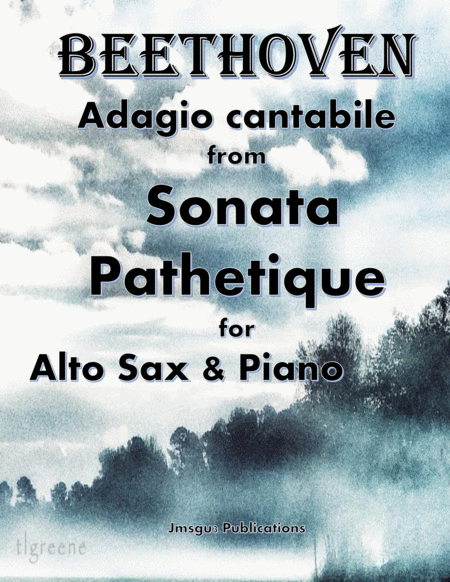
Beethoven: Adagio from Sonata Pathetique for Alto Sax & Piano
Saxophone Alto et Piano

$24.95 21.48 € Saxophone Alto et Piano PDF SheetMusicPlus

Alto Saxophone,Piano - Level 2 - Digital Download SKU: A0.1510447 Composed by Various. Arranged by B. C. Dockery. Christian,Easter,Lent,Religious,Sacred. Score and part. 207 pages. Ben Dockery #1085642. Published by Ben Dockery (A0.1510447). These fifty classic hymns have been arranged for alto saxophone solo with piano accompaniment. They are easy enough for early intermediate students to learn or for more advanced players to sight-read. Great for preludes, offertories, postludes, recitals, and lessons. Includes both scores and individual parts.A Mighty Fortress Is Our GodAbide with MeAll Creatures of Our God and KingAll Hail the Power of Jesus’ NameAlleluia! Alleluia! (Ode to Joy)Amazing GraceAre You Washed in the Blood?At the CrossBe Thou My VisionBlessed AssuranceChrist Arose (Low in the Grave He Lay)Christ the Lord is Risen TodayCome, Christians, Join to SingCome, Thou Fount of Every BlessingCome, Thou Long-Expected JesusCrown Him with Many Crowns Down at the CrossFairest Lord JesusHe Leadeth MeHe Lives (I Know That My Redeemer Lives!)Holy, Holy, HolyHow Great Thou ArtI Stand Amazed in the Presence (How Marvelous)In the GardenIt Is Well with My SoulJesus Loves MeJesus Paid It AllJesus SavesJust as I AmLove Divine, All Loves ExcellingMy Hope Is Built On Nothing LessNear the CrossNearer, My God, to TheeNothing but the BloodO For A Thousand Tongues To SingO Sacred Head, Now WoundedO the Blood of JesusO Worship the KingOnward, Christian SoldiersRock Of AgesShall We Gather at the RiverTell Me the Story of JesusThe Old Rugged CrossThere is a FountainTo God Be the GloryWe Gather TogetherWere You ThereWhat A Friend We Have in JesusWhat Wondrous Love Is ThisWhen I Survey the Wondrous CrossBecause this is a single bound book, photocopies are permitted for performance purposes.
50 Greatest Hymns for Alto Sax Solo with Piano Accompaniment
Saxophone Alto et Piano

$24.99 21.51 € Saxophone Alto et Piano PDF SheetMusicPlus

Instrumental Duet,Piano Alto Saxophone,Baritone Saxophone,Instrumental Duet,Piano - Level 4 - Digital Download SKU: A0.636368 By Whitney Houston. By Michael Masser. Arranged by Fishel Pustilnik. Contemporary,Pop. Score and parts. 9 pages. F & N Enterprise #6413895. Published by F & N Enterprise (A0.636368). An excellent arrangement of the famous Song The Greatest Love Of Allfor Alto Sax and Piano-Jazz/Pop Version. The video for Violin and Piano: https://youtu.be/dPUU9tXTMRwThe composition is easy to read, fun to play, and sound professional when performed. Arranged by Fishel Pustilnik, a very well known as Composer/Publisher. His books Jazz & Pop Piano Paradise (Volumes 1-5) have become a commercial success and a hit with music teachers and students in Canada. (Thousands of books already sold in Canada). They are also starting to enter the US, Brazil, Norway, Russia, Holland, Israel, Belgium, Sweden, Finland, Greece, Latvia, and the UK markets. This is a wonderful new publication. These pieces offer much appeal for the young pianist and excellent choice for a supplementary book for students from Grade 3 to 8. Lore Ruschiensky, Editor, (from the review in The Canadian Music Teacher) Yesterday I spent at least two pleasure-filled hours playing through your imaginatively inventive compositions. Congratulations! I trust students will decide to program your well crafted and entertaining works on recitals and examinations. Review from Dr. Jack Behrens, B.Sc. (Julliard), Ph.D. (Harvard), Director of Academic Studies, The Glenn Gould School I liked this book the best so far. Great work! You have a gift for melody and your arrangements are very playable. Congratulations on the 3rd Volume. Mark Carlstein, Hal Leonard, Keyboard Publications.
The Greatest Love Of All
Saxophone Alto et Piano
Whitney Houston
$4.99 4.3 € Saxophone Alto et Piano PDF SheetMusicPlus

Alto Saxophone,Piano - Level 4 - Digital Download SKU: A0.549443 Composed by Sir Arthur Seymour Sullivan. Arranged by James M. Guthrie, ASCAP. Instructional,Romantic Period,Sacred,Standards. Score and part. 15 pages. Jmsgu3 #3494751. Published by jmsgu3 (A0.549443). Score: 10 pages, solo part: 2 pages, piano part: 3 pages. Duration: 4:25. Not difficult, but requires sensitivity & dynamic control. Suitable for recitals, church meditations, or school programs. School Years First of all, Sullivan attended music school at the Royal Academy of Music. Because Sullivan was so talented, the Academy awarded him the Mendelssohn Scholarship for two years in a row. He, therefore, studied with John Goss, who studied with Thomas Atwood, who in turn studied with Mozart. Sullivan similarly studied the piano at the Academy with Arthur O’Leary. Study Abroad During his first year, he also earned money by singing solos in the Chapel Royal. At the end of his second year, the Academy consequently continued his scholarship and sent him to study at the Leipzig Conservatoire. He certainly studied composition, and likewise counterpoint and piano. Hence, during his final year in Leipzig, Sullivan finally completed his graduation composition project: Incidental Music for Shakespeare’s The Tempest. Association with Gilbert It seems like Sullivan built the bulk of his composing career largely in the 1860s. As a result, he became famous for his incidental music for the Tempest and his Irish Symphony. He, therefore, began collaborating with the poet W. S. Gilbert in the 1870s. Rather than focus on serious opera, Gilbert and Sullivan, in contrast, concentrated on comic operas such as H. M. S. Pinafore, the Pirates of Penzance, and the Mikado. Therefore, certainly as a result of his education and experience, Sullivan composed a total of 24 operas, 11 symphonic works, and 10 choral pieces. Even more, he wrote a large number of noteworthy hymns such as Onward Christian Soldiers. Lost Chord Winds The general style of his music is maybe similar to Mendelssohn, Schumann, and perhaps Liszt. It seems like Sullivan was fond of writing distinct melodies for each character in his operettas. His melodies combine together as the characters did. Furthermore, he was a master orchestrator, and therefore played the flute, clarinet, trumpet, and trombone fluently. The Lost Chord Sullivan wrote his most noteworthy song the Lost Chord in 1877. As a result, it was a great success and was certainly performed all over the world by a variety of singers such as Enrico Caruso. Because Sullivan was the most famous composer in England, the Lost Chord became the most famous of all British or American songs of the 1870s and 1890s. Consequently, in 1888 Thomas Edison recorded The Lost Chord for the phonograph. It was one of the first songs ever recorded. Furthermore, Queen Victoria knighted Sullivan in 1883.  
Sullivan: The Lost Chord for Alto Sax & Piano
Saxophone Alto et Piano

$26.95 23.2 € Saxophone Alto et Piano PDF SheetMusicPlus

Alto Saxophone,Piano - Level 2 - Digital Download SKU: A0.549235 Composed by Johann Sebastian Bach. Arranged by James M. Guthrie, ASCAP. Baroque,Easter,Standards,Wedding. Score and part. 9 pages. Jmsgu3 #3468804. Published by jmsgu3 (A0.549235). J. S. Bach BWV 508.  Bist du bei mir Bach adapted this aria from a lost Stölzel opera called Diomedes. He changed the original orchestral instrumentation to soprano, strings, and continuo.  He also modified the voice-leading making it sound more like a Bach composition. The work appears as BWV 508 No. 25 in the Anna Magdalena Notebook No. 2.   Source Only a few remnants of the original opera have survived. Historians speculate that Anna Magdalena got the song from the Leipzig Opera after the bankruptcy of 1720. Chances are good, though, that the tune was a favorite of everyone in Leipzig at the time.   Lyrics When thou art near, I go with joyTo death and to my rest.O how joyous would my end be,If your fair hands            Would close my faithful eyes. - Unknown Bach Overview First of all, Johann Sebastian Bach is maybe the greatest composer in music history. Certainly, he was prolific. As a result, everyone has heard of his works. Furthermore, these works number well over a thousand. It seems like people are probably most familiar with instrumental works such as the Brandenburg Concertos, and the Goldberg Variations. But, similarly famous are such noteworthy works as the Well-Tempered Clavier, the Musical Offering, and certainly the Art of Fugue. Seems like his most famous vocal works include the most noteworthy Mass in B Minor. Also, most noteworthy are the St. John Passion, and indeed the Christmas Oratorio.  History Bach came from a long line of musicians and above all, composers. Consequently, he, first of all, pursued a career as a church organist. So as a result, he gained employment in various Protestant churches in Germany. For a while, he worked as a court musician in Weimar and Köthen. Here he probably developed his organ style and likewise his chamber music style. Eventually, he, therefore, gained an appointment as Cantor of St. Thomas in Leipzig. Here he worked until difficulties with his employer ultimately drove him away. The King of Poland finally appointed him as court composer.  Style It seems like Bach created a fascinating new international style. He synthesized elements of the most noteworthy European music ideas into his new style. Even more, this new style was probably his synthesis of European musical rhythm and form. Furthermore, he demonstrated a complete mastery of counterpoint and motivic development. His sense of harmonic organization probably propelled him to the top. Revival                Mendelssohn conducted a Bach revival in the nineteenth century. His effort probably helped to re-familiarize the public with the magnitude of Bach’s works. During this period, scholars published many noteworthy Bach biographies. Moreover, Wolfgang Schmieder published the BWV (Bach Werke Verzeichnis). As a result, this is now the official catalog of his entire artistic output. The BWV number allows us to locate a work in the catalog. Sometimes scholars will simply use an S (Schmieder) as an abbreviation for BWV.  Voyager NASA launched two Voyager spacecraft in 1977. Onboard are phonograph records with sounds, music, and images of life on Earth. The purpose of the launch was to inform intelligent extraterrestrial life forms about conditions on Earth. The music on the disc is varied. There is Bach, Mozart, Beethoven, and Stravinsky among others. However, because Bach is so important in our music history, it contains three times more Bach than all the others combined.
Bach: Bist du bei mir BWV 508 for Alto Sax & Piano
Saxophone Alto et Piano

$32.95 28.36 € Saxophone Alto et Piano PDF SheetMusicPlus

Alto Saxophone,Piano - Level 3 - Digital Download SKU: A0.587684 Composed by Peter Ilyich Tchaikovsky. Arranged by David McKeown. Children,Concert,Instructional,Romantic Period,Standards. Score and part. 9 pages. David McKeown #4737755. Published by David McKeown (A0.587684). Swan Lake, is the first ballet of three composed by Pyotr Tchaikovsky. Here, the famous main theme is arranged for Solo Alto Saxophone and Piano, directly from the orchestral score. The first performance of the ballet in Moscow in 1877 was not well received. The production was fraught with disagreements between choreographer and composer; the Russian audience were suspicious of the story’s Germanic origins and the music was regarded as too complex for ballet. Tchaikovsky did not live to see a triumphant revival production in 1895 that confirmed Swan Lake as one of the greatest ballet scores of all. Included in the single download are six pages of piano score and a separate two-page part for the solo instrument. The short sample here and the full length version on the youtube link are from the Clarinet version of this arrangement.Musicians at an intermediate level and above will find this ideal for formal and informal performances. The melody is expressive and legato; the accompaniment is challenging in parts, with tremolos and rich chords. Both parts require dramatic dynamic contrasts and the solo part explores a wide range of the instrument. The overall performance time is around two and a half minutes.There are many more top quality arrangements and compositions by David McKeown for you to browse at http://www.sheetmusicplus.com/publishers/david-mckeown/6203
Swan Lake Theme, for Solo Alto Saxophone and Piano
Saxophone Alto et Piano

$4.60 3.96 € Saxophone Alto et Piano PDF SheetMusicPlus

Alto Saxophone,Piano - Level 3 - Digital Download SKU: A0.1323824 Composed by Paul Dukas. Arranged by Rodrigo Faleiros. 19th Century,Classical,Film/TV. Score and part. 3 pages. Rodrigo Faleiros #912004. Published by Rodrigo Faleiros (A0.1323824). Embark on a musical journey with our unique alto sax solo arrangement of The Sorcerer's Apprentice theme by Paul Dukas. Crafted for intermediate players seeking to refine their staccato technique, this arrangement contains a piano accompaniment and not only captures the magic and excitement of the original composition but also ensures easy reading with a thoughtful transposition to the key of D minor.Key Features: Staccato Mastery: Elevate your staccato technique with the dynamic and engaging phrases of The Sorcerer's Apprentice theme. Intermediate Level: Perfect for players looking to expand their skills and add a touch of virtuosity to their repertoire. Transposed to D Minor for Easy Reading: Enjoy a smoother reading experience with this alto sax solo arrangement thoughtfully transposed to enhance readability. Evocative Piano Accompaniment: The piano part enhances the harmonic resonance of this great composition. Whether you're preparing for a recital, looking to challenge yourself, or simply captivated by the magic of the original composition, this alto sax solo arrangement in D minor offers a delightful exploration of Dukas' timeless work.Check out my other arrangements for classics transposed and adapted to several instruments by clicking here!
The Sorcerer's Apprentice theme
Saxophone Alto et Piano

$3.99 3.43 € Saxophone Alto et Piano PDF SheetMusicPlus

Alto Saxophone,Piano - Level 3 - Digital Download SKU: A0.1323781 Composed by Paul Dukas. Arranged by Rodrigo Faleiros. 19th Century,Classical,Film/TV. Score and part. 3 pages. Rodrigo Faleiros #911967. Published by Rodrigo Faleiros (A0.1323781). Embark on a musical journey with our unique alto sax solo arrangement of The Sorcerer's Apprentice theme by Paul Dukas. Crafted for intermediate players seeking to refine their staccato technique, this arrangement contains a piano accompaniment and not only captures the magic and excitement of the original composition but also ensures easy reading with a thoughtful transposition to the key of D minor.Key Features: Staccato Mastery: Elevate your staccato technique with the dynamic and engaging phrases of The Sorcerer's Apprentice theme. Intermediate Level: Perfect for players looking to expand their skills and add a touch of virtuosity to their repertoire. Transposed to D Minor for Easy Reading: Enjoy a smoother reading experience with this alto sax solo arrangement thoughtfully transposed to enhance readability. Evocative Piano Accompaniment: The piano part enhances the harmonic resonance of this great composition. Whether you're preparing for a recital, looking to challenge yourself, or simply captivated by the magic of the original composition, this alto sax solo arrangement in D minor offers a delightful exploration of Dukas' timeless work.Check out my other arrangements for classics transposed and adapted to several instruments by clicking here!
The Sorcerer's Apprentice theme
Saxophone Alto et Piano

$3.99 3.43 € Saxophone Alto et Piano PDF SheetMusicPlus

Alto Saxophone,Piano - Level 2 - Digital Download SKU: A0.549015 Composed by Franz Schubert. Arranged by James M. Guthrie, ASCAP. Holiday,Romantic Period,Sacred,Standards. Score and part. 10 pages. Jmsgu3 #3447439. Published by jmsgu3 (A0.549015). Alto Sax version of Moment Musicaux, Op. 94 (D. 780) No. 3 by Franz Schubert, published in 1828. Duration: 1:53 Score 6 pg. 54 ms. Alto Sax 1 pg. Piano part 3 pg. One of Schubert's most well-known pieces. This is an effective recital encore due to its brevity and range of expression. Could work well for a variety of occasions: wedding receptions, church services (Easter), and anniversaries. It seems like a pleasant dance, unlike some previous dance music. Schubert improvised these dances at parties for his friends.  Although conceived on-the-fly, these dances are the work of a genius. Composers have similarly elevated dance music to artistic status. As a result, they freed it from the original purpose of dancing. Certainly, the older masters used the dance forms as vehicles for complex treatments. Here, however, Schubert retains the dance-like quality while finally expressing his innermost thoughts and emotions. The dance is certainly filled with a doleful expression, yet the texture remains even more light and refined. Therefore, to perform these with sensitivity we probably need to use a light but accurate touch. The accompaniment pattern needs to be crisp and delicate – probably even in the more forceful parts. The piano pedal should also be used very carefully so as a result not to blur the outline. Instead, it should contribute to the dynamic quality of the piece. Schubert Franz Schubert (1797–1828) was, in fact, a famous Austrian composer. Moreover, he composed during the late Classical and early Romantic periods. Schubert was comparatively prolific. He wrote more than 600 secular vocal works, seven symphonies, and, correspondingly, a massive amount of piano and chamber music. Critics agree, as a matter of fact, that his most famous works include his Piano Quintet in A major, D. 667 (also known as the Trout Quintet), the Symphony No. 8 in B minor, D. 759 (Unfinished Symphony), the last sonatas for piano (D. 958–960), and the song cycles Die schöne Müllerin (D. 795) and Winterreise (D. 911). Education Schubert was furthermore a musical child prodigy. He studied violin with his father as well as piano with his older brother. In addition, when Schubert was eleven he studied at Stadtkonvikt school, where he became familiar with the orchestral music of Haydn, Mozart, and likewise Beethoven. In due time he left school and returned home where he studied to become an educator; nevertheless, he continued studying composition with Antonio Salieri. Performance Eventually, Schubert was admitted to the Gesellschaft der Musikfreunde as a performer. This appointment straightaway established his name in Vienna as a composer and pianist. Finally, he gave his only composition recital in 1828. He died suddenly a few months later probably due to typhoid fever. Legacy Schubert’s music was by and large underappreciated while he was alive. There were all in all only a few enthusiasts in Vienna. After he died, however, interest in his work in fact increased. Felix Mendelssohn, Robert Schumann, Franz Liszt, Johannes Brahms, and other famous composers in due time discovered his compositions. Nowadays, historians rank Schubert expressly among the greatest composers of the era, and his music remains in general very popular.
Schubert: Moment Musicaux for Alto Sax & Piano
Saxophone Alto et Piano

$32.95 28.36 € Saxophone Alto et Piano PDF SheetMusicPlus

Alto Saxophone,Piano - Level 3 - Digital Download SKU: A0.1178687 Composed by Wolfgang Amadeus Mozart. Arranged by César Madeira. Children,Classical,Film/TV,Multicultural,Opera,World. Score and part. 13 pages. Sheet Music To Play Editions #778650. Published by Sheet Music To Play Editions (A0.1178687). Queen of the Night from Die Zauberflöte by Mozart for Alto Sax and Piano. With Full Score and Individual Parts. Enjoy it!Wolfgang Amadeus Mozart (1756 - 1791), was a prolific and influential composer of the Classical period. Despite his short life, his rapid pace of composition resulted in more than 800 works of virtually every genre of his time. Many of these compositions are acknowledged as pinnacles of the symphonic, concertante, chamber, operatic, and choral repertoire. Mozart was among the greatest composers in the history of Western music.For Tutorials, Play Alongs or request New Arrangements, visit the YouTube Channel: Sheet Music To Play
Queen of the Night Aria - Alto Sax and Piano (Full Score and Parts)
Saxophone Alto et Piano

$7.99 6.88 € Saxophone Alto et Piano PDF SheetMusicPlus

Alto Saxophone,Piano - Level 2 - Digital Download SKU: A0.550919 Composed by J. S. Bach - Gounod. Arranged by James M. Guthrie, ASCAP. Christmas,Contemporary,Easter,Wedding. Score and part. 11 pages. Jmsgu3 #4888291. Published by jmsgu3 (A0.550919). This arrangement features the controversial Schwencke measure (ms. 27) that was originally introduced in 1783 by Christian Friedrich Gottlieb Schwencke. The convenient 1st & 2nd endings provide an option for extended performance. Duration with repeat - 4:50. Score: 6 pages. Solo part: 2 pages, piano part: 4 pages. Based on Prelude #1 in C Major from the Well-Tempered Clavier, Book 1. Well suited for church meditations or school programs or recital encores.  Ave Maria Ave Maria is a Catholic prayer that consequently asks for the mother of Jesus (Mary) to intercede. Charles Gounod composed a famous version of the Ave Maria. He was a French Romantic composer who overlaid a new melody on an existing Bach chord progression. The progression is from Bach’s Prelude No. 1 from Well-Tempered Clavier I. This version, as well as Schubert’s version, have become essential items at weddings, masses, and funerals. Bach Overview First of all, Johann Sebastian Bach is maybe the greatest composer in music history. Certainly, he was prolific. As a result, everyone has heard of his works. Furthermore, these works number well over a thousand. It seems like people are probably most familiar with instrumental works such as the Brandenburg Concertos, and the Goldberg Variations. But, similarly famous are such noteworthy works as the Well-Tempered Clavier, the Musical Offering, and the Art of Fugue. Seems like his most famous vocal works include the most noteworthy Mass in B Minor. Also, most noteworthy, though, are the St. John Passion, and certainly the Christmas Oratorio.  History Bach came from a long line of musicians and above all, composers. Consequently, he, first of all, pursued a career as a church organist. So as a result, he gained employment in various Protestant churches in Germany. For a while, he worked as a court musician in Weimar and Köthen. Here he probably developed his organ style and likewise his chamber music style. Eventually, he, therefore, gained an appointment as Cantor of St. Thomas in Leipzig. Here he worked until difficulties with his employer ultimately drove him away. The King of Poland finally appointed him as a court composer.  Style It seems like Bach created an engaging new international style. He synthesized elements of the most noteworthy European music ideas into his new style. Even more, this new style was probably his synthesis of European musical rhythm and form. Furthermore, he demonstrated a complete mastery of counterpoint and motivic development. His sense of harmonic organization probably propelled him to the top. Revival               Mendelssohn conducted a Bach revival in the nineteenth century. His effort probably helped to re-familiarize the public with the magnitude of Bach’s works. During this period, scholars published many noteworthy Bach biographies. Moreover, Wolfgang Schmieder published the BWV (Bach Werke Verzeichnis). As a result, this is now the official catalog of his entire artistic output. The BWV number allows us to locate a work in the catalog. Sometimes scholars will simply use an S (Schmieder) as an abbreviation for BWV.  
Bach-Gounod: Ave Maria, Schwencke version for Alto Sax & Piano
Saxophone Alto et Piano

$32.95 28.36 € Saxophone Alto et Piano PDF SheetMusicPlus


1 16 31 ....646


Partitions Gratuites
Acheter des Partitions Musicales
Acheter des Partitions Digitales à Imprimer
Acheter des Instruments de Musique

© 2000 - 2026

Accueil - Version intégrale





