EUROPE
4225 articles
USA
32 articles
DIGITAL
30 articles (à imprimer)
Partitions Digitales
Partitions à imprimer
30 partitions trouvées


Alto Saxophone,Piano - Level 3 - Digital Download SKU: A0.587739 Composed by Edward Elgar. Arranged by David McKeown. Concert,Contemporary,Romantic Period,Standards,Wedding. Score and part. 5 pages. David McKeown #4833263. Published by David McKeown (A0.587739). Nimrod, is the ninth of the Enigma Variations composed by Edward Elgar in 1899.  Here, the music is arranged for solo Alto Saxophone and Piano, directly from the orchestral score. Elgar wrote fourteen variations on a theme, each one depicting close friends and family. Nimrod represents his publisher and friend Augustus Jaeger. The biblical character of Nimrod is described as a mighty hunter, and jaeger means hunter in German.The single pdf file contains both the piano score and a separate solo instrumental part.Musicians at an intermediate level and above will find this ideal for formal and informal performances. Both parts require dramatic dynamic contrasts and lyrical legato playing. The overall performance time is around three minutes.There are many more top quality arrangements and compositions by David McKeown for you to browse at http://www.sheetmusicplus.com/publishers/david-mckeown/6203
Nimrod, from the Enigma Variations by Elgar, for Alto Saxophone and Piano
Saxophone Alto et Piano

$4.60 3.96 € Saxophone Alto et Piano PDF SheetMusicPlus

Alto Saxophone,Piano - Level 4 - Digital Download SKU: A0.755042 Composed by Sy Brandon. 20th Century,Contemporary. Score and part. 23 pages. Sy Brandon #3249479. Published by Sy Brandon (A0.755042). Fantasie Variation on Mazurek Dabrowskiego was commissioned in 2010 by David Wozniak. Wozniak suggested using the Polish National Anthem as the basis of a composition that can serve as a fiery opener to a concert. After a short introduction, the anthem is stated using a repetitive rhythmic motif in the piano. Variation one is a minor variant that has a chromatic obligato in the saxophone on the repeat. After a two measure interlude in 4/4 that breaks up the 3/4 meter of the mazurka, Variation two begins. This variation uses motives from the anthem to create a new saxophone melody. Variation three changes meter often and is more technical and angular. A repeat of the minor variant brings the first fast section to a close. After a transition to a slower tempo, a mysterious variation with sudden outbursts occurs. It uses a lot of feminine endings that are characteristic of some Polish music. The tempo slows once again before variation seven which is a lyrical and romantic treatment of motives from the anthem. The final fast section begins with a rhythmic 5/8 variation that changes to 6/8 for the second part of the anthem’s structure. An ornamental version of the anthem with the mazurka rhythm returns at the end before a rousing coda brings the work to a close. This composition is recorded by David Wozniak and Krista Wallace-Boaz on the Emeritus label American Fusion CD.
Fantasie Variations on Mazurek Dabrowskiego
Saxophone Alto et Piano

$9.99 8.6 € Saxophone Alto et Piano PDF SheetMusicPlus

Alto Saxophone,Piano - Level 3 - Digital Download SKU: A0.844328 Composed by Lyrics: Charles Wesley, Music: Thomas Campbell, published 1738, and published 1825. Arranged by Dan Cutchen. Easter,Gospel,Sacred,Spiritual. Score and part. 15 pages. Dan Cutchen Music #3115903. Published by Dan Cutchen Music (A0.844328). This arrangement of And Can It Be That I Should Gain? is for alto saxophone solo and piano.A theme and variation treatment is used.  For a piano background Mp3 track, search for: Alto Sax - And Can It Be? Theme and Variations-Accompaniment Track, Dan CutchenTime: approximately 6:00And Can It Be That I Should Gain? is a Christian hymn written by Charles Wesley. And Can It Be was written in 1738 to celebrate Wesley's conversion, which he regarded as having taken place on May 21 of that year. This beautiful hymn has been popular and enduring.And Can It Be That I Should Gain is perhaps one of the most joyfully poignant hymns penned by Charles Wesley (1707-1788). On Whitsunday (Pentecost), May 21, 1738, three days before his brother John experienced his heart strangely warmed,’ Charles was convalescing in the home of John Bray, a poor mechanic, when he heard a voice saying, In the name of Jesus of Nazareth, arise, and believe, and thou shalt be healed of all thy infirmities. The voice was most likely Mr. Bray’s sister who felt commanded to say these words in a dream.Anglican hymn writer Timothy Dudley-Smith, notes that the following then happened:Charles got out of bed and opening his Bible read from the Psalms: He have put a new song in my mouth, even praise unto our God, followed by the first verse of Isaiah 40, Comfort ye, comfort ye my people, saith your God. He wrote in his journal, I have found myself at peace with God, and rejoiced in the hope of love Christ (Dudley-Smith, 1987, 1).The statement from Mr. Bray’s sister sparked within Charles a conviction like he had never felt before. Moved and convicted in spirit, Charles wrestled with these words until he came to rest in his faith, knowing that it is by faith we are saved (Ephesians 2:8).Soon after this conversion experience, he wrote two hymns in celebration of the amazing love he had come to know: And Can It Be that I Should Gain and Where Shall My Wondering Soul Begin? (United Methodist Hymnal, 342)There has been some debate as to which hymn was written first, but most current scholarship accepts the latter as the first hymn written by Charles after his conversion experience. No matter its place in the chronology of Wesley's output, And Can It Be has been and remains one of his most remarkable hymns, expressing like no other the rapturous joy of receiving salvation.And Can It Be That I Should Gain. Hymnary.org, https://hymnary.org/text/and_can_it_be_that_i_should_gainDudley-Smith, Timothy. A Flame of Love: A Personal Choice of Charles Wesley’s Verse. London: Triangle SPCK, 1987.Timothy Dudley-Smith. And can it be that I should gain. The Canterbury Dictionary of Hymnology. Canterbury Press, accessed May 29, 2018, http://www.hymnology.co.uk/a/and-can-it-be-that-i-should-gain.Young, Carlton R. And Can It Be That I Should Gain. Companion to the United Methodist Hymnal. Abingdon Press, 1993.(Taken from: History of Hymns: And Can It Be That I Should Gain by DeAndre Johnson found at https://www.umcdiscipleship.org/resources)https://youtu.be/BSX9yYcNY2E
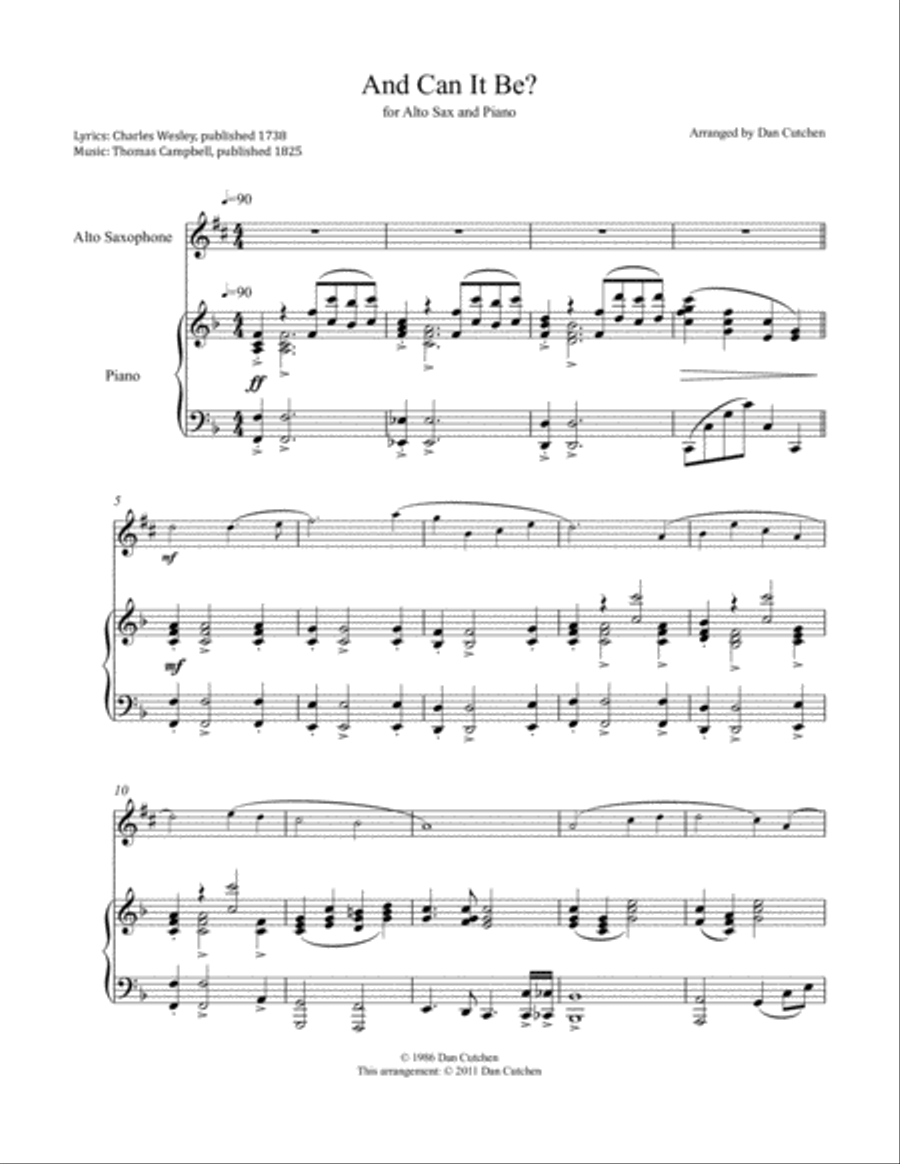
Alto Sax - "And Can It Be?" Theme and Variations
Saxophone Alto et Piano

$7.00 6.03 € Saxophone Alto et Piano PDF SheetMusicPlus

Alto Saxophone,Piano - Level 5 - Digital Download SKU: A0.533621 Composed by Carson Cooman. Concert,Contemporary,Standards. Score and part. 18 pages. Musik Fabrik Music Publishing #3033373. Published by Musik Fabrik Music Publishing (A0.533621). Fantasy Variations (2005) for alto saxophone and piano was written for saxophonist PaulWehage and is dedicated to him and to American composer George Perle (on his 90thbirthday).The work is cast as two presentations of the theme surrounding five free variations -- allplayed without break. The theme serves as the basis of the musical material for the entirework as well as the structural template for each variation. Also, each variation containsmaterial referring back specifically to the previous variation.The opening theme is declamatory and massive. The first variation is fast and limber. Thesecond variation is introspective and stratified. The third variation is fleeting. The fourthvariation is distant and spare. The fifth variation is fast and driving, and the final themebegins whispered and slowly regains its declamatory nature before an intensely hammeredcoda.Carson
Carson Cooman: Fantasy Variations (2005) for alto saxophone and piano
Saxophone Alto et Piano

$14.95 12.87 € Saxophone Alto et Piano PDF SheetMusicPlus

Alto Saxophone,Piano - Level 3 - Digital Download SKU: A0.1491891 Composed by Paul-Agricole Génin. Arranged by Paul Wehage (édition). 19th Century,Contest,Festival,Romantic Period. Score and part. 20 pages. Musik Fabrik Music Publishing #1068574. Published by Musik Fabrik Music Publishing (A0.1491891). Paul-Agricole Génin was born on 14th February 1832, in Avignon; died 22nd December 1903, in Paris, France. His is often confused with Pierre Génin, who was a flutist who performed mainly in England during the early 20th century. Génin was the Principal flute of the Theatre Italien in Paris, and of the Colonne Orchestra. In addition to writing many works for the flute (he wrote over 60 works for this instrument, he was also one of the first composers to write for the saxophone. He was an Officier de l’Académie des Beaux-ArtsThe six works in the set of Opus 15 are among the first works ever written for the saxophone. They are in the form of charactor pieces; The theme of this work was one of Napoléon Bonaparte's favorite songs.
Variations sur "Marlborough s'en va en Guerre"
Saxophone Alto et Piano

$9.95 8.57 € Saxophone Alto et Piano PDF SheetMusicPlus

Alto Saxophone,Piano - Level 3 - Digital Download SKU: A0.1178542 Composed by Johann Sebastian Bach. Arranged by César Madeira. Baroque,Early Music,Film/TV,Multicultural,Wedding,World. Score and part. 6 pages. Sheet Music To Play Editions #778502. Published by Sheet Music To Play Editions (A0.1178542). Air on the G String from Orchestral Suite No.3 (BWV1068). Arrangement for Alto Sax and Piano. With Full Score and Individual Parts. Enjoy it!Johann Sebastian Bach (1685 - 1750) was a German composer and musician of the Baroque period. He is known for instrumental compositions such as the Brandenburg Concertos and the Goldberg Variations, and for vocal music such as the St Matthew Passion and the Mass in B minor. Since the 19th-century Bach Revival, he has been generally regarded as one of the greatest composers of all time.For Tutorials, Play Alongs or request New Arrangements, visit the YouTube Channel: Sheet Music To Play
Air on G String - Alto Sax and Piano (Full Score and Parts)
Saxophone Alto et Piano

$7.99 6.88 € Saxophone Alto et Piano PDF SheetMusicPlus

Alto Saxophone,Piano - Level 4 - Digital Download SKU: A0.534527 Composed by Jean-Thierry Boisseau. 20th Century,Concert,Contemporary,Standards,World. Score and part. 27 pages. Musik Fabrik Music Publishing #3604007. Published by Musik Fabrik Music Publishing (A0.534527). It was in the process of preparing the publication of the works of Demersseman and of Ali Ben Sou Alle that suggested to me the idea of the typical 19th century practice of the Fantasy and Variations on well-known themes.The saxophone lends itself perfectly for this stylistic exercise. I therefore chose to write for this instrument, which the piano supports seriously.My republican roots (in the French sense) suggested that I set several revolutionary songs from 1789. I therefore chose the emblematic “ Ah ça ira ! â€, after having seen the famous sequence of “Si Versailles l’était conté†where Piaf sings this song hanging of the grill of the Palace of Versailles, in the superbe version by Jean Françaix.I added at the end “ La Carmagnole †and the famous “ Il pleut bergère †a foreshadowing of the destiny of Marie-Antoinette who is said to have enjoyed singing this air. One will find, a bit hidden, a short citation of a work for organ by Bach.This isn’t a pastiche but rather a sort of modern update to this form in respecting its codes, its forms of this type of work which disappeared temporarily due to forced musical austerity.
Jean-Thierry Boisseau: Fantaisie Révolutionaire for alto saxophone and piano
Saxophone Alto et Piano

$16.95 14.59 € Saxophone Alto et Piano PDF SheetMusicPlus


Partitions Gratuites
Acheter des Partitions Musicales
Acheter des Partitions Digitales à Imprimer
Acheter des Instruments de Musique

© 2000 - 2026

Accueil - Version intégrale





