EUROPE
1009 articles
USA
0 articles
DIGITAL
13 articles (à imprimer)
Partitions Digitales
Partitions à imprimer
13 partitions trouvées


Alto Saxophone,Piano - Level 3 - Digital Download SKU: A0.791245 By Neil Diamond. By Bob Russell and Bobby Scott. Arranged by Kevin P Holdgate. Pop. Score and part. 8 pages. Kevin P Holdgate #5772015. Published by Kevin P Holdgate (A0.791245). KPHMS 'Solo' CollectionHe Ain't Heavy, He's My Brother is a ballad written by Bobby Scott and Bob Russell. Originally recorded by Kelly Gordon in 1969, the song became a worldwide hit for The Hollies later that year and a minor hit for Neil Diamond in 1970. It has been recorded by many artists in subsequent years.Scott and Russell were introduced to each other by Johnny Mercer, at a California nightclub. Although Russell was dying of lymphoma and the pair met only three times, they managed to collaborate on the song.This is an arrangement as a solo with piano accompaniment that I would judge to be around Grade 5/6 standard for most instruments.
He Ain't Heavy, He's My Brother
Saxophone Alto et Piano
Neil Diamond
$4.99 4.33 € Saxophone Alto et Piano PDF SheetMusicPlus

Alto Saxophone,Piano - Level 1 - Digital Download SKU: A0.1470341 Composed by Ludwig van Beethoven. Arranged by Benzaiten Editions. 19th Century,Classical,Instructional,Romantic Period. Score and part. 2 pages. Benzaiten Editions #1048070. Published by Benzaiten Editions (A0.1470341). Hey there, music enthusiast! Ready to experience the uplifting melodies of Ludwig van Beethoven's timeless Ode to Joy? Let's make some music! ?Beethoven • Ode to Joy | alto saxophone sheet music w/ piano accompaniment [chords]Ideal for concerts, family gatherings, or simply enjoying the beauty of classical music, this easy arrangement is perfect for beginners. Bring the inspiring spirit of Ode to Joy to your fingertips, spread joy, and elevate your musical repertoire with this timeless piece! Our 'Ode to Joy' arrangement | Benzaiten Editions By purchasing our edition, you'll be able to download:• Full score with all instruments of the arrangement• Alto saxophone solo part About 'Ode to Joy' Ode to Joy, composed by Ludwig van Beethoven, is the final movement of his Ninth Symphony, completed in 1824. This piece has become a universal anthem of joy and brotherhood, known for its powerful and uplifting melody.
Beethoven • Ode to Joy | alto saxophone sheet music w/ piano accompaniment [chords]
Saxophone Alto et Piano
purchasing our edition, you'll be able to download:
• Full score with all instruments of the arrangement
• Alto saxophone solo part

About 'Ode to Joy'

Ode to Joy, composed by Ludwig van Beethoven, is the final movement of his Ninth Symphony, completed in 1824
This piece has become a universal anthem of joy and brotherhood, known for its powerful and uplifting melody
$4.99 4.33 € Saxophone Alto et Piano PDF SheetMusicPlus

Alto Saxophone,Piano - Level 1 - Digital Download SKU: A0.1470340 Composed by Ludwig van Beethoven. Arranged by Benzaiten Editions. 19th Century,Classical,Instructional,Romantic Period. Score and part. 2 pages. Benzaiten Editions #1048069. Published by Benzaiten Editions (A0.1470340). Hey there, music enthusiast! Ready to experience the uplifting melodies of Ludwig van Beethoven's timeless Ode to Joy? Let's make some music! ?Beethoven • Ode to Joy | alto saxophone sheet music w/ piano accompanimentIdeal for concerts, family gatherings, or simply enjoying the beauty of classical music, this easy arrangement is perfect for beginners. Bring the inspiring spirit of Ode to Joy to your fingertips, spread joy, and elevate your musical repertoire with this timeless piece! Our 'Ode to Joy' arrangement | Benzaiten Editions By purchasing our edition, you'll be able to download:• Full score with all instruments of the arrangement• Alto saxophone solo part About 'Ode to Joy' Ode to Joy, composed by Ludwig van Beethoven, is the final movement of his Ninth Symphony, completed in 1824. This piece has become a universal anthem of joy and brotherhood, known for its powerful and uplifting melody.
Beethoven • Ode to Joy | alto saxophone sheet music w/ piano accompaniment
Saxophone Alto et Piano
purchasing our edition, you'll be able to download:
• Full score with all instruments of the arrangement
• Alto saxophone solo part

About 'Ode to Joy'

Ode to Joy, composed by Ludwig van Beethoven, is the final movement of his Ninth Symphony, completed in 1824
This piece has become a universal anthem of joy and brotherhood, known for its powerful and uplifting melody
$4.99 4.33 € Saxophone Alto et Piano PDF SheetMusicPlus

Alto Saxophone,Piano - Level 2 - Digital Download SKU: A0.549015 Composed by Franz Schubert. Arranged by James M. Guthrie, ASCAP. Holiday,Romantic Period,Sacred,Standards. Score and part. 10 pages. Jmsgu3 #3447439. Published by jmsgu3 (A0.549015). Alto Sax version of Moment Musicaux, Op. 94 (D. 780) No. 3 by Franz Schubert, published in 1828. Duration: 1:53 Score 6 pg. 54 ms. Alto Sax 1 pg. Piano part 3 pg. One of Schubert's most well-known pieces. This is an effective recital encore due to its brevity and range of expression. Could work well for a variety of occasions: wedding receptions, church services (Easter), and anniversaries. It seems like a pleasant dance, unlike some previous dance music. Schubert improvised these dances at parties for his friends.  Although conceived on-the-fly, these dances are the work of a genius. Composers have similarly elevated dance music to artistic status. As a result, they freed it from the original purpose of dancing. Certainly, the older masters used the dance forms as vehicles for complex treatments. Here, however, Schubert retains the dance-like quality while finally expressing his innermost thoughts and emotions. The dance is certainly filled with a doleful expression, yet the texture remains even more light and refined. Therefore, to perform these with sensitivity we probably need to use a light but accurate touch. The accompaniment pattern needs to be crisp and delicate – probably even in the more forceful parts. The piano pedal should also be used very carefully so as a result not to blur the outline. Instead, it should contribute to the dynamic quality of the piece. Schubert Franz Schubert (1797–1828) was, in fact, a famous Austrian composer. Moreover, he composed during the late Classical and early Romantic periods. Schubert was comparatively prolific. He wrote more than 600 secular vocal works, seven symphonies, and, correspondingly, a massive amount of piano and chamber music. Critics agree, as a matter of fact, that his most famous works include his Piano Quintet in A major, D. 667 (also known as the Trout Quintet), the Symphony No. 8 in B minor, D. 759 (Unfinished Symphony), the last sonatas for piano (D. 958–960), and the song cycles Die schöne Müllerin (D. 795) and Winterreise (D. 911). Education Schubert was furthermore a musical child prodigy. He studied violin with his father as well as piano with his older brother. In addition, when Schubert was eleven he studied at Stadtkonvikt school, where he became familiar with the orchestral music of Haydn, Mozart, and likewise Beethoven. In due time he left school and returned home where he studied to become an educator; nevertheless, he continued studying composition with Antonio Salieri. Performance Eventually, Schubert was admitted to the Gesellschaft der Musikfreunde as a performer. This appointment straightaway established his name in Vienna as a composer and pianist. Finally, he gave his only composition recital in 1828. He died suddenly a few months later probably due to typhoid fever. Legacy Schubert’s music was by and large underappreciated while he was alive. There were all in all only a few enthusiasts in Vienna. After he died, however, interest in his work in fact increased. Felix Mendelssohn, Robert Schumann, Franz Liszt, Johannes Brahms, and other famous composers in due time discovered his compositions. Nowadays, historians rank Schubert expressly among the greatest composers of the era, and his music remains in general very popular.
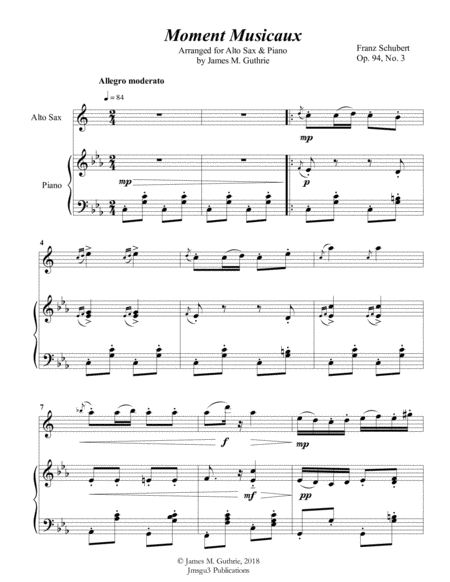
Schubert: Moment Musicaux for Alto Sax & Piano
Saxophone Alto et Piano

$32.95 28.59 € Saxophone Alto et Piano PDF SheetMusicPlus

Alto Saxophone,Piano - Level 3 - Digital Download SKU: A0.844328 Composed by Lyrics: Charles Wesley, Music: Thomas Campbell, published 1738, and published 1825. Arranged by Dan Cutchen. Easter,Gospel,Sacred,Spiritual. Score and part. 15 pages. Dan Cutchen Music #3115903. Published by Dan Cutchen Music (A0.844328). This arrangement of And Can It Be That I Should Gain? is for alto saxophone solo and piano.A theme and variation treatment is used.  For a piano background Mp3 track, search for: Alto Sax - And Can It Be? Theme and Variations-Accompaniment Track, Dan CutchenTime: approximately 6:00And Can It Be That I Should Gain? is a Christian hymn written by Charles Wesley. And Can It Be was written in 1738 to celebrate Wesley's conversion, which he regarded as having taken place on May 21 of that year. This beautiful hymn has been popular and enduring.And Can It Be That I Should Gain is perhaps one of the most joyfully poignant hymns penned by Charles Wesley (1707-1788). On Whitsunday (Pentecost), May 21, 1738, three days before his brother John experienced his heart strangely warmed,’ Charles was convalescing in the home of John Bray, a poor mechanic, when he heard a voice saying, In the name of Jesus of Nazareth, arise, and believe, and thou shalt be healed of all thy infirmities. The voice was most likely Mr. Bray’s sister who felt commanded to say these words in a dream.Anglican hymn writer Timothy Dudley-Smith, notes that the following then happened:Charles got out of bed and opening his Bible read from the Psalms: He have put a new song in my mouth, even praise unto our God, followed by the first verse of Isaiah 40, Comfort ye, comfort ye my people, saith your God. He wrote in his journal, I have found myself at peace with God, and rejoiced in the hope of love Christ (Dudley-Smith, 1987, 1).The statement from Mr. Bray’s sister sparked within Charles a conviction like he had never felt before. Moved and convicted in spirit, Charles wrestled with these words until he came to rest in his faith, knowing that it is by faith we are saved (Ephesians 2:8).Soon after this conversion experience, he wrote two hymns in celebration of the amazing love he had come to know: And Can It Be that I Should Gain and Where Shall My Wondering Soul Begin? (United Methodist Hymnal, 342)There has been some debate as to which hymn was written first, but most current scholarship accepts the latter as the first hymn written by Charles after his conversion experience. No matter its place in the chronology of Wesley's output, And Can It Be has been and remains one of his most remarkable hymns, expressing like no other the rapturous joy of receiving salvation.And Can It Be That I Should Gain. Hymnary.org, https://hymnary.org/text/and_can_it_be_that_i_should_gainDudley-Smith, Timothy. A Flame of Love: A Personal Choice of Charles Wesley’s Verse. London: Triangle SPCK, 1987.Timothy Dudley-Smith. And can it be that I should gain. The Canterbury Dictionary of Hymnology. Canterbury Press, accessed May 29, 2018, http://www.hymnology.co.uk/a/and-can-it-be-that-i-should-gain.Young, Carlton R. And Can It Be That I Should Gain. Companion to the United Methodist Hymnal. Abingdon Press, 1993.(Taken from: History of Hymns: And Can It Be That I Should Gain by DeAndre Johnson found at https://www.umcdiscipleship.org/resources)https://youtu.be/BSX9yYcNY2E
Alto Sax - "And Can It Be?" Theme and Variations
Saxophone Alto et Piano

$7.00 6.07 € Saxophone Alto et Piano PDF SheetMusicPlus

Alto Saxophone,Piano - Level 2 - Digital Download SKU: A0.1190011 Composed by Allesandro Marcello. Arranged by Diego Marani. Baroque,Classical,Instructional,Standards,Wedding. Score and part. 4 pages. Diego Marani #789639. Published by Diego Marani (A0.1190011). The Oboe Concerto in D minor, S D935, is an early 18th-century concerto for oboe, strings and continuo attributed to the Venetian composer Alessandro Marcello. The earliest extant manuscript containing Johann Sebastian Bach's solo keyboard arrangement of the concerto, BWV 974, dates from around 1715.Bach's keyboard version was published as an arrangement of a concerto by Antonio Vivaldi in the 19th century. In 1923 the C minor version of the oboe concerto was published as a composition by Benedetto Marcello, Alessandro's brother. In the second half of the 20th century several publications indicated Alessandro again as the composer of the piece, as it had been in its early 18th-century print, and the oboe concerto was again published in its D minor version.This easy arrangement for alto sax with piano accompaniment of the marvelous second movement (adagio) of the concerto is suitable for any occasion.
Marcello's Adagio for Alto Saxophone and Piano
Saxophone Alto et Piano

$7.99 6.93 € Saxophone Alto et Piano PDF SheetMusicPlus

Alto Saxophone,Piano - Level 3 - Digital Download SKU: A0.1206948 Composed by Johann Sebastian Bach. Arranged by Diego Marani. Baroque,Classical,Instructional,Standards,Wedding. Score and part. 5 pages. Diego Marani #805131. Published by Diego Marani (A0.1206948). The Oboe Concerto in D minor, S D935, is an early 18th-century concerto for oboe, strings and continuo attributed to the Venetian composer Alessandro Marcello. The earliest extant manuscript containing Johann Sebastian Bach's solo keyboard arrangement of the concerto, BWV 974, dates from around 1715.Bach's keyboard version was published as an arrangement of a concerto by Antonio Vivaldi in the 19th century. In 1923 the C minor version of the oboe concerto was published as a composition by Benedetto Marcello, Alessandro's brother. In the second half of the 20th century several publications indicated Alessandro again as the composer of the piece, as it had been in its early 18th-century print, and the oboe concerto was again published in its D minor version.This arrangement for alto sax with piano accompaniment of the marvelous second movement (adagio) of the concerto is suitable for any occasion.
Adagio from BWV 974 for Alto Saxophone and Piano
Saxophone Alto et Piano

$8.99 7.8 € Saxophone Alto et Piano PDF SheetMusicPlus

Alto Saxophone,Piano - Level 1 - Digital Download SKU: A0.1108456 Composed by Sir Arthur Seymour Sullivan. Arranged by Piacere Music Sheets. Instructional,Romantic Period,Standards. Score and part. 13 pages. Piacere Music Sheets #711098. Published by Piacere Music Sheets (A0.1108456). Opus/Catalog Number: IAS 42 Key/Tone: B-flat Major Movements/Sections: Andante moderato Year/Date of Composition: 1858/1877 Difficulty: Grade 3/12 (Easy) Obs.: Sir Arthur Sullivan composed this song at the bedside of his brother Fred during Fred's last illness. Fred Sullivan died five days after, on January 18. This song has been recorded by many singers, including Enrico Caruso, who sang it at the Metropolitan Opera House on 29 April 1912 at a benefit concert for families of victims of the Titanic disaster. The Lost Chord is one of Sullivan's best-known songs, and it is still performed nowadays. This is an arrangement for Alto Saxophone with piano accompaniment. Included: Full score and separated parts for each instrument.
Sullivan - The Lost Chord in B flat Major - Easy
Saxophone Alto et Piano

$8.95 7.77 € Saxophone Alto et Piano PDF SheetMusicPlus

Instrumental Duet,Piano Alto Saxophone,Baritone Saxophone,Instrumental Duet,Piano - Level 3 - Digital Download SKU: A0.636249 By The Everly Brothers. By Carole King and Howard Greenfield. Arranged by Fishel Pustilnik. Rock. Score and parts. 8 pages. F & N Enterprise #6333395. Published by F & N Enterprise (A0.636249). An excellent arrangement of the famous Song Crying In The Rainfor Alto Sax and Piano-Jazz/Pop Version. The video for Violin and Piano: https://youtu.be/iURAuaxX33YThe composition is easy to read, fun to play, and sound professional when performed. Arranged by Fishel Pustilnik, a very well known as Composer/Publisher. His books Jazz & Pop Piano Paradise (Volumes 1-5) have become a commercial success and a hit with music teachers and students in Canada. (Thousands of books already sold in Canada). They are also starting to enter the US, Brazil, Norway, Russia, Holland, Israel, Belgium, Sweden, Finland, Greece, Latvia, and the UK markets. This is a wonderful new publication. These pieces offer much appeal for the young pianist and excellent choice for a supplementary book for students from Grade 3 to 8. Lore Ruschiensky, Editor, (from the review in The Canadian Music Teacher) Yesterday I spent at least two pleasure-filled hours playing through your imaginatively inventive compositions. Congratulations! I trust students will decide to program your well crafted and entertaining works on recitals and examinations. Review from Dr. Jack Behrens, B.Sc. (Julliard), Ph.D. (Harvard), Director of Academic Studies, The Glenn Gould School I liked this book the best so far. Great work! You have a gift for melody and your arrangements are very playable. Congratulations on the 3rd Volume. Mark Carlstein, Hal Leonard, Keyboard Publications.
Crying In The Rain
Saxophone Alto et Piano
The Everly Brothers
$4.99 4.33 € Saxophone Alto et Piano PDF SheetMusicPlus


Partitions Gratuites
Acheter des Partitions Musicales
Acheter des Partitions Digitales à Imprimer
Acheter des Instruments de Musique

© 2000 - 2026

Accueil - Version intégrale





