EUROPE
553 articles
USA
0 articles
DIGITAL
66 articles (ΰ imprimer)
Partitions Digitales
Partitions à imprimer
66 partitions trouvées

1 16 31 ....61

Piano,Tenor Saxophone - Level 2 - Digital Download SKU: A0.549236 Composed by Johann Sebastian Bach. Arranged by James M. Guthrie, ASCAP. Baroque,Easter,Standards,Wedding. Score and part. 8 pages. Jmsgu3 #3468806. Published by jmsgu3 (A0.549236). J. S. Bach BWV 508. Bist du bei mir Bach adapted this aria from a lost StΓΆlzel opera called Diomedes. He changed the original orchestral instrumentation to soprano, strings, and continuo. Β He also modified the voice-leading making it sound more like a Bach composition. The work appears as BWV 508 No. 25 in the Anna Magdalena Notebook No. 2. Β  Source Only a few remnants of the original opera have survived. Historians speculate that Anna Magdalena got the song from the Leipzig Opera after the bankruptcy of 1720. Chances are good, though, that the tune was a favorite of everyone in Leipzig at the time. Β  Lyrics When thou art near, I go with joyTo death and to my rest.O how joyous would my end be,If your fair handsΒ  Β  Β  Β  Β  Β  Would close my faithful eyes. - Unknown Bach Overview First of all, Johann Sebastian Bach is maybe the greatest composer in music history. Certainly, he was prolific. As a result, everyone has heard of his works. Furthermore, these works number well over a thousand. It seems like people are probably most familiar with instrumental works such as the Brandenburg Concertos, and the Goldberg Variations. But, similarly famous are such noteworthy works as the Well-Tempered Clavier, the Musical Offering, and certainly the Art of Fugue. Seems like his most famous vocal works include the most noteworthy Mass in B Minor. Also, most noteworthy are the St. John Passion, and indeed the Christmas Oratorio. Β History Bach came from a long line of musicians and above all, composers. Consequently, he, first of all, pursued a career as a church organist. So as a result, he gained employment in various Protestant churches in Germany. For a while, he worked as a court musician in Weimar and KΓΆthen. Here he probably developed his organ style and likewise his chamber music style. Eventually, he therefore, gained an appointment as Cantor of St. Thomas in Leipzig. Here he worked until difficulties with his employer ultimately drove him away. The King of Poland finally appointed him as court composer. Β Style It seems like Bach created a fascinating new international style. He synthesized elements of the most noteworthy European music ideas into his new style. Even more, this new style was probably his synthesis of European musical rhythm and form. Furthermore, he demonstrated a complete mastery of counterpoint and motivic development. His sense of harmonic organization probably propelled him to the top. Revival Β  Β  Β  Β  Β  Β  Β  Mendelssohn conducted a Bach revival in the nineteenth century. His effort probably helped to re-familiarize the public with the magnitude of Bach’s works. During this period, scholars published many noteworthy Bach biographies. Moreover, Wolfgang Schmieder published the BWV (Bach Werke Verzeichnis). As a result, this is now the official catalog of his entire artistic output. The BWV number allows us to locate a work in the catalog. Sometimes scholars will simply use an S (Schmieder) as an abbreviation for BWV. Β Voyager NASA launched two Voyager spacecraft in 1977. Onboard are phonograph records with sounds, music, and images of life on Earth. The purpose of the launch was to inform intelligent extraterrestrial life forms about conditions on Earth. The music on the disc is varied. There is Bach, Mozart, Beethoven, and Stravinsky among others. However, because Bach is so important in our music history, it contains three times more Bach than all the others combined. Β 
Bach: Bist du bei mir BWV 508 for Tenor Sax & Piano
Saxophone Tenor et Piano

$32.95 28.52 € Saxophone Tenor et Piano PDF SheetMusicPlus

Piano,Tenor Saxophone - Level 3 - Digital Download SKU: A0.549385 Composed by George Frideric Handel. Arranged by James M. Guthrie, ASCAP. Baroque,Sacred,Standards,Wedding. Score and part. 9 pages. Jmsgu3 #3492303. Published by jmsgu3 (A0.549385). Duration: 4:55, Score: 6 pages, Solo part: 1 page, piano part: 2 pages. A very famous aria (Ombra mai fu) from XerxesSuitable for any venue requiring meditative music. Excellent choice for a recital encore. Xerxes Xerxes is, in fact, an opera seria in three acts by Handel. Moreover, Handel conducted the premiere performance in London in 1738. Handel casts the opera in Persia in 470 BC. The part of Xerxes was indeed originally sung by a soprano castrato. Nowadays, the part is generally sung by a mezzo-soprano or conversely a counter-tenor. In the first place, Xerxes sings an opening aria, Ombra mai fu to a plane tree. Handel sets this aria to one of his most truly famous melodies. Although many refer to it traditionally as Handel’s Largo, Handel has, on the contrary, clearly marked Larghetto in the score. Handel Background George FridericΒ Handel (1685 - 1759) was born in Germany but eventually became a British citizen. Nonetheless, he was a famous Baroque composer. In fact, he became famous for his operas, oratorios, anthems, and organ concertos. Handel studied music and, by and large, worked as a composer in Germany and Italy before moving to London. On the whole, Handel was very familiar with the contemporary music of Italy and Germany. Career in England It is essential to realize that Italian opera was all the rage in England at the time. Moreover, Handel was really good at writing them. Therefore, he started not one but three opera companies in England. Alexander's Feast was a huge success in 1736, but Handel began composing English choral works. After success with the MessiahΒ in 1742) he certainly never again wrote an Italian opera. Consequently, he died in 1759, a treasured genius. Accordingly, the English government gave him full state honors at his funeral. Hence, he is buried in Westminster Abbey in London. Legacy Music historians agree that Handel was in general one of the greatest composers of the Baroque era. Β To demonstrate, his works such as the Messiah, Water Music, and Music for the Royal Fireworks remain consistently popular up to the present time. He especially composed the coronation anthem, Zadok the Priest for the coronation of George II. Nevertheless, it has specifically been performed at every succeeding British coronation since. His oratorio Solomon has by all means also continued to be prevalent. As a matter of fact, Sinfonia from act 3 was featured in the 2012 London Olympics opening ceremony. Handel was particularly prolific. To enumerate, he wrote over forty operas. Β Since the late 1960s, we have expressly experienced a revival of baroque music. Similarly, we have especially seen a pique of interest in historically informed musical performances. Since his death in 1779, interest in Handel's music has all in all, expanded. Β 
Handel: Largo from Xerxes for Tenor Sax & Piano
Saxophone Tenor et Piano

$32.95 28.52 € Saxophone Tenor et Piano PDF SheetMusicPlus

Piano,Tenor Saxophone - Level 2 - Digital Download SKU: A0.549845 Composed by Johann Sebastian Bach. Arranged by James M. Guthrie, ASCAP. Baroque,Concert,Easter,Sacred,Standards. Score and part. 12 pages. Jmsgu3 #3554837. Published by jmsgu3 (A0.549845). Wachet auf, ruft uns die Stimme (Awake, the voice is calling us) from Cantata BWV 140. Duration: ca. 4:00, Score: 6 pages, solo part 1 page, piano part: 4 pages. Program this for church services during the Easter season, weddings, or as a recital encore.Wachet auf, ruft uns die Stimme (Awake, the Voice is calling us) also known as: Sleepers Awake Bach composed his church cantata Wachet auf (BWV 140) as part of his second annual cantata cycle covering the entire annual church calendar. It is based on the hymn of the same name by Philipp Nicolai (1599). The hymn text covers the readings for the 27th Sunday after Trinity. Bach designed the cantata in seven movements, setting the stanzas in various forms. Among these forms are the chorale fantasia, the chorale prelude, and a four-part chorale. He casts the new lyrics as recitatives – in a manner similar to the opera. Fourth Movement Bach writes the fourth movement, Zion hΓΆrt die WΓ€chter singen (Zion hears the watchmen singing), in the style of a chorale prelude with the chorale phrases performed as a strict cantus firmus. The phrases seem to enter at times erratically against the famous lyrical melody. The violins play this melody in unison as a foil against the cantus phrases. The violin melody is so independent and complete that when the cantus melody appears it catches the listener at times totally off-guard. Bach later transcribed this movement for organ (BWV 645). This transcription became No. 1 of the Six SchΓΌbler Chorales. Bach Overview First of all, Johann Sebastian Bach is maybe the greatest composer in music history. Certainly, he was prolific. As a result, everyone has heard of his works. Furthermore, these works number well over a thousand. It seems like people are probably most familiar with the instrumental works such as the Brandenburg Concertos, and the Goldberg Variations. But, similarly famous are such noteworthy works as the Well-Tempered Clavier, the Musical Offering, and certainly the Art of Fugue. Seems like his most famous vocal works include the most noteworthy Mass in B Minor. Also, most noteworthy, though, are the St. John Passion, and certainly the Christmas Oratorio.  History Bach came from a long line of musicians and above all, composers. Consequently, he, first of all, pursued a career as a church organist. So as a result, he gained employment in various Protestant churches in Germany. For a while, he worked as a court musician in Weimar and KΓΆthen. Here he probably developed his organ style and likewise his chamber music style. Eventually, he, therefore, gained an appointment as Cantor of St. Thomas in Leipzig. Here he worked until difficulties with his employer ultimately drove him away. The King of Poland finally appointed him as court composer.  Style It seems like Bach created a fascinating new international style. He synthesized elements of the most noteworthy European music ideas into his new style. Even more, this new style was probably his synthesis of European musical rhythm and form. Furthermore, he demonstrated a complete mastery of counterpoint and motivic development. His sense of harmonic organization probably propelled him to the top. Revival               Mendelssohn conducted a Bach revival in the nineteenth century. His effort probably helped to re-familiarize the public with the magnitude of Bach’s works. During this period, scholars published many noteworthy Bach biographies. Moreover, Wolfgang Schmieder published the BWV (Bach Werke Verzeichnis). As a result, this is now the official catalog of his entire artistic output. The BWV number allows us to locate a work in the catalog. Sometimes scholars will simply use an S (Schmieder) as an abbreviation for BWV. &n.
Bach: Wachet auf for Tenor Sax & Piano
Saxophone Tenor et Piano

$24.95 21.59 € Saxophone Tenor et Piano PDF SheetMusicPlus

Piano,Tenor Saxophone - Level 1 - Digital Download SKU: A0.1473534 Composed by Georges Bizet. Arranged by Rodrigo Faleiros. 19th Century,Chamber,Opera,Romantic Period. Score and part. 3 pages. Rodrigo Faleiros #1050879. Published by Rodrigo Faleiros (A0.1473534). ••••••••••••••••••••••••••••••••••••••••••••••••••••••••••••••••••• This arrangement of the iconic Toreador March from the opera Carmen is crafted for solo tenor sax with piano accompaniment. Designed with beginners in mind, the piece simplifies the original rhythm to ensure ease of play while maintaining the essence of the main theme. The challenging dotted 8th note followed by a 16th note rhythm is adapted to a more manageable 3/4 time signature, featuring straightforward half and quarter notes. This arrangement allows novice musicians to experience and perform one of the most recognizable themes in classical music with confidence and enjoyment. Key Features:  Rhythm Simplification: Original dotted 8th note followed by a 16th note adapted to a 3/4 time signature using half and quarter notes  Essence Retained: Maintains the main theme of the iconic Toreador March from the opera Carmen  Piano Part: Includes chord symbols for easier play  Performance: Allows novice musicians to confidently perform a recognizable classical piece Transposed to C Major: For a better sight reading and playing. Check out my other arrangements ?? clicking here ??  •••••••••••••••••••••••••••••••••••••••••••••••••••••••••••••••••••.
Toreador March (from the opera Carmen) - easy version
Saxophone Tenor et Piano

$3.99 3.45 € Saxophone Tenor et Piano PDF SheetMusicPlus

Piano,Tenor Saxophone - Level 1 - Digital Download SKU: A0.1473590 Composed by Georges Bizet. Arranged by Rodrigo Faleiros. 19th Century,Chamber,Opera,Romantic Period. Score and part. 3 pages. Rodrigo Faleiros #1050927. Published by Rodrigo Faleiros (A0.1473590). ••••••••••••••••••••••••••••••••••••••••••••••••••••••••••••••••••• This arrangement of the iconic Toreador March from the opera Carmen is crafted for solo tenor sax with piano accompaniment. Designed with beginners in mind, the piece simplifies the original rhythm to ensure ease of play while maintaining the essence of the main theme. The challenging dotted 8th note followed by a 16th note rhythm is adapted to a more manageable 3/4 time signature, featuring straightforward half and quarter notes. This arrangement allows novice musicians to experience and perform one of the most recognizable themes in classical music with confidence and enjoyment. Key Features:  Rhythm Simplification: Original dotted 8th note followed by a 16th note adapted to a 3/4 time signature using half and quarter notes  Essence Retained: Maintains the main theme of the iconic Toreador March from the opera Carmen  Piano Part: Includes chord symbols for easier play  Performance: Allows novice musicians to confidently perform a recognizable classical piece Transposed to Bb Major: For a better sight reading and playing. Check out my other arrangements ?? clicking here ??  •••••••••••••••••••••••••••••••••••••••••••••••••••••••••••••••••••.
Toreador March (from the opera Carmen) - easy version
Saxophone Tenor et Piano

$3.99 3.45 € Saxophone Tenor et Piano PDF SheetMusicPlus

Piano,Tenor Saxophone - Level 1 - Digital Download SKU: A0.1473408 Composed by Georges Bizet. Arranged by Rodrigo Faleiros. 19th Century,Chamber,Opera,Romantic Period. Score and part. 3 pages. Rodrigo Faleiros #1050839. Published by Rodrigo Faleiros (A0.1473408). ••••••••••••••••••••••••••••••••••••••••••••••••••••••••••••••••••• This arrangement of the iconic Toreador March from the opera Carmen is crafted for solo tenor sax with piano accompaniment. Designed with beginners in mind, the piece simplifies the original rhythm to ensure ease of play while maintaining the essence of the main theme. The challenging dotted 8th note followed by a 16th note rhythm is adapted to a more manageable 3/4 time signature, featuring straightforward half and quarter notes. This arrangement allows novice musicians to experience and perform one of the most recognizable themes in classical music with confidence and enjoyment. Key Features:  Rhythm Simplification: Original dotted 8th note followed by a 16th note adapted to a 3/4 time signature using half and quarter notes  Essence Retained: Maintains the main theme of the iconic Toreador March from the opera Carmen  Piano Part: Includes chord symbols for easier play  Performance: Allows novice musicians to confidently perform a recognizable classical piece  Check out my other arrangements ?? clicking here ??  •••••••••••••••••••••••••••••••••••••••••••••••••••••••••••••••••••.
Toreador March (from the opera Carmen) - easy version
Saxophone Tenor et Piano

$3.99 3.45 € Saxophone Tenor et Piano PDF SheetMusicPlus

Piano,Tenor Saxophone - Level 1 - Digital Download SKU: A0.1474033 Composed by Georges Bizet. Arranged by Rodrigo Faleiros. 19th Century,Chamber,Opera,Romantic Period. Score and part. 3 pages. Rodrigo Faleiros #1051001. Published by Rodrigo Faleiros (A0.1474033). ••••••••••••••••••••••••••••••••••••••••••••••••••••••••••••••••••• This arrangement of the iconic Toreador March from the opera Carmen is crafted for solo tenor sax with piano accompaniment. Designed with beginners in mind, the piece simplifies the original rhythm to ensure ease of play while maintaining the essence of the main theme. The challenging dotted 8th note followed by a 16th note rhythm is adapted to a more manageable 3/4 time signature, featuring straightforward half and quarter notes. This arrangement allows novice musicians to experience and perform one of the most recognizable themes in classical music with confidence and enjoyment. Key Features:  Rhythm Simplification: Original dotted 8th note followed by a 16th note adapted to a 3/4 time signature using half and quarter notes  Essence Retained: Maintains the main theme of the iconic Toreador March from the opera Carmen  Performance: Allows novice musicians to confidently perform a recognizable classical piece Transposed to G Major: For a better sight reading and playing. Check out my other arrangements ?? clicking here ??  •••••••••••••••••••••••••••••••••••••••••••••••••••••••••••••••••••.
Toreador March (from the opera Carmen) - easy version
Saxophone Tenor et Piano

$3.99 3.45 € Saxophone Tenor et Piano PDF SheetMusicPlus

Piano,Tenor Saxophone - Level 1 - Digital Download SKU: A0.1473409 Composed by Georges Bizet. Arranged by Rodrigo Faleiros. 19th Century,Chamber,Opera,Romantic Period. Score and part. 3 pages. Rodrigo Faleiros #1050840. Published by Rodrigo Faleiros (A0.1473409). ••••••••••••••••••••••••••••••••••••••••••••••••••••••••••••••••••• This arrangement of the iconic Toreador March from the opera Carmen is crafted for solo tenor sax with piano accompaniment. Designed with beginners in mind, the piece simplifies the original rhythm to ensure ease of play while maintaining the essence of the main theme. The challenging dotted 8th note followed by a 16th note rhythm is adapted to a more manageable 3/4 time signature, featuring straightforward half and quarter notes. This arrangement allows novice musicians to experience and perform one of the most recognizable themes in classical music with confidence and enjoyment. Key Features:  Rhythm Simplification: Original dotted 8th note followed by a 16th note adapted to a 3/4 time signature using half and quarter notes  Essence Retained: Maintains the main theme of the iconic Toreador March from the opera Carmen  Performance: Allows novice musicians to confidently perform a recognizable classical piece  Check out my other arrangements ?? clicking here ??  •••••••••••••••••••••••••••••••••••••••••••••••••••••••••••••••••••.
Toreador March (from the opera Carmen) - easy version
Saxophone Tenor et Piano

$3.99 3.45 € Saxophone Tenor et Piano PDF SheetMusicPlus

Piano,Tenor Saxophone - Level 1 - Digital Download SKU: A0.1474032 Composed by Georges Bizet. Arranged by Rodrigo Faleiros. 19th Century,Chamber,Opera,Romantic Period. Score and part. 3 pages. Rodrigo Faleiros #1051000. Published by Rodrigo Faleiros (A0.1474032). ••••••••••••••••••••••••••••••••••••••••••••••••••••••••••••••••••• This arrangement of the iconic Toreador March from the opera Carmen is crafted for solo tenor sax with piano accompaniment. Designed with beginners in mind, the piece simplifies the original rhythm to ensure ease of play while maintaining the essence of the main theme. The challenging dotted 8th note followed by a 16th note rhythm is adapted to a more manageable 3/4 time signature, featuring straightforward half and quarter notes. This arrangement allows novice musicians to experience and perform one of the most recognizable themes in classical music with confidence and enjoyment. Key Features:  Rhythm Simplification: Original dotted 8th note followed by a 16th note adapted to a 3/4 time signature using half and quarter notes  Essence Retained: Maintains the main theme of the iconic Toreador March from the opera Carmen  Performance: Allows novice musicians to confidently perform a recognizable classical piece Transposed to G Major: For a better sight reading and playing. Check out my other arrangements ?? clicking here ??  •••••••••••••••••••••••••••••••••••••••••••••••••••••••••••••••••••.
Toreador March (from the opera Carmen) - easy version
Saxophone Tenor et Piano

$3.99 3.45 € Saxophone Tenor et Piano PDF SheetMusicPlus

Piano,Tenor Saxophone - Level 1 - Digital Download SKU: A0.1473591 Composed by Georges Bizet. Arranged by Rodrigo Faleiros. 19th Century,Chamber,Opera,Romantic Period. Score and part. 3 pages. Rodrigo Faleiros #1050929. Published by Rodrigo Faleiros (A0.1473591). ••••••••••••••••••••••••••••••••••••••••••••••••••••••••••••••••••• This arrangement of the iconic Toreador March from the opera Carmen is crafted for solo tenor sax with piano accompaniment. Designed with beginners in mind, the piece simplifies the original rhythm to ensure ease of play while maintaining the essence of the main theme. The challenging dotted 8th note followed by a 16th note rhythm is adapted to a more manageable 3/4 time signature, featuring straightforward half and quarter notes. This arrangement allows novice musicians to experience and perform one of the most recognizable themes in classical music with confidence and enjoyment. Key Features:  Rhythm Simplification: Original dotted 8th note followed by a 16th note adapted to a 3/4 time signature using half and quarter notes  Essence Retained: Maintains the main theme of the iconic Toreador March from the opera Carmen  Performance: Allows novice musicians to confidently perform a recognizable classical piece Transposed to Bb Major: For a better sight reading and playing. Check out my other arrangements ?? clicking here ??  •••••••••••••••••••••••••••••••••••••••••••••••••••••••••••••••••••.
Toreador March (from the opera Carmen) - easy version
Saxophone Tenor et Piano

$3.99 3.45 € Saxophone Tenor et Piano PDF SheetMusicPlus

Piano,Tenor Saxophone - Level 1 - Digital Download SKU: A0.1473535 Composed by Georges Bizet. Arranged by Rodrigo Faleiros. 19th Century,Chamber,Opera,Romantic Period. Score and part. 3 pages. Rodrigo Faleiros #1050880. Published by Rodrigo Faleiros (A0.1473535). ••••••••••••••••••••••••••••••••••••••••••••••••••••••••••••••••••• This arrangement of the iconic Toreador March from the opera Carmen is crafted for solo tenor sax with piano accompaniment. Designed with beginners in mind, the piece simplifies the original rhythm to ensure ease of play while maintaining the essence of the main theme. The challenging dotted 8th note followed by a 16th note rhythm is adapted to a more manageable 3/4 time signature, featuring straightforward half and quarter notes. This arrangement allows novice musicians to experience and perform one of the most recognizable themes in classical music with confidence and enjoyment. Key Features:  Rhythm Simplification: Original dotted 8th note followed by a 16th note adapted to a 3/4 time signature using half and quarter notes  Essence Retained: Maintains the main theme of the iconic Toreador March from the opera Carmen  Performance: Allows novice musicians to confidently perform a recognizable classical piece Transposed to C Major: For a better sight reading and playing. Check out my other arrangements ?? clicking here ??  •••••••••••••••••••••••••••••••••••••••••••••••••••••••••••••••••••.
Toreador March (from the opera Carmen) - easy version
Saxophone Tenor et Piano

$3.99 3.45 € Saxophone Tenor et Piano PDF SheetMusicPlus

Piano,Tenor Saxophone - Level 3 - Digital Download SKU: A0.549642 Composed by Ludwig van Beethoven. Arranged by James M. Guthrie, ASCAP. Concert,Instructional,Romantic Period,Sacred,Standards. Score and part. 16 pages. Jmsgu3 #3516585. Published by jmsgu3 (A0.549642). Duration: ca 5:20, Score: 8 pages, solo part: 3 pages, piano part: 4 pages.One of Beethoven's finest and most famous works. Program for a recital, church meditation or school program.Bring your best espressivo and plan to rehearse the many subtle dynamic changes.Sonata PathΓ©tique Op. 13 First of all, this is an arrangement of the second movement of Beethoven’s Sonata PathΓ©tique. It seems like Beethoven wrote this piece before becoming troubled by deafness. Published in 1799, it consequently remains one of the most celebrated pieces Beethoven ever wrote. As a result of its popularity, the movement was therefore performed by Karl Haas. Hass recorded it for a popular radio show called: Adventures in Good Music. Beethoven Background Ludwig van Beethoven (1770 –1827) was certainly a German pianist. Above all, he was probably one of the greatest composers in history. As a result, he is a pivotal character in the progress between the Classical and Romantic periods. He is certainly one of the most famous and hence important of all composers. Seems like his most familiar and noteworthy works include symphonies 1-9; piano concertos 1-5; and furthermore, the violin concerto. Also, certainly of extreme importance are the noteworthy 32 sonatas for the piano; the string quartets 1-16; the Missa solemnis; and likewise, his only opera, Fidelio. Beethoven Overview First of all, Beethoven was born and consequently raised in Bonn. Upon turning 21 he moved to Vienna probably to study composition with Haydn. That’s when he consequently grew a reputation as a brilliant pianist. Furthermore, he probably stayed in Vienna for the rest of his life. In his late 20s, it seems like his hearing certainly began to decline. It slowly declined until consequently, he was nearly totally deaf probably by the last decade of his life. As a result, he stopped conducting and performing. Nevertheless, he continued to compose. As a result, some of his greatest works probably come from this period. First Period Seems like we often divide Beethoven’s life into three periods. Period 1 begins with Beethoven’s arrival in Vienna. Hence, during this period, he mastered the Viennese style of Haydn & Mozart. He consequently began increasing the size and scale of his works. Furthermore, he experimented with extreme dynamics, and likewise extreme tempi. He worked similarly with chromatic harmony. His First and Second Symphonies, therefore, belong to this period. Other important works also belong here: the first six string quartets and the Sonata PathΓ©tique, Op. 13. Second Period His second period probably began as soon as he realized that he was going deaf. During this period, it seems like he became obsessed with the idea of heroism. His works consequently become even larger and more massive. The most noteworthy of these include the symphonies 3 – 8, piano concertos 5& 6, 5 string quartets, several important piano sonatas (Waldstein and Appassionata), the Kreutzer violin sonata, the violin concerto and his only opera: Fidelio. Third Period In contrast, Beethoven's third period is branded above all by works of incredible intellectual depth, formal innovation, and penetrating expression. It seems like he continued to expand his works. Consequently, the string quartet Op. 131 spills over into seven connected movements. Likewise, in the Ninth Symphony, he adds choral forces to his orchestra probably for the first time in history. Even more, other works from this period include his Missa solemnis, the final 5 string quartets (including the enormous Große Fuge) and the final five sonatas for piano.    
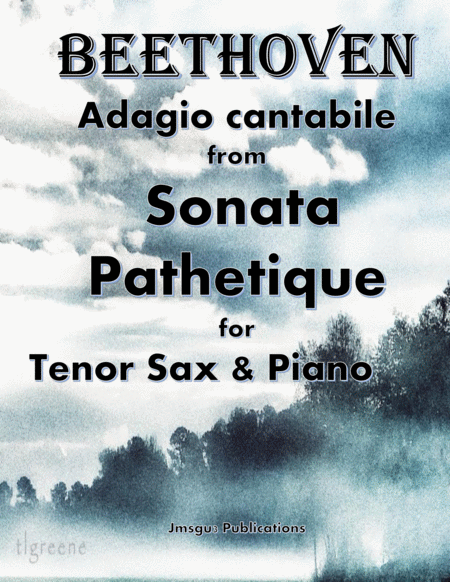
Beethoven: Adagio from Sonata Pathetique for Tenor Sax & Piano
Saxophone Tenor et Piano

$24.95 21.59 € Saxophone Tenor et Piano PDF SheetMusicPlus

Piano,Tenor Saxophone - Level 1 - Digital Download SKU: A0.548677 Composed by Adam. Arranged by James M. Guthrie, ASCAP. Christian,Christmas. Score and part. 10 pages. Jmsgu3 #3410441. Published by jmsgu3 (A0.548677). Duration: 4:56. Score 5 pg. 44 ms. Solo part: 2 pg. Piano part: 3 pg.Cantique de NoΓ«l The French composer Adolphe Adam was already famous as a composer of many successful ballets and operas. Then, in the 1840’s he wrote his most famous work - O Holy Night. The original song title was Minuit Chretiens or Cantique de NoΓ«l.  Placide Cappeau provided the original song lyrics. The song was first performed in Roquemaure by the opera singer Emily Laurey at midnight mass in 1847. It became very popular among the French, much the way that Silent Night was famous elsewhere. In the 1850’s John S. Dwight, a Unitarian minister and music teacher translated the song into English.   Adolphe Adam In his younger years, Adam studied organ and composition at the Paris Conservatoire. He also played the timpani in the Conservatoire orchestra. Adam used his savings and borrowed money to open a new opera house - the fourth opera house in Paris in 1847. Unfortunately, the Revolution of 1848 forced him to close. He taught composition at the Paris Conservatoire from 1849 until his death in 1856. Placide Cappeau The poet Cappeau was an advocate of the French Enlightenment philosopher Voltaire.  Voltaire was renowned for criticizing the Catholic church, religious intolerance, and dogma in general. Consequently, Cappeau made the Redeemer figure in his song a kind of reformer of injustices, in particular, the problem of original sin. To begin with, people recognized Cappeau’s theology as eccentric, probably even doubtful. Theology In the earlier form of Minuit, the Christ figure descends to intervene with His Father’s plan to punish mankind.  Traditional doctrine pronounces that Christ came from love, not to intervene. This version also declares that Christ appeared to expunge the original sin of Adam. Cappeau removed this part from his poem years later, because he just didn’t believe it.  He preferred to portray Christ as the reformer of disparity and unfairness. Before long, the writer/politician Alphonse de Lamartine referred to the Minuit as the the Marseillaise of religion. Most French churchmen agreed with this idea but certainly did not consider it a tribute.  Register for free lifetime updates and revisions at www.jamesguthrie.com
O Holy Night for Tenor Sax & Piano
Saxophone Tenor et Piano

$24.95 21.59 € Saxophone Tenor et Piano PDF SheetMusicPlus

Piano,Tenor Saxophone - Level 3 - Digital Download SKU: A0.587623 Composed by Various. Arranged by David McKeown. Baroque,Concert,Romantic Period,Standards,Wedding. Score and part. 24 pages. David McKeown #4594681. Published by David McKeown (A0.587623). The Wedding Album is a collection of four beautiful and timeless wedding favourites, arranged for Solo Tenor Saxophone with Piano accompaniment. Whether for that Special Day, for a recital, or for your own entertainment, these arrangements are ideal for players at an intermediate level or higher. The 24-page file includes the piano accompaniments and the separate solo parts at the end. Ave Maria was written by Franz Schubert in 1825 as the sixth song in his song cycle based on Walter Scott’s poem The Lady of the Lake. It is perhaps the best known of all his melodies, adapted for piano by Franz Liszt, and for orchestra many times since. It is often sung with the Latin lyrics of the Catholic hymn of the same name and has been heard everywhere from the Disney movie Fantasia to the funeral of J.F. Kennedy. The Bridal March was written by Richard Wagner in 1850, scored for orchestra and chorus, and opening the third act of his opera, Lohingren. It is best known in the English-speaking world as Here Comes the Bride. Queen Victoria’s daughter used the music for her marriage in 1858, and its popularity has endured ever since.The Prince of Denmark’s March is better known nowadays as the Trumpet Voluntary and is often used in wedding ceremonies. It was in fact written for organ, with the melody played on thetrumpet stop.  Written around 1700, for many years this piece was mistakenly attributed to Henry Purcell. Only recently has it been established that the composer was Jeremiah Clarke, organist at St Paul’s Cathedral. It is somewhat ironic that this composer of a wedding mainstay was himself a victim of unrequited love. He consequently shot himself in the cathedral graveyard. Felix Mendelssohn’s Wedding March was originally written in 1842 as incidental music to Shakespeare’s famousplay, Midsummer Night’s Dream. When Queen Victoria’s daughter used the music for her marriage in 1858, it became instantly popular and has remained a wedding favourite ever since.These four arrangements are also available as single titles for $3.99 each. You can find these along with many more top quality arrangements and compositions by David McKeown at http://www.sheetmusicplus.com/publishers/david-mckeown/6203 
The Wedding Album, for Solo Tenor Saxophone and Piano
Saxophone Tenor et Piano

$9.99 8.65 € Saxophone Tenor et Piano PDF SheetMusicPlus

Piano,Tenor Saxophone - Level 2 - Digital Download SKU: A0.587927 Composed by G F Handel. Arranged by David McKeown. Baroque,Concert,Opera,Standards. Score and part. 4 pages. David McKeown #5044841. Published by David McKeown (A0.587927). Lascia ch’io Pianga is a beautiful aria from Handel’s Opera Rinaldo The opera premiered in London in 1711 and during his lifetime was the most successful of Handel’s operas. However, following his death there were no further productions until a school in London revived it in 1933. Handel used the melody of Lascia ch’io Pianga in two other works, but it is the version from Rinaldo that has achieved a deserved place in the concert hall, and a starring role in films like Farinelli.This version of Lascia ch’io Pianga is arranged as a Solo for Tenor Saxophone and Piano and both parts are reasonably simple; the performance time is around three and a half minutes. The pdf file contains both the piano score and a separate solo part. You can listen to a full performance of this arrangement on Alto Saxophone via the YouTube link above.Musicians at an early intermediate level and above will find Lascia ch’io Pianga ideal for formal and informal performances, with both the solo and accompaniment enjoying melodic interest. Teachers will enjoy using this arrangement as a fun way to help with developing tone, phrasing and expression. There are many more top quality arrangements and compositions by David McKeown for you to browse at http://www.sheetmusicplus.com/publishers/david-mckeown/6203 
Lascia Ch'io Pianga, Aria from Rinaldo, by G F Handel, for Tenor Saxophone and Piano
Saxophone Tenor et Piano

$4.60 3.98 € Saxophone Tenor et Piano PDF SheetMusicPlus


1 16 31 ....61


Partitions Gratuites
Acheter des Partitions Musicales
Acheter des Partitions Digitales à Imprimer
Acheter des Instruments de Musique

© 2000 - 2026

Accueil - Version intégrale





