EUROPE
3238 articles
USA
0 articles
DIGITAL
39 articles (à imprimer)
Partitions Digitales
Partitions à imprimer
39 partitions trouvées


Piano,Tenor Saxophone - Level 4 - Digital Download SKU: A0.551574 Composed by Johann Sebastian Bach. Arranged by James Guthrie, ASCAP. Baroque,Instructional,Standards,Wedding. Score and part. 22 pages. Jmsgu3 #5317607. Published by jmsgu3 (A0.551574). BACH: Sonata in C Major BWV 1033, Duration: 8:30, Score:13 pages.1. Andante - Presto2. Allegro3. Adagio4. Menuet I.5. Menuet II.Johann Sebastian Bach was a German composer, musician, organist, and harpsichordist in the Baroque period of music. He is considered one of the greatest and most influential composers of his time and of all time, and his works form an essential part of the standard concert repertoire. Bach is credited with being largely responsible for the development of the sonata form in the Baroque era. He created several new forms of writing, such as the sinfonia and the prelude, which became popular in the Baroque. Bach also regularly combined two or three voice parts in the form of canons or fugues. His forms were complex and innovative and helped to establish the sonata as a form of composition. He composed some of the most famous and beautiful sonatas in music history. Bach's influence on the sonata form was massive.
BACH: Sonata in C Major BWV 1033 for Tenor Sax & Piano
Saxophone Tenor et Piano

$32.95 27.86 € Saxophone Tenor et Piano PDF SheetMusicPlus

Piano,Tenor Saxophone - Level 4 - Digital Download SKU: A0.533440 Composed by Johann Sebastian Bach. Arranged by Paul Wehage. Baroque,Concert,Standards. Score and part. 35 pages. Musik Fabrik Music Publishing #2914077. Published by Musik Fabrik Music Publishing (A0.533440). In 1720 J. S. Bach was in the service of Prince Leopold of Anhalt-Cöthen, serving as his Kapellmeister. Since the court of Anhalt-Cöthen was Calvinist, Church music was limited to congregational psalms and hymns. Bach’s work during this period consisted of writing chamber music for the Prince, who was an accomplished violinist, gambist and harpsichordist. Other works from this period include the Cello Suites, the violin and keyboard sonatas,, the Flute sonatas and the partita for solo flute and the Orchestral SuitesThe Sonata no. III in g minor is written in a three-movement Concerto form. The first movement uses a main theme close to that of the first theme of the Third Brandeburg concerto. The slow movement is static and very sparce, but very expressive. The third movement is in the form of a gigue in the Italian style..
J. S. Bach: Sonata no. 3 in g minor, bwv 1029, arranged for tenor saxophone and keyboard by Paul Weh
Saxophone Tenor et Piano

$16.95 14.33 € Saxophone Tenor et Piano PDF SheetMusicPlus

Piano,Tenor Saxophone - Level 2 - Digital Download SKU: A0.550935 Composed by J. S. Bach - Gounod. Arranged by James M. Guthrie, ASCAP. Christmas,Concert,Contemporary,Easter,Wedding. Score and part. 12 pages. Jmsgu3 #4888767. Published by jmsgu3 (A0.550935). This arrangement features the controversial Schwencke measure (ms. 27) that was originally introduced in 1783 by Christian Friedrich Gottlieb Schwencke. The convenient 1st & 2nd endings provide an option for extended performance. Duration with repeat - 4:50. Score: 7 pages. Solo part: 1 page, piano part: 4 pages. Based on Prelude #1 in C Major from the Well-Tempered Clavier, Book 1. Well suited for church meditations or school programs or recital encores. Register for free lifetime updates and revisions at www.jamesguthrie.comAve MariaAve Maria is a Catholic prayer that consequently asks for the mother of Jesus (Mary) to intercede. Charles Gounod composed a famous version of the Ave Maria. He was a French Romantic composer who overlaid a new melody on an existing Bach chord progression. The progression is from Bach’s Prelude No. 1 from Well-Tempered Clavier I. This version, as well as Schubert’s version, have become essential items at weddings, masses, and funerals.Bach OverviewFirst of all, Johann Sebastian Bach is maybe the greatest composer in music history. Certainly, he was prolific. As a result, everyone has heard of his works. Furthermore, these works number well over a thousand. It seems like people are probably most familiar with the instrumental works such as the Brandenburg Concertos, and the Goldberg Variations. But, similarly famous are such noteworthy works as the Well-Tempered Clavier, the Musical Offering, and certainly the Art of Fugue. Seems like his most famous vocal works include the most noteworthy Mass in B Minor. Also, most noteworthy, though, are the St. John Passion, and certainly the Christmas Oratorio. HistoryBach came from a long line of musicians and above all, composers. Consequently, he, first of all, pursued a career as a church organist. So as a result, he gained employment in various Protestant churches in Germany. For a while, he worked as a court musician in Weimar and Köthen. Here he probably developed his organ style and likewise his chamber music style. Eventually, he, therefore, gained an appointment as Cantor of St. Thomas in Leipzig. Here he worked until difficulties with his employer ultimately drove him away. The King of Poland finally appointed him as a court composer. StyleIt seems like Bach created a fascinating new international style. He synthesized elements of the most noteworthy European music ideas into his new style. Even more, this new style was probably his synthesis of European musical rhythm and form. Furthermore, he demonstrated a complete mastery of counterpoint and motivic development. His sense of harmonic organization probably propelled him to the top.Revival              Mendelssohn conducted a Bach revival in the nineteenth century. His effort probably helped to re-familiarize the public with the magnitude of Bach’s works. During this period, scholars published many noteworthy Bach biographies. Moreover, Wolfgang Schmieder published the BWV (Bach Werke Verzeichnis). As a result, this is now the official catalog of his entire artistic output. The BWV number allows us to locate a work in the catalog. Sometimes scholars will simply use an S (Schmieder) as an abbreviation for BWV. VoyagerNASA launched two Voyager spacecraft in 1977. Onboard are phonograph records with sounds, music, and images of life on Earth. The purpose of the launch was to inform intelligent extraterrestrial life forms about conditions on Earth. The music on the disc is varied. There is Bach, Mozart, Beethoven and Stravinsky among others. However, because Bach is so important in our music history, it contains three times more Bach that all the others combined.
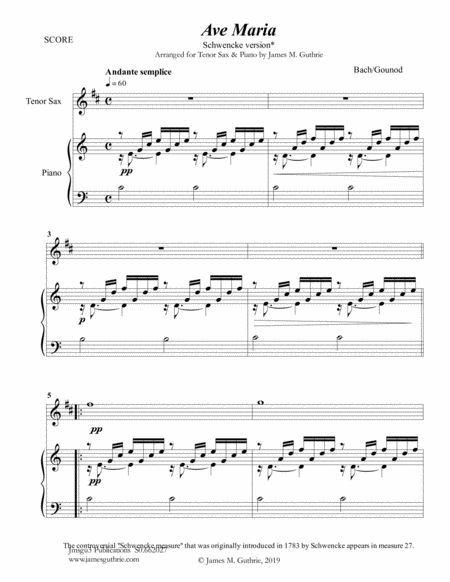
Bach-Gounod: Ave Maria, Schwencke version for Tenor Sax & Piano
Saxophone Tenor et Piano

$27.95 23.63 € Saxophone Tenor et Piano PDF SheetMusicPlus

Piano,Tenor Saxophone - Level 2 - Digital Download SKU: A0.549367 Composed by Bach-Gounod. Arranged by James M. Guthrie, ASCAP. Christmas,Contemporary,Easter,Wedding. Score and part. 12 pages. Jmsgu3 #3490159. Published by jmsgu3 (A0.549367). This arrangement follows the original Bach prelude and so excludes the extra measure that Schwencke introduced in 1783. If you prefer the extra measure, please see Bach-Gounod: Ave Maria, Schwencke version for Tenor Sax & Piano - S0.662027. The convenient 1st & 2nd endings provide an option for extended performance with minimal page turns for the accompanist. The duration with repeat is about 4:50. Score: 6 pages. Solo part: 1 page, piano part: 4 pages. Based on Prelude #1 in C Major from the Well-Tempered Clavier, Book 1. Well suited for church meditations or school programs or recital encores. Ave Maria Ave Maria is a Catholic prayer that consequently asks for the mother of Jesus (Mary) to intercede. Charles Gounod composed a famous version of the Ave Maria. He was a French Romantic composer who overlaid a new melody on an existing Bach chord progression. The progression is from Bach’s Prelude No. 1 from Well-Tempered Clavier I. This version, as well as Schubert’s version, have become essential items at weddings, masses, and funerals. Bach Overview First of all, Johann Sebastian Bach is maybe the greatest composer in music history. Certainly, he was prolific. As a result, everyone has heard of his works. Furthermore, these works number well over a thousand. It seems like people are probably most familiar with instrumental works such as the Brandenburg Concertos, and the Goldberg Variations. But, similarly famous are such noteworthy works as the Well-Tempered Clavier, the Musical Offering, and the Art of Fugue. Seems like his most famous vocal works include the most noteworthy Mass in B Minor. Also, most noteworthy, though, are the St. John Passion, and certainly the Christmas Oratorio.  History Bach came from a long line of musicians and above all, composers. Consequently, he, first of all, pursued a career as a church organist. So as a result, he gained employment in various Protestant churches in Germany. For a while, he worked as a court musician in Weimar and Köthen. Here he probably developed his organ style and likewise his chamber music style. Eventually, he gained an appointment as Cantor of St. Thomas in Leipzig. Here he worked until difficulties with his employer ultimately drove him away. The King of Poland finally appointed him as court composer.  Style It seems like Bach created an engaging new international style. He synthesized elements of the most noteworthy European music ideas into his new style. Even more, this new style was probably his synthesis of European musical rhythm and form. Furthermore, he demonstrated a complete mastery of counterpoint and motivic development. His sense of harmonic organization probably propelled him to the top. Revival               Mendelssohn conducted a Bach revival in the nineteenth century. His effort probably helped to re-familiarize the public with the magnitude of Bach’s works. During this period, scholars published many noteworthy Bach biographies. Moreover, Wolfgang Schmieder published the BWV (Bach Werke Verzeichnis). As a result, this is now the official catalog of his entire artistic output. The BWV number allows us to locate a work in the catalog. Sometimes scholars will simply use an S (Schmieder) as an abbreviation for BWV.  
Bach-Gounod: Ave Maria for Tenor Sax & Piano
Saxophone Tenor et Piano

$32.95 27.86 € Saxophone Tenor et Piano PDF SheetMusicPlus

Piano,Tenor Saxophone - Level 4 - Digital Download SKU: A0.551522 Composed by Carl Philipp Emanuel Bach (1714-1788). Arranged by James Guthrie, ASCAP. Classical,Instructional,Standards,Wedding. Score and part. 22 pages. Jmsgu3 #5308653. Published by jmsgu3 (A0.551522). Sonata in E Minor, Score: 11 pages, Duration: 7:151. Adagio2. Allegro3. Menuett & 2 VariationsCarl Philipp Emanuel Bach (1714-1788) was an influential composer who worked during a time of transition between the Baroque and Classical styles of music. His personal approach, known as empfindsamer Stil or sensitive style, applied the principles of rhetoric and drama to musical structures. The duets composed by C.P.E. Bach are significant because they showcase his unique style and are considered to be some of his most important works. They are known for their unpredictability and expressive qualities, which were a departure from the style of his father, Johann Sebastian Bach.
CPE BACH: Sonata in E Minor WQ124 for Tenor Sax & Piano
Saxophone Tenor et Piano

$24.95 21.1 € Saxophone Tenor et Piano PDF SheetMusicPlus

Piano,Tenor Saxophone - Level 1 - Digital Download SKU: A0.1045602 Composed by Johann Sebastian Bach. Arranged by Ander. Baroque,Easter,Traditional,Wedding. Score and part. 4 pages. Woods Only, Arrangements #650181. Published by Woods Only, Arrangements (A0.1045602). This easy arrangement for tenor sax and piano was written to be uncomplicated to perform and understand the structure of the piece. It can be freely played by beginning students, because of the ease imposed on the piece; however, this does not prevent it from being played by professionals and music teachers. It is also ideal for academic recitals, student method and ceremonies that are arranged in the same way as the piece contains. The original piece is part of Johann Sebastian Bach's Suite No. 3 for orchestra, in D Major, BWV 1068, written for Prince Leopold of Anhalt. The so-called Air on the G String dates from one of these latter employments. In the service of the Prince of Cöthen, Bach composed not only the famous Brandenburg Concertos, but also several orchestral suites, from the third of which comes the Air on the G String. This curious title derives from a later arrangement of this piece for violin solo, in which the melody is played entirely on the lower, higher string of the instrument.
Air on the G String by Bach for Tenor Sax and Piano
Saxophone Tenor et Piano

$1.99 1.68 € Saxophone Tenor et Piano PDF SheetMusicPlus

Piano,Tenor Saxophone - Level 3 - Digital Download SKU: A0.525044 Composed by Johann Sebastian Bach. Arranged by John A. Dempsey. Baroque,Christmas,Easter,Traditional,Wedding. Score and part. 16 pages. John A. Dempsey #6622257. Published by John A. Dempsey (A0.525044). With its bell-like refrain, Bach's exquisite, elegant Sheep May Safely Graze (from Cantata, No. 208) appeals not only to fans of the Baroque era but also to lovers of classical, romantic and pop music. This duet for tenor sax and piano is recommended for concerts, recitals, weddings, traditional church services and other worship events.  Suggested wedding uses: prelude, unity candle music, bridesmaid processional, bridal march and wedding recessional.  As worship music, Sheep May Safely Graze may serve as a prelude, postlude, Christmas play overture, an offertory, interlude, silent prayer accompaniment and special music.  12 pages of music (that includes a separate two-page tenor sax part).  Concert Key (Piano): Bb major.  Tenor Sax Key: C major
Sheep May Safely Graze (Bach): Tenor Sax and Piano
Saxophone Tenor et Piano

$6.99 5.91 € Saxophone Tenor et Piano PDF SheetMusicPlus


Partitions Gratuites
Acheter des Partitions Musicales
Acheter des Partitions Digitales à Imprimer
Acheter des Instruments de Musique

© 2000 - 2026

Accueil - Version intégrale





