EUROPE
4735 articles
USA
0 articles
DIGITAL
21 articles (à imprimer)
Partitions Digitales
Partitions à imprimer
21 partitions trouvées


Tenor saxophone in Bb and piano - Digital Download SKU: S9.Q41487 From Children's Corner. Composed by Claude Debussy. Arranged by Wolfgang Birtel. This edition: Sheet music. Edition Schott - Single Edition. Downloadable. Schott Music - Digital #Q41487. Published by Schott Music - Digital (S9.Q41487). The famous Golliwogg’s Cakewalk is the final piece from Debussy's cycle Children’s Corner which consists of 6 miniatures for piano, written for his daughter in the years 1906-1908. The style corresponds to that of ragtime, a dance which was in vogue around the turn of the century. In the middle section, he parodies several times the beginning of the opera Tristan and Isolde by Richard Wagner with whom Debussy had a rather ambiguous relationship. The present arrangement now allows musicians to play the popular movement in a version for melodic instrument with accompaniment.n und Isolde von Richard Wagner, zu dem Debussy ein eher zwiespältiges Verhältnis hatte.
Golliwogg's Cakewalk
Saxophone Tenor et Piano

$5.99 5.2 € Saxophone Tenor et Piano PDF SheetMusicPlus

Piano,Tenor Saxophone - Level 3 - Digital Download SKU: A0.549469 Composed by Alexander Scriabin. Arranged by James M. Guthrie, ASCAP. Concert,Instructional,Romantic Period,Sacred,Standards. Score and part. 12 pages. Jmsgu3 #3499759. Published by jmsgu3 (A0.549469). Score: 8 pages, solo part: 2 pages, piano part: 2 pages. Duration: 3:10. An introspective and meditative work with a lot of dynamic and phrasing nuance. Works well for church meditations or recital encores. Background Op.11/2 Alto Clarinet version. First of all, Scriabin composed mostly for the solo piano and also the orchestra. This is probably because he was a gifted pianist and therefore certainly appreciated the piano. Scriabin grew up in the late Romantic period, consequently, he was fond of the great piano masters of the time. As a result, he wrote his first noteworthy compositions in the manner of Chopin and Liszt. Forms Likewise, Scriabin used many of the same forms as Chopin. These certainly include the étude, prelude, nocturne, and even the mazurka. In contrast, as he developed his own sense of style his music became more and more unusual. So, the last five of his Piano Sonatas do not have a key signature and therefore lean towards atonality. Philosophy Scriabin also developed a keen interest in philosophy and likewise poetry. He was above all particularly fascinated by Nietzsche, Delville, and Blavatsky. Consequently, he finally established his own ideas about metaphysics and certainly mysticism. Scriabin consequently advanced theories about the relationship between color and musical keys. Synesthesia He also may have experienced a condition called synesthesia where he could probably sense a response created from a different stimulus. Therefore, it was almost as if he could see music and hear colors. Scriabin, therefore, arranged the colors in a circle similar to the circle-of-fifths and assigned each key area a color. Finally, he assigned the key of C to the color red, while the key of G was orange. Similarly, he assigned D to yellow, A to green, and so forth. Strangely, he did not differentiate between major and minor key colors.  Multimedia Hence, his ability to translate colors into music certainly gave Scriabin a most noteworthy interest in creating multimedia events. Furthermore, He designed his biggest work, the Mysterium, to last an entire week. Even more, Scriabin made plans not only for music, but also colored lights, incense, and dancing. He designed the performance to occur in the foothills of the Himalaya mountains. The Mysterium was never performed, and only sketches of the work remain. Modern Performances In modern times, we often experience performances of Scriabin’s most famous completed works accompanied by colored laser lights and incense. These are the Poem of Ecstasy (completed in 1908) and the Poem of Fire (completed in 1910). The lighting effects for these early performances were accomplished by the clavier à lumiéres. It was a keyboard instrument that projected colored light onto a screen.
Scriabin: Prelude Op. 11 No. 2 for Tenor Sax & Piano
Saxophone Tenor et Piano

$19.95 17.31 € Saxophone Tenor et Piano PDF SheetMusicPlus

Piano,Tenor Saxophone - Level 3 - Digital Download SKU: A0.1382161 By ABBA. By Benny Andersson and Bjorn Ulvaeus. Arranged by Louis Drummond. Pop,Rock. Score and part. 17 pages. Louis Drummond Van Rensburg #966691. Published by Louis Drummond Van Rensburg (A0.1382161). Chiquitita (a Spanish term of endearment for a woman meaning little one) by ABBA was released in January 1979 as the first single from their album Voulez-Vous. It proved to be one of ABBA's biggest hits. It became number 1 in Belgium, Finland, Ireland, the Nederlands, New Zealand, Spain, South Africa and Zimbabwe.In my arrangement for piano and tenor sax the piano provides an effective accompaniment for the sax with a bass line in the LH and chords and melodic lines in the RH. Score and parts are available.
Chiquitita
Saxophone Tenor et Piano
ABBA
$6.99 6.07 € Saxophone Tenor et Piano PDF SheetMusicPlus

Piano,Tenor Saxophone - Level 3 - Digital Download SKU: A0.549294 By Styx. By Dennis Deyoung. Arranged by James M. Guthrie, ASCAP. Pop,Rock. Score and part. 16 pages. Jmsgu3 #3483823. Published by jmsgu3 (A0.549294). Duration: 4:25, score: 10 pages, 62 measures, solo part: 2 pages, piano part: 4 pages. Suitable for the recital stage or nightclub performance. Come Sail Away is a song by American progressive rock group Styx, featured on the band's seventh album The Grand Illusion (1977). Upon its release as the lead single from the album, Come Sail Away charted at #8 on the Billboard Hot 100, and helped The Grand Illusion achieve multi-platinum sales in 1978. It is one of the biggest hits of Styx's career.
Come Sail Away
Saxophone Tenor et Piano
Styx
$27.95 24.25 € Saxophone Tenor et Piano PDF SheetMusicPlus

Piano,Tenor Saxophone - Level 3 - Digital Download SKU: A0.747020 By Dizzy Gillespie. By Dizzy Gillespie and Frank Paparelli. Arranged by Keith Terrett. Jazz. Score and part. 12 pages. Keith Terrett #5898999. Published by Keith Terrett (A0.747020). A great sounding arrangement of A Night in Tunisia arranged for Bb Tenor Saxophone & Piano, Saxophonists will love this!A jazz solo is written out for you, if you wish you can improvise on the given chord symbols!A Night in Tunisia is a musical composition written by Dizzy Gillespie around 1941–42, while Gillespie was playing with the Benny Carter band. It has become a jazz standard.It is also known as Interlude. Gillespie called the tune Interlude and said some genius decided to call it 'Night in Tunisia'. He said the tune was composed at the piano at Kelly's Stables in New York. He gave Frank Paparelli co-writer credit in compensation for some unrelated transcription work, but Paparelli had nothing to do with the song. A Night in Tunisia was one of the signature pieces of Gillespie's bebop big band, and he also played it with his small groups. In January 2004, The Recording Academy added the 1946 Victor recording by Gillespie to the Grammy Hall of Fame.On the album A Night at Birdland Vol. 1, Art Blakey introduced his 1954 cover version with this statement: At this time we'd like to play a tune [that] was written by the famous Dizzy Gillespie. I feel rather close to this tune because I was right there when he composed it in Texas on the bottom of a garbage can. The audience laughs, but Blakey responds, Seriously. The liner notes say, The Texas department of sanitation can take a low bow.The complex ostinato bass line in the A section is notable for avoiding the standard walking bass pattern of straight quarter notes, and the use of oscillating half-step-up/half-step-down chord changes (using the Sub V, a tritone substitute chord for the dominant chord) gives the song a unique, mysterious feeling. The B section is notable for having an unresolved minor II-V, since the chord progression of the B section is taken from the B section of the standard Alone Together, causing the V chord to lead back into the Sub V of the A section.Like many of Gillespie's tunes, it features a short written introduction and a brief interlude that occurs between solo sections - in this case, a twelve-bar sequence leading into a four-bar break for the next soloist.
A Night In Tunisia
Saxophone Tenor et Piano
Dizzy Gillespie
$8.99 7.8 € Saxophone Tenor et Piano PDF SheetMusicPlus

Large Ensemble Alto Saxophone,Baritone Saxophone,Bass Guitar,Clarinet,Drums,Flute,Piano,Tenor Saxophone - Level 4 - Digital Download SKU: A0.876447 Composed by Joe Procopio. Dance,Jazz,Pop. Score and parts. 24 pages. JoeCopio Music LLC #53323. Published by JoeCopio Music LLC (A0.876447). LILLY’S DANCE (THE TUMBLER) Back to School 2015 From PAPA’S FAMOUS DANCES by Joe Procopio LILLY’S DANCE (THE TUMBLER) is a delightful Latin flavored dance that was inspired by Little Miss Lilly who could tumble on command all by her big self when she was only 15 months old. When I first saw her dance and tumble at such a young age, I was so moved that I wrote this piece to celebrate her ability to amaze everyone with her dancing and tumbling. LILLY’S DANCE (THE TUMBLER) was originally written and arranged for a small ensemble, band, stage band or combo with flexible instrumentation so that it may be performed with only two Saxophones (Alto Sax I and Alto Sax II) and a standard backup with Piano/Keyboard, Guitar, Bass and Drums. In addition, any combo may be augmented by adding any or all of the parts included for Flute, Clarinet, Tenor Sax, and Baritone Sax. This flexible or variable instrumentation of LILLY’S DANCE (THE TUMBLER) makes it unique and perfect for schools and colleges that do not have a permanent roster of music students entering their music programs annually. It also eases the burden for Directors searching for good music to perform for groups with ever changing numbers of music students. What’s more, LILLY’S DANCE (THE TUMBLER) has a section open for solos to enable the ensemble to feature players who can improvise well enhancing not only the group’s enjoyment but also everyone’s listening pleasure. This piece is composed in the same style of the other dances in the set - all of which have been performed by College and High School students in many major concert events along the East Coast with great success. It is published separately and in a set entitled PAPA’S FAMOUS DANCES PART 1 from the sets PAPA’S FAMOUS DANCES Part I and Part II. Each Part contains 3 Dances. I have adapted the audio here for synthesizer so that it may be previewed. It is one of 6 works named and dedicated to each of my 6 Grandchildren: Lilly, Mary, Lydia, Emma, Joey and Wilson. Instrumentation for LILLY’S DANCE (THE TUMBLER) includes SCORE and parts for: ALTO SAX I ALTO SAX II TENOR SAX BARITONE SAX FLUTE CLARINET PIANO/KEYBOARD - GUITAR - BASS - DRUMS VITA Joe Procopio is a master musician and teacher with proven success for over 50 years. His purpose in teaching, writing music and books is to make his successful method of making musicians available to as many people as possible around the world. While I cannot guarantee that my methods will make you a great musician as they have for many others, says Procopio, I can say that they are designed to magnify your love of music - and that I guarantee each will enrich and enhance your life. People from all over the world have written to me to tell me so. As a Master Musician , Joe Procopio is an ASCAP Artist, composer, conductor and professional musician. He was the Lead Reed for many of the nation's top recording artists including: The Temptations, Steve and Eydie Gorme, Aretha Franklin, Tony Bennett, Lawrence Welk, Frankie Avalon, Frankie Laine, Jack Jones, Kathryn Grayson, Carmel Quinn, Don Cornell, Bobby Rydell, Vic Damone, Rodney Dangerfield, Foster Brooks, The Vagabonds, The Ritz Brothers, Sammy Cohn, Jimmy Van Heusen, Tiny Tim, Al Martino, Petula Clark, Wayne Newton, Pat Cooper, The Four Tops, The Spinners, etc. Lead Alto Sax Jimmy Dorsey Orchestra and the Palace Theater Myrtle Beach, SC He is listed in The Encyclopedia of Saxophone Music Londeix, Roncorp Pub. He is the teacher of Guitarist T. Maxwell heard in TV’s Magnum P.I., The Rockford Files and Kojak ; the vocalist/bassist I. Cattell of Brit Floyd (Pink Floyd) and New York Tenor Saxophonist Paul Carlon to mention a few. His accomplishments as a teacher include: The Miles Clark Endowed Chair, Music, College of the Albemarle, Elizabeth City, NC, Chair Music Depart.
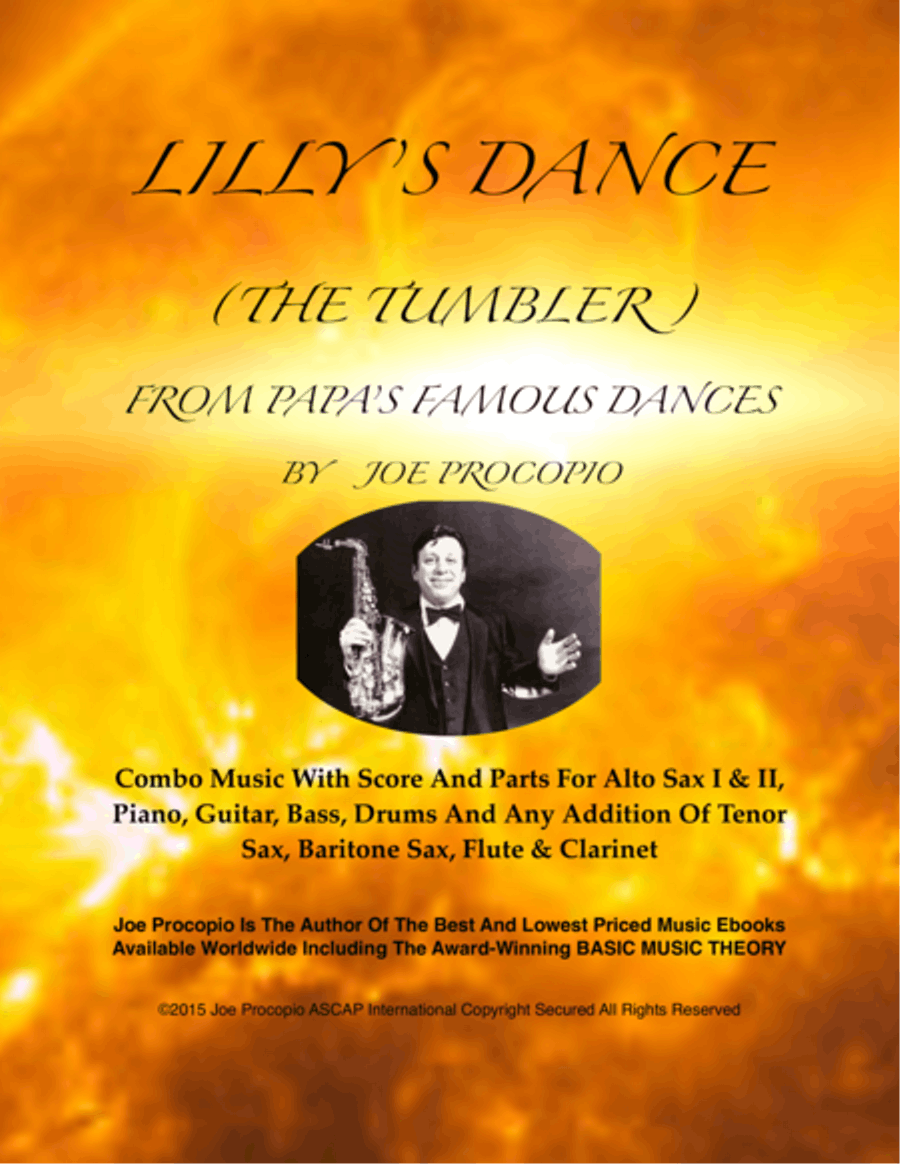
LILLY'S DANCE (THE TUMBLER)
Saxophone Tenor et Piano

$4.99 4.33 € Saxophone Tenor et Piano PDF SheetMusicPlus


Partitions Gratuites
Acheter des Partitions Musicales
Acheter des Partitions Digitales à Imprimer
Acheter des Instruments de Musique

© 2000 - 2026

Accueil - Version intégrale





