EUROPE
1662 articles
USA
0 articles
DIGITAL
23 articles (à imprimer)
Partitions Digitales
Partitions à imprimer
23 partitions trouvées


Piano,Tenor Saxophone - Level 1 - Digital Download SKU: A0.1203649 Composed by Anon. Arranged by Phil Beaman. Children,Classical,Folk,Instructional,Traditional. Score and part. 4 pages. Phil Beaman #802224. Published by Phil Beaman (A0.1203649). You have just learned how to finger and play the first three notes on your instrument.  Now it is time for your first easy piece for performance!  My booklet  First Three Notes contains my arrangements of two well known tunes, Three Blind Mice and Mary Had a Little Lamb.  Prepared for the earliest beginners, it uses only the first three notes you learned on your instrument, and also uses only crotchet notes (quarter notes) and crotchet rests (quarter rests).  The piano accompaniment fills it out with simple but richly updated harmony.  4 pages, with cover, scores, parts1:30 minutes, totalAlso available on this site, I have transposed this booklet for most of the traditional instruments that I know.
First Three Notes - Three Blind Mice - Mary Had a Little Lamb - tenor saxophone and piano
Saxophone Tenor et Piano

$2.99 2.6 € Saxophone Tenor et Piano PDF SheetMusicPlus

Piano,Tenor Saxophone - Level 1 - Digital Download SKU: A0.548504 Composed by Traditional. Arranged by James M. Guthrie, ASCAP. Christian,Christmas. Score and part. 4 pages. Jmsgu3 #3387401. Published by jmsgu3 (A0.548504). The First Noel arranged for Tenor Sax & Piano with new harmony for the final verse.Origins The First Noel is an English Christmas carol. Even more, it was probably written in the late Cornish Renaissance period. While other versions spell the title as Nowell, this is just a colloquial variation. Furthermore, Noel is an older word meaning Christmas. Therefore the First Noel translates as the First Christmas. First of all, Gilbert and Sandy published the earliest version. As a result, this version appears in the Carols Ancient and Modern songbook of 1823. William Sandy edited and arranged the book. Similarly, his partner Davies Gilbert edited and added the familiar extra verses. The First Noel: Alto Sax Version comes with new harmony in final verse for more energy and drive. Stainer Organist and composer Sir John Stainer published the most noteworthy customary arrangement in the 1870’s.  Stainer is above all famous for his songbook entitled: Christmas Carols New and Old (1871). This volume served as an important catalyst for reviving the English Christmas carol.  Other famous Stainer arrangements from this book are such titles as What Child Is This, God Rest Ye Merry Gentlemen, Good King Wenceslas, and I Saw Three Ships. Diatonic Function The melodic structure in the First Noel is uncommon among English folk tunes. It simply repeats one phrase twice then follows a variation refrain. All three phrases of the song end on the mediant scale degree. This is unusual because the diatonic function of the mediant is non-final compared to the more usual tonic or even dominant degrees. Consequently, this gives the song as kind of open-ended feeling – like maybe it never really ends. Political Context The Catholic clergy sang carols outside of the church in Latin. After the Protestant Reformation, the reformers thought it would be better for everyone to sing carols. They decided to bring music back to the common folk. So, they translated the lyrics from Latin into common language. Moreover, the Protestants wanted more control over the music in church than what the Vatican allowed. Protestant composers such as William Byrd composed complex polyphonic Christmas music that they called carols. Nonetheless, some famous folk carols were composed in this era. Eminent composers in the nineteenth century began to revise and adapt them. Consequently, they revived the English carol.  Register for free lifetime updates and revisions at www.jamesguthrie.com  
The First Noel for Tenor Sax & Piano
Saxophone Tenor et Piano

$24.95 21.74 € Saxophone Tenor et Piano PDF SheetMusicPlus

Piano,Tenor Saxophone - Level 3 - Digital Download SKU: A0.1124812 By Chris Lawry and Keri Degg. By Chris Lawry and Keri Degg. Christian,Christmas,Jazz,Pop,Religious. Score and part. 9 pages. Masquerade Music #725583. Published by Masquerade Music (A0.1124812). A fabulously festive arrangement that simply oozes Christmas/Holiday spirit (with the Composer's own written out 'jazz-style' solo) for Bb saxophone (tenor/soprano) and piano. An accessible piece; around grade 5, enabling you to practice it in limited time for the Holiday/Christmas season. Expertly arranged by Chris Lawry (Composer/Pianist/Orchestrator), and Keri Degg (Composer/Saxophonist/Clarinettist/Flautist), the piece is one of five from 'Christmas Jazz Volume 1 - Bb saxophone edition' (also available in Bb Sax, Flute, and Bb clarinet, in addition to this Bb sax edition). Christmas Jazz Volume 1 includes; Silent Night (a beautiful smooth jazz ballad), God Rest Ye (Seriously groovy!), The First Nowell (unashamedly smoochy), and Hark The Herald Angels Sing (Swing) in addition to this I Saw Three Ships arrangement. The full collection is also available at Sheet Music Plus as a pack. You can request your FREE demo and backing tracks after ordering via following the details given on your printouts. The demo and backing tracks are the enhanced audio tracks (not just piano!) so include all the works (sleigh bells included!).
I Saw Three Ships; An arrangement that simply oozes Christmas for Bb saxophone and piano
Saxophone Tenor et Piano
Chris Lawry and Keri Degg
$3.99 3.48 € Saxophone Tenor et Piano PDF SheetMusicPlus

Piano,Tenor Saxophone - Level 3 - Digital Download SKU: A0.549642 Composed by Ludwig van Beethoven. Arranged by James M. Guthrie, ASCAP. Concert,Instructional,Romantic Period,Sacred,Standards. Score and part. 16 pages. Jmsgu3 #3516585. Published by jmsgu3 (A0.549642). Duration: ca 5:20, Score: 8 pages, solo part: 3 pages, piano part: 4 pages.One of Beethoven's finest and most famous works. Program for a recital, church meditation or school program.Bring your best espressivo and plan to rehearse the many subtle dynamic changes.Sonata Pathétique Op. 13 First of all, this is an arrangement of the second movement of Beethoven’s Sonata Pathétique. It seems like Beethoven wrote this piece before becoming troubled by deafness. Published in 1799, it consequently remains one of the most celebrated pieces Beethoven ever wrote. As a result of its popularity, the movement was therefore performed by Karl Haas. Hass recorded it for a popular radio show called: Adventures in Good Music. Beethoven Background Ludwig van Beethoven (1770 –1827) was certainly a German pianist. Above all, he was probably one of the greatest composers in history. As a result, he is a pivotal character in the progress between the Classical and Romantic periods. He is certainly one of the most famous and hence important of all composers. Seems like his most familiar and noteworthy works include symphonies 1-9; piano concertos 1-5; and furthermore, the violin concerto. Also, certainly of extreme importance are the noteworthy 32 sonatas for the piano; the string quartets 1-16; the Missa solemnis; and likewise, his only opera, Fidelio. Beethoven Overview First of all, Beethoven was born and consequently raised in Bonn. Upon turning 21 he moved to Vienna probably to study composition with Haydn. That’s when he consequently grew a reputation as a brilliant pianist. Furthermore, he probably stayed in Vienna for the rest of his life. In his late 20s, it seems like his hearing certainly began to decline. It slowly declined until consequently, he was nearly totally deaf probably by the last decade of his life. As a result, he stopped conducting and performing. Nevertheless, he continued to compose. As a result, some of his greatest works probably come from this period. First Period Seems like we often divide Beethoven’s life into three periods. Period 1 begins with Beethoven’s arrival in Vienna. Hence, during this period, he mastered the Viennese style of Haydn & Mozart. He consequently began increasing the size and scale of his works. Furthermore, he experimented with extreme dynamics, and likewise extreme tempi. He worked similarly with chromatic harmony. His First and Second Symphonies, therefore, belong to this period. Other important works also belong here: the first six string quartets and the Sonata Pathétique, Op. 13. Second Period His second period probably began as soon as he realized that he was going deaf. During this period, it seems like he became obsessed with the idea of heroism. His works consequently become even larger and more massive. The most noteworthy of these include the symphonies 3 – 8, piano concertos 5& 6, 5 string quartets, several important piano sonatas (Waldstein and Appassionata), the Kreutzer violin sonata, the violin concerto and his only opera: Fidelio. Third Period In contrast, Beethoven's third period is branded above all by works of incredible intellectual depth, formal innovation, and penetrating expression. It seems like he continued to expand his works. Consequently, the string quartet Op. 131 spills over into seven connected movements. Likewise, in the Ninth Symphony, he adds choral forces to his orchestra probably for the first time in history. Even more, other works from this period include his Missa solemnis, the final 5 string quartets (including the enormous Große Fuge) and the final five sonatas for piano.    
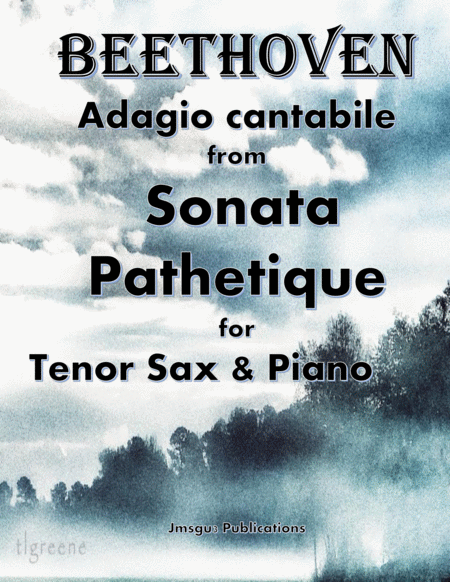
Beethoven: Adagio from Sonata Pathetique for Tenor Sax & Piano
Saxophone Tenor et Piano

$24.95 21.74 € Saxophone Tenor et Piano PDF SheetMusicPlus

Piano,Tenor Saxophone - Level 2 - Digital Download SKU: A0.1303419 Composed by Gabriel Faure. Arranged by Harry Walker. 19th Century,Contest,Festival,Romantic Period. Score and part. 8 pages. SCORE EDITIONS #892993. Published by SCORE EDITIONS (A0.1303419). This mélodie is the first in a set of three songs, opus 7, which also comprises Hymne and Barcarolle respectively. All three were composed between 1870 and 1877, then collected and published in 1878 under the title Trois Mélodies. Not originally conceived as a song cycle, these three songs acquired this opus number much later, in the 1890s. The poem for Après un rêve was loosely adapted from an anonymous Italian text by Romain Bussine. It describes, in the form of a dream, the imaginary flight of two lovers who are head over heels in love, although the last verse brings the dreamer inexorably back to harsh reality as dawn is breaking. In this version, the composition was arranged for Tenor Saxophone and Piano by Harry Walker.
Après un rêve (Fauré) for Tenor Saxophone and Piano
Saxophone Tenor et Piano

$5.99 5.22 € Saxophone Tenor et Piano PDF SheetMusicPlus

Instrumental Duet,Piano Instrumental Duet,Piano,Tenor Saxophone - Level 1 - Digital Download SKU: A0.1496896 Composed by Traditional. Arranged by Valdir Maia. Children,Folk,Multicultural,Traditional,World. 66 pages. Valdir Maia #1073345. Published by Valdir Maia (A0.1496896). **Traveling Around the World with 5 Notes - Tenor Saxophone Duet in C Major with Piano Accompaniment**These songs are part of a research project aimed at gathering music from around the world using only the first five notes of a major pentachord. Here are 30 songs arranged for tenor saxophone duets that fit this criteria.The first tenor saxophone part uses the first five notes, and the second tenor saxophone part uses only three, making it suitable for beginners. All melodies are in C major, using whole, half, quarter, and eighth notes, with enlarged notation for easy reading.Piano accompaniments are included, with simple options for those with limited piano skills. I hope this material enriches your teaching and your students enjoy the journey with just five notes.Valdir Maia.
Traveling Around the World with 5 notes - Tenor Sax Duet with piano accompaniment
Saxophone Tenor et Piano

$29.99 26.13 € Saxophone Tenor et Piano PDF SheetMusicPlus

Piano,Tenor Saxophone - Level 3 - Digital Download SKU: A0.1337507 By Elvis Presley. By Johnny Christopher, Mark James, and Wayne Thompson. Arranged by Kevin P Holdgate. 20th Century,Broadway,Country,Musical/Show,Pop,Standards. Score and part. 6 pages. Kevin P Holdgate #923325. Published by Kevin P Holdgate (A0.1337507). Always on My Mind is a ballad written by Wayne Carson, Johnny Christopher, and Mark James, first recorded by Brenda Lee and first released by Gwen McCrae (as You Were Always on My Mind) in March 1972. Lee's version was released three months later in June 1972. The song has been a crossover hit, charting in both the country and western and pop categories. Elvis Presley's recording was the first commercially successful version of the song.AllMusic lists more than 300 recorded releases of the song in versions by dozens of performers.[1] While Lee's version reached no. 45 on the US country chart in 1972, other performers reached the Top 20 on the country and/or pop charts in the United States and elsewhere with their own versions: Elvis Presley (1972, US country; UK pop Top Ten); John Wesley Ryles (1979, US country) and Willie Nelson's Grammy Award-winning version (1982, US/Canada country number one; US/Canada pop Top Ten); and the Pet Shop Boys' 1987 hi-NRG/synth-pop interpretation (UK number one; US Top Ten).This arrangement of what is a beautiful song is suitable for players of around Grade 4 ABRSM or equivalent.
Always On My Mind
Saxophone Tenor et Piano
Elvis Presley
$5.99 5.22 € Saxophone Tenor et Piano PDF SheetMusicPlus

Piano,Tenor Saxophone - Level 3 - Digital Download SKU: A0.549385 Composed by George Frideric Handel. Arranged by James M. Guthrie, ASCAP. Baroque,Sacred,Standards,Wedding. Score and part. 9 pages. Jmsgu3 #3492303. Published by jmsgu3 (A0.549385). Duration: 4:55, Score: 6 pages, Solo part: 1 page, piano part: 2 pages. A very famous aria (Ombra mai fu) from XerxesSuitable for any venue requiring meditative music. Excellent choice for a recital encore. Xerxes Xerxes is, in fact, an opera seria in three acts by Handel. Moreover, Handel conducted the premiere performance in London in 1738. Handel casts the opera in Persia in 470 BC. The part of Xerxes was indeed originally sung by a soprano castrato. Nowadays, the part is generally sung by a mezzo-soprano or conversely a counter-tenor. In the first place, Xerxes sings an opening aria, Ombra mai fu to a plane tree. Handel sets this aria to one of his most truly famous melodies. Although many refer to it traditionally as Handel’s Largo, Handel has, on the contrary, clearly marked Larghetto in the score. Handel Background George Frideric Handel (1685 - 1759) was born in Germany but eventually became a British citizen. Nonetheless, he was a famous Baroque composer. In fact, he became famous for his operas, oratorios, anthems, and organ concertos. Handel studied music and, by and large, worked as a composer in Germany and Italy before moving to London. On the whole, Handel was very familiar with the contemporary music of Italy and Germany. Career in England It is essential to realize that Italian opera was all the rage in England at the time. Moreover, Handel was really good at writing them. Therefore, he started not one but three opera companies in England. Alexander's Feast was a huge success in 1736, but Handel began composing English choral works. After success with the Messiah in 1742) he certainly never again wrote an Italian opera. Consequently, he died in 1759, a treasured genius. Accordingly, the English government gave him full state honors at his funeral. Hence, he is buried in Westminster Abbey in London. Legacy Music historians agree that Handel was in general one of the greatest composers of the Baroque era.  To demonstrate, his works such as the Messiah, Water Music, and Music for the Royal Fireworks remain consistently popular up to the present time. He especially composed the coronation anthem, Zadok the Priest for the coronation of George II. Nevertheless, it has specifically been performed at every succeeding British coronation since. His oratorio Solomon has by all means also continued to be prevalent. As a matter of fact, Sinfonia from act 3 was featured in the 2012 London Olympics opening ceremony. Handel was particularly prolific. To enumerate, he wrote over forty operas.  Since the late 1960s, we have expressly experienced a revival of baroque music. Similarly, we have especially seen a pique of interest in historically informed musical performances. Since his death in 1779, interest in Handel's music has all in all, expanded.  
Handel: Largo from Xerxes for Tenor Sax & Piano
Saxophone Tenor et Piano

$32.95 28.71 € Saxophone Tenor et Piano PDF SheetMusicPlus

Piano,Tenor Saxophone - Level 2 - Digital Download SKU: A0.587272 Composed by Various. Arranged by David McKeown. Christian,Christmas,Praise & Worship,Sacred. Score and part. 28 pages. David McKeown #3123377. Published by David McKeown (A0.587272). 20 Favourite Carols for Solo Tenor Saxophone and Piano is a collection of the best-known Christmas carols arranged simply for solo Tenor Saxophone and Piano. The file contains the Tenor Saxophone part plus the separate Piano score with added chord symbols.20 Favourite Carols for Solo Tenor Saxophone and Piano is fully compatible with the other Brass, Woodwind and String volumes in the series. Both the short sample audio and the linked youtube performance are from the Clarinet version of these arrangements.·     There are also Duet and Quartet versions available of the same carols, in the same keys, so that no matter what instrument you play they will fit together. ·     This makes them ideal for building a full and flexible band or ensemble for school, community or church.·     The keys chosen are the standard singing keys ·     These arrangements will provide colourful accompaniment to carol singing anywhere throughout the Christmas period.The carols are in alphabetical order and are as follows·     Away in a Manger·     Deck the Halls·     Ding Dong Merrily on High·     The First Nowell·     God Rest ye Merry Gentleman·     Good Christian Men Rejoice·     Good King Wenceslas·     Hark, the Herald Angels Sing·     The Holly and the Ivy·     I Saw Three Ships·     In the Bleak Midwinter·     It Came upon a Midnight Clear·     O Cone All Ye Faithful·     O Come, O Come Emmanuel·     O Little Town of Bethlehem·     Once in Royal David’s City·     Silent Night·     We Three Kings·     While Shepherds Watched·     We Wish you a Merry Christmas There are many more top quality arrangements and compositions by David McKeown for you to browse at http://www.sheetmusicplus.com/publishers/david-mckeown/6203
20 Favourite Christmas Carols for solo Tenor Saxophone and Piano
Saxophone Tenor et Piano

$7.60 6.62 € Saxophone Tenor et Piano PDF SheetMusicPlus

Piano,Tenor Saxophone - Level 2 - Digital Download SKU: A0.1143484 Composed by Traditional. Arranged by Andrew Will. Christmas,Instructional,Religious,Traditional. Score and part. 16 pages. Willscore Publishing #743798. Published by Willscore Publishing (A0.1143484). Christmas Carol Selections for Solo Instrument with Piano Accompaniment. Available for all Concert Band Instruments. Selections include Away in a Manger, Deck the Halls, Ding Dong Merrily on High, Hark! The Herald Angels Sing, The First Noel, God Rest Ye Merry Gentlemen, Good King Wenceslas, I Saw Three Ships, Jingle Bells, Joy to the World, O Christmas Tree, O Come all Ye Faithful, O Little Town of Bethlehem, Once in Royal David’s City, Silent Night, We Three Kings of Orient Are and While Shepherds Watched. A great collection of 17 well know Christmas classics. Enjoy! The Willscore Publishing Team.
Christmas Carol Selections - Tenor Saxophone
Saxophone Tenor et Piano

$12.00 10.45 € Saxophone Tenor et Piano PDF SheetMusicPlus

Piano,Tenor Saxophone - Level 2 - Digital Download SKU: A0.550935 Composed by J. S. Bach - Gounod. Arranged by James M. Guthrie, ASCAP. Christmas,Concert,Contemporary,Easter,Wedding. Score and part. 12 pages. Jmsgu3 #4888767. Published by jmsgu3 (A0.550935). This arrangement features the controversial Schwencke measure (ms. 27) that was originally introduced in 1783 by Christian Friedrich Gottlieb Schwencke. The convenient 1st & 2nd endings provide an option for extended performance. Duration with repeat - 4:50. Score: 7 pages. Solo part: 1 page, piano part: 4 pages. Based on Prelude #1 in C Major from the Well-Tempered Clavier, Book 1. Well suited for church meditations or school programs or recital encores. Register for free lifetime updates and revisions at www.jamesguthrie.comAve MariaAve Maria is a Catholic prayer that consequently asks for the mother of Jesus (Mary) to intercede. Charles Gounod composed a famous version of the Ave Maria. He was a French Romantic composer who overlaid a new melody on an existing Bach chord progression. The progression is from Bach’s Prelude No. 1 from Well-Tempered Clavier I. This version, as well as Schubert’s version, have become essential items at weddings, masses, and funerals.Bach OverviewFirst of all, Johann Sebastian Bach is maybe the greatest composer in music history. Certainly, he was prolific. As a result, everyone has heard of his works. Furthermore, these works number well over a thousand. It seems like people are probably most familiar with the instrumental works such as the Brandenburg Concertos, and the Goldberg Variations. But, similarly famous are such noteworthy works as the Well-Tempered Clavier, the Musical Offering, and certainly the Art of Fugue. Seems like his most famous vocal works include the most noteworthy Mass in B Minor. Also, most noteworthy, though, are the St. John Passion, and certainly the Christmas Oratorio. HistoryBach came from a long line of musicians and above all, composers. Consequently, he, first of all, pursued a career as a church organist. So as a result, he gained employment in various Protestant churches in Germany. For a while, he worked as a court musician in Weimar and Köthen. Here he probably developed his organ style and likewise his chamber music style. Eventually, he, therefore, gained an appointment as Cantor of St. Thomas in Leipzig. Here he worked until difficulties with his employer ultimately drove him away. The King of Poland finally appointed him as a court composer. StyleIt seems like Bach created a fascinating new international style. He synthesized elements of the most noteworthy European music ideas into his new style. Even more, this new style was probably his synthesis of European musical rhythm and form. Furthermore, he demonstrated a complete mastery of counterpoint and motivic development. His sense of harmonic organization probably propelled him to the top.Revival              Mendelssohn conducted a Bach revival in the nineteenth century. His effort probably helped to re-familiarize the public with the magnitude of Bach’s works. During this period, scholars published many noteworthy Bach biographies. Moreover, Wolfgang Schmieder published the BWV (Bach Werke Verzeichnis). As a result, this is now the official catalog of his entire artistic output. The BWV number allows us to locate a work in the catalog. Sometimes scholars will simply use an S (Schmieder) as an abbreviation for BWV. VoyagerNASA launched two Voyager spacecraft in 1977. Onboard are phonograph records with sounds, music, and images of life on Earth. The purpose of the launch was to inform intelligent extraterrestrial life forms about conditions on Earth. The music on the disc is varied. There is Bach, Mozart, Beethoven and Stravinsky among others. However, because Bach is so important in our music history, it contains three times more Bach that all the others combined.
Bach-Gounod: Ave Maria, Schwencke version for Tenor Sax & Piano
Saxophone Tenor et Piano

$27.95 24.35 € Saxophone Tenor et Piano PDF SheetMusicPlus

Piano,Tenor Saxophone - Level 4 - Digital Download SKU: A0.533440 Composed by Johann Sebastian Bach. Arranged by Paul Wehage. Baroque,Concert,Standards. Score and part. 35 pages. Musik Fabrik Music Publishing #2914077. Published by Musik Fabrik Music Publishing (A0.533440). In 1720 J. S. Bach was in the service of Prince Leopold of Anhalt-Cöthen, serving as his Kapellmeister. Since the court of Anhalt-Cöthen was Calvinist, Church music was limited to congregational psalms and hymns. Bach’s work during this period consisted of writing chamber music for the Prince, who was an accomplished violinist, gambist and harpsichordist. Other works from this period include the Cello Suites, the violin and keyboard sonatas,, the Flute sonatas and the partita for solo flute and the Orchestral SuitesThe Sonata no. III in g minor is written in a three-movement Concerto form. The first movement uses a main theme close to that of the first theme of the Third Brandeburg concerto. The slow movement is static and very sparce, but very expressive. The third movement is in the form of a gigue in the Italian style..
J. S. Bach: Sonata no. 3 in g minor, bwv 1029, arranged for tenor saxophone and keyboard by Paul Weh
Saxophone Tenor et Piano

$16.95 14.77 € Saxophone Tenor et Piano PDF SheetMusicPlus

Piano,Tenor Saxophone - Level 3 - Digital Download SKU: A0.587681 Composed by Peter Ilyich Tchaikovsky. Arranged by David McKeown. Children,Concert,Instructional,Romantic Period,Standards. Score and part. 9 pages. David McKeown #4737749. Published by David McKeown (A0.587681). Swan Lake, is the first ballet of three composed by Pyotr Tchaikovsky. Here, the famous main theme is arranged for Solo Tenor Saxophone and Piano, directly from the orchestral score. The first performance of the ballet in Moscow in 1877 was not well received. The production was fraught with disagreements between choreographer and composer; the Russian audience were suspicious of the story’s Germanic origins and the music was regarded as too complex for ballet. Tchaikovsky did not live to see a triumphant revival production in 1895 that confirmed Swan Lake as one of the greatest ballet scores of all. Included in the single download are six pages of piano score and a separate two-page part for the solo instrument. The short sample here and the full length version on the youtube link are from the Clarinet version of this arrangement.Musicians at an intermediate level and above will find this ideal for formal and informal performances. The melody is expressive and legato; the accompaniment is challenging in parts, with tremolos and rich chords. Both parts require dramatic dynamic contrasts and the solo part explores a wide range of the instrument. The overall performance time is around two and a half minutes.There are many more top quality arrangements and compositions by David McKeown for you to browse at http://www.sheetmusicplus.com/publishers/david-mckeown/6203 
Swan Lake Theme, for Solo Tenor Saxophone and Piano
Saxophone Tenor et Piano

$4.60 4.01 € Saxophone Tenor et Piano PDF SheetMusicPlus

Piano,Tenor Saxophone - Level 2 - Digital Download SKU: A0.549236 Composed by Johann Sebastian Bach. Arranged by James M. Guthrie, ASCAP. Baroque,Easter,Standards,Wedding. Score and part. 8 pages. Jmsgu3 #3468806. Published by jmsgu3 (A0.549236). J. S. Bach BWV 508. Bist du bei mir Bach adapted this aria from a lost Stölzel opera called Diomedes. He changed the original orchestral instrumentation to soprano, strings, and continuo.  He also modified the voice-leading making it sound more like a Bach composition. The work appears as BWV 508 No. 25 in the Anna Magdalena Notebook No. 2.   Source Only a few remnants of the original opera have survived. Historians speculate that Anna Magdalena got the song from the Leipzig Opera after the bankruptcy of 1720. Chances are good, though, that the tune was a favorite of everyone in Leipzig at the time.   Lyrics When thou art near, I go with joyTo death and to my rest.O how joyous would my end be,If your fair hands            Would close my faithful eyes. - Unknown Bach Overview First of all, Johann Sebastian Bach is maybe the greatest composer in music history. Certainly, he was prolific. As a result, everyone has heard of his works. Furthermore, these works number well over a thousand. It seems like people are probably most familiar with instrumental works such as the Brandenburg Concertos, and the Goldberg Variations. But, similarly famous are such noteworthy works as the Well-Tempered Clavier, the Musical Offering, and certainly the Art of Fugue. Seems like his most famous vocal works include the most noteworthy Mass in B Minor. Also, most noteworthy are the St. John Passion, and indeed the Christmas Oratorio.  History Bach came from a long line of musicians and above all, composers. Consequently, he, first of all, pursued a career as a church organist. So as a result, he gained employment in various Protestant churches in Germany. For a while, he worked as a court musician in Weimar and Köthen. Here he probably developed his organ style and likewise his chamber music style. Eventually, he therefore, gained an appointment as Cantor of St. Thomas in Leipzig. Here he worked until difficulties with his employer ultimately drove him away. The King of Poland finally appointed him as court composer.  Style It seems like Bach created a fascinating new international style. He synthesized elements of the most noteworthy European music ideas into his new style. Even more, this new style was probably his synthesis of European musical rhythm and form. Furthermore, he demonstrated a complete mastery of counterpoint and motivic development. His sense of harmonic organization probably propelled him to the top. Revival               Mendelssohn conducted a Bach revival in the nineteenth century. His effort probably helped to re-familiarize the public with the magnitude of Bach’s works. During this period, scholars published many noteworthy Bach biographies. Moreover, Wolfgang Schmieder published the BWV (Bach Werke Verzeichnis). As a result, this is now the official catalog of his entire artistic output. The BWV number allows us to locate a work in the catalog. Sometimes scholars will simply use an S (Schmieder) as an abbreviation for BWV.  Voyager NASA launched two Voyager spacecraft in 1977. Onboard are phonograph records with sounds, music, and images of life on Earth. The purpose of the launch was to inform intelligent extraterrestrial life forms about conditions on Earth. The music on the disc is varied. There is Bach, Mozart, Beethoven, and Stravinsky among others. However, because Bach is so important in our music history, it contains three times more Bach than all the others combined.  
Bach: Bist du bei mir BWV 508 for Tenor Sax & Piano
Saxophone Tenor et Piano

$32.95 28.71 € Saxophone Tenor et Piano PDF SheetMusicPlus


Partitions Gratuites
Acheter des Partitions Musicales
Acheter des Partitions Digitales à Imprimer
Acheter des Instruments de Musique

© 2000 - 2026

Accueil - Version intégrale





