EUROPE
1674 articles
USA
2 articles
DIGITAL
48 articles (à imprimer)
Partitions Digitales
Partitions à imprimer
48 partitions trouvées


Piano,Tenor Saxophone - Level 2 - Digital Download SKU: A0.549424 Composed by Antonin Dvorak. Arranged by James M. Guthrie, ASCAP. Instructional,Romantic Period,Sacred,Standards. Score and part. 12 pages. Jmsgu3 #3494011. Published by jmsgu3 (A0.549424). Score: 7 pages, solo part: 2 pages, piano part: 3 pages. Duration: 4:25 Not difficult, but requires sensitivity & dynamic control. Suitable for recitals, church meditations, or school programs. Dvořák Background Antonín Dvořák (1841 –1904) was, of course, a composer from Czechoslovakia. As a matter of fact, he was among the first Bohemian composers to attain universal recognition. It is important to realize that the late Romantic Nationalist period featured composers who used traditional and folk elements to portray the character of their nation. In particular, we see this in the music of Grieg (Norway), Finland (Sibelius), and Smetana (Bohemia).  Dvořák relied markedly on rhythms and other characteristics of Moravian and Bohemian folk music. Ascent to Fame Dvořák was truly a child musical prodigy on the violin. The premiere performances of his compositions notably occurred in 1872 and 1873. He submitted his First Symphony in particular to a German competition, but it failed to win. Consequently, in 1874 he presented two more symphonies to the Austrian State Prize for Composition. Johannes Brahms was the principal of the jury and was accordingly very impressed. They forthwith awarded the prize to Dvořák in 1874, 1876, and 1877. At this point, Brahms thereupon endorsed Dvořák to the publisher Simrock. Later, the publisher commissioned Dvořák to compose the Slavonic Dances, Op. 46. These became popular overnight and, as a result, Dvořák's worldwide status was launched. International Status Dvořák visited England upon invitation nine times. On each visit, he frequently conducted performances of his own compositions. He conducted concerts of his music, especially in Moscow and St. Petersburg. Eventually, the Prague Conservatory in fact appointed Dvořák as a professor. There, to be sure, he wrote his famous Dumky Trio. United States Consequently, the National Conservatory of Music of America appointed him as director in 1892. As a result, Dvořák composed his two most famous symphonic works: the Symphony No. 9 (From the New World), which spread his name universally, and his Concerto for Cello and Orchestra, one of the most famous of all cello works. Moreover, he wrote his most celebrated American String Quartet during this time. At the same time, because of his growing recognition in Europe and his homesickness for his own country, he left to return to Bohemia in 1895.
DvoÅ™ák: Largo from the New World Symphony for Tenor Sax & Piano
Saxophone Tenor et Piano

$32.95 28 € Saxophone Tenor et Piano PDF SheetMusicPlus

Piano,Tenor Saxophone - Level 1 - Digital Download SKU: A0.548723 Composed by Martin Luther. Arranged by James M. Guthrie, ASCAP. Easter,Instructional,Standards. Score and part. 4 pages. Jmsgu3 #3411761. Published by jmsgu3 (A0.548723). Out of the Depths I Cry to You by Martin Luther. The first verses feature modified counterpoint and harmony proceeding at quarter = 82. The final verse is reharmonized for maximum dramatic effect at a more contemplative tempo such as quarter = 64. Features the entire range of the instrument. Very powerful selection for Lent or Easter. Duration (3 verses) 3:05, 36 ms. Score: 3 pg. Solo part: 1 pg. The piano reads from the score. Out of the Depths Aus tiefer Not schrei ich zu dir (From deep affliction I cry out to you), is, of course, a hymn composed by Martin Luther. Moreover, Luther also wrote the lyrics, essentially a paraphrase of Psalm 130. First published in 1524, it is also one of eight songs in the original Lutheran hymnal. It appears likewise in many hymnals and in different translations. The lyrics furthermore stimulated compositions from the Renaissance to the contemporary. Consequently, composers such as Johann Sebastian Bach built an entire chorale cantata on it. Other composers similarly contributed pieces, such as Felix Mendelssohn and Max Reger. Luther Background Martin Luther, (1483 –1546) was a German professor of theology, composer, priest, and moreover, an influential character in the Protestant Reformation. Luther had a momentous impact on church and society due to his contributions to the musical arts. He wanted to disseminate the gospel among mankind and with this intention thought that the best way to do that was through music. Influence It is important to realize that other musicians, and their descendants, were encouraged by Luther’s songs and wrote their own hymns. Luther, to be sure, had a thorough musical education. For example, he knew secular and sacred songs from an early age. He, in particular, played the lute well and sang in the monastery when he was a monk. That is to say, music was an essential part of his life. He in fact first began writing songs in 1523, sometimes writing the melody as well as the lyrics. Luther was certainly able to evaluate the composers of his time. He thought especially highly of Josquin des and Ludwig Senfl. He was also acquainted, with this in mind, with other composers and their works. Legacy The Lutheran musical ethos soon covered all of Germany and later significantly fashioned Protestant musical culture. Heinrich Schütz and Johann Sebastian Bach are the most compelling evidence of this Protestant musical culture. Additionally, as a point often overlooked, the pedal organ, first refined in northern Germany, became universally prevalent. As a matter of fact, Dieterich Buxtehude established a regular evening organ concert series in Lübeck. Another key point is that this concert series, in turn, spread North German Musical ideas worldwide. Luther was especially convinced that music is a beautiful and exclusive offering of the divine.
Luther: Out of the Depths for Tenor Sax & Piano
Saxophone Tenor et Piano

$24.95 21.2 € Saxophone Tenor et Piano PDF SheetMusicPlus

Piano,Tenor Saxophone - Level 1 - Digital Download SKU: A0.1275491 Composed by Antonin Dvorak. Arranged by Rodrigo Faleiros. 19th Century,Chamber,Christmas,Romantic Period,Wedding. Score and part. 3 pages. Rodrigo Faleiros #867299. Published by Rodrigo Faleiros (A0.1275491). Step into a world of musical enchantment with this adaptation of the Largo, 2nd movement from Antonin Dvorak's Symphony no. 9, From the New World. Designed for an easy solo tenor sax with a piano accompaniment, this rendition has been carefully tailored to embrace aspiring musicians and create an intimate ambiance, making it a perfect choice for students, weddings, graduations and other special gatherings. The arrangement is transposed to the key of F major, ensuring ease for beginners, allowing them to delve into the soulful melodies effortlessly.
Largo (2nd movement of the Symphony no. 9 'From The New World')
Saxophone Tenor et Piano

$3.99 3.39 € Saxophone Tenor et Piano PDF SheetMusicPlus

Piano,Tenor Saxophone - Level 1 - Digital Download SKU: A0.1275475 Composed by Antonin Dvorak. Arranged by Rodrigo Faleiros. 19th Century,Chamber,Christmas,Romantic Period,Wedding. Score and part. 3 pages. Rodrigo Faleiros #867277. Published by Rodrigo Faleiros (A0.1275475). Step into a world of musical enchantment with this adaptation of the Largo, 2nd movement from Antonin Dvorak's Symphony no. 9, From the New World. Designed for an easy solo tenor sax with a piano accompaniment notated with chords, this rendition has been carefully tailored to embrace aspiring musicians and create an intimate ambiance, making it a perfect choice for students, weddings, graduations and other special gatherings. The arrangement is transposed to the key of F major, ensuring ease for beginners, allowing them to delve into the soulful melodies effortlessly.
Largo (2nd movement of the Symphony no. 9 'From The New World')
Saxophone Tenor et Piano

$3.99 3.39 € Saxophone Tenor et Piano PDF SheetMusicPlus

Piano,Tenor Saxophone - Level 3 - Digital Download SKU: A0.549802 Composed by Peter Ilyich Tchaikovsky. Arranged by James M. Guthrie, ASCAP. Children,Christmas,Romantic Period,Standards. Score and part. 16 pages. Jmsgu3 #3539213. Published by jmsgu3 (A0.549802). Duration: ca. 2:10. Score: 9 pages. 77 measures in 2/4. Solo part: 2 pages, Piano part: 4 pages. A favorite Christmas selection from the Nutcracker Suite. Pyotr Ilyich Tchaikovsky Tchaikovsky is probably the most popular of the great composers in America. His music certainly appeals to musicians. Likewise, it appeals even to folks who don’t normally listen to serious music. This is probably because of his most noteworthy melodies. Above all, he writes with great emotion. This certainly makes a most noteworthy if not an unforgettable impact. Education First of all, He attended classes at the Russian Musical Society. Even more, He also attended the St. Petersburg Conservatory. There he studied music theory with Nikolai Zaremba. He also consequently studied composition with Anton Rubenstein. It seems like Rubenstein came under criticism from a group of Russian composers known as the Five. The Five The Five certainly rejected Western musical influences. They rather sought to use elements from Russian music. They furthermore wanted to use more exotic musical materials. Western Techniques More than other Russian composers, Tchaikovsky studied modern Western music. He certainly develops his music like the European masters. So, rather than repeating a motive, he moves to a new key. He then introduces a different theme in the new key. Hence, he maintained his independence from the Five. Even more, he became the first Russian composer of international stature. Influences Tchaikovsky was probably influenced in his ballet scoring by Léo Delibes. Richard Wagner influenced his symphonic writing. Tchaikovsky’s most famous works include the 1812 Overture, The Nutcracker Suite, and Swan Lake. Also famous are the Violin Concerto in D and the six symphonies. The greatest of the six symphonies may be No. 6, the Pathétique. Nutcracker Suite, Op. 71a The Nutcracker Suite is a ballet that was performed for the first time in December 1892 in St. Petersburg. To begin with, the original ballet failed to attract a positive reception. However, the ballet suite became probably one of the most popular of all of Tchaikovsky’s works. The ballet suite became even more famous in the 1960s. It is now performed all over the world, particularly during the Christmas season.
Tchaikovsky: Dance of the Flutes from Nutcracker Suite for Tenor Sax & Piano
Saxophone Tenor et Piano

$32.95 28 € Saxophone Tenor et Piano PDF SheetMusicPlus

Piano,Tenor Saxophone - Level 3 - Digital Download SKU: A0.549684 Composed by Peter Ilyich Tchaikovsky. Arranged by James M. Guthrie, ASCAP. Children,Christmas,Romantic Period,Standards. Score and part. 14 pages. Jmsgu3 #3520279. Published by jmsgu3 (A0.549684). Duration: ca. 1:42, 52 measures, Score: 7 pages, solo part: 2 pages, piano part: 4 pages. A popular Christmas favorite from Tchaikovsky's Nutcracker Suite. Pyotr Ilyich Tchaikovsky Tchaikovsky is probably the most popular of the great composers in America. His music certainly appeals to musicians. Likewise, it appeals even to folks who don’t normally listen to serious music. This is probably because of his most noteworthy melodies. Above all, he writes with great emotion. This certainly makes a most noteworthy if not an unforgettable impact. Education First of all, He attended classes at the Russian Musical Society. Even more, He also attended the St. Petersburg Conservatory. There he studied music theory with Nikolai Zaremba. He also consequently studied composition with Anton Rubenstein. It seems like Rubenstein came under criticism from a group of Russian composers known as the Five. The Five The Five certainly rejected Western musical influences. They rather sought to use elements from Russian music. They furthermore wanted to use more exotic musical materials. Western Techniques More than other Russian composers, Tchaikovsky studied modern Western music. He certainly develops his music like the European masters. So, rather than repeating a motive, he moves to a new key. He then introduces a different theme in the new key. Hence, he maintained his independence from the Five. Even more, he became the first Russian composer of international stature. Influences Tchaikovsky was probably influenced in his ballet scoring by Léo Delibes. Richard Wagner influenced his symphonic writing. Tchaikovsky’s most famous works include the 1812 Overture, The Nutcracker Suite, and Swan Lake. Also famous are the Violin Concerto in D and the six symphonies. The greatest of the six symphonies may be No. 6, the Pathétique. Nutcracker Suite, Op. 71a The Nutcracker Suite is a ballet that was performed for the first time in December 1892 in St. Petersburg. To begin with, the original ballet failed to attract a positive reception. However, the ballet suite became probably one of the most popular of all of Tchaikovsky’s works. The ballet suite became even more famous in the 1960s. It is now performed all over the world, particularly during the Christmas season.
Tchaikovsky: Dance of the Sugar-Plum Fairy from Nutcracker Suite for Tenor Sax & Piano
Saxophone Tenor et Piano

$32.95 28 € Saxophone Tenor et Piano PDF SheetMusicPlus

Piano,Tenor Saxophone - Level 3 - Digital Download SKU: A0.549752 Composed by Peter Ilyich Tchaikovsky. Arranged by James M. Guthrie, ASCAP. Children,Christmas,Romantic Period,Standards. Score and part. 17 pages. Jmsgu3 #3532705. Published by jmsgu3 (A0.549752). Duration: ca. 3:15 Score: 10 pages, solo part: 2 pages, piano part: 4 pages. Tchaikovsky paints a very mysterious mood in this favorite masterpiece from the Nutcracker Suite. It is also a traditional Christmas favorite. Pyotr Ilyich Tchaikovsky Tchaikovsky is probably the most popular of the great composers in America. His music certainly appeals to musicians. Likewise, it appeals even to folks who don’t normally listen to serious music. This is probably because of his most noteworthy melodies. Above all, he writes with great emotion. This certainly makes a most noteworthy if not an unforgettable impact. Education First of all, He attended classes at the Russian Musical Society. Even more, He also attended the St. Petersburg Conservatory. There he studied music theory with Nikolai Zaremba. He also consequently studied composition with Anton Rubenstein. It seems like Rubenstein came under criticism from a group of Russian composers known as the Five. The Five The Five certainly rejected Western musical influences. They rather sought to use elements from Russian music. They furthermore wanted to use more exotic musical materials. Western Techniques More than other Russian composers, Tchaikovsky studied modern Western music. He certainly develops his music like the European masters. So, rather than repeating a motive, he moves to a new key. He then introduces a different theme in the new key. Hence, he maintained his independence from the Five. Even more, he became the first Russian composer of international stature. Influences Tchaikovsky was probably influenced in his ballet scoring by Léo Delibes. Richard Wagner influenced his symphonic writing. Tchaikovsky’s most famous works include the 1812 Overture, The Nutcracker Suite, and Swan Lake. Also famous are the Violin Concerto in D and the six symphonies. The greatest of the six symphonies may be No. 6, the Pathétique. Nutcracker Suite, Op. 71a The Nutcracker Suite is a ballet that was performed for the first time in December 1892 in St. Petersburg. To begin with, the original ballet failed to attract a positive reception. However, the ballet suite became probably one of the most popular of all of Tchaikovsky’s works. The ballet suite became even more famous in the 1960s. It is now performed all over the world, particularly during the Christmas season.
Tchaikovsky: Arabian Dance from Nutcracker Suite for Tenor Sax & Piano
Saxophone Tenor et Piano

$32.95 28 € Saxophone Tenor et Piano PDF SheetMusicPlus

Piano,Tenor Saxophone - Level 3 - Digital Download SKU: A0.549774 Composed by Peter Ilyich Tchaikovsky. Arranged by James M. Guthrie, ASCAP. Children,Christmas,Romantic Period,Standards. Score and part. 11 pages. Jmsgu3 #3535009. Published by jmsgu3 (A0.549774). Duration: ca 1:00 Score: 5 pages, Solo part: 2 pages, piano part: 3 pages. Short but fascinating Chinese Dance from the Nutcracker Suite. Program this for a recital encore or Christmas pageant. Pyotr Ilyich Tchaikovsky Tchaikovsky is probably the most popular of the great composers in America. His music certainly appeals to musicians. Likewise, it appeals even to folks who don’t normally listen to serious music. This is probably because of his most noteworthy melodies. Above all, he writes with great emotion. This certainly makes a most noteworthy if not an unforgettable impact. Education First of all, He attended classes at the Russian Musical Society. Even more, He also attended the St. Petersburg Conservatory. There he studied music theory with Nikolai Zaremba. He also consequently studied composition with Anton Rubenstein. It seems like Rubenstein came under criticism from a group of Russian composers known as the Five. The Five The Five certainly rejected Western musical influences. They rather sought to use elements from Russian music. They furthermore wanted to use more exotic musical materials. Western Techniques More than other Russian composers, Tchaikovsky studied modern Western music. He certainly develops his music like the European masters. So, rather than repeating a motive, he moves to a new key. He then introduces a different theme in the new key. Hence, he maintained his independence from the Five. Even more, he became the first Russian composer of international stature. Influences Tchaikovsky was probably influenced in his ballet scoring by Léo Delibes. Richard Wagner influenced his symphonic writing. Tchaikovsky’s most famous works include the 1812 Overture, The Nutcracker Suite, and Swan Lake. Also famous are the Violin Concerto in D and the six symphonies. The greatest of the six symphonies may be No. 6, the Pathétique. Nutcracker Suite, Op. 71a The Nutcracker Suite is a ballet that was performed for the first time in December 1892 in St. Petersburg. To begin with, the original ballet failed to attract a positive reception. However, the ballet suite became probably one of the most popular of all of Tchaikovsky’s works. The ballet suite became even more famous in the 1960s. It is now performed all over the world, particularly during the Christmas season.
Tchaikovsky: Chinese Dance from Nutcracker Suite for Tenor Sax & Piano
Saxophone Tenor et Piano

$32.95 28 € Saxophone Tenor et Piano PDF SheetMusicPlus

Piano,Tenor Saxophone - Level 3 - Digital Download SKU: A0.549662 Composed by Peter Ilyich Tchaikovsky. Arranged by James M. Guthrie, ASCAP. Children,Christmas,Romantic Period,Standards. Score and part. 20 pages. Jmsgu3 #3518955. Published by jmsgu3 (A0.549662). Score: 10 pages: solo part: 3 pages, piano part: 6 pages. Duration: 2:22. This famous selection from the Nutcracker Suite is a classic Christmas program favorite. Pyotr Ilyich Tchaikovsky Tchaikovsky is probably the most popular of the great composers in America. His music certainly appeals to musicians. Likewise, it appeals even to folks who don’t normally listen to serious music. This is probably because of his most noteworthy melodies. Above all, he writes with great emotion. This certainly makes a most noteworthy if not an unforgettable impact. Education First of all, He attended classes at the Russian Musical Society. Even more, He also attended the St. Petersburg Conservatory. There he studied music theory with Nikolai Zaremba. He also consequently studied composition with Anton Rubenstein. It seems like Rubenstein came under criticism from a group of Russian composers known as the Five. The Five The Five certainly rejected Western musical influences. They rather sought to use elements from Russian music. They furthermore wanted to use more exotic musical materials. Western Techniques More than other Russian composers, Tchaikovsky studied modern Western music. He certainly develops his music like the European masters. So, rather than repeating a motive, he moves to a new key. He then introduces a different theme in the new key. Hence, he maintained his independence from the Five. Even more, he became the first Russian composer of international stature. Influences Tchaikovsky was probably influenced in his ballet scoring by Léo Delibes. Richard Wagner influenced his symphonic writing. Tchaikovsky’s most famous works include the 1812 Overture, The Nutcracker Suite, and Swan Lake. Also famous are the Violin Concerto in D and the six symphonies. The greatest of the six symphonies may be No. 6, the Pathétique. Nutcracker Suite, Op. 71a The Nutcracker Suite is a ballet that was performed for the first time in December 1892 in St. Petersburg. To begin with, the original ballet failed to attract a positive reception. However, the ballet suite became probably one of the most popular of all of Tchaikovsky’s works. The ballet suite became even more famous in the 1960s. It is now performed all over the world, particularly during the Christmas season.
Tchaikovsky: March from Nutcracker Suite for Tenor Sax & Piano
Saxophone Tenor et Piano

$32.95 28 € Saxophone Tenor et Piano PDF SheetMusicPlus

Piano,Tenor Saxophone - Level 3 - Digital Download SKU: A0.549706 Composed by Peter Ilyich Tchaikovsky. Arranged by James M. Guthrie, ASCAP. Children,Christmas,Romantic Period,Standards. Score and part. 15 pages. Jmsgu3 #3530257. Published by jmsgu3 (A0.549706). Duration: ca. 58, score: 9 pages, solo part: 2 pages, piano part: 3 pages.This piece would be a perfect recital encore - short, energetic - leave your audience wanting more. Also, program this for your Christmas pageant. Pyotr Ilyich Tchaikovsky Tchaikovsky is probably the most popular of the great composers in America. His music certainly appeals to musicians. Likewise, it appeals even to folks who don’t normally listen to serious music. This is probably because of his most noteworthy melodies. Above all, he writes with great emotion. This certainly makes a most noteworthy if not an unforgettable impact. Education First of all, He attended classes at the Russian Musical Society. Even more, He also attended the St. Petersburg Conservatory. There he studied music theory with Nikolai Zaremba. He also consequently studied composition with Anton Rubenstein. It seems like Rubenstein came under criticism from a group of Russian composers known as the Five. The Five The Five certainly rejected Western musical influences. They rather sought to use elements from Russian music. They furthermore wanted to use more exotic musical materials. Western Techniques More than other Russian composers, Tchaikovsky studied modern Western music. He certainly develops his music like the European masters. So, rather than repeating a motive, he moves to a new key. He then introduces a different theme in the new key. Hence, he maintained his independence from the Five. Even more, he became the first Russian composer of international stature. Influences Tchaikovsky was probably influenced in his ballet scoring by Léo Delibes. Richard Wagner influenced his symphonic writing. Tchaikovsky’s most famous works include the 1812 Overture, The Nutcracker Suite, and Swan Lake. Also famous are the Violin Concerto in D and the six symphonies. The greatest of the six symphonies may be No. 6, the Pathétique. Nutcracker Suite, Op. 71a The Nutcracker Suite is a ballet that was performed for the first time in December 1892 in St. Petersburg. To begin with, the original ballet failed to attract a positive reception. However, the ballet suite became probably one of the most popular of all of Tchaikovsky’s works. The ballet suite became even more famous in the 1960s. It is now performed all over the world, particularly during the Christmas season.
Tchaikovsky: Russian Dance from Nutcracker Suite for Tenor Sax & Piano
Saxophone Tenor et Piano

$32.95 28 € Saxophone Tenor et Piano PDF SheetMusicPlus

Piano,Tenor Saxophone - Level 3 - Digital Download SKU: A0.549621 Composed by Peter Ilyich Tchaikovsky. Arranged by James M. Guthrie, ASCAP. Children,Christmas,Romantic Period,Standards. Score and part. 1 pages. Jmsgu3 #3515123. Published by jmsgu3 (A0.549621). Duration: ca. 3:20 Score: 13 pages, solo part: 3 pages, piano part: 7 pages, 182 measures in 2/4. Overture in Miniature to Tchaikovsky's Nutcracker Suite. Program for a recital, church meditation, school plays, and Christmas presentations of all kinds. Pyotr Ilyich Tchaikovsky Tchaikovsky is probably the most popular of the great composers in America. His music certainly appeals to musicians. Likewise, it appeals even to folks who don’t normally listen to serious music. This is probably because of his most noteworthy melodies. Above all, he writes with great emotion. This certainly makes a most noteworthy if not an unforgettable impact. Education First of all, He attended classes at the Russian Musical Society. Even more, He also attended the St. Petersburg Conservatory. There he studied music theory with Nikolai Zaremba. He also consequently studied composition with Anton Rubenstein. It seems like Rubenstein came under criticism from a group of Russian composers known as the Five. The Five The Five certainly rejected Western musical influences. They rather sought to use elements from Russian music. They furthermore wanted to use more exotic musical materials. Western Techniques More than other Russian composers, Tchaikovsky studied modern Western music. He certainly develops his music like the European masters. So, rather than repeating a motive, he moves to a new key. He then introduces a different theme in the new key. Hence, he maintained his independence from the Five. Even more, he became the first Russian composer of international stature. Influences Tchaikovsky was probably influenced in his ballet scoring by Léo Delibes. Richard Wagner influenced his symphonic writing. Tchaikovsky’s most famous works include the 1812 Overture, The Nutcracker Suite, and Swan Lake. Also famous are the Violin Concerto in D and the six symphonies. The greatest of the six symphonies may be No. 6, the Pathétique. Nutcracker Suite, Op. 71a The Nutcracker Suite is a ballet that was performed for the first time in December 1892 in St. Petersburg. To begin with, the original ballet failed to attract a positive reception. However, the ballet suite became probably one of the most popular of all of Tchaikovsky’s works. The ballet suite became even more famous in the 1960s. It is now performed all over the world, particularly during the Christmas season. Register for free lifetime updates and revisions of this product at www.jamesguthrie.com
Tchaikovsky: Overture from Nutcracker Suite for Tenor Sax & Piano
Saxophone Tenor et Piano

$32.95 28 € Saxophone Tenor et Piano PDF SheetMusicPlus

Large Ensemble Alto Saxophone,Baritone Saxophone,Bass Guitar,Clarinet,Drums,Flute,Piano,Tenor Saxophone - Level 4 - Digital Download SKU: A0.876447 Composed by Joe Procopio. Dance,Jazz,Pop. Score and parts. 24 pages. JoeCopio Music LLC #53323. Published by JoeCopio Music LLC (A0.876447). LILLY’S DANCE (THE TUMBLER) Back to School 2015 From PAPA’S FAMOUS DANCES by Joe Procopio LILLY’S DANCE (THE TUMBLER) is a delightful Latin flavored dance that was inspired by Little Miss Lilly who could tumble on command all by her big self when she was only 15 months old. When I first saw her dance and tumble at such a young age, I was so moved that I wrote this piece to celebrate her ability to amaze everyone with her dancing and tumbling. LILLY’S DANCE (THE TUMBLER) was originally written and arranged for a small ensemble, band, stage band or combo with flexible instrumentation so that it may be performed with only two Saxophones (Alto Sax I and Alto Sax II) and a standard backup with Piano/Keyboard, Guitar, Bass and Drums. In addition, any combo may be augmented by adding any or all of the parts included for Flute, Clarinet, Tenor Sax, and Baritone Sax. This flexible or variable instrumentation of LILLY’S DANCE (THE TUMBLER) makes it unique and perfect for schools and colleges that do not have a permanent roster of music students entering their music programs annually. It also eases the burden for Directors searching for good music to perform for groups with ever changing numbers of music students. What’s more, LILLY’S DANCE (THE TUMBLER) has a section open for solos to enable the ensemble to feature players who can improvise well enhancing not only the group’s enjoyment but also everyone’s listening pleasure. This piece is composed in the same style of the other dances in the set - all of which have been performed by College and High School students in many major concert events along the East Coast with great success. It is published separately and in a set entitled PAPA’S FAMOUS DANCES PART 1 from the sets PAPA’S FAMOUS DANCES Part I and Part II. Each Part contains 3 Dances. I have adapted the audio here for synthesizer so that it may be previewed. It is one of 6 works named and dedicated to each of my 6 Grandchildren: Lilly, Mary, Lydia, Emma, Joey and Wilson. Instrumentation for LILLY’S DANCE (THE TUMBLER) includes SCORE and parts for: ALTO SAX I ALTO SAX II TENOR SAX BARITONE SAX FLUTE CLARINET PIANO/KEYBOARD - GUITAR - BASS - DRUMS VITA Joe Procopio is a master musician and teacher with proven success for over 50 years. His purpose in teaching, writing music and books is to make his successful method of making musicians available to as many people as possible around the world. While I cannot guarantee that my methods will make you a great musician as they have for many others, says Procopio, I can say that they are designed to magnify your love of music - and that I guarantee each will enrich and enhance your life. People from all over the world have written to me to tell me so. As a Master Musician , Joe Procopio is an ASCAP Artist, composer, conductor and professional musician. He was the Lead Reed for many of the nation's top recording artists including: The Temptations, Steve and Eydie Gorme, Aretha Franklin, Tony Bennett, Lawrence Welk, Frankie Avalon, Frankie Laine, Jack Jones, Kathryn Grayson, Carmel Quinn, Don Cornell, Bobby Rydell, Vic Damone, Rodney Dangerfield, Foster Brooks, The Vagabonds, The Ritz Brothers, Sammy Cohn, Jimmy Van Heusen, Tiny Tim, Al Martino, Petula Clark, Wayne Newton, Pat Cooper, The Four Tops, The Spinners, etc. Lead Alto Sax Jimmy Dorsey Orchestra and the Palace Theater Myrtle Beach, SC He is listed in The Encyclopedia of Saxophone Music Londeix, Roncorp Pub. He is the teacher of Guitarist T. Maxwell heard in TV’s Magnum P.I., The Rockford Files and Kojak ; the vocalist/bassist I. Cattell of Brit Floyd (Pink Floyd) and New York Tenor Saxophonist Paul Carlon to mention a few. His accomplishments as a teacher include: The Miles Clark Endowed Chair, Music, College of the Albemarle, Elizabeth City, NC, Chair Music Depart.
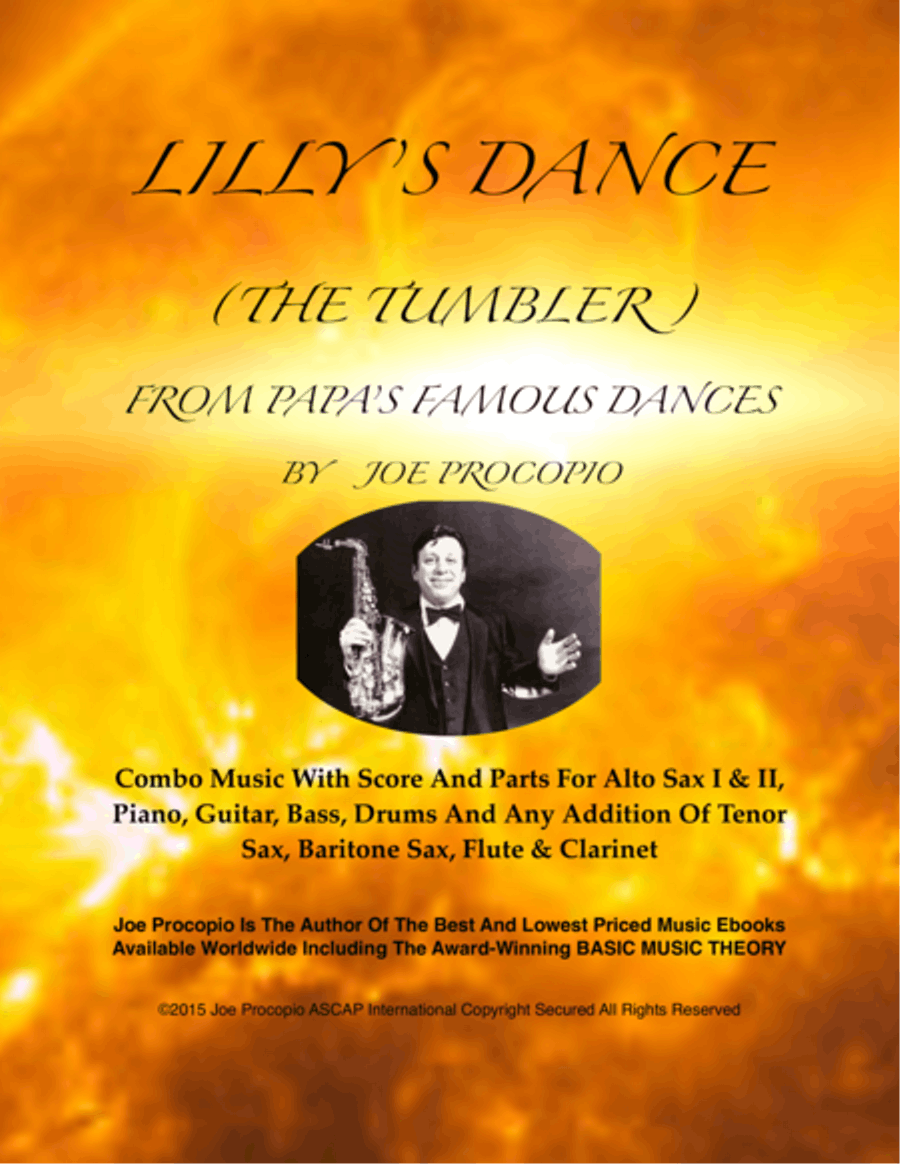
LILLY'S DANCE (THE TUMBLER)
Saxophone Tenor et Piano

$4.99 4.24 € Saxophone Tenor et Piano PDF SheetMusicPlus

Piano,Tenor Saxophone - Level 3 - Digital Download SKU: A0.1458251 Composed by Alan Menken and Tim Rice. Arranged by Harry Walker. Broadway,Film/TV,Musical/Show,Pop,Singer/Songwriter,Wedding. Score and part. 11 pages. SCORE EDITIONS #1037229. Published by SCORE EDITIONS (A0.1458251). A Whole New World is the signature song from Disney's 1992 animated feature film Aladdin, with music by Alan Menken and lyrics by Tim Rice. A duet originally recorded by singers Brad Kane and Lea Salonga in their respective roles as the singing voices of the main characters Aladdin and Jasmine, the ballad serves as both the film's love and theme song. Lyrically, A Whole New World describes Aladdin showing the confined princess a life of freedom and the pair's acknowledgment of their love for each other while riding on a magic carpet. In this version, the composition was arranged for Tenor Saxophone and Piano by Harry Walker.
A Whole New World
Saxophone Tenor et Piano

$5.99 5.09 € Saxophone Tenor et Piano PDF SheetMusicPlus

Large Ensemble Alto Saxophone,Baritone Saxophone,Bass Guitar,Clarinet,Drums,Flute,Piano,Tenor Saxophone - Level 4 - Digital Download SKU: A0.876449 Composed by Joe Procopio. Dance,Jazz,Pop. Score and parts. 33 pages. JoeCopio Music LLC #53329. Published by JoeCopio Music LLC (A0.876449). MY SWEET LYDIA Back to School 2015 From PAPA’S FAMOUS DANCES by Joe Procopio MY SWEET LYDIA is a dance written and arranged by Joe Procopio for a small ensemble, band, stage band or combo. It was originally composed for a small band with flexible instrumentation. It may be performed with only two Saxophones (Alto Sax I and Alto Sax II) and a standard backup with Piano/Keyboard, Guitar, Bass and Drums. In addition, any combo may be augmented by adding any or all of the parts included for Flute, Clarinet, Tenor Sax, and Baritone Sax. This flexible or variable instrumentation of MY SWEET LYDIA makes it unique and perfect for schools and colleges that do not have a permanent roster of music students entering their music programs annually. It also eases the burden for Directors searching for good music to perform for groups with ever changing numbers of music students. What’s more, MY SWEET LYDIA has a section open for solos to enable the ensemble to feature players who can improvise well enhancing not only the group’s enjoyment but also everyone’s listening pleasure. This piece has been performed by College and High School students in many major concert events all along the East Coast with great success. It is published separately and in a set entitled PAPA’S FAMOUS DANCES PART 1 from the sets PAPA’S FAMOUS DANCES Part I and Part II. Each Part contains 3 Dances. I have adapted the audio here for synthesizer so that it may be previewed. It is one of 6 works named and dedicated to each of my 6 Grandchildren: Lilly, Mary, Lydia, Emma, Joey and Wilson. Instrumentation for MY SWEET LYDIA includes SCORE and parts for: ALTO SAX I ALTO SAX II TENOR SAX BARITONE SAX FLUTE CLARINET PIANO/KEYBOARD - GUITAR - BASS - DRUMS VITA Joe Procopio is a master musician and teacher with proven success for over 50 years. His purpose in teaching, writing music and books is to make his successful method of making musicians available to as many people as possible around the world. While I cannot guarantee that my methods will make you a great musician as they have for many others, says Procopio, I can say that they are designed to magnify your love of music - and that I guarantee each will enrich and enhance your life. People from all over the world have written to me to tell me so. As a Master Musician , Joe Procopio is an ASCAP Artist, composer, conductor and professional musician. He was the Lead Reed for many of the nation's top recording artists including: The Temptations, Steve and Eydie Gorme, Aretha Franklin, Tony Bennett, Lawrence Welk, Frankie Avalon, Frankie Laine, Jack Jones, Kathryn Grayson, Carmel Quinn, Don Cornell, Bobby Rydell, Vic Damone, Rodney Dangerfield, Foster Brooks, The Vagabonds, The Ritz Brothers, Sammy Cohn, Jimmy Van Heusen, Tiny Tim, Al Martino, Petula Clark, Wayne Newton, Pat Cooper, The Four Tops, The Spinners, etc. Lead Alto Sax Jimmy Dorsey Orchestra and the Palace Theater Myrtle Beach, SC He is listed in The Encyclopedia of Saxophone Music Londeix, Roncorp Pub. He is the teacher of Guitarist T. Maxwell heard in TV’s Magnum P.I., The Rockford Files and Kojak ; the vocalist/bassist I. Cattell of Brit Floyd (Pink Floyd) and New York Tenor Saxophonist Paul Carlon to mention a few. His accomplishments as a teacher include: The Miles Clark Endowed Chair, Music, College of the Albemarle, Elizabeth City, NC, Chair Music Department Cazenovia Central School NY Director Of Instrumental Music Chapel Hill/Carrboro City Schools NC Adjunct Professor Applied Music Cazenovia College, NY.
MY SWEET LYDIA
Saxophone Tenor et Piano

$4.99 4.24 € Saxophone Tenor et Piano PDF SheetMusicPlus


Partitions Gratuites
Acheter des Partitions Musicales
Acheter des Partitions Digitales à Imprimer
Acheter des Instruments de Musique

© 2000 - 2026

Accueil - Version intégrale





