EUROPE
7756 articles
USA
0 articles
DIGITAL
54 articles (à imprimer)
Partitions Digitales
Partitions à imprimer
54 partitions trouvées


Instrumental Duet,Piano Instrumental Duet,Piano,Soprano Saxophone,Tenor Saxophone - Level 4 - Digital Download SKU: A0.635976 By Whitney Houston. By Nickolas Ashford and Valerie Simpson. Arranged by Fishel Pustilnik. Contemporary. Score and parts. 10 pages. F & N Enterprise #6104775. Published by F & N Enterprise (A0.635976). An excellent arrangement of the famous Song I'm Every Woman for Tenor Sax and Piano-Jazz/Pop Version. The video for Violin and Piano: https://youtu.be/V00RxK2n5J8 The composition is easy to read, fun to play, and sound professional when performed. Arranged by Fishel Pustilnik, a very well known as Composer/Publisher. His books Jazz & Pop Piano Paradise (Volumes 1-5) have become a commercial success and a hit with music teachers and students in Canada. (Thousands of books already sold in Canada). They are also starting to enter the US, Brazil, Norway, Russia, Holland, Israel, Belgium, Sweden, Finland, Greece, Latvia, and the UK markets. This is a wonderful new publication. These pieces offer much appeal for the young pianist and excellent choice for a supplementary book for students from Grade 3 to 8. Lore Ruschiensky, Editor, (from the review in The Canadian Music Teacher) Yesterday I spent at least two pleasure-filled hours playing through your imaginatively inventive compositions. Congratulations! I trust students will decide to program your well crafted and entertaining works on recitals and examinations. Review from Dr. Jack Behrens, B.Sc. (Julliard), Ph.D. (Harvard), Director of Academic Studies, The Glenn Gould School I liked this book the best so far. Great work! You have a gift for melody and your arrangements are very playable. Congratulations on the 3rd Volume. Mark Carlstein, Hal Leonard, Keyboard Publications.
I'm Every Woman
Saxophone Tenor et Piano
Whitney Houston
$4.99 4.34 € Saxophone Tenor et Piano PDF SheetMusicPlus

Piano,Tenor Saxophone - Level 4 - Digital Download SKU: A0.549447 Composed by Sir Arthur Seymour Sullivan. Arranged by James M. Guthrie, ASCAP. Instructional,Romantic Period,Sacred,Standards. Score and part. 15 pages. Jmsgu3 #3497143. Published by jmsgu3 (A0.549447). Score: 10 pages, solo part: 2 pages, piano part: 3 pages. Duration: 4:25. Not difficult, but requires sensitivity & dynamic control. Suitable for recitals, church meditations, or school programs. School Years First of all, Sullivan attended music school at the Royal Academy of Music. Because Sullivan was so talented, the Academy awarded him the Mendelssohn Scholarship for two years in a row. He, therefore, studied with John Goss, who studied with Thomas Atwood, who in turn studied with Mozart. Sullivan similarly studied the piano at the Academy with Arthur O’Leary. Study Abroad During his first year, he also earned money by singing solos in the Chapel Royal. At the end of his second year, the Academy consequently continued his scholarship and sent him to study at the Leipzig Conservatoire. He certainly studied composition, and likewise counterpoint and piano. Hence, during his final year in Leipzig, Sullivan finally completed his graduation composition project: Incidental Music for Shakespeare’s The Tempest. Association with Gilbert It seems like Sullivan built the bulk of his composing career largely in the 1860s. As a result, he became famous for his incidental music for the Tempest and his Irish Symphony. He, therefore, began collaborating with the poet W. S. Gilbert in the 1870s. Rather than focus on serious opera, Gilbert and Sullivan, in contrast, concentrated on comic opera such as H. M. S. Pinafore, the Pirates of Penzance, and the Mikado. Therefore, certainly as a result of his education and experience, Sullivan composed a total of 24 operas, 11 symphonic works, 10 choral pieces. Even more, he wrote a large number of noteworthy hymns such as Onward Christian Soldiers. Lost Chord The general style of his music is maybe similar to Mendelssohn, Schumann, and perhaps Liszt. It seems like Sullivan was fond of writing distinct melodies for each character in his operettas. His melodies combine together as the characters did. Furthermore, he was a master orchestrator, and therefore played the flute, clarinet, trumpet, and trombone fluently. The Lost Chord Sullivan wrote his most noteworthy song the Lost Chord in 1877. As a result, it was a great success and was certainly performed all over the world by a variety of singers such as Enrico Caruso. Because Sullivan was the most famous composer in England, the Lost Chord became the most famous of all British or American songs of the 1870s and 1890s. Consequently, in 1888 Thomas Edison recorded The Lost Chord for the phonograph. It was one of the first songs ever recorded. Furthermore, Queen Victoria knighted Sullivan in 1883.  
Sullivan: The Lost Chord for Tenor Sax & Piano
Saxophone Tenor et Piano

$26.95 23.43 € Saxophone Tenor et Piano PDF SheetMusicPlus

Piano,Tenor Saxophone - Level 2 - Digital Download SKU: A0.550935 Composed by J. S. Bach - Gounod. Arranged by James M. Guthrie, ASCAP. Christmas,Concert,Contemporary,Easter,Wedding. Score and part. 12 pages. Jmsgu3 #4888767. Published by jmsgu3 (A0.550935). This arrangement features the controversial Schwencke measure (ms. 27) that was originally introduced in 1783 by Christian Friedrich Gottlieb Schwencke. The convenient 1st & 2nd endings provide an option for extended performance. Duration with repeat - 4:50. Score: 7 pages. Solo part: 1 page, piano part: 4 pages. Based on Prelude #1 in C Major from the Well-Tempered Clavier, Book 1. Well suited for church meditations or school programs or recital encores. Register for free lifetime updates and revisions at www.jamesguthrie.comAve MariaAve Maria is a Catholic prayer that consequently asks for the mother of Jesus (Mary) to intercede. Charles Gounod composed a famous version of the Ave Maria. He was a French Romantic composer who overlaid a new melody on an existing Bach chord progression. The progression is from Bach’s Prelude No. 1 from Well-Tempered Clavier I. This version, as well as Schubert’s version, have become essential items at weddings, masses, and funerals.Bach OverviewFirst of all, Johann Sebastian Bach is maybe the greatest composer in music history. Certainly, he was prolific. As a result, everyone has heard of his works. Furthermore, these works number well over a thousand. It seems like people are probably most familiar with the instrumental works such as the Brandenburg Concertos, and the Goldberg Variations. But, similarly famous are such noteworthy works as the Well-Tempered Clavier, the Musical Offering, and certainly the Art of Fugue. Seems like his most famous vocal works include the most noteworthy Mass in B Minor. Also, most noteworthy, though, are the St. John Passion, and certainly the Christmas Oratorio. HistoryBach came from a long line of musicians and above all, composers. Consequently, he, first of all, pursued a career as a church organist. So as a result, he gained employment in various Protestant churches in Germany. For a while, he worked as a court musician in Weimar and Köthen. Here he probably developed his organ style and likewise his chamber music style. Eventually, he, therefore, gained an appointment as Cantor of St. Thomas in Leipzig. Here he worked until difficulties with his employer ultimately drove him away. The King of Poland finally appointed him as a court composer. StyleIt seems like Bach created a fascinating new international style. He synthesized elements of the most noteworthy European music ideas into his new style. Even more, this new style was probably his synthesis of European musical rhythm and form. Furthermore, he demonstrated a complete mastery of counterpoint and motivic development. His sense of harmonic organization probably propelled him to the top.Revival              Mendelssohn conducted a Bach revival in the nineteenth century. His effort probably helped to re-familiarize the public with the magnitude of Bach’s works. During this period, scholars published many noteworthy Bach biographies. Moreover, Wolfgang Schmieder published the BWV (Bach Werke Verzeichnis). As a result, this is now the official catalog of his entire artistic output. The BWV number allows us to locate a work in the catalog. Sometimes scholars will simply use an S (Schmieder) as an abbreviation for BWV. VoyagerNASA launched two Voyager spacecraft in 1977. Onboard are phonograph records with sounds, music, and images of life on Earth. The purpose of the launch was to inform intelligent extraterrestrial life forms about conditions on Earth. The music on the disc is varied. There is Bach, Mozart, Beethoven and Stravinsky among others. However, because Bach is so important in our music history, it contains three times more Bach that all the others combined.
Bach-Gounod: Ave Maria, Schwencke version for Tenor Sax & Piano
Saxophone Tenor et Piano

$27.95 24.3 € Saxophone Tenor et Piano PDF SheetMusicPlus

Piano,Tenor Saxophone - Level 2 - Digital Download SKU: A0.549236 Composed by Johann Sebastian Bach. Arranged by James M. Guthrie, ASCAP. Baroque,Easter,Standards,Wedding. Score and part. 8 pages. Jmsgu3 #3468806. Published by jmsgu3 (A0.549236). J. S. Bach BWV 508. Bist du bei mir Bach adapted this aria from a lost Stölzel opera called Diomedes. He changed the original orchestral instrumentation to soprano, strings, and continuo.  He also modified the voice-leading making it sound more like a Bach composition. The work appears as BWV 508 No. 25 in the Anna Magdalena Notebook No. 2.   Source Only a few remnants of the original opera have survived. Historians speculate that Anna Magdalena got the song from the Leipzig Opera after the bankruptcy of 1720. Chances are good, though, that the tune was a favorite of everyone in Leipzig at the time.   Lyrics When thou art near, I go with joyTo death and to my rest.O how joyous would my end be,If your fair hands            Would close my faithful eyes. - Unknown Bach Overview First of all, Johann Sebastian Bach is maybe the greatest composer in music history. Certainly, he was prolific. As a result, everyone has heard of his works. Furthermore, these works number well over a thousand. It seems like people are probably most familiar with instrumental works such as the Brandenburg Concertos, and the Goldberg Variations. But, similarly famous are such noteworthy works as the Well-Tempered Clavier, the Musical Offering, and certainly the Art of Fugue. Seems like his most famous vocal works include the most noteworthy Mass in B Minor. Also, most noteworthy are the St. John Passion, and indeed the Christmas Oratorio.  History Bach came from a long line of musicians and above all, composers. Consequently, he, first of all, pursued a career as a church organist. So as a result, he gained employment in various Protestant churches in Germany. For a while, he worked as a court musician in Weimar and Köthen. Here he probably developed his organ style and likewise his chamber music style. Eventually, he therefore, gained an appointment as Cantor of St. Thomas in Leipzig. Here he worked until difficulties with his employer ultimately drove him away. The King of Poland finally appointed him as court composer.  Style It seems like Bach created a fascinating new international style. He synthesized elements of the most noteworthy European music ideas into his new style. Even more, this new style was probably his synthesis of European musical rhythm and form. Furthermore, he demonstrated a complete mastery of counterpoint and motivic development. His sense of harmonic organization probably propelled him to the top. Revival               Mendelssohn conducted a Bach revival in the nineteenth century. His effort probably helped to re-familiarize the public with the magnitude of Bach’s works. During this period, scholars published many noteworthy Bach biographies. Moreover, Wolfgang Schmieder published the BWV (Bach Werke Verzeichnis). As a result, this is now the official catalog of his entire artistic output. The BWV number allows us to locate a work in the catalog. Sometimes scholars will simply use an S (Schmieder) as an abbreviation for BWV.  Voyager NASA launched two Voyager spacecraft in 1977. Onboard are phonograph records with sounds, music, and images of life on Earth. The purpose of the launch was to inform intelligent extraterrestrial life forms about conditions on Earth. The music on the disc is varied. There is Bach, Mozart, Beethoven, and Stravinsky among others. However, because Bach is so important in our music history, it contains three times more Bach than all the others combined.  
Bach: Bist du bei mir BWV 508 for Tenor Sax & Piano
Saxophone Tenor et Piano

$32.95 28.65 € Saxophone Tenor et Piano PDF SheetMusicPlus

Piano,Tenor Saxophone - Level 3 - Digital Download SKU: A0.549469 Composed by Alexander Scriabin. Arranged by James M. Guthrie, ASCAP. Concert,Instructional,Romantic Period,Sacred,Standards. Score and part. 12 pages. Jmsgu3 #3499759. Published by jmsgu3 (A0.549469). Score: 8 pages, solo part: 2 pages, piano part: 2 pages. Duration: 3:10. An introspective and meditative work with a lot of dynamic and phrasing nuance. Works well for church meditations or recital encores. Background Op.11/2 Alto Clarinet version. First of all, Scriabin composed mostly for the solo piano and also the orchestra. This is probably because he was a gifted pianist and therefore certainly appreciated the piano. Scriabin grew up in the late Romantic period, consequently, he was fond of the great piano masters of the time. As a result, he wrote his first noteworthy compositions in the manner of Chopin and Liszt. Forms Likewise, Scriabin used many of the same forms as Chopin. These certainly include the étude, prelude, nocturne, and even the mazurka. In contrast, as he developed his own sense of style his music became more and more unusual. So, the last five of his Piano Sonatas do not have a key signature and therefore lean towards atonality. Philosophy Scriabin also developed a keen interest in philosophy and likewise poetry. He was above all particularly fascinated by Nietzsche, Delville, and Blavatsky. Consequently, he finally established his own ideas about metaphysics and certainly mysticism. Scriabin consequently advanced theories about the relationship between color and musical keys. Synesthesia He also may have experienced a condition called synesthesia where he could probably sense a response created from a different stimulus. Therefore, it was almost as if he could see music and hear colors. Scriabin, therefore, arranged the colors in a circle similar to the circle-of-fifths and assigned each key area a color. Finally, he assigned the key of C to the color red, while the key of G was orange. Similarly, he assigned D to yellow, A to green, and so forth. Strangely, he did not differentiate between major and minor key colors.  Multimedia Hence, his ability to translate colors into music certainly gave Scriabin a most noteworthy interest in creating multimedia events. Furthermore, He designed his biggest work, the Mysterium, to last an entire week. Even more, Scriabin made plans not only for music, but also colored lights, incense, and dancing. He designed the performance to occur in the foothills of the Himalaya mountains. The Mysterium was never performed, and only sketches of the work remain. Modern Performances In modern times, we often experience performances of Scriabin’s most famous completed works accompanied by colored laser lights and incense. These are the Poem of Ecstasy (completed in 1908) and the Poem of Fire (completed in 1910). The lighting effects for these early performances were accomplished by the clavier à lumiéres. It was a keyboard instrument that projected colored light onto a screen.
Scriabin: Prelude Op. 11 No. 2 for Tenor Sax & Piano
Saxophone Tenor et Piano

$19.95 17.35 € Saxophone Tenor et Piano PDF SheetMusicPlus

Piano,Tenor Saxophone - Level 2 - Digital Download SKU: A0.549845 Composed by Johann Sebastian Bach. Arranged by James M. Guthrie, ASCAP. Baroque,Concert,Easter,Sacred,Standards. Score and part. 12 pages. Jmsgu3 #3554837. Published by jmsgu3 (A0.549845). Wachet auf, ruft uns die Stimme (Awake, the voice is calling us) from Cantata BWV 140. Duration: ca. 4:00, Score: 6 pages, solo part 1 page, piano part: 4 pages. Program this for church services during the Easter season, weddings, or as a recital encore.Wachet auf, ruft uns die Stimme (Awake, the Voice is calling us) also known as: Sleepers Awake Bach composed his church cantata Wachet auf (BWV 140) as part of his second annual cantata cycle covering the entire annual church calendar. It is based on the hymn of the same name by Philipp Nicolai (1599). The hymn text covers the readings for the 27th Sunday after Trinity. Bach designed the cantata in seven movements, setting the stanzas in various forms. Among these forms are the chorale fantasia, the chorale prelude, and a four-part chorale. He casts the new lyrics as recitatives – in a manner similar to the opera. Fourth Movement Bach writes the fourth movement, Zion hört die Wächter singen (Zion hears the watchmen singing), in the style of a chorale prelude with the chorale phrases performed as a strict cantus firmus. The phrases seem to enter at times erratically against the famous lyrical melody. The violins play this melody in unison as a foil against the cantus phrases. The violin melody is so independent and complete that when the cantus melody appears it catches the listener at times totally off-guard. Bach later transcribed this movement for organ (BWV 645). This transcription became No. 1 of the Six Schübler Chorales. Bach Overview First of all, Johann Sebastian Bach is maybe the greatest composer in music history. Certainly, he was prolific. As a result, everyone has heard of his works. Furthermore, these works number well over a thousand. It seems like people are probably most familiar with the instrumental works such as the Brandenburg Concertos, and the Goldberg Variations. But, similarly famous are such noteworthy works as the Well-Tempered Clavier, the Musical Offering, and certainly the Art of Fugue. Seems like his most famous vocal works include the most noteworthy Mass in B Minor. Also, most noteworthy, though, are the St. John Passion, and certainly the Christmas Oratorio.  History Bach came from a long line of musicians and above all, composers. Consequently, he, first of all, pursued a career as a church organist. So as a result, he gained employment in various Protestant churches in Germany. For a while, he worked as a court musician in Weimar and Köthen. Here he probably developed his organ style and likewise his chamber music style. Eventually, he, therefore, gained an appointment as Cantor of St. Thomas in Leipzig. Here he worked until difficulties with his employer ultimately drove him away. The King of Poland finally appointed him as court composer.  Style It seems like Bach created a fascinating new international style. He synthesized elements of the most noteworthy European music ideas into his new style. Even more, this new style was probably his synthesis of European musical rhythm and form. Furthermore, he demonstrated a complete mastery of counterpoint and motivic development. His sense of harmonic organization probably propelled him to the top. Revival               Mendelssohn conducted a Bach revival in the nineteenth century. His effort probably helped to re-familiarize the public with the magnitude of Bach’s works. During this period, scholars published many noteworthy Bach biographies. Moreover, Wolfgang Schmieder published the BWV (Bach Werke Verzeichnis). As a result, this is now the official catalog of his entire artistic output. The BWV number allows us to locate a work in the catalog. Sometimes scholars will simply use an S (Schmieder) as an abbreviation for BWV. &n.
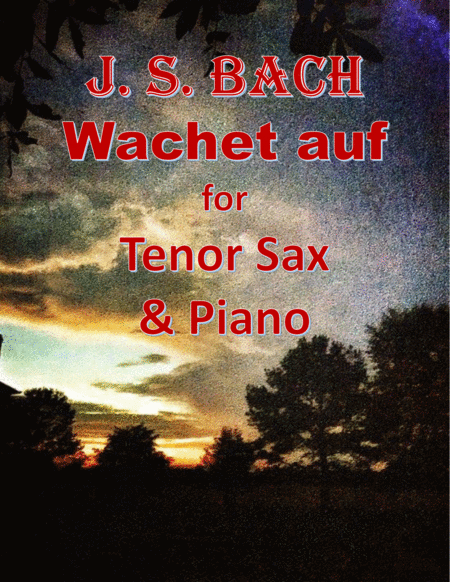
Bach: Wachet auf for Tenor Sax & Piano
Saxophone Tenor et Piano

$24.95 21.7 € Saxophone Tenor et Piano PDF SheetMusicPlus

Piano,Tenor Saxophone - Level 1 - Digital Download SKU: A0.548490 Composed by Gruber. Arranged by James M. Guthrie, ASCAP. Christmas. Score and part. 3 pages. Jmsgu3 #3387061. Published by jmsgu3 (A0.548490). Silent Night for Tenor Sax & Piano with new harmony for the final verse. Score: 2 pg. Part: 1 pg. Silent Night Origins Father Joseph Mohr wrote the lyrics for a new Christmas Carol. He wanted the new carol for his Christmas Eve Mass. With only a couple of hours until the service, He asked organist and schoolteacher Franz Gruber to write a melody and simple accompaniment to go with the lyrics. The result is probably the most famous of all Christmas carols – Silent Night. First Performance Perhaps because the organ was undergoing repairs, or to make sure the accompaniment was easy enough, Mohr asked Gruber to write it for the guitar. Mohr played the guitar, and both Mohr and Gruber gave the world premiere performance at the Christmas Eve Mass in 1818 at St. Nicholas Church in Oberndorf in Salzburg. Original Score Eventually, the original score became lost, and consequently, Mohr's name was largely forgotten.  Though the public originally recognized Gruber as the composer, many people over time began rumors that a more famous composer was responsible. Thus, they floated the names of Haydn, Mozart, and even Beethoven. Authorities eventually settled the matter when a manuscript in Mohr’s handwriting turned up in 1820. Consequently, we learn that Mohr wrote the lyrics in 1816, and Gruber composed the melody in 1818. Popularity Nonetheless, Silent Night is still very popular. Singers have performed this song in nearly every genre and in multiple languages. Perhaps the most famous version is the one Bing Crosby crafted. This version is the third best-selling physical single recording in the history of recorded music. This particular recording was released in 1935 and sold at least 30 million copies. Only two songs have ever sold more. Elton John released Candle in the Wind in 1997 and sold 33 million copies. The record for most copies ever sold goes to Bing Crosby. He released White Christmas in 1942 and sold 50 million physical copies.  Register for free lifetime updates and revisions at www.jamesguthrie.com    
Silent Night for Tenor Sax & Piano
Saxophone Tenor et Piano

$28.95 25.17 € Saxophone Tenor et Piano PDF SheetMusicPlus

Piano,Tenor Saxophone - Level 2 - Digital Download SKU: A0.1303419 Composed by Gabriel Faure. Arranged by Harry Walker. 19th Century,Contest,Festival,Romantic Period. Score and part. 8 pages. SCORE EDITIONS #892993. Published by SCORE EDITIONS (A0.1303419). This mélodie is the first in a set of three songs, opus 7, which also comprises Hymne and Barcarolle respectively. All three were composed between 1870 and 1877, then collected and published in 1878 under the title Trois Mélodies. Not originally conceived as a song cycle, these three songs acquired this opus number much later, in the 1890s. The poem for Après un rêve was loosely adapted from an anonymous Italian text by Romain Bussine. It describes, in the form of a dream, the imaginary flight of two lovers who are head over heels in love, although the last verse brings the dreamer inexorably back to harsh reality as dawn is breaking. In this version, the composition was arranged for Tenor Saxophone and Piano by Harry Walker.
Après un rêve (Fauré) for Tenor Saxophone and Piano
Saxophone Tenor et Piano

$5.99 5.21 € Saxophone Tenor et Piano PDF SheetMusicPlus

Instrumental Duet,Piano Instrumental Duet,Piano,Soprano Saxophone,Tenor Saxophone - Level 4 - Digital Download SKU: A0.633909 Composed by Fishel Pustilnik. Arranged by Fishel Pustilnik. Film/TV,Jazz,Pop,Standards. Score and parts. 7 pages. F & N Enterprise #3479025. Published by F & N Enterprise (A0.633909). An excellent arrangement of famous Song Flight Of The Fingers-Jazz Waltz for Tenor Sax and Piano (Jazz/Pop Version),Video for Violin and Piano: https://www.youtube.com/watch?v=2Nj2ne4NY-M&feature=youtu.be The composition is easy to read, fun to play and sound professional when performed. Arranged by Fishel Pustilnik, very well known as Composer/Publisher. His books Jazz & Pop Piano Paradise (Volumes 1-5) have become a commercial success and a hit with music teachers and students in Canada. (Thousands books already sold in Canada). They are also starting to enter the US, Brazil, Norway, Russia, Holland, Israel, Belgium, Sweden, Finland, Greece, Latvia and UK markets. This is a wonderful new publication. These pieces offer much appeal for the young pianist and excellent choice for a supplementary book for students from Grade 3 to 8. Lore Ruschiensky, Editor, (from review in The Canadian Music Teacher) Yesterday I spent at least two pleasure filled hours playing through your imaginatively inventive compositions. Congratulations! I trust students will decide to program your well crafted and entertaining works on recitals and examinations. Review from Dr. Jack Behrens, B.Sc. (Julliard), PH.D (Harvard), Director of Academic Studies, The Glenn Gould School I liked this book the best so far. Great work! You have a gift for melody and your arrangements are very playable. Congratulations on the 3rd Volume. Mark Carlstein, Hal Leonard, Keyboard Publications.Additional Information regarding my arrangements at SheetMusicPlus: https://www.facebook.com/arrangementsofsheetmusic/
"Flight Of The Fingers"-Jazz Waltz for Tenor Sax and Piano-Video
Saxophone Tenor et Piano

$2.99 2.6 € Saxophone Tenor et Piano PDF SheetMusicPlus

Piano,Tenor Saxophone - Level 1 - Digital Download SKU: A0.548723 Composed by Martin Luther. Arranged by James M. Guthrie, ASCAP. Easter,Instructional,Standards. Score and part. 4 pages. Jmsgu3 #3411761. Published by jmsgu3 (A0.548723). Out of the Depths I Cry to You by Martin Luther. The first verses feature modified counterpoint and harmony proceeding at quarter = 82. The final verse is reharmonized for maximum dramatic effect at a more contemplative tempo such as quarter = 64. Features the entire range of the instrument. Very powerful selection for Lent or Easter. Duration (3 verses) 3:05, 36 ms. Score: 3 pg. Solo part: 1 pg. The piano reads from the score. Out of the Depths Aus tiefer Not schrei ich zu dir (From deep affliction I cry out to you), is, of course, a hymn composed by Martin Luther. Moreover, Luther also wrote the lyrics, essentially a paraphrase of Psalm 130. First published in 1524, it is also one of eight songs in the original Lutheran hymnal. It appears likewise in many hymnals and in different translations. The lyrics furthermore stimulated compositions from the Renaissance to the contemporary. Consequently, composers such as Johann Sebastian Bach built an entire chorale cantata on it. Other composers similarly contributed pieces, such as Felix Mendelssohn and Max Reger. Luther Background Martin Luther, (1483 –1546) was a German professor of theology, composer, priest, and moreover, an influential character in the Protestant Reformation. Luther had a momentous impact on church and society due to his contributions to the musical arts. He wanted to disseminate the gospel among mankind and with this intention thought that the best way to do that was through music. Influence It is important to realize that other musicians, and their descendants, were encouraged by Luther’s songs and wrote their own hymns. Luther, to be sure, had a thorough musical education. For example, he knew secular and sacred songs from an early age. He, in particular, played the lute well and sang in the monastery when he was a monk. That is to say, music was an essential part of his life. He in fact first began writing songs in 1523, sometimes writing the melody as well as the lyrics. Luther was certainly able to evaluate the composers of his time. He thought especially highly of Josquin des and Ludwig Senfl. He was also acquainted, with this in mind, with other composers and their works. Legacy The Lutheran musical ethos soon covered all of Germany and later significantly fashioned Protestant musical culture. Heinrich Schütz and Johann Sebastian Bach are the most compelling evidence of this Protestant musical culture. Additionally, as a point often overlooked, the pedal organ, first refined in northern Germany, became universally prevalent. As a matter of fact, Dieterich Buxtehude established a regular evening organ concert series in Lübeck. Another key point is that this concert series, in turn, spread North German Musical ideas worldwide. Luther was especially convinced that music is a beautiful and exclusive offering of the divine.
Luther: Out of the Depths for Tenor Sax & Piano
Saxophone Tenor et Piano

$24.95 21.7 € Saxophone Tenor et Piano PDF SheetMusicPlus

Piano,Tenor Saxophone - Level 1 - Digital Download SKU: A0.548504 Composed by Traditional. Arranged by James M. Guthrie, ASCAP. Christian,Christmas. Score and part. 4 pages. Jmsgu3 #3387401. Published by jmsgu3 (A0.548504). The First Noel arranged for Tenor Sax & Piano with new harmony for the final verse.Origins The First Noel is an English Christmas carol. Even more, it was probably written in the late Cornish Renaissance period. While other versions spell the title as Nowell, this is just a colloquial variation. Furthermore, Noel is an older word meaning Christmas. Therefore the First Noel translates as the First Christmas. First of all, Gilbert and Sandy published the earliest version. As a result, this version appears in the Carols Ancient and Modern songbook of 1823. William Sandy edited and arranged the book. Similarly, his partner Davies Gilbert edited and added the familiar extra verses. The First Noel: Alto Sax Version comes with new harmony in final verse for more energy and drive. Stainer Organist and composer Sir John Stainer published the most noteworthy customary arrangement in the 1870’s.  Stainer is above all famous for his songbook entitled: Christmas Carols New and Old (1871). This volume served as an important catalyst for reviving the English Christmas carol.  Other famous Stainer arrangements from this book are such titles as What Child Is This, God Rest Ye Merry Gentlemen, Good King Wenceslas, and I Saw Three Ships. Diatonic Function The melodic structure in the First Noel is uncommon among English folk tunes. It simply repeats one phrase twice then follows a variation refrain. All three phrases of the song end on the mediant scale degree. This is unusual because the diatonic function of the mediant is non-final compared to the more usual tonic or even dominant degrees. Consequently, this gives the song as kind of open-ended feeling – like maybe it never really ends. Political Context The Catholic clergy sang carols outside of the church in Latin. After the Protestant Reformation, the reformers thought it would be better for everyone to sing carols. They decided to bring music back to the common folk. So, they translated the lyrics from Latin into common language. Moreover, the Protestants wanted more control over the music in church than what the Vatican allowed. Protestant composers such as William Byrd composed complex polyphonic Christmas music that they called carols. Nonetheless, some famous folk carols were composed in this era. Eminent composers in the nineteenth century began to revise and adapt them. Consequently, they revived the English carol.  Register for free lifetime updates and revisions at www.jamesguthrie.com  
The First Noel for Tenor Sax & Piano
Saxophone Tenor et Piano

$24.95 21.7 € Saxophone Tenor et Piano PDF SheetMusicPlus


Partitions Gratuites
Acheter des Partitions Musicales
Acheter des Partitions Digitales à Imprimer
Acheter des Instruments de Musique

© 2000 - 2026

Accueil - Version intégrale





